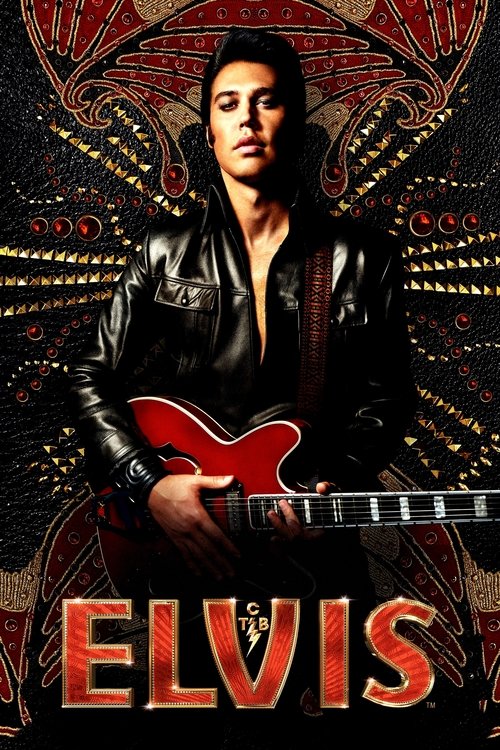
Elvis
2022 · Baz Luhrmann
Elvis revived maximalism discourse and gave the culture Austin Butler's voice; his re-edited EPiC Elvis project keeps the "director's cut as living text" conversation going.
For when you want a big, loud, maximalist night — a spectacle you surrender to rather than study. Come for the music and the rhinestones; expect to leave with a lump in your throat.
What it's about
The rise and unraveling of Elvis Presley, told from the deathbed of the man who managed him: Colonel Tom Parker, the carnival huckster who discovered a Memphis kid steeped in gospel and blues and rode him all the way to Las Vegas. It follows Elvis across two decades — the scandalous early TV appearances, the Hollywood years, the comeback, and the long gilded captivity of the International Hotel residency — always through the lens of a partnership that made him a phenomenon and slowly consumed him.
The experience
A two-and-a-half-hour fever dream that moves like a concert, not a history lesson — montage on montage, wall-to-wall music, period America colliding with modern sound. It's exhilarating and exhausting by design, and underneath the glitter it turns genuinely sad.
Performances
Austin Butler doesn't impersonate Elvis so much as inhabit him — the voice, the stage physicality, and the wounded boyishness underneath all hold up across twenty years of the man's life. Tom Hanks, buried in prosthetics as Colonel Parker, plays gleefully against a career of decency.
The craft
Baz Luhrmann at full tilt: whip-pan editing, split screens, anachronistic needle drops woven into period reconstruction, production and costume design that treat every era of Elvis as its own color scheme. The concert sequences are staged like actual events, which means this is a film for the biggest screen and loudest speakers you can find.
Why it matters
A rare blockbuster-scale hit for the music biopic, it launched Austin Butler as a leading man and put Elvis back into the cultural conversation for a generation that knew him mostly as an impersonator's costume.
Snapshot
Elvis is Baz Luhrmann's maximalist biographical epic of Elvis Presley, structured not as a cradle-to-grave chronicle told from within but as a confession delivered from without — narrated by the dying Colonel Tom Parker (Tom Hanks), the manager who made and arguably consumed his client. Austin Butler plays Presley across roughly two decades, from a Tupelo boyhood steeped in Black gospel and blues to the sequined isolation of the Las Vegas International Hotel residency. Running about two and a half hours, the film compresses a life into a fever of montage, wall-to-wall music, and Luhrmann's signature collision of period reconstruction and contemporary sound. It premiered out of competition at the Cannes Film Festival in May 2022 and was released by Warner Bros. that summer, becoming both a major commercial success for a music biopic and the launching pad for Butler's career. Its central argument is less about the songs than about the machinery of American celebrity: how a poor Southern boy's genius was routed, monetized, and finally caged by a carnival huckster of dubious origin.
Industry & production
Elvis is a Warner Bros. release produced through Luhrmann's Bazmark banner, and it bears every mark of a director-driven prestige tentpole: a substantial budget, an original-IP-adjacent property (the life of a real icon rather than a franchise), and a filmmaker granted wide latitude over a long gestation. The film's use of Presley's music required the cooperation of the Presley estate and the relevant rights-holders, and the production's access to Elvis's catalog and, for later-period numbers, his original master vocals, is central to its texture.
The most consequential production fact is external: the shoot in Queensland, Australia — based at Village Roadshow Studios on the Gold Coast — was interrupted by the onset of the COVID-19 pandemic in March 2020, when star Tom Hanks and his wife Rita Wilson tested positive, among the first high-profile cases to make the illness tangible to a global public. The shutdown delayed the production by months and contributed to the film's protracted post-production, pushing its release into 2022. Casting was itself a widely reported saga; Butler emerged from a field that reportedly included several other young actors, and his selection — a relative unknown for a role of enormous cultural weight — was a notable bet. Shooting in Australia with Australian craft departments (a Luhrmann and Catherine Martin habit) also situates the film within Queensland's role as a competitive international production hub.
Technology
The film was captured digitally on a large sensor, in keeping with contemporary big-canvas practice, and Luhrmann and cinematographer Mandy Walker built the look around aggressive lighting, saturated color, and constant camera motion rather than around a single format signature. Where the film is genuinely innovative technologically is in its treatment of voice. The production blended Butler's own singing — used extensively for the young Elvis of the 1950s — with Presley's original recordings, especially for the older, Vegas-era performances, so that the audience hears a controlled gradient from the actor's approximation to the authentic article. This vocal-blending strategy is a documented and deliberate choice; the exact ratio track by track is not something the film advertises, and I won't invent specifics. Post-production leaned heavily on the same digital compositing and montage tools that let Luhrmann layer archival-style imagery, split screens, and comic-book panels into the historical reconstruction.
Technique
Cinematography
Mandy Walker's photography is the film's engine, and it earned her wide recognition, including an Academy Award nomination — a landmark, as she became one of the very few women ever nominated in the category. Her camera is almost never still: it swoops through the Beale Street clubs, cranes over the 1956 fairground stage, pushes into faces at the moment of erotic and spiritual overload. The palette is hot and jeweled — neon pinks, gospel-tent golds, the bruised blues of decline — and Walker modulates it as a dramatic clock, so that the Vegas years curdle into a colder, sicker light. She favors extreme scale contrasts: vast crowd tableaux against sudden, intimate close-ups, a strategy that dramatizes the theme of a single body consumed by a mass. The lensing is expressionist rather than observational; it renders subjective states — arousal, panic, grief — as much as it records events.
Editing
Cut by Matt Villa and Jonathan Redmond, Elvis is edited as continuous propulsion. Its default grammar is the montage — years of biography telescoped into music-driven sequences — and its rhythm is closer to a concert film or a music video than to classical biopic pacing. The editing is where Luhrmann's "more is more" philosophy is most audible: rapid intercutting between performance and reaction, between the historical event and the machinery (posters, ledgers, contracts, spinning newspapers) that turns it into product. The film is most disciplined, and most powerful, when the cutting slows for a complete performance — the 1968 Comeback Special, the closing "Unchained Melody" — letting a single number breathe after two hours of acceleration.
Mise-en-scène / staging
Production and costume design are by Catherine Martin, Luhrmann's longtime creative partner and co-author of the Bazmark aesthetic. Her work here is exacting and theatrical at once: the meticulously rebuilt Sun Records, Beale Street, and Graceland interiors coexist with the deliberately artificial, showman's-world staging of the carnival and the Vegas stage. Costume is character: the pink suit and eyeliner of the early scandal years, the black leather of the 1968 special, the escalating baroque of the jumpsuits as armor and coffin. Martin stages Presley's body as a spectacle to be looked at — the film repeatedly frames him through the hungry eyes of a crowd — which literalizes the movie's argument about objectification and consumption.
Sound
Music is the film's connective tissue, supervised and scored by Elliott Wheeler as executive music producer and composer. The soundtrack is a Luhrmann anachronism-machine: period rock-and-roll, gospel, and blues are interwoven with contemporary hip-hop and pop reinterpretations, so that the lineage Luhrmann wants to assert — from Black Southern music through Elvis to modern popular culture — is made audible rather than merely stated. Sound design amplifies the subjective register: the roar of crowds swells into abstraction, silence drops out to isolate a heartbeat or a held note. The film's most defensible thematic claim, that Presley was a conduit for and beneficiary of Black musical traditions, is carried substantially by the mix.
Performance
Austin Butler's Presley is a total physical transformation — voice, gait, the specific electricity of the hips — pitched deliberately between impersonation and interpretation. He earned Golden Globe and BAFTA awards for Best Actor and an Academy Award nomination, and the performance became the film's critical and cultural center of gravity. Tom Hanks, buried in prosthetics and a much-debated accent, plays Colonel Parker as a grotesque — a self-described carnival "snowman" whose unreliable narration frames the whole film. Hanks's stylization divided critics, some reading it as bold caricature suited to Luhrmann's mode, others as distracting. The supporting cast pointedly foregrounds Presley's Black contemporaries: Kelvin Harrison Jr. as B.B. King, Alton Mason as Little Richard, Shonka Dukureh as Big Mama Thornton, and Yola as Sister Rosetta Tharpe — casting choices that are themselves an argument about influence.
Narrative & dramatic mode
The film's boldest structural decision is to refuse Elvis his own voice as narrator and hand the story to his exploiter. Colonel Parker, dying and self-justifying, tells the tale to exonerate himself — insisting he did not kill Elvis, that "love" did — and the film invites us to disbelieve him even as we watch through his eyes. This unreliable-narrator frame turns the biopic into something closer to a tragedy with a chorus-of-one, and it lets Luhrmann sidestep the genre's usual problem of hagiography: the story is openly mediated, openly interested. Dramatically, the mode is operatic and expressionist rather than realist; scenes are pitched to emotional maxima, causality is rendered through montage, and historical episodes (the Steve Allen humiliation, the 1956 Russwood Park defiance, the '68 special, the Vegas entrapment) function as set-piece arias. The trade-off is that interiority is often sacrificed to spectacle — we feel Elvis's states more than we understand his choices.
Genre & cycle
Elvis belongs to the music biopic, a durable and formula-bound cycle that in the 2010s and early 2020s enjoyed a strong commercial revival — Ray, Walk the Line, and more immediately Bohemian Rhapsody and Rocketman established a template of arc-of-fame storytelling built around performance recreations. Luhrmann both uses and strains against that template: he keeps the rise-and-fall shape and the greatest-hits performance beats, but detonates the genre's realism with his anachronistic scoring and his carnival framing. The film also participates in a broader reckoning within the cycle — a growing critical interest in the racial politics of white artists who drew on Black music — placing it in dialogue with revisionist tendencies in how popular-music history is dramatized.
Authorship & method
This is unmistakably a Baz Luhrmann film, the product of a stable, decades-long creative partnership. Luhrmann directs and shares story and screenplay credit (with collaborators including Sam Bromell, Craig Pearce, and Jeremy Doner), and his method is total design: the film is storyboarded and pre-visualized as spectacle, then built through an in-house creative team. Catherine Martin — his wife, producer, and production/costume designer — is the indispensable co-author of the visual world across his career. Mandy Walker's camera, Elliott Wheeler's music production, and the Villa/Redmond editing translate Luhrmann's maximalism into a coherent sensory system. Luhrmann's signature — the "Red Curtain" impulse toward heightened, self-aware theatricality established in Strictly Ballroom, Romeo + Juliet, and Moulin Rouge! — is fully present, now applied to American history rather than to fable. The method's risk is legible on screen: authorship this controlling can overwhelm its subject, and the film's detractors argue that Luhrmann's style sometimes crowds out Elvis himself.
Movement / national cinema
Luhrmann is a central figure of a distinctly Australian strand of global commercial filmmaking — an expatriate sensibility that makes American and European subjects through Australian craft, capital, and locations. Elvis, though wholly American in subject, was made in Queensland with Australian departments and reflects that transnational production model. It is not attached to any art-cinema movement; rather, it exemplifies a post-classical, MTV-inflected maximalism — the tradition of rapid montage, music-video grammar, and self-conscious spectacle that Luhrmann helped popularize in feature form. In that sense the film's "movement" is aesthetic and commercial rather than national: a cinema of overwhelming surface, made for a global multiplex audience.
Era / period
Released in 2022, Elvis arrived as theatrical exhibition was straining to recover from pandemic disruption, and its strong commercial performance was read within the industry as evidence that adult-oriented, star-and-spectacle event films could still draw audiences to cinemas. Its own long production, disrupted by COVID-19, makes it in part a document of that moment. Thematically it looks back across the mid-twentieth century — the 1950s birth of rock and roll, the moral panics of the Eisenhower era, the assassinations and upheavals of 1968 that the film explicitly threads into the Comeback Special, and the corporate spectacle of late-1960s and 1970s Las Vegas. Luhrmann uses the period as a mirror for the present: the manufacture of celebrity, the extraction of value from a performing body, the appropriation of Black culture, all framed as unfinished American business.
Themes
The film's governing theme is exploitation — the transformation of a gifted human being into a commercial instrument, dramatized through the parasitic Parker relationship. Around it cluster several others: the racial genealogy of American popular music, insistently foregrounded through Presley's immersion in gospel and blues and his debts to Black artists; the erotics and dangers of spectacle, with Elvis's sexualized body as both his power and the thing that terrifies authority; and the loss of freedom, staged as a literal caging in Vegas. Fame is figured throughout as a carnival — Parker's origin as a huckster is the film's controlling metaphor — where wonder and fraud are inseparable. Underlying all of this is a tragedy of thwarted agency: a man of enormous instinctive gift who never controls the machine built around him, and who is loved to death by the crowd and the Colonel alike.
Reception, canon & influence
Critical reception was strongly positive but not unanimous, and the split fell along predictable lines: near-universal praise for Butler's transformation and Walker's cinematography, and division over whether Luhrmann's relentless style illuminated or smothered its subject, with Hanks's stylized Colonel a particular flashpoint. The film was a significant awards presence, earning multiple Academy Award nominations, including Best Picture and Best Actor, and Butler swept much of the season's lead-actor recognition before the Oscar went elsewhere. Commercially it performed well above the norm for its genre, ranking among the more successful music biopics.
Its backward influences are legible and, in the case of Luhrmann's own filmography, self-declared: the anachronistic scoring and heightened theatricality descend directly from Moulin Rouge! and The Great Gatsby; the music-biopic architecture inherits the arc-of-fame and performance-recreation conventions consolidated by Walk the Line and, more recently, Bohemian Rhapsody and Rocketman. Deeper still, the film's thematic spine — Elvis as conduit for Black Southern music — engages a long-running critical and historical debate about appropriation and credit in American popular culture, and the casting of B.B. King, Little Richard, Sister Rosetta Tharpe, and Big Mama Thornton is the film's way of writing that scholarship into the drama.
Its forward legacy is still consolidating, but two lines are already visible. First, it made Austin Butler a leading man, with immediate consequences for his subsequent casting. Second, it extended and reinforced the early-2020s music-biopic boom, part of a wave that has since drawn other icons toward similar treatments; where subsequent films in the cycle adopt anachronistic scoring or frame-story mediation, Elvis stands as a recent high-profile precedent. Because these developments are recent, any claim about the film's lasting canonical position would be premature, and I flag that the historical record here is genuinely still forming.
A Deleuzian reading
He comes out onto the fairground stage in 1956 in a pink suit and eyeliner, and the camera cranes over him like weather moving in.
The full Deleuzian reading of Elvis →
Reception
It split critics at Cannes in 2022 — 'exhausting Baz maximalism' vs 'the biopic finally made cinematic' — but audiences turned it into a $280M+ hit, and eight Oscar nominations (including Best Picture) settled it as the rare divisive movie that won the argument commercially. Butler's near-miss Best Actor loss to Brendan Fraser is still relitigated every awards season.
How Elvis was received, from release to now →
How to watch Elvis: what to notice on a first viewing
- Watch Walker's camera leave Elvis for one face in the crowd. Luhrmann keeps cutting between the body making the feeling and the faces that feel it, again and again through every performance. This turns the crowd into one hungry organism, the dividual, feeding on Elvis's body.
- Notice how the film's colors shift from gold to cold blue. Mandy Walker's palette starts in gospel-tent golds and neon pinks, then curdles into a colder, sicker light as the Vegas years arrive. The color itself works as a clock, marking Presley's decline before the story says so.
- Listen for old rock and gospel mixed with modern hip-hop. Elliott Wheeler's soundtrack interweaves period rock, gospel, and blues with contemporary pop and hip-hop reworkings throughout the film. This makes audible the lineage Luhrmann wants to assert, from Black Southern music to modern pop.
- Track how Presley's costumes change across the film's decades. Catherine Martin moves him from the pink suit and eyeliner of the scandal years to black leather in 1968 to the escalating jumpsuits of Vegas. Each costume marks a stage of ownership over his body, ending in armor that is also a coffin.
The whole guide to watching Elvis, with the keys for a rewatch →
Influences: the films it descends from and the films it influenced
- Strictly Ballroom (1992) — Originates Luhrmann's 'Red Curtain' method — proscenium-framed, self-aware theatricality where the audience is cued that it is watching a heightened performance — the grammar Elvis applies to the concert stage and the Colonel's carnival barker address.
- Romeo + Juliet (1996) — Establishes his MTV-maximalist cutting — whip-pans, crash zooms, and needle-drops slammed against a canonical text — the exact restless-camera-plus-pop-collision editing Mandy Walker and the Villa/Redmond cut reproduce for the Beale Street and Comeback Special sequences.
- Moulin Rouge! (2001) — The self-declared source of anachronistic jukebox scoring — sampling and remixing pop across eras as emotional shorthand — directly extended by Elliott Wheeler's hip-hop and trap reworkings of Presley's catalog.
- The Great Gatsby (2013) — Pairs period spectacle with contemporary hip-hop and frames the whole through a broken, institutionalized narrator (Nick), the twin devices Elvis reuses in Wheeler's scoring and Parker's deathbed unreliable-narrator frame.
- Citizen Kane (1941) — Sets the template of the great-man life assembled through a mediating investigator's fallible retrospective testimony — the structural DNA of Parker narrating and rationalizing Elvis from beyond his own reputation.
- Amadeus (1984) — Provides the specific model of the envious, complicit impresario-narrator (Salieri) who both promotes and consumes the genius he recounts — Hanks's Colonel Parker is that same self-exculpating framing voice.
- All That Jazz (1979) — Pioneers the self-mythologizing showbiz montage that intercuts live performance, backstage machinery, and encroaching mortality — the editorial rhythm Elvis borrows for its Vegas-residency decline.
- A Hard Day's Night (1964) — Invents cut-to-the-beat, hysteria-of-the-crowd pop filmmaking where the star's body is staged as spectacle for a screaming audience — the visual grammar Luhrmann amplifies in the '54 Hayride hip-swivel sequence.
- Walk the Line (2005) — Consolidates the modern arc-of-fame biopic architecture and the actor-sung, meticulously restaged live performance — the convention Butler's from-scratch vocal work both honors and pushes past.
- Cadillac Records (2008) — Dramatizes the Chess Records economy of white labels profiting from Black R&B (Muddy Waters, Etta James), writing the appropriation-and-credit debate into biopic drama exactly as Elvis does through Tharpe, Thornton, and B.B. King.
- Bohemian Rhapsody (2018) — Immediate precedent for digital vocal-blending — fusing the actor's voice with the original recording — the technology Elvis deploys to seam Butler into Presley's later Vegas vocals.
- Rocketman (2019) — Breaks the biopic from literalism into fantasy-musical staging where songs become non-diegetic emotional set-pieces, licensing the expressionist, chronology-bending numbers Luhrmann builds around Presley's catalog.
- Priscilla (2023) — A direct counter-text answering Elvis's spectacle with restrained, interior POV — using costume and Graceland domestic space as character from Priscilla's vantage, deliberately inverting Luhrmann's exteriorized body-as-spectacle staging.
- A Complete Unknown (2024) — Mangold returns to the music biopic he helped codify, again foregrounding actor-sung live recreation and the electric-controversy performance climax — the post-Elvis cycle Luhrmann's box-office success helped sustain.
- Back to Black (2024) — An entry in the biopic boom Elvis reinforced, betting on a single transformative lead performance and stylized recreation of signature performances as the film's central spectacle.
- Michael (2026) — Model for kinetic, montage-driven concert spectacle that treats the icon's onstage body as pure cinematic event — plus the controlling-manager dynamic that maps directly onto Joe Jackson.
- Blonde (2022) — A contemporaneous experiment in the same mode — formally aggressive, subjective expressionism that renders a pop icon as an exploited body consumed by a manager-machine, arriving in the same year with the same maximalist-vs-subject tension.
- Maestro (2023) — Part of the same early-2020s biopic wave that stakes prestige on total actor-transformation and formally restless technique (aspect-ratio and stylistic shifts) rather than cradle-to-grave literalism.
- Latin Blood – The Ballad of Ney Matogrosso (2025) — Photographs the performing body as kinetic, sexualized glam spectacle and lets montage-driven musical numbers carry the biography — a contemporary sibling in performance-photography and song-as-structure.
Similar films
- Bohemian Rhapsody (2018) — influence & lineage · same viewing thread
- Moulin Rouge! (2001) — influence & lineage
- Rocketman (2019) — influence & lineage
- Priscilla (2023) — influence & lineage
- Walk the Line (2005) — influence & lineage · same viewing thread
- A Complete Unknown (2024) — influence & lineage · same viewing thread
- Michael (2026) — same viewing thread
- Latin Blood – The Ballad of Ney Matogrosso (2025) — same viewing thread
All the films related to Elvis →
Watch it with: curated runs of related films
- The Making of a Legend — A run of biopics that watch private people get forged into public icons — the ambition, the pressure, and the loneliness of becoming somebody the world can't stop looking at.