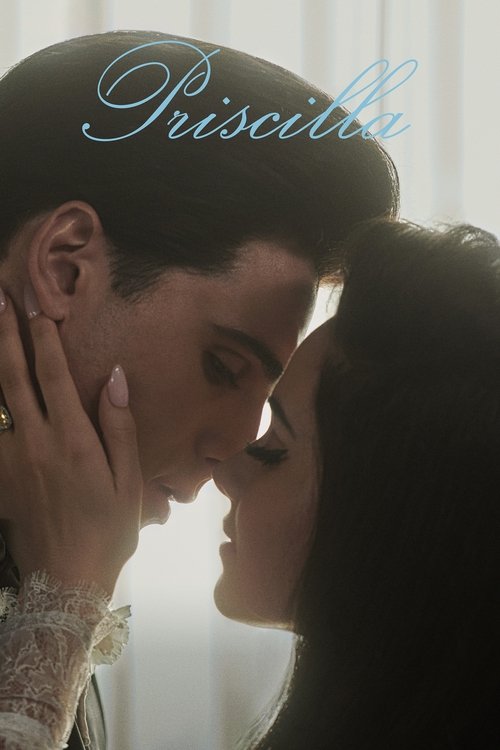
Priscilla
2023 · Sofia Coppola
For a contemplative night when you want mood over plot — something gorgeous and melancholy to sit with, and to chew on for days after. A challenge dressed as comfort: it looks like a fairy tale and reads like a warning.
What it's about
In 1959, fourteen-year-old Priscilla Beaulieu meets Elvis Presley at a party on a U.S. Army base in Germany — and the most famous man in the world becomes, in private, her crush, her confidant, her whole horizon. Drawn from Priscilla Presley's own memoir, the film follows her years inside Graceland: a girlhood spent waiting in a gilded house, shaped by a man who is adored by everyone and known by almost no one.
The experience
Hushed, dreamy, and quietly devastating — the film moves at the pace of waiting itself, all soft light and plush interiors that slowly start to feel like a beautiful cage. It doesn't editorialize; it lets the imbalance speak, and the unease accumulates.
Performances
Cailee Spaeny, who won the Volpi Cup at Venice for the role, ages convincingly from fourteen to womanhood almost entirely through posture and gaze, while Jacob Elordi plays Elvis as charm with a controlling undertow — never a caricature, which makes him harder to shake.
The craft
Sofia Coppola tells the story through texture — costumes, cosmetics, wallpaper, the ritual of dressing up for a man's approval — so Graceland becomes both dollhouse and prison. The framing keeps us at Priscilla's scale, and the fame stays outside the windows. It's a film of surfaces that are doing all the talking.
Why it matters
Arriving a year after the maximalist Elvis biopic, it flipped the myth to the perspective of the person usually kept at its margins — a defining entry in Coppola's career-long study of enclosed girlhood, and a corrective to how pop culture tells famous men's stories.
Snapshot
Priscilla is Sofia Coppola's adaptation of Priscilla Presley's 1985 memoir Elvis and Me (written with Sandra Harmon), tracing the relationship from Priscilla Beaulieu's first meeting with Elvis in 1959, as a fourteen-year-old on a U.S. Army base in West Germany, through her years inside Graceland, their 1967 marriage and 1973 departure. Cailee Spaeny plays Priscilla and Jacob Elordi plays Elvis. Distributed by A24, it premiered in competition at the Venice Film Festival in 2023, where Spaeny won the Volpi Cup for Best Actress. The film is best understood as a chamber drama of enclosed girlhood — Coppola's most sustained recurring subject — pointedly told from the perspective of the person usually relegated to the margins of the Elvis myth. It arrived roughly a year after Baz Luhrmann's maximalist Elvis (2022), and the contrast between the two films is now part of how each is read.
Industry & production
The film was produced through Coppola's family company American Zoetrope together with A24 and the Italian producer Lorenzo Mieli's The Apartment; Coppola, Youree Henley and Mieli are among the credited producers. Crucially, Priscilla Presley served as an executive producer and publicly endorsed the project, which gave Coppola direct access to the memoirist's account and lent the film authority as an authorized life story — while also raising the familiar question of a subject shaping her own portrait.
The single most consequential production fact is a rights problem: the film did not secure the use of Elvis Presley's recordings. Elvis Presley Enterprises was not a creative partner, and the absence of his music is not an aesthetic whim but a constraint Coppola turned into strategy. A film about Elvis Presley that cannot play a single Elvis song is forced to build its sound world elsewhere, and to keep the star as an object of Priscilla's experience rather than a performing legend.
The production was modestly budgeted and shot on a notably compressed schedule in the Toronto area, with Graceland's interiors recreated on soundstages rather than filmed at the Memphis site. Precise budget and shooting-day figures have circulated in the trade press; where I cannot vouch for a specific number I will not assert one, but the film's scale — few locations, intimate crew, tight timeline — is evident on screen and consistent with Coppola's post-Marie Antoinette preference for lean, controlled productions. A24 handled the U.S. release; the film reached international audiences through varied distributors.
Technology
Priscilla pursues a soft, grained, tactile image — close skin, cosmetics, fabric, hair — rather than the crisp digital clarity of much contemporary studio filmmaking. Cinematographer Philippe Le Sourd, who previously shot The Beguiled (2017) for Coppola on film, works here in a register of shallow focus and diffused light that reads as photochemical in feel. I am not certain of the exact capture format and will not overstate it; whether the grain is celluloid or a controlled digital emulation, the intent is unmistakably toward the texture and intimacy of period photography rather than technological display. The film's technological signature, in other words, is subtractive: it withholds the spectacle (concert reconstruction, archival Elvis) that its budget and rights situation could not have supported anyway, and converts limitation into an aesthetic of interiority.
Technique
Cinematography
Le Sourd frames Priscilla almost continuously — the camera stays with her, waits in rooms with her, watches her wait. Interiors are lit softly and often warmly, so that Graceland registers less as a mansion than as a padded, gilded interior world. A recurring, widely-noted device is the exploitation of the real height difference between the diminutive Spaeny and the very tall Elordi: staged so that Elvis physically towers over Priscilla, the disparity does the film's argument about power without dialogue. Close-ups on hands, eyes, makeup and pills carry as much narrative weight as any wide shot.
Editing
Sarah Flack — Coppola's regular editor since Lost in Translation — cuts the film elliptically, in the director's characteristic mode of montage and gap. Years compress into passages; the drama advances less through scenes of confrontation than through accreted moments, dissolves and time-skips. The rhythm is deliberately becalmed, sometimes to the point that critics found it slight; that stillness is the point, a formal analog for a life spent waiting.
Mise-en-scène / staging
The film is essentially a study of one house. Graceland is staged as a beautiful cage: plush carpets, ornate furnishings, a girl small inside large rooms. Costume designer Stacey Battat, another longtime Coppola collaborator, charts Priscilla's transformation across the film — from schoolgirl to the beehive-and-eyeliner "Priscilla" molded to Elvis's taste, then toward a plainer, self-chosen look as she leaves. The production design recreates the mansion's interiors in period detail; I won't attribute the design to a specific name I cannot confirm. The staging repeatedly isolates Priscilla in the frame — alone by a pool, alone in a bed, waiting for a phone call — so that the mise-en-scène itself narrates loneliness.
Sound
Because Elvis's recordings were unavailable, the score by the French band Phoenix (whose Thomas Mars is Coppola's husband and a frequent musical collaborator) and a curated selection of other songs carry the film's musical identity. Coppola deploys needle drops in her signature manner — pop music used affectively and sometimes anachronistically, as in Marie Antoinette — to color Priscilla's inner life. The closing passage, as Priscilla drives away from Graceland, has been widely reported to use Dolly Parton's "I Will Always Love You," a choice that reframes the song's authorship (a woman's) over the departure. Beyond music, the sound design leans on quiet: the hush of empty rooms, the ambient dead air of a life on hold.
Performance
Spaeny's performance is the film's spine and its most acclaimed element, credited by the Venice jury with the Volpi Cup. She physically ages from fourteen to the mid-twenties largely through carriage, voice and stillness rather than heavy prosthetics, and she keeps Priscilla legible as a watching, withholding consciousness. Elordi plays Elvis not as impersonation-through-song but as a charismatic, mercurial, controlling presence — tender, then punishing — seen entirely as Priscilla experiences him. The two performances are calibrated against each other: his expansiveness, her containment.
Narrative & dramatic mode
The film is a first-person subjective drama in a minor, elliptical key. It renders a two-decade span as a series of impressions rather than a plotted rise-and-fall, and it deliberately refuses the biopic's usual engines — the career montage, the triumphant performance, the causal march to fame. Dramatic conflict is muted and domestic: pills, jealousy, absence, control, a marriage that is also a captivity. The mode is closer to memoir and mood piece than to conventional biography, and its restraint — some viewers experience it as coldness or distance — is a formal choice about whose experience organizes the story and what that experience felt like from the inside.
Genre & cycle
Nominally a Drama/Romance, Priscilla sits within the biographical film while quietly critiquing it. It belongs to a small cycle of revisionist, female-centered accounts that recover the woman standing beside a famous man, and it is most productively read in dialogue with Luhrmann's Elvis — where that film is loud, kinetic and centered on the performer's genius and exploitation, Coppola's is quiet, static and centered on the wife's confinement. It also extends Coppola's own ongoing genre: the study of privileged, watched, isolated young women, which recurs across her filmography strongly enough to function as an authorial cycle in itself.
Authorship & method
Priscilla is a thoroughly Coppola film, made largely with her long-standing collaborators. She wrote the screenplay alone, adapting Priscilla Presley's memoir, and directed and produced. Cinematographer Philippe Le Sourd (returning from The Beguiled) supplies the soft, intimate image; editor Sarah Flack (with Coppola since Lost in Translation) supplies the elliptical rhythm; costume designer Stacey Battat supplies the visual arc of Priscilla's self-fashioning; and Phoenix supply the score, sustaining the director's practice of scoring emotion through pop and rock rather than through diegetic period accuracy.
Coppola's method is consistent with her body of work: adaptation of a text about an enclosed woman (as with The Virgin Suicides and The Beguiled); privileging texture, atmosphere and interiority over incident; using music affectively; and directing performance toward stillness and implication. The authorized-memoir basis is central to her method here — she is dramatizing one woman's remembered version of events, not adjudicating the historical Elvis, and the film's point of view is total.
Movement / national cinema
The film belongs to American independent-inflected auteur cinema as practiced within the A24 orbit — director-driven, aesthetically distinctive, mid-budget work positioned between the studio and the festival. Coppola herself is a second-generation figure of American independent film (via American Zoetrope), and her sensibility has always been transnational, marked by European art-cinema restraint. The co-production with Italian partners and Coppola's own Francophile, European-tinged style locate the film in an American independent tradition that is porous to international art film rather than in any national school narrowly defined.
Era / period
Set from 1959 to the early 1970s, the film is a period piece about the American postwar consumer idyll seen from inside its gilded interiors, but it declines the nostalgic pop-cultural rush that often accompanies Elvis-era reconstructions. Its politics are contemporary: made and received amid ongoing reckonings about the age gap and power imbalance at the story's foundation — a grown superstar's relationship with a fourteen-year-old — the film lets modern audiences register the coercion that period framing once romanticized, without editorializing in dialogue. It is a 1960s story told with a 2020s awareness of consent and control.
Themes
The film's governing theme is the gilded cage: Graceland as a beautiful prison and Priscilla as its most cherished, most confined resident. Around this cluster Coppola's persistent preoccupations — girlhood and its early foreclosure; isolation and waiting; the construction of a young woman's image by others (the makeup, the hair, the wardrobe dictated by a man); the loss and eventual reclamation of self. It inverts the conventional male-gaze star narrative by making the star an object of a woman's looking and the woman the subject whose interior life matters. Consumer luxury as compensation for freedom, the tedium behind glamour, and the slow accretion of control into captivity run throughout. The ending's movement out of the house completes the film's one essential action: departure as self-authorship.
Reception, canon & influence
Critical reception was largely positive, with widespread praise for Spaeny's performance — ratified by the Volpi Cup at Venice — and for Coppola's control of mood and image; Elordi's Elvis was also well received. The most common reservation was that the film's restraint tips into distance or slightness, that its refusal of dramatic incident leaves it feeling thin. Priscilla Presley's public endorsement shaped its reception as an authorized account, even as some observers noted the interpretive limits of a portrait guided by its own subject.
Looking backward, the film's influences are chiefly Coppola's own: The Virgin Suicides and The Beguiled as studies of confined young women, Marie Antoinette as the template for a costumed, pop-scored, interiority-first period biography of a girl swallowed by an institution, and Lost in Translation and Somewhere for the register of quiet, watchful loneliness. Its source is Priscilla Presley's memoir, and its immediate intertext is Luhrmann's Elvis, against which it defines itself. Beyond cinema, it draws on the visual vocabulary of period photography and fashion imagery that has always informed Coppola's eye.
Looking forward, the film is too recent for a settled legacy, and I will not overstate its influence. Its most durable contributions are likely to be Spaeny's arrival as a leading actress and the film's consolidation of a revisionist, woman-centered mode of the music biopic — the counter-portrait that displaces the great man to the edge of his own legend. Within Coppola's filmography it stands as perhaps the fullest statement of her career-long subject, the girl in the beautiful room, and its place in the larger canon will depend on how that project is judged over time.
A Deleuzian reading
A girl sits by a pool in a house that isn't hers, in a state she has never lived in, waiting.
The full Deleuzian reading of Priscilla →
Reception
It premiered at Venice to strong notices (and a Best Actress prize for Cailee Spaeny) but landed as the hushed, divisive counter-programming to Baz Luhrmann's maximalist Elvis the year before — and has since settled comfortably into the Letterboxd 'girlhood' canon alongside Coppola's Virgin Suicides and Marie Antoinette.
How Priscilla was received, from release to now →
How to watch Priscilla: what to notice on a first viewing
- Watch how much taller Elvis stands over Priscilla in every frame. Coppola and Le Sourd compose so Elordi towers over Spaeny in scene after scene, using the real height gap between the actors. Before either says a word, the frame has already told you who holds the power in this marriage.
- Notice Spaeny's carriage and voice as she ages fourteen years on screen. Coppola ages Priscilla from schoolgirl to woman almost entirely through posture and stillness, with no heavy prosthetics marking the years passing. The performance does the work most biopics leave to makeup, so you watch a person change rather than a costume.
- Watch the soft, warm light inside Graceland's rooms. Le Sourd lights interiors in a diffused, golden glow that makes the mansion feel plush and cushioned rather than grand, more like a nest than a house. The warmth is doing comfort's job while the space quietly narrows around her.
- Listen for the hush in empty rooms, a phone that doesn't ring. Coppola fills long stretches with near silence, using the emptiness of Graceland's rooms as its own kind of sound, since so much of Priscilla's life is spent waiting. Waiting has its own soundtrack here, and it is the sound of nothing arriving.
The whole guide to watching Priscilla, with the keys for a rewatch →
Influences: the films it descends from and the films it influenced
- Marie Antoinette (2006) — Establishes Coppola's template of the pop-scored, costume-forward period biopic organized around a girl's interior experience of institutional confinement rather than around historical incident.
- The Virgin Suicides (1999) — Introduces the soft-diffused, hazy-lit observation of confined adolescent girls and the elliptical montage of half-remembered domestic time that Priscilla reprises.
- The Beguiled (2017) — Philippe Le Sourd's candle-soft, shallow-focus interior photography and hothouse-of-women staging carry directly into Priscilla, his return engagement with Coppola.
- Lost in Translation (2003) — Editor Sarah Flack's mood-first, elliptical cutting and the register of quiet watchful loneliness become the film's rhythmic and emotional grammar.
- Somewhere (2010) — The study of a figure marooned in luxury interiors, with narrative action drained away to expose stasis and waiting, prefigures Priscilla's Graceland.
- Elvis (2022) — The maximalist, kinetic great-man biopic against which Priscilla defines itself by inverting scale — pushing Elvis to the edge of his own frame.
- Barry Lyndon (1975) — Period image constructed as painterly, softly-lit tableaux and the ironic gilded cage of a protagonist gradually swallowed by his own decor.
- The Age of Innocence (1993) — Subjective period interiority rendered through fetishized texture — fabric, objects, rooms shot in fetishistic close-up — as instruments of social confinement.
- Rosemary's Baby (1968) — Totalizing subjective point of view of a young woman entrapped within a gilded domestic space by a charismatic, controlling male world.
- Jeanne Dielman, 23 quai du Commerce, 1080 Bruxelles (1975) — Durational stillness and domestic containment made into form, with performance built on withheld affect — the containment-and-implication acting Priscilla adopts.
- Spencer (2021) — A confinement-first, interiority-total portrait of a woman dwarfed by an institution, privileging mood and claustrophobic decor over dramatic incident.
- Jackie (2016) — Revisionist woman-centered biopic told as fragmented subjective memory, displacing the famous man to reframe his legend through her remembered vantage.
- Blonde (2022) — Interiority-total, dream-textured portrait of a woman consumed by a male-built legend, extending the subjective-memoir mode Priscilla keeps restrained.
- Portrait of a Lady on Fire (2019) — Female-gaze compositional practice built on stillness, held looks and women's interior worlds foregrounded over external event.
- Saltburn (2023) — Needle-drop-scored study of desire staged inside a seductive gilded interior, sharing Jacob Elordi and the beautiful-house-as-trap staging in a less restrained key.
- Maestro (2023) — The spouse-at-the-edge-of-genius biopic, foregrounding the woman living beside a legend and the private cost of that proximity.
Similar films
- Marie Antoinette (2006) — influence & lineage
- Elvis (2022) — influence & lineage
- Portrait of a Lady on Fire (2019) — influence & lineage
- Michael (2026) — shared sensibility
- The Ice Tower (2025) — shared sensibility
- The Virgin Suicides (2000) — shared sensibility
- The Beloved (2026) — shared sensibility
- Blue Is the Warmest Color (2013) — shared sensibility
All the films related to Priscilla →
Watch it with: curated runs of related films
- Women Refusing to Disappear — Watch these together for one steady study of women taking back the space a violent husband, a famous man, a marriage, or a curated public image has boxed them into.