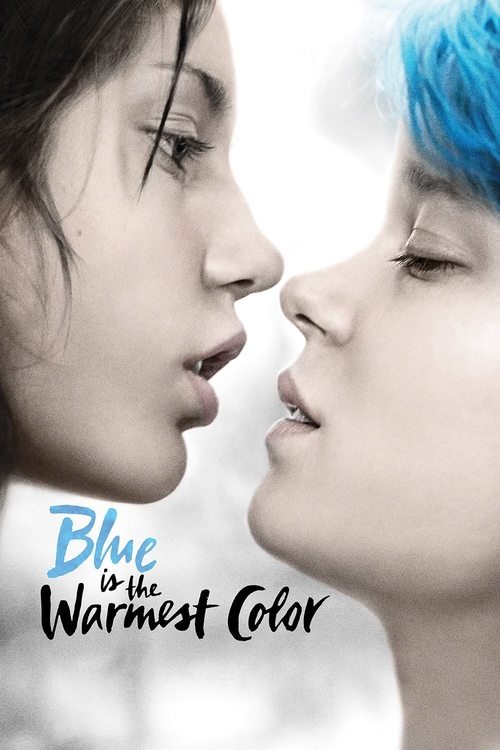
Blue Is the Warmest Color
2013 · Abdellatif Kechiche
For when you want to feel a first love — and first heartbreak — at full, unguarded intensity, and you have the evening and the emotional reserves to give it. Challenging in length and candor, overwhelming in payoff.
What it's about
Adèle is a working-class high schooler in Lille, drifting through classes and boys, when she passes a blue-haired art student named Emma on the street — and her whole life reorients. Across roughly a decade, the film follows their love story from first glance through everything a first great love contains: desire, class friction, ambition, cooking, jealousy, growing up and growing apart from who you were.
The experience
Immersive and intensely intimate — three hours shot almost entirely in close-up, so you live inside Adèle's face through every flush of joy and devastation. It's frank about sex and raw about heartbreak; expect to come out emotionally wrung dry.
Performances
Adèle Exarchopoulos gives one of the most exposed, complete performances of the decade — eating, sleeping, crying, wanting, all without a visible seam — and Léa Seydoux matches her with cool, wounding confidence. Cannes recognized it by awarding the Palme d'Or jointly to the director and both actors, an unprecedented gesture.
The craft
Kechiche shoots in long, searching takes and relentless close-ups, building scenes past the point where most films would cut until they stop feeling acted at all. The result is a texture of real time and real appetite — classrooms, dinner tables, dance floors — that makes the emotional blows land like documentary.
Why it matters
Palme d'Or winner and one of the most discussed films of the 2010s — a landmark of queer cinema whose acclaim arrived tangled with real controversy over its grueling shoot and its explicitness, a debate that still shapes conversations about what directors ask of actors.
Snapshot
Abdellatif Kechiche's fourth-and-a-half feature — his fifth, counting the two-part structure he originally imagined — arrived at Cannes in May 2013 under the French title La Vie d'Adèle – Chapitres 1 et 2, and left with a Palme d'Or awarded in an unprecedented form: jury president Steven Spielberg's panel gave the prize jointly to Kechiche and to his two lead actors, Adèle Exarchopoulos and Léa Seydoux. That gesture was itself a piece of criticism. It named the film's true subject as the labor and exposure of performance, and it anticipated the controversy that would consume the film's public life within weeks, when both actors described the shoot in terms that no press campaign could absorb.
The film runs roughly three hours and follows Adèle from her mid-teens through her early twenties: a lycée student in Lille who crosses paths with a blue-haired art student, Emma, falls into a consuming relationship, becomes a nursery-school teacher, betrays Emma, and is discarded. Loosely adapted from Julie Maroh's 2010 graphic novel Le bleu est une couleur chaude, it discards the novel's framing device (a posthumous diary) and its terminal illness, replacing tragedy with something more corrosive: class attrition, the slow discovery that desire does not confer belonging.
What makes the film a durable object of study rather than a scandal footnote is its method. Kechiche shot enormous quantities of footage in close proximity to his actors' faces, on long handheld takes, over a five-and-a-half-month production, then cut the result into a naturalist epic of appetite — for food, for sex, for language, for a life one has not been raised into. The film is simultaneously one of the most sensuously attentive works of 2010s European cinema and a case study in the ethics of directorial extraction. Both readings are correct, and the second has, over the past decade, come to condition the first.
Industry & production
Blue Is the Warmest Color is a French production centered on Kechiche's own company Quat'sous Films, with Wild Bunch (Vincent Maraval's outfit, a dominant force in French arthouse financing and sales) as a principal partner alongside France 2 Cinéma and regional support from the Nord-Pas-de-Calais region, where the film is set and largely shot. This is the standard architecture of French auteur financing: a producer-sales hybrid, a public broadcaster's cinema arm, regional subsidy tied to location shooting, and the CNC's advance-and-support apparatus underneath. It is also an architecture built for films of predictable duration and schedule, which is precisely what Kechiche did not deliver.
The production is inseparable from its overruns. The shoot ran far beyond its planned schedule — accounts from the production and from the cast converge on roughly five months rather than the two or so budgeted — and the film's post-production and delivery were completed close enough to Cannes that its festival premiere carried the atmosphere of a rescue. Kechiche's shooting ratio was extraordinary by any standard; the figure most often cited in press accounts is on the order of 750 hours of material, and while such numbers are inherently soft, the scale is corroborated by the editing team's descriptions of the assembly and by the film's own texture, which repeatedly implies that the take we are watching was selected from many near-identical siblings.
The aftermath was unusually ugly and unusually public. In interviews around and after the festival, Seydoux and Exarchopoulos characterized the shoot as punishing — long days, repeated takes, an atmosphere they described as coercive in its intensity, and in particular the extended sex sequences, which were shot over a period of days. Kechiche responded publicly and combatively, at one point suggesting the film should not be released. Separately, a French technicians' union (the Syndicat des Producteurs Indépendants' counterpart on the crew side, SPIAC-CGT) publicly criticized the production over working conditions and unpaid overtime. Julie Maroh, the author of the source graphic novel, published a blog response that praised elements of the film but objected to the sex scenes as displaying, in her account, a heterosexual gaze onto lesbian intimacy — a critique that traveled globally and shaped the film's reception among queer audiences.
Commercially, the film performed strongly for a three-hour subtitled drama with an NC-17 rating in the United States (IFC/Sundance Selects released it there in October 2013), and it was a substantial arthouse success in France and internationally. It did not, however, become France's Academy Award submission for the foreign-language category, because its late 2013 French release date fell outside the eligibility window — a scheduling accident that removed it from the awards conversation where its Palme would otherwise have made it a frontrunner.
Technology
Technically the film is unglamorous and deliberately so. It was shot digitally — Kechiche and cinematographer Sofian El Fani worked with compact digital cameras that permitted very long takes and handheld operation in tight domestic and public spaces, with two cameras frequently running to cover an exchange without the interruption of resetting. The choice is functional rather than expressive: digital capture in the early 2010s had reached the point where a director could roll for the length of a scene's emotional arc without a magazine change, and Kechiche's method depends absolutely on that. A film shot on 35mm at his ratio would have been financially impossible.
The palette is built around available and practical light — classroom fluorescents, café windows, streetlamps, the sodium wash of a night bus — with minimal supplemental sourcing. Skin is rendered warm and slightly ruddy; the image tolerates noise in the darker interiors rather than lighting the noise away. There is no grading conceit imposed on the whole, only the film's one governing chromatic idea: blue, seeded everywhere from Emma's hair to a bedspread, a bench, a dress, a wall, and progressively withdrawn as Emma withdraws.
The other technological fact of the film is its scale of data. Managing three-quarters of a million-odd minutes of footage — logging, syncing, and cutting it — is a post-production problem that only becomes tractable with nonlinear systems and cheap storage. The film is in this narrow sense a document of what digital abundance permits and what it costs: the ratio that produced the performances is the same ratio that produced the exhaustion the performers described.
Technique
Cinematography
Sofian El Fani, who had shot Kechiche's Black Venus (2010), operates almost entirely in close-up and medium close-up, handheld, with a shallow field. The face fills the frame; the world behind it dissolves. This is the film's most consistent formal decision and its most consequential. Kechiche has spoken of the face as the primary landscape of his cinema, and here the camera treats Exarchopoulos's face as a continuous surface to be read — the wet lower lip, the tangled hair falling forward, the reddened eyes, the mouth working through food. The framing is often too close for comfort and rarely settles; it drifts, corrects, breathes with the operator.
Two consequences follow. First, geography is suppressed. We rarely receive a clean establishing view of the school, the apartment, the gallery; space is inferred from fragments, which keeps the viewer inside Adèle's absorbed, unreflective perception. Second, the film's occasional wider compositions land with disproportionate force — the demonstration marching down a boulevard, the beach, the final walk away from the gallery in a blue dress, where Kechiche at last permits distance and the character becomes small.
El Fani's lighting refuses beautification. Faces sweat, shine, flush. There is no glamour lens on the sex, and none on the crying either; the extended breakup scene in the café is filmed with the same unblinking proximity as the meals, so that grief becomes a physical event — mucus, breath, the failure of the face to hold together.
Editing
The film was cut by a team — Camille Toubkis, Albertine Lastera, Jean-Marie Lengellé, and Ghalya Lacroix (Lacroix a long-standing Kechiche collaborator who also shares screenplay credit) — a division of labor that reflects the sheer volume of material. Their governing principle is duration. Scenes are permitted to run past their informational function: a classroom discussion of Marivaux continues after the point has been made; a party continues; a meal continues. The cutting inside scenes is frequent, however, and this is the film's characteristic rhythm — long scenes assembled from many short shots, so that the effect is of continuous attention rather than of long-take contemplation. It is a naturalism produced in the edit, not preserved in camera.
The macro-structure is brutally elliptical against this micro-density. Years disappear between shots with no marker except a haircut, a job, a different apartment. The film gives us hours inside single evenings and skips whole seasons of a relationship. That asymmetry is the film's argument about memory: what survives is sensation and humiliation, not chronology.
Mise-en-scène / staging
Kechiche stages around two motifs above all: eating and talking. Meals recur as class diagnostics — the spaghetti bolognese at Adèle's parents' table, eaten fast and in quantity, against the oysters and wine at Emma's mother's, where seafood is discussed as an acquired pleasure and Adèle is being, without cruelty, examined. The staging in these scenes is documentary in feel: bodies crowded around tables, overlapping speech, the camera moving between faces as though catching what it can.
Talk is staged as social sorting. In the gallery party sequence, Adèle circulates with trays while the guests discuss Klimt, Schiele, and Sartre; she is fluent, warm, well-liked, and structurally a servant. Kechiche does not underline it. He simply keeps her hands busy.
Bodies in space carry the film's emotional information. The lovers are staged in constant contact early — legs entangled on a bench, sleeping curled — and staged with a hand's width of unbridgeable air late. The café scene near the end is a masterclass in blocking as psychology: the two women reach across the table, touch, escalate, and the physical intimacy that once resolved everything now resolves nothing.
Sound
The sound design is aggressively naturalistic: no non-diegetic score of consequence, only source music (club and party tracks, a Lykke Li song, incidental radio) and a dense, unswept field of ambient noise — corridor chatter, traffic, cutlery, wind. Dialogue is recorded live with the acoustic messiness that implies; lines overlap, trail off, get stepped on. The absence of score is the film's most disciplined refusal, because a score would tell us how to feel about scenes whose entire method is to withhold that instruction.
Two sonic set pieces stand out. The demonstration, where chanted slogans and whistles build a collective body of sound that Adèle joins with real joy. And the crying, in the café and on the bench outside her school, where breath and sob are foregrounded to a degree that borders on the unbearable — the loudest thing in the film is a person failing to stop weeping.
Performance
Exarchopoulos was seventeen at casting and eighteen during the shoot; the film is built on her. Her performance is a study in the pre-verbal: chewing, sleeping with her mouth open, wiping her nose on her sleeve, looking at Emma with an appetite she has no vocabulary for. She is asked to be watched constantly and to appear unaware of it, and she sustains that for three hours. Seydoux, already an established actor, plays Emma as the one who has language — for art, for politics, for her own desire — and therefore as the one with power. Her performance's key move is a hardening: the confidence that reads as generous in the early scenes reveals itself as a form of curatorship, and by the end she is describing Adèle's body in the past tense.
The Cannes jury's decision to attach the Palme to both actors formalized what the film makes obvious — that the authorship here is significantly theirs — while the actors' subsequent statements complicated what that authorship cost. Any account of the performances now has to hold both: that they are among the most complete in modern French cinema, and that the performers publicly said they would not repeat the experience.
Narrative & dramatic mode
The film is a Bildungsroman told in two chapters, as the French title insists. Chapter one is formation: a girl discovers what she wants and reorganizes herself around it. Chapter two is subtraction: she loses it and does not recover. There is no reversal, no revelation, no structuring plot device. Kechiche works in the mode of literary naturalism — Zola and Flaubert are the ancestors, and the film names its own lineage in classroom scenes on Marivaux's La Vie de Marianne (the source of Adèle's surname, and of the film's argument that love arrives as a coup de foudre that rearranges a life) and on Sophocles' Antigone.
The dramatic engine is class, not sexuality. Adèle's family is working-class, pragmatic, food-on-the-table; Emma's is cultured, bohemian, comfortable with the arts and with their daughter's lesbianism. Adèle never closes that gap. She becomes a teacher — good, devoted, unglamorous work — while Emma's circle assumes she must want to write. Her infidelity is not presented as a moral crisis but as the action of someone starved of recognition. The film's cruelty is that it declines to give her a redemptive third act; the last movement is simply her leaving a room where she is no longer legible.
The three-hour running time is itself a dramatic mode. Kechiche is arguing that a life's texture cannot be summarized, and the film's longueurs are load-bearing: we must be bored in the classroom and full at the table in order for the loss to register as the loss of an entire sensory world.
Genre & cycle
Nominally a romance and a coming-of-age drama; functionally, a naturalist social novel. It belongs to a 2010s cycle of long-form, sensually explicit European art films that treated sex as a legitimate register of dramatic information rather than as spectacle or transgression — a cycle that includes Lars von Trier's Nymphomaniac (2013), Alain Guiraudie's Stranger by the Lake (2013), and, later and in a very different register, Luca Guadagnino's Call Me by Your Name (2017).
Within queer cinema, it sits at a hinge. It arrives after the New Queer Cinema of the early 1990s had ceded ground to a more assimilationist mainstream, and alongside a wave of lesbian romances that would define the decade: Carol (2015), The Handmaiden (2016), Portrait of a Lady on Fire (2019). Its explicitness and its heterosexual male authorship made it the negative example against which several of those films were positioned — Céline Sciamma's Portrait in particular was widely received (and discussed by Sciamma herself in terms of the "female gaze") as an alternative model of filming desire between women, though it would be a simplification to reduce that film to a rebuttal.
The film also belongs to Kechiche's own cycle: a body of work about French bodies at the margins of French culture — Games of Love and Chance (2003), The Secret of the Grain (2007), Black Venus (2010) — in which food, language, and performance are the instruments of inclusion and exclusion.
Authorship & method
Kechiche, born in Tunis in 1960 and raised in Nice, began as an actor and carries an actor's-eye method that is also, by many accounts, an actor's-nightmare method. He writes with Ghalya Lacroix (credited on the screenplay here alongside him, and a longtime editor on his films), but his scripts function as armatures; the working practice is extended improvisation within a scene's given circumstances, shot repeatedly until something unplanned occurs. He has described looking for a truth that appears only when the actor stops performing — a familiar rationale, and one that shifts its meaning depending on how many takes are required to produce that exhaustion.
The key collaborators are few and consistent. El Fani's camera, Lacroix's presence across writing and cutting, the four-person edit team. There is no composer of consequence, by design; the absence of a score is a signature. Casting is central to the method — Kechiche has repeatedly built films around a young performer's face, and Blue is the most complete instance.
The authorship question here is not academic. The Palme's tripartite award, the actors' testimony, the union's complaint, and Maroh's response together make the film a permanent case study in whose labor produces what we see. The most defensible critical position is that the film is a genuine collaboration whose terms were set unilaterally — that Exarchopoulos and Seydoux authored the performances, and Kechiche authored the conditions.
Movement / national cinema
The film is French cinema in its post-New-Wave naturalist line, descending less from Godard than from Renoir, Pialat, and the Dardennes' Belgian social realism. Maurice Pialat is the essential predecessor: the same faith in the unruly, over-long scene, the same emotional violence in domestic settings, the same conviction that a performance is something the director extracts rather than shapes. À nos amours (1983), with its teenage protagonist's sexual awakening filmed with unnerving proximity, is the film's clearest French ancestor.
Kechiche's position within that national cinema is doubled. As a Franco-Tunisian filmmaker he is customarily grouped with a generation of directors who redrew French cinema's map of who counts as a subject — his earlier films are about immigrant and banlieue life — but Blue is his least ethnically inflected work, with a white working-class protagonist and a story about class rather than origin. Some critics read this as an assimilation of his concerns into a more universalizable frame; others as a demonstration that his real subject was always class and the body's fluency in a social code.
The film also functions as a document of French institutional life circa 2010: the lycée classroom as a site of literary transmission, the mass street demonstration (against austerity and education reform) as a form of belonging, the public school as an employer. Few contemporary films take French secondary education as seriously as a formative environment — Laurent Cantet's The Class (2008), another Palme winner, is the obvious companion.
Era / period
Blue is a film of a very specific French moment. It premiered in May 2013 and opened in France in October, during and immediately after the bitter national fight over mariage pour tous, the same-sex marriage law passed that May amid the largest conservative street demonstrations in France in decades. Kechiche did not make an issue film, and the law is not mentioned — but a mainstream French film about a lesbian relationship winning the Palme in that specific spring could not be received apolitically, and was not. Its scenes of Adèle being bullied by classmates over her sexuality, and of her never coming out to her parents, register differently against that backdrop.
It is also a film of the early digital 2010s in its production logic: cheap capture, enormous ratios, the director as a gatherer of raw material. And its afterlife is inseparable from what came four years later. Released in 2013, it was re-litigated after 2017, when #MeToo gave the actors' 2013 statements a vocabulary and an audience they had not had at the time. Kechiche's subsequent career — the Mektoub, My Love films, the second of which premiered at Cannes in 2019 to walkouts over an extended sequence of similar method, and separate allegations against him that he has denied — has retroactively colored the earlier film for many viewers.
Themes
Class as the real barrier. The film's central claim is that Adèle and Emma are separated not by sexuality but by cultural capital. Every dinner table, every party, every discussion of a painter is a test Adèle passes socially and fails structurally. Bourdieu is the unspoken reference; taste is the mechanism of exclusion.
Appetite. Eating and sex are filmed with the same grammar — proximity, duration, mess. Adèle eats constantly and without technique, and the film treats this as a form of honesty and a mark of origin. The oysters scene makes the equation explicit without saying it.
The gap between desire and language. Emma can name what she wants; Adèle can only feel it. Adèle reads and teaches literature but cannot narrate herself, and the film's saddest recurring image is her being asked what she wants to be and having no answer that satisfies the room.
Looking and being looked at. Emma draws Adèle, paints her, exhibits her. The film watches Adèle for three hours. The parallel is deliberate — Kechiche builds a critique of aestheticizing consumption into a film that itself consumes — and whether that reflexivity is earned or self-serving is the central interpretive fight the film has generated.
Loss without catastrophe. Nobody dies (unlike in the graphic novel). Adèle simply keeps living in a life that has been emptied. The final scene, in which she walks away from Emma's gallery and out of frame, refuses both reconciliation and tragedy.
Reception, canon & influence
Critical reception. The Cannes premiere produced near-rapturous notices and the Palme; the film went on to win the FIPRESCI prize at the festival and, subsequently, major critics' awards internationally, including recognition from the Los Angeles Film Critics Association and the New York Film Critics Circle, and the BAFTA for Film Not in the English Language. Reviewers singled out Exarchopoulos as a discovery of the first order. American critics were, on balance, more unreserved than French ones, and Cahiers du cinéma and parts of the French press were notably cooler on Kechiche's method.
The counter-current arrived quickly and has proved more durable than the initial acclaim. Maroh's objection to the sex scenes framed the dominant critique: that a straight male director had filmed lesbian sex as a spectacle for a viewer positioned outside it, at a length and with a choreography that many queer viewers found alien to the experience depicted. This became one of the most-cited film-critical debates of the decade and a standing reference point in discussions of the gaze. The actors' accounts of the shoot then shifted the argument from representation to labor, and by the late 2010s the film was routinely invoked as the paradigm case of art produced under conditions that its own admirers found indefensible.
Influences on the film (backward). Maroh's graphic novel supplies the premise, the blue motif, and the class asymmetry, though Kechiche strips out its diary structure and its ending. Marivaux's La Vie de Marianne is cited in the film itself and supplies the heroine's name and the model of the socially mobile young woman undone by love. Pialat, especially À nos amours, supplies the method and the register of domestic violence-by-conversation. The Dardennes and the tradition of Belgian and French social realism supply the handheld proximity. Kechiche's own The Secret of the Grain supplies the food-as-social-language grammar almost wholesale — the long communal meal is his signature scene type, transplanted here from a Franco-Tunisian family in Sète to a French one in Lille.
Legacy (forward). Three legacies, of unequal kind.
Artistically, it made Exarchopoulos a major actor and consolidated Seydoux's international standing, and it demonstrated that a three-hour naturalist romance could be a genuine international arthouse event. Its influence on the filming of intimacy is real but largely negative-dialectical: the wave of lesbian romances that followed it — Carol, Portrait of a Lady on Fire, Ammonite — were widely discussed in relation to it, as correctives, and Sciamma's Portrait in particular crystallized an alternative model of reciprocal looking that was defined partly against Blue's asymmetry.
Institutionally, it belongs to the pre-history of the intimacy-coordinator profession. The role existed in a nascent form before 2013 and became standard practice in Anglophone production after 2017 for many reasons, of which this film was one input rather than a cause — but the actors' accounts of shooting the sex scenes over multiple days without such support are among the most frequently cited examples in the case for that infrastructure, and the film is a fixture of the discussion.
Critically, it survives as an unresolved test case. It is difficult to name another film of the 2010s that is simultaneously so widely acknowledged as an achievement in performance and so widely regarded as a cautionary account of how such performances are obtained. That unresolvedness is the honest state of the record, and it is likely to remain the terms on which the film is taught.
A Deleuzian reading
Watch her mouth.
The full Deleuzian reading of Blue Is the Warmest Color →
Reception
It swept out of Cannes 2013 with the Palme d'Or — Spielberg's jury so moved they gave the prize to the two lead actresses as well as the director — and within months the glow curdled as Léa Seydoux and Adèle Exarchopoulos described the shoot as 'horrible' and crew members protested working conditions. A decade on it's the textbook case study in loving a film while litigating how it was made.
How Blue Is the Warmest Color was received, from release to now →
How to watch Blue Is the Warmest Color: what to notice on a first viewing
- Watch Adèle's mouth while she eats. Exarchopoulos eats fast and without technique, the fork loaded again before the last bite is down, sauce at the corner of the lip. Kechiche gives meals the same closeness he gives everything else. Hunger is the film's basic unit, and it is never only hunger for food.
- Watch how close Sofian El Fani keeps the camera to faces. He works almost entirely in close-up and medium close-up, handheld, with a shallow field. The face fills the frame and the room behind it dissolves. The framing drifts and corrects instead of settling. You stay pinned inside one girl's absorbed attention, with no vantage on the world she is moving through.
- Notice you never get a clean wide view of the school. Kechiche withholds establishing shots. The lycée, the apartment, and the gallery arrive as fragments that will not assemble into a floor plan. Then three or four wides land: a boulevard, a beach, a crowd. You cannot take a position on a room you were never shown, so the rare distance hits like a blow.
- Watch for blue in the hair, a bench, a bedspread. Blue is seeded everywhere early, across objects and walls and Emma's hair. As the relationship changes, the color thins out of the frame one object at a time until almost nothing carries it. The color holds the feeling of the film, so its draining registers on you before you consciously notice it.
- Listen for what plays under the scenes: nothing. There is no score. You get club tracks, a song on a radio, corridor chatter, cutlery, traffic, and live dialogue where lines overlap, trail off, and get stepped on. Refusing music is the discipline the whole method rests on, and it leaves every judgment to you.
The whole guide to watching Blue Is the Warmest Color, with the keys for a rewatch →
Influences: the films it descends from and the films it influenced
- The Passion of Joan of Arc (1928) — The suppressed geography of Blue — scenes played in unanchored facial close-ups where the room is never established — is Dreyer's Joan grammar, in which the tear-tracked face is the entire dramatic space and weeping becomes the event rather than its punctuation.
- Faces (1968) — Cassavetes' practice of running scenes far past the written material until the actor's social mask fails is the precedent for Kechiche's enormous shooting ratio and refusal to cut; both films are assembled from behavioral accident rather than from blocking.
- The Mother and the Whore (1973) — Eustache's long, unscored, verbally dense takes — literary French spoken at real-time length until talk turns into cruelty — set the register of Blue's café and bedroom arguments, where the cut arrives only when a speaker breaks.
- À nos amours (1983) — Pialat's dinner-table scene, which he entered himself to provoke unprepared reactions from the teenage Sandrine Bonnaire, is the direct template for Kechiche's meal-as-ambush and for directing a discovery by destabilizing her rather than rehearsing her.
- La Vie de Jésus (1997) — Dumont's casting of nonprofessional Nord–Pas-de-Calais faces and his flat, available-light staging of sex without flattering coverage established the northern-French provincial texture and the anti-glamour lighting protocol Sofian El Fani works within.
- Rosetta (1999) — The Dardennes' shoulder-mounted pursuit of a walking protagonist — no establishing shot, no score, the frame pinned to a nape — is the handheld proximity reproduced in Blue's corridor and street scenes, where the camera is a body keeping pace rather than an observer choosing a vantage.
- Intimacy (2001) — Chéreau's choice to shoot sex as continuous, unflattering long takes, making the actors' physical exposure the film's central labor, is the immediate European precedent for Blue's multi-minute scenes — and for the labor critique both films attracted.
- Games of Love and Chance (L'Esquive) (2003) — Kechiche's own earlier film, in which banlieue teenagers rehearse Marivaux, invented the device Blue reuses with La Vie de Marianne: a canonical eighteenth-century text recited in class as a diagnostic of who is permitted to speak which register of French.
- The Secret of the Grain (2007) — The communal-meal scene type — a table held for twenty minutes in tight shot/reverse-shot on chewing, interrupting, overlapping speakers recorded live — is transplanted almost wholesale from Sète to the two Lille dinner tables that measure the class gap between Adèle's family and Emma's.
- Last Tango in Paris (1972) — Kechiche inherits both halves of the legacy: the extended, frank intimacy as the dramatic core of an art film, and the now-notorious director-coercion controversy that made Last Tango the founding case for performer duty-of-care.
- Beach Rats (2017) — Hittman films adolescent desire as tactile grain-heavy 16mm close-up on skin, neck and mouth with no score, sustaining Blue's premise that eroticism is produced by proximity and duration rather than by coverage.
- Mektoub, My Love: Canto Uno (2017) — Kechiche's own extension of the method — hours of bodies observed at a beach and in a nightclub, cut from an even larger ratio, with every piece of music diegetic — isolates the durational-observation principle that Blue applied to faces.
- Portrait of a Lady on Fire (2019) — Sciamma builds the shot grammar as a point-by-point rebuttal: eyeline matches are reciprocal and equally weighted, intimacy is choreographed in advance with the actors, and the only music is diegetic — an alternative model of looking defined against Blue's asymmetry.
- Happening (2021) — Diwan and Laurent Tangy pin Academy-ratio handheld to Anamaria Vartolomei's nape and face with almost no score, letting single unbroken takes carry physical duration — the Blue/Dardenne proximity transferred from a body in desire to a body in pain.
- The Little Sister (2025) — Handheld close-ups that linger on a teenage girl's face, charting a queer awakening through micro-expression and appetite — the observational-proximity grammar Herzi inherits and tempers.
- God's Own Country (2017) — Extended tactile close-ups of eating, skin and faces that make bodily appetite the grammar of a queer love story.
- Falcon Lake (2022) — A graphic-novel adaptation rendered as tactile naturalist close-up on teenage desire — the same source-medium translation (Vivès/Maroh comics → intimate live-action skin and light) Le Bon performs on 'Une sœur.'
- Girls Like Girls (2026) — Establishes durational, close-framed intimacy and the treatment of a first sapphic relationship as a full bildungsroman rather than an incident.
- The Way He Looks (2014) — Kechiche's skin-close handheld close-ups of faces and hands establish the tactile-proximity register de Kerchove warms and softens.
- Fish Tank (2009) — Arnold casts an untrained teenager off the street and shoots her in skin-close handheld with no score and pages withheld until the day — the Anglophone parallel to Kechiche's method of extracting a performance by denying the actor foreknowledge.
- Stranger by the Lake (2013) — Its 2013 Cannes companion shares the total absence of non-diegetic score and the insistence on filming sex in unbroken takes inside an otherwise naturalist frame, while inverting Blue's suppressed geography into a rigorously mapped, repeatable one.
- Girlhood (2014) — Sciamma casts nonprofessionals from the estates and sustains long takes on young working-class faces, keeping Kechiche's face-first observation of French adolescence while replacing handheld pursuit with composed, held widescreen framing.
- Carol (2015) — Haynes answers Blue at the level of découpage: desire is staged through obstructed frames — rain on glass, doorways, car windows — and carried by Burwell's score, deliberately withholding the unmediated facial access on which Kechiche stakes the entire film.
- American Honey (2016) — Chronological shooting, a nonprofessional lead, an enormous ratio of handheld 4:3 footage and scenes allowed to run until behavior stops reading as performance — the same extraction economy as Blue, applied to a group rather than a couple.
- The Handmaiden (2016) — Sibling in the explicit, extended lesbian sex scene as central dramatic event — and the live critical debate over whether such staging serves or betrays the female gaze.
- Young Hearts (2024) — Handheld naturalist close-ups on a young lead's transparent face through sexual awakening, with available light and sensory realism carrying the emotional charge.
- Soulmate (2023) — An intimate-two-shot and contrasting-dyad performance study that anchors its entire melodrama in the reading of two women's faces across a years-long span.
- I Killed My Mother (2009) — Builds a Cannes-anointed queer adolescence out of relentless facial close-ups that hold raw emotion in the frame, extending the same intimate-portrait proximity.
- Nymphomaniac: Vol. I (2013) — Released the same year, it is the era's other flashpoint in the debate over extended, quasi-unsimulated sex with name performers in serious cinema — the discourse Nymphomaniac's digital-double solution directly answers.
- Kokuho (2025) — Kokuho's DP Sofian El Fani deploys the same mobile, skin-attentive extreme-close-up handheld register he pioneered here, reading emotion off pores, sweat, and faces in tight pursuit rather than composed master shots.
- Fat Girl (2001) — Kechiche's protracted, uninterrupted sex and eating scenes treat appetite and duration as the film's argument, with no non-diegetic music to soften either — the same insistence that a body's real-time behavior carries meaning a cut would destroy.
Similar films
- Portrait of a Lady on Fire (2019) — influence & lineage
- Laurence Anyways (2012) — same viewing thread
- Three Colors: Blue (1993) — shared sensibility
- Call Me by Your Name (2017) — shared sensibility
- Moonlight (2016) — shared sensibility
- Betty Blue (1986) — shared sensibility
- Close (2022) — shared sensibility
- Amour (2012) — shared sensibility
All the films related to Blue Is the Warmest Color →
Watch it with: curated runs of related films
- Love Against the Grain — A run of films where desire refuses the shape its world demands — opera stages, drought-struck Taipei, an honor-bound Lahore household, drenched Buenos Aires — and burns brighter, and more dangerously, for the refusal.