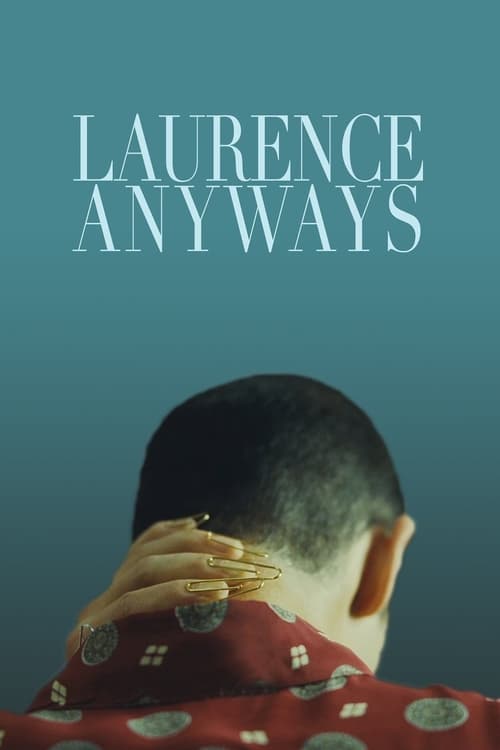
Laurence Anyways
2012 · Xavier Dolan
For when you want a big, all-consuming romance and have the whole evening to give it — a grand emotional epic rather than a light date movie. Reach for it when you want to feel everything at operatic volume.
What it's about
Montreal, 1989. Laurence, a literature teacher, tells Fred — the woman she loves, and who loves her back fiercely — that she has always been a woman. What follows is a decade of the two of them trying to invent a shape for a love that fits no available category, against family, workplaces, and a world that keeps demanding they choose.
The experience
Sweeping and maximalist — slow-motion reveries, wall-to-wall 80s and 90s needle drops, sudden surreal flourishes — anchored by two people fighting for each other and with each other. It's nearly three hours and it feels like a decade lived; expect to come out wrung out and a little in love.
Performances
Suzanne Clément is the film's live wire as Fred — her ferocity won the Un Certain Regard acting prize at Cannes — while Melvil Poupaud gives Laurence a watchful, wounded dignity.
The craft
Xavier Dolan, just twenty-three, deploys the full arsenal: costume and wallpaper as emotional weather, clothes raining from the sky, a boxy square frame that keeps cropping the world down to two faces. The music and color alone make it worth the biggest screen and best sound you have.
Why it matters
A cornerstone of Quebec's twenty-first-century cinema and of the new queer canon, and the film that confirmed Dolan as one of the most audacious young directors of his generation.
Montreal, 1989: a literature teacher tells the woman she loves that she has always been a woman, and the two spend the following decade trying to invent a form for a love that fits no available category. Xavier Dolan was twenty-three when he made this, his third feature, and it announced the full Dolan arsenal: slow-motion reveries, wall-to-wall needle drops from Visage to Duran Duran, costume and wallpaper as emotional weather, and sudden surrealist eruptions — clothes raining from the sky, a waterfall indoors. Shot in boxy 1.33:1, the frame keeps cropping the world down to two faces. Suzanne Clément, whose ferocious Fred won the Un Certain Regard acting prize at Cannes, is the film's live wire; Melvil Poupaud plays Laurence with a watchful, wounded dignity. A cornerstone of Quebec's twenty-first-century cinema and of the new queer canon — though later viewers have rightly debated the casting of a cis actor — it remains Dolan's most expansive work: nearly three hours, ten years, and a romance conducted at the pitch of opera.
Reception
At Cannes 2012 it was the 23-year-old enfant terrible's 168-minute folly — relegated to Un Certain Regard and tagged as indulgent by many critics. A decade on it's routinely called Dolan's masterpiece and a landmark of 2010s queer cinema.
How Laurence Anyways was received, from release to now →
Influences: the films it descends from and the films it influenced
- In the Mood for Love (2000) — The ritualized slow-motion glide set to a recurring musical cue — bodies drifting through corridors as a song swells — is the exact template Dolan uses for his slow-mo/needle-drop emotional suspensions.
- Happy Together (1997) — Charts a queer relationship's decay through abrupt saturated-color shifts and pop needle-drops rather than plot, the structuring device Dolan inherits for his decade-spanning love story.
- All About My Mother (1999) — Places a transgender character inside a maternal melodrama and lets theatrical costume and color excess carry the emotion — Dolan's costume-as-emotion and melodramatic register descend directly from this Almodóvarian mode.
- All That Heaven Allows (1955) — Externalizes forbidden love through Technicolor mise-en-scène and pointed color coding, the founding grammar of Dolan's idea that clothing and hue can speak the feeling the characters cannot.
- The Bitter Tears of Petra von Kant (1972) — Reworks Sirkian melodrama into queer chamber drama where successive costume changes mark the shifting emotional temperature — a device Dolan literalizes in Laurence's evolving wardrobe.
- Far From Heaven (2002) — A studied Sirk revival that resurrects period-precise production design and pushes gay subtext into text, modeling how a contemporary director can inhabit vintage melodrama sincerely rather than ironically.
- 8½ (1963) — Punctures its realist surface with surrealist eruptions and fantasy set-pieces, the license Dolan draws on for his indoor rainfall and cascading-clothing interruptions.
- Magnolia (1999) — Stages a literal surreal downpour of falling objects as an emotional climax across an ensemble, a precedent for Dolan's staging of surrealist eruptions as feeling made physical.
- My Own Private Idaho (1991) — A cornerstone of New Queer Cinema that folds lyrical slow-motion and dreamlike interludes into a queer narrative, the arthouse lineage Dolan explicitly extends.
- Nowhere (1997) — New Queer Cinema built on saturated stylization and a curated shoegaze/pop needle-drop soundtrack, an antecedent for Dolan's use of music cues as the emotional engine.
- I Killed My Mother (2009) — Pushes the needle-drop maximalism and aspect-ratio experimentation latent in the debut into full-scale operatic set-pieces like the falling-clothes montage.
- Mommy (2014) — Extends Dolan's aspect-ratio expressiveness from Laurence's boxy Academy framing to a locked 1:1 square that physically opens up during a euphoric needle-drop, pushing the same formal device further.
- A Fantastic Woman (2017) — Builds a trans-led melodrama around Almodóvarian surrealist eruptions — gale-force wind, mirror and dance fantasias — and casts a trans actress, answering Laurence's craft and its cis-casting debate at once.
- The Danish Girl (2015) — A period-set transgender-identity melodrama that leans on painterly costume and design as emotional signifiers, and became the flashpoint sibling to Laurence's cis-casting controversy.
- Girlhood (2014) — Its centerpiece — the girls miming Rihanna's 'Diamonds' in blue light — is a Dolan-style needle-drop set-piece where a pop song and suspended movement hold the whole emotional weight of the scene.
- Heartbeats (Les amours imaginaires) (2010) — Dolan's own prior film establishes the signature fusion of fetishistic slow-motion and needle-drop (its recurring Dalida cue) that Laurence Anyways expands to feature-length ambition.
- A Single Man (2009) — Uses couture-precise costume and desaturation-to-saturation color surges to externalize a gay man's grief, the same 'design-as-emotion' melodrama grammar Dolan practices.
Similar films
- Mommy (2014) — influence & lineage
- In the Mood for Love (2000) — influence & lineage · same viewing thread
- The Bitter Tears of Petra von Kant (1972) — influence & lineage · same viewing thread
- Happy Together (1997) — influence & lineage · same viewing thread
- Blue Is the Warmest Color (2013) — same viewing thread
- Cold War (2018) — same viewing thread
- Joyland (2022) — same viewing thread
- Take It All (1963) — shared sensibility
All the films related to Laurence Anyways →
Watch it with: curated runs of related films
- Love Against the Grain — A run of films where desire refuses the shape its world demands — opera stages, drought-struck Taipei, an honor-bound Lahore household, drenched Buenos Aires — and burns brighter, and more dangerously, for the refusal.