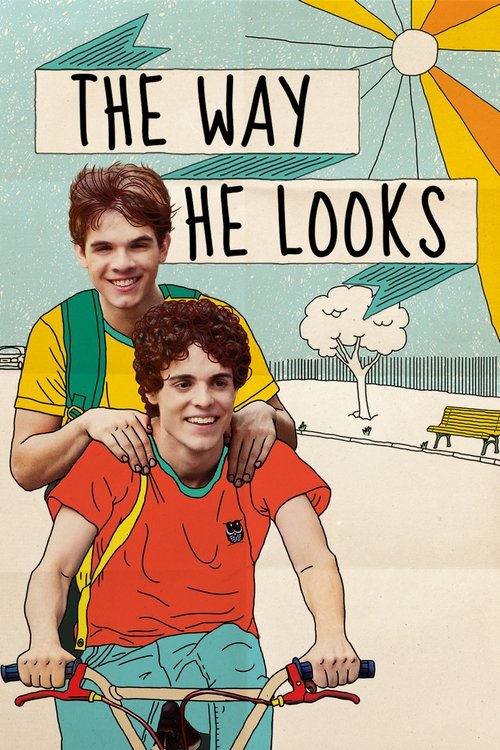
The Way He Looks
2014 · Daniel Ribeiro
For a soft evening when you want to fall in love a little — pure comfort, the kind of film you put on when the world's been harsh and you need proof of tenderness.
What it's about
Leonardo is a blind teenager in São Paulo, chafing against an overprotective mother and dreaming of an exchange program abroad — a plan that quietly wounds Giovana, the best friend who's always been his eyes and his ally. Then Gabriel joins their class, and as the new boy folds into their routines of homework, music, and walks home, Leonardo starts feeling things that make him rethink everything, including leaving.
The experience
Gentle, sunlit, and quietly swoony — a first-love story told through touch, voices, and shared headphones rather than big declarations. It's unhurried and low-stakes in the best way; the tension is all in almosts and maybes, and it leaves you warm.
Performances
Ghilherme Lobo plays Leonardo with wry, unsentimental self-possession — never a figure of pity — and the easy chemistry among the three young leads makes the friendship as affecting as the romance.
The craft
Ribeiro expanded the film from his own beloved short, and it keeps that intimacy: close-up, tactile filmmaking that lets you feel how Leonardo experiences the world through sound and skin. Music carries much of the emotion, and the everyday São Paulo settings keep it grounded and real.
Why it matters
One of the most internationally embraced Brazilian films of its decade and a landmark of queer coming-of-age cinema precisely because it treats a gay first love as sweet and ordinary rather than as tragedy.
Snapshot
The Way He Looks (Portuguese: Hoje Eu Quero Voltar Sozinho, literally "Today I Want to Go Back Alone") is a Brazilian coming-of-age drama written and directed by Daniel Ribeiro. It follows Leonardo, a blind teenager in São Paulo, as he negotiates the twin pressures of an overprotective mother and his own longing for independence, and as friendship with a new classmate, Gabriel, ripens into first love. The film is notable on several counts: it is an expansion of Ribeiro's 2010 short Eu Não Quero Voltar Sozinho ("I Don't Want to Go Back Alone"), which had circulated widely online; it treats a queer teenage romance with a matter-of-fact tenderness rather than as trauma or tragedy; and it became one of the most internationally visible Brazilian films of its decade on the festival circuit. It premiered in the Panorama section of the 64th Berlin International Film Festival in February 2014, where it won the Teddy Award for best LGBT-themed feature and the FIPRESCI Prize, and it was later selected as Brazil's official submission for the Academy Award for Best Foreign Language Film. Its enduring reputation rests on its gentleness — a deliberately low-stakes, warmly observed portrait of adolescence in which blindness and queerness are handled as facts of a life rather than as problems to be solved.
Industry & production
The film emerged from Brazil's independent auteur sector rather than its commercial mainstream, produced by Ribeiro's own company, Lacuna Filmes, based in São Paulo. Its most distinctive production feature is its origin as a feature-length adaptation of a proven short. Ribeiro had directed Eu Não Quero Voltar Sozinho in 2010 with much the same conceit — a blind boy, his best friend, and a new arrival — and that short found a substantial online audience, giving the feature both a template and a demonstrated appetite. Financing in the Brazilian context of the early 2010s typically drew on public and cultural-incentive mechanisms (the federal audiovisual laws and state funds that underwrote much São Paulo independent production of the period); the specific funding stack for this film is not something I can detail from memory, and I won't invent line items. What is clear is that the picture was made on a modest budget with a small cast and largely contemporary, everyday locations — a domestic drama rather than a production-heavy one.
Commercially and reputationally, the film's trajectory ran through the festival circuit before theatrical release. The Berlinale premiere and its two awards there gave it international sales and press traction that a small Brazilian teen drama would not otherwise command, and the subsequent Oscar submission consolidated its status as a national cinematic calling card. I do not have reliable box-office figures and will not fabricate them.
Technology
The Way He Looks is a straightforward digital production of its moment, and the record on its precise camera and workflow is thin enough that I won't assert a specific model. It belongs to the era in which mid-budget international independents had largely migrated to digital acquisition, and its look — clean, naturally lit, unshowy — is consistent with contemporary digital cinematography rather than film origination. There is nothing technologically experimental about the film; its innovations are entirely in the register of performance, writing, and observational technique rather than tools. What is worth noting technologically is adjacent: the short that seeded it was, in effect, a beneficiary of the YouTube-era distribution shift, in which a well-made queer short could reach a global audience without traditional gatekeepers and build the case for a feature.
Technique
Cinematography
The cinematography, credited to Pierre de Kerchove, is unobtrusive and warm, favoring natural light, shallow but not aggressive focus, and a palette of soft daytime interiors, classrooms, and suburban São Paulo streets. The camera tends to stay close to the actors' faces and hands — a choice with thematic weight in a film about a protagonist who apprehends the world through touch and sound rather than sight. Crucially, the film resists point-of-view gimmickry: it does not simulate blindness through blacked-out or blurred frames. Instead it keeps Leonardo fully visible to us while dramatizing, through framing and proximity, the sensory intimacy of how he reads other people. Small gestures — a hand finding a shoulder, the closeness required to guide someone — are staged and shot so that physical contact carries the erotic and emotional charge that a more conventional romance would place in exchanged glances.
Editing
The editing is measured and classical, built around scene-length observation rather than montage energy; it lets conversations and silences breathe at the unhurried tempo of a slice-of-life teen drama. I don't want to attribute the cut to a specific editor from memory, as I'm not certain of the credit, so I'll flag that the record here is thin. What can be said stylistically is that the pacing is deliberately gentle: the film trusts small incremental shifts in the trio's dynamic — jealousy, curiosity, tentative desire — and cuts to preserve continuity of feeling rather than to generate suspense.
Mise-en-scène / staging
Staging is the film's quiet strength. Domestic and school spaces are rendered as ordinary, lived-in environments, and blocking repeatedly foregrounds the mechanics of guidance and touch that structure Leonardo's daily life — walking arm-in-arm, being led, learning a route. The famous set pieces are almost aggressively modest: a shared shower after a swim, a slow dance at a party, a bike ride. Ribeiro's staging invests these commonplace teenage situations with romantic gravity precisely because they double as the moments in which sighted intimacy and Leonardo's tactile way of knowing the world converge.
Sound
Given the protagonist's blindness, the film's sound design carries unusual dramatic responsibility, and it is handled with care: ambient texture, proximity of voices, and the audibility of small movements stand in for the visual cues a sighted character would use. The soundtrack also leans on pop and indie-pop needle-drops to mark emotional beats in a recognizably teenage idiom; the use of Belle & Sebastian's "There's Too Much Love" is the most cited example, functioning almost as a motif for the film's yearning. I'm less certain of the original-score credit and won't name a composer I can't confirm.
Performance
The performances are the film's engine. Ghilherme Lobo plays Leonardo with a poised naturalism that avoids both self-pity and inspirational uplift; Fabio Audi's Gabriel is warm and unforced; and Tess Amorim's Giovana grounds the film's other great subject — the way a first romance reshapes an old friendship — with real comic and emotional texture. The trio's chemistry is understated and credible, and the film's restraint depends on their ability to play affection and jealousy in small increments rather than declarations.
Narrative & dramatic mode
The film operates in a low-key realist, character-driven mode: a bildungsroman compressed into a short span of adolescent time. Its dramatic engine is not external threat but internal negotiation — Leonardo's desire for autonomy against his mother's protectiveness, and his emerging feelings against the settled comfort of his friendship with Giovana. The structure is a classic romantic triangle recast so that the "rivalry" is really about a friend's fear of being left behind. Conflict is domestic and emotional rather than melodramatic; the stakes are a slap, a sulk, a misread signal, a first kiss. This deliberate smallness is a thesis: by refusing tragedy — no gay-bashing catastrophe, no punishing revelation — the film asserts that a blind gay teenager's coming-of-age can be told in the same gentle register as any other.
Genre & cycle
The Way He Looks sits at the intersection of the teen coming-of-age film and the LGBT romance, and it belongs to a 2010s cycle of queer youth stories that emphasized ordinariness and tenderness over persecution. It arrived in the same broad wave as internationally successful queer coming-of-age films that treated first love with sincerity, and it is frequently discussed alongside them as part of a shift away from the "tragic gay narrative" toward affirming, low-conflict storytelling. It also participates in the specific micro-genre of the successful short-to-feature expansion. Within Brazilian cinema, it is part of a strand of intimate, contemporary-set São Paulo dramas rather than the tradition of politically charged or favela-centered work that dominated international perceptions of the national cinema in the prior decade.
Authorship & method
The film is thoroughly an authorial work: Daniel Ribeiro wrote and directed it, and it is the culmination of a sustained interest — the same premise and characters had already appeared in his 2010 short, so the feature reads as a considered expansion rather than a fresh idea. Ribeiro's method here is one of patient realism and empathy, foregrounding performance and everyday detail over stylistic assertion; his signature is tonal control, the ability to keep a film about disability and desire free of both pity and sensationalism.
Among collaborators, cinematographer Pierre de Kerchove is the most identifiable creative partner, responsible for the film's warm, tactile visual register. The recurring cast — Lobo, Audi, and Amorim — carried over from the short, giving the feature a continuity of chemistry that is itself a kind of authorship. On the editing and original-music credits I am not confident of specific names and will not guess; the honest position is that the granular below-the-line record isn't something I can reconstruct reliably from memory.
Movement / national cinema
The film is a product of contemporary Brazilian independent cinema, specifically the São Paulo auteur scene of the 2010s. It stands somewhat apart from the internationally dominant image of Brazilian film — the socially urgent, violence-adjacent tradition associated with the Cinema Novo legacy and, more recently, with films of urban crime and inequality. Instead it aligns with a quieter, more intimate contemporary current interested in interiority, sexuality, and middle-class domestic life. Its significance for the national cinema is partly representational: it became one of the most widely seen Brazilian queer films internationally, and it did so by exporting gentleness rather than spectacle.
Era / period
Made and set in the early-to-mid 2010s, the film is very much of its moment: a smartphone-and-internet adolescence, an indie-pop soundtrack sensibility, and a post-It Gets Better, increasingly visible cultural conversation about queer youth. Its production also reflects the health of Brazil's public film-financing ecosystem in that period, before the political and funding disruptions of the later decade. The picture reads now as a document of a relatively optimistic instant in both Brazilian cultural production and in mainstream representation of queer adolescence.
Themes
The film's central themes are independence and dependence — Leonardo's push for autonomy from a loving but smothering mother — and the discovery of desire. Blindness functions less as a "disability issue" than as a lens on intimacy: because Leonardo cannot see, the film relocates romance into touch, voice, and presence, and asks the audience to feel attraction through senses other than the visual, an idea encoded even in the title's play on "looks." Friendship and its jealousies form a parallel theme, with Giovana embodying the fear that romance will dissolve an old closeness. Underneath runs a quiet argument about normalcy: the film insists that a blind gay teenager's first love is unremarkable in the best sense, worthy of an ordinary, happy story.
Reception, canon & influence
Critical reception was warm, particularly at Berlin, where the film's Teddy Award and FIPRESCI Prize signaled both LGBT-community and critical endorsement; reviewers repeatedly praised its tenderness, its avoidance of cliché, and its lead performances, while some noted that its gentleness verges on the slight. Its selection as Brazil's Oscar submission confirmed its domestic standing, though it did not reach the nomination shortlist.
Looking backward, the film's most direct influence is Ribeiro's own 2010 short, which supplied its premise, characters, and cast; more broadly it draws on the long tradition of the coming-of-age romance and on a growing 2010s appetite for affirming rather than tragic queer narratives. Looking forward, its legacy is chiefly as a touchstone of that affirming cycle: it is regularly cited in discussions of blindness and queerness on screen and in curricula and programming devoted to LGBT cinema, and it helped demonstrate — alongside contemporaneous international successes — that a sincere, low-conflict queer teen romance could travel globally. It also stands as a case study in the short-to-feature pipeline of the streaming and viral-video era. Claims that it directly "inspired" specific later films should be made cautiously; its influence is better described as atmospheric and exemplary than as a traceable chain of direct descent, and the record on precise lines of influence is genuinely thin.
A Deleuzian reading
A hand finds a shoulder.
The full Deleuzian reading of The Way He Looks →
Reception
It won the Teddy Award at Berlin in 2014 and became Brazil's Oscar submission, but its real ascent came after: streaming and Letterboxd word-of-mouth turned it into one of the most beloved queer coming-of-age films of the decade, the pre-Heartstopper touchstone for gentle gay romance.
How The Way He Looks was received, from release to now →
How to watch The Way He Looks: what to notice on a first viewing
- Watch the camera stay close on hands as much as faces. De Kerchove's camera favors proximity to touch and gesture, never simulating Leonardo's blindness with blacked-out or blurred frames, keeping him fully visible to us instead. We watch him perceive the world rather than being made to perceive it as he does.
- Listen for ambient detail, voices, and small movements around him. Because Leonardo can't see, the sound design carries the cues a sighted character would get visually, proximity of voice standing in for a glance. You start reading the soundtrack the way he has to, for information rather than atmosphere.
- Watch how often a hand settles on Leonardo's shoulder before they walk. Guidance and touch structure his whole day, arm-in-arm walks, a hand finding him, the mechanics of being led shown again and again. The same gesture that guides a blind friend across a street is also how you'd touch someone you wanted.
- Notice how long scenes run before the film cuts away. Ribeiro lets conversations and silences breathe at an unhurried pace, cutting to preserve the feeling of a scene rather than to build suspense. The patience gives small shifts in mood room to register as real changes, not just beats in a script.
- Watch the trio play jealousy and affection in small increments. Lobo, Audi, and Amorim underplay every reaction, letting affection and jealousy surface gradually instead of through declarations or confrontations. The restraint keeps the story feeling like an ordinary friendship instead of a scripted triangle.
The whole guide to watching The Way He Looks, with the keys for a rewatch →
Influences: the films it descends from and the films it influenced
- I Don't Want to Go Back Alone (2010) — The literal short-to-feature pipeline: Ribeiro expands his own short's premise, characters and returning cast (Lobo, Audi, Amorim), carrying over the chemistry as a form of authorship.
- Show Me Love (1998) — Moodysson's near-documentary observational staging of provincial teen queer desire, low-conflict and refusing tragedy, models the classical-observational, ensemble-driven register Ribeiro adopts.
- Beautiful Thing (1996) — Established the affirming, non-tragic gay teen romance scored to buoyant pop (Mama Cass) rather than doom — the tonal and needle-drop template Ribeiro's indie-pop cues extend.
- Water Lilies (2007) — Sciamma builds adolescent desire from held glances and the choreography of near-touch rather than dialogue — the gesture-of-touch grammar central to Ribeiro's staging.
- Weekend (2011) — Haigh's intimate two-hander renders queer connection through understated performance and diegetic indie music, proving sustained tenderness needs no melodramatic engine.
- Blue Is the Warmest Color (2013) — Kechiche's skin-close handheld close-ups of faces and hands establish the tactile-proximity register de Kerchove warms and softens.
- Moonlight (2016) — Jenkins renders queer interiority through skin-close framing and subjective sound (the ocean, the diner), extending the tactile-proximity-plus-subjective-sound route to intimacy.
- Handsome Devil (2016) — An affirming school-set queer coming-of-age pairing understated ensemble performance with pop needle drops in the same non-tragic, low-conflict mode.
- Notes on Blindness (2016) — Reconstructs blindness through subjective sound design as the organizing device — the sensory route into blindness Ribeiro deliberately withholds.
- Call Me by Your Name (2017) — Stakes an entire romance on sensory tactility and the gesture of touch, resolving affirmingly rather than tragically — the fullest bloom of Ribeiro's low-conflict tenderness.
- God's Own Country (2017) — Lee builds romance from mud, hands and near-wordless gesture-of-touch, delivering an affirming (not punished) queer union in the same tactile register.
- Love, Simon (2018) — Studio mainstreaming of the low-conflict, affirming teen gay romance keyed to indie-pop needle drops that Ribeiro helped prove could travel globally.
- Portrait of a Lady on Fire (2019) — Makes the gaze and the withheld-then-granted gesture of touch the film's entire erotic grammar — the apex of the look-and-touch staging Ribeiro works in miniature.
- Blind (2014) — Vogt simulates the blind protagonist's subjectivity through manipulated sound and image — the exact POV-simulation Ribeiro pointedly refuses, making the two a direct craft dialogue on rendering blindness.
- Seashore (2015) — Contemporaneous Brazilian-independent queer coming-of-age built, like Ribeiro's, on quiet proximity, coastal light and the tentative gesture of a first touch.
- And Then We Danced (2019) — Centers a tender adolescent queer coming-of-age on a physical-lead performance and the tactility of first desire, first-touch discovery over plot.
- Young Hearts (2024) — Adolescent queer romance staged in a warm, unthreatening world that deliberately refuses the tragedy template — the same 'tenderness-over-tragedy' authorial choice.
Similar films
- Call Me by Your Name (2017) — influence & lineage
- Moonlight (2016) — influence & lineage
- Young Hearts (2024) — shared sensibility
- Boy & the World (2014) — shared sensibility
- Dou kyu sei – Classmates (2016) — shared sensibility
- My Sunshine (2024) — shared sensibility
- Girls Like Girls (2026) — shared sensibility
- House of Hummingbird (2019) — shared sensibility