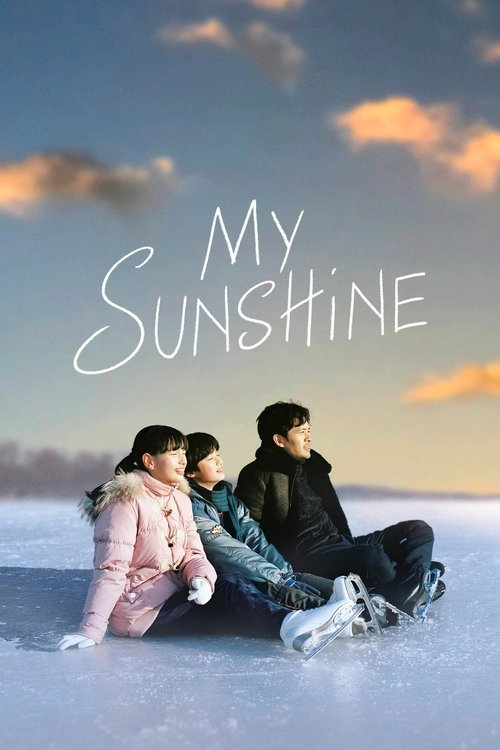
My Sunshine
2024 · Hiroshi Okuyama
For a quiet evening when you want something soft and beautiful that still leaves a small ache — a contemplative comfort watch for anyone who misses being young enough to feel everything for the first time.
What it's about
On a snowbound Hokkaido island, a hockey-playing boy with a stammer becomes quietly transfixed by a girl practicing figure skating on the same ice. Her coach notices, and pairs the two opposites to train for an ice-dance competition — a winter of falling and getting up, as a bond forms that neither of them has words for yet.
The experience
Hushed, tender, and unhurried, like the season it inhabits: breath hanging in cold air, blades scraping ice, feelings arriving before names for them do. It's gentle almost all the way through, with an honesty underneath that keeps it from being merely sweet.
The craft
Okuyama wrote, shot, and edited the film himself, framing the rink in soft, boxy compositions where snow-light does most of the talking, with warm folk songs drifting over the wobble and glide of practice. It's a film of textures — ice, breath, wool — that rewards a calm room and an unhurried mood.
Why it matters
Premiering at Cannes while its director was still in his twenties, it confirmed him as one of Japanese cinema's most promising new voices in the tradition of patient, child-centered filmmaking.
On a snowbound Hokkaido island, a hockey-playing boy with a stammer becomes transfixed by a girl practicing figure skating — and her coach, sensing something, pairs them for an ice-dance competition. Hiroshi Okuyama, who debuted at 22 with Jesus, was still in his twenties when this second feature premiered in Un Certain Regard at Cannes, and it confirmed him as Japanese cinema's gentlest new formalist: he wrote, edited, and shot the film himself, framing the rink in soft, boxy compositions where breath hangs in the air and Humbert Humbert's folk songs drift over the wobble and glide of practice. The lineage is clear — Kore-eda's patience with children, Somai's respect for their gravity — but the film's shape is Okuyama's own: a season-long idyll of falling and getting up, alert to first feelings that don't yet have names, and honest enough to admit that adult frailty can intrude on even the most protected winter. It ends when the ice does. What lingers is the light: pale sun through rink windows, two small figures learning to move as one.
Reception
It arrived at Cannes 2024 in Un Certain Regard as the word-of-mouth 'hidden gem' of the festival — Thierry Frémaux hyped Okuyama as possibly 'the next Kore-eda' — and over its 2024–25 rollout it settled into life as a quietly treasured little winter film rather than a prize magnet.
How My Sunshine was received, from release to now →
Influences: the films it descends from and the films it influenced
- Nobody Knows (2004) — Builds child performances through fragmentary, largely unscripted shooting so behavior reads as observed daily texture rather than delivered lines — the documentary-of-childhood method Okuyama adopts with his young skaters.
- I Wish (2011) — Structures a child's emotional world around a small ritual goal and low-key domestic downtime, the gentle everyday-miracle pacing Okuyama's observational register inherits.
- Moving (1993) — Sustained long takes trail a child weathering a parent's failure toward a cathartic ritual climax; Sōmai's let-the-take-breathe grammar underlies Okuyama's patient rink coverage.
- Typhoon Club (1985) — Organizes adolescence by weather and season and lets bodies drift through extended, uncut frames — the seasonal-structure-plus-long-take DNA of Japanese slow cinema Okuyama works in.
- An Autumn Afternoon (1962) — Season-as-title and low, static, boxy framing of everyday interiors — the squared-off, ground-level compositional discipline echoed in Okuyama's soft-boxy setups.
- The Spirit of the Beehive (1973) — Renders a child's-eye apprehension of the adult world in soft, honeyed natural light and hushed stillness — the first-feelings-in-available-light aesthetic Okuyama shoots toward.
- Ponette (1996) — Holds the camera at a very young non-professional's eye level for long stretches, trusting the child to carry the emotion unaided — the same faith in child actors Okuyama's casting demands.
- The 400 Blows (1959) — Location-shot, unsentimental closeness to a boy's inner life, refusing to editorialize his hurt — the foundational coming-of-age observational stance.
- Shall We Dance? (1996) — Patiently frames untrained bodies learning a graceful discipline in a rented hall, turning rehearsal itself into drama — the template for Okuyama filming skating as tender skill-acquisition.
- Jesus (2018) — Okuyama's self-shot debut establishes the identical signature: a solitary boy, soft boxy frames, wintry natural light, and the director serving as his own cinematographer for intimacy.
- Aftersun (2022) — A child registers an adult guardian's concealed frailty through soft-lit naturalistic fragments rather than exposition — the same adult-frailty-glimpsed-through-a-kid device.
- Petite Maman (2021) — Child-scale storytelling in soft even light and autumnal woods with radical emotional economy — the pared, gentle register Okuyama shares.
- The Florida Project (2017) — Non-professional child performers and adult precarity filmed at kid height in saturated naturalism — extending the observe-childhood-against-fragile-adults approach.
- Close (2022) — Two boys' tender first feelings shot in warm natural light with soft, close framing and minimal dialogue — a direct sibling in filming children's earliest emotions.
- The Kid with a Bike (2011) — Unsentimental portrait of a child attaching himself to a fallible adult who may not hold — the same fragile-guardian dynamic viewed without pity.
- Kikujiro (1999) — A summer-structured road of a child paired with an unreliable adult, told in static, painterly frames and a recurring folk-inflected score — kin to Okuyama's seasonal shape and folk scoring.
Similar films
- Nobody Knows (2004) — influence & lineage
- Close (2022) — influence & lineage
- Moving (1993) — influence & lineage
- Young Hearts (2024) — shared sensibility
- Happyend (2024) — shared sensibility
- Little Amélie or the Character of Rain (2025) — shared sensibility
- House of Hummingbird (2019) — shared sensibility
- 18x2 Beyond Youthful Days (2024) — shared sensibility
All the films related to My Sunshine →
Watch it with: curated runs of related films
- The Quiet Thaw of Grief — A run of hushed, big-hearted films where a widow, a widower, or a withdrawn child is coaxed back toward life by one unlikely bond — watch them near each other when you want to be moved, not wrung out.