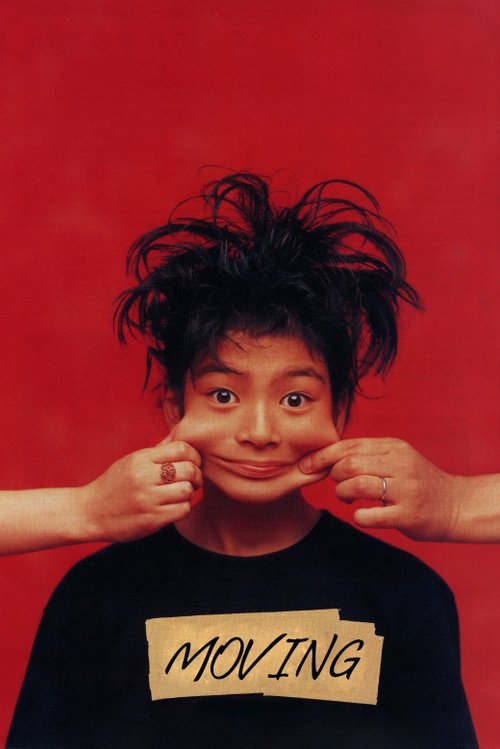
Moving
1993 · Shinji Sōmai
For when you want a coming-of-age film with real soul — something that starts as a sharp family drama and blooms into something dreamlike and cathartic. A rewarding pick when you're up for feeling a lot without being manipulated.
What it's about
An eleven-year-old girl in Kyoto watches her parents' marriage come apart: her father moves out, her mother rebuilds the household on her own terms, and Renko simply refuses to accept the new arrangement. She negotiates, schemes, and engineers a family trip meant to glue her parents back together — and when the adult world won't bend, she takes off on her own strange journey toward growing up.
The experience
Funny, prickly, and alive with a child's stubborn energy, then gradually stranger and more moving as it goes — the final stretch, set amid a night fire festival, is genuinely transporting. It treats a kid's grief over divorce with total seriousness and zero sentimentality.
Performances
Tomoko Tabata is extraordinary as Renko — ferocious, wounded, and completely unselfconscious, holding the entire film at eleven years old.
The craft
Sōmai's signature long takes hold young Tabata in the frame until something true happens, and the film's late movement into festival fire and water is one of the most beautiful passages in 1990s Japanese cinema. It's a gorgeous, sensory film that rewards the biggest screen you can give it.
Why it matters
Long hard to see outside Japan, it has been rediscovered and restored as a masterpiece of the era, cementing Sōmai's reputation as a profound influence on later Japanese directors of youth and adolescence.
Snapshot
Moving (お引越し, Ohikkoshi) is the film in which Shinji Sōmai turned his career-long subject — the adolescent body under pressure, held in the frame until something true leaks out of it — onto the smallest possible domestic catastrophe: a divorce, seen entirely from the height of an eleven-year-old. Renko Okonogi lives in a Kyoto apartment with her parents; her father moves out; her mother, Nazuna, tries to reconstitute a household on her own terms; Renko refuses the premise. She negotiates, schemes, sulks, stage-manages a "family trip" to Lake Biwa designed to reunite them, and, when that fails as it must, runs. What follows is one of the strangest and most beautiful last acts in 1990s Japanese cinema: a night of fire festival, hallucination, and water, from which the girl emerges at dawn to greet herself.
Adapted from a children's novel by Hiko Tanaka, the film sits at the hinge of Sōmai's filmography and of the national industry around it. It is his most formally disciplined work and his warmest, and it has become — through the retrospectives and restorations of the early 2020s — the entry point through which a director long known abroad only by reputation finally became visible.
Industry & production
By 1993 the Japanese studio system that had trained Sōmai no longer existed in any functional sense. He had come up the last stretch of the old apprenticeship ladder — assistant director work in the 1970s, including under Kazuhiko Hasegawa, and time in the Nikkatsu orbit when roman porno was the only reliable school of production craft left. His own directing career began inside the Kadokawa idol machine: The Terrible Couple (1980) and Sailor Suit and Machine Gun (1981) were built to sell a star, Hiroko Yakushimaru, and Sōmai used the assignment to make films that were nearly unclassifiable within their own marketing.
Moving comes from a different and messier economy. The majors had ceded most production risk to television networks, publishers, advertising agencies and video labels; V-Cinema absorbed the genre volume; the prestige literary adaptation survived as a co-financed object assembled per-project rather than produced by a studio. A film like Moving — a mid-budget adaptation of a well-regarded children's book, shot largely on Kyoto and Shiga locations, carrying two recognizable adult stars and an unknown child lead — is characteristic of that arrangement. English-language documentation of its below-the-line financing and credits remains thin, and I would rather flag that gap than fill it.
Two casting facts matter. Kiichi Nakai, who plays the father, was a durable leading man of the period and the son of Keiji Sada, the Shochiku star of Ozu's Equinox Flower and Good Morning — a genealogical rhyme that puts the postwar family drama literally in the film's bloodline. Junko Sakurada, who plays Nazuna, was one of the defining idol singers of the 1970s; her participation in a Unification Church mass wedding in 1992 effectively ended her public career, and Moving stands as her last significant screen work. The film's account of a woman trying to build a self outside an institution that had defined her is, in retrospect, uncomfortably legible.
The lead, Tomoko Tabata, was a newcomer of about thirteen, cast without a career behind her. The performance made her, and she went on to a long working life in Japanese film and television.
Technology
Moving is a 35mm film in the standard Japanese theatrical ratio of the period, made with the tools available to a mid-budget location production in 1993: dollies, a crane, handheld and Steadicam-class stabilized work, practical and augmented location lighting. Nothing about the technology is exotic; what matters is how Sōmai's shooting method presses against its limits.
A director who builds scenes as unbroken multi-minute takes is working inside a hard physical constraint: a 35mm magazine holds roughly eleven minutes of run time at sound speed, and the real ceiling is lower once you account for camera movement, focus pulls across long depth, and the coordination of performers who must hit marks in continuous time. Every long take in Moving is therefore an engineering problem as much as a directorial one — light that works across a 180-degree camera arc, sound that survives a moving boom in a real apartment, focus held on a child who is genuinely running. The take-based method also multiplies stock consumption, which is a budget line, not an aesthetic abstraction; the visible fatigue in Sōmai's young performers is downstream of a technological economics as much as a philosophy.
The film's night climax pushes the era's emulsion hard: torchlight, water, fog and firelight rendered on stock without the latitude a digital sensor would later give. The result is grain and smear that read as hallucination rather than as deficiency — one of those cases where the medium's limit becomes the image's argument. The 4K-era restorations that returned Sōmai to circulation in the 2020s recovered exactly this: shadow information and color in sequences that had survived for decades only in degraded video.
Technique
Cinematography
The camerawork — the credit is generally given to Toyomichi Kurita, a cinematographer with both Japanese and American credits — is organized around the nagamawashi, the long take, and around the refusal of shot/reverse-shot. Sōmai's rule of thumb is that cutting into a scene concedes the argument: it lets the filmmaker decide what the scene means. So the camera stays out, and moves.
Two consequences follow. First, blocking replaces editing: characters advance, retreat, turn away, leave the frame and re-enter it, and the emotional shape of a scene is written in floor plan rather than in cuts. Second, the frame acquires a point of view without ever adopting a literal one. The camera in Moving is repeatedly placed low, at or near Renko's eye level, and it prefers her back, her ear, the doorway she is standing in — parents are cropped, decapitated by the frame line, heard from the next room. We are not given her optical POV; we are given her scale. Adults are structurally too large for the composition.
Kyoto is shot as an inhabited grid rather than a postcard: the apartment's cramped interior geography, the river, the school route, the covered arcades. The city's flatness and its water are set up early so that Lake Biwa can pay them off.
Editing
For a film running just over two hours, Moving contains remarkably few shots. The cutting logic is architectural — a scene is a room, and the cut is the door. Because so much is held in long take, the few hard cuts land with unusual force, and Sōmai reserves his sharpest ones for the final movement, where continuity begins to fail deliberately: the fire festival sequence fragments, time slips, and images arrive that cannot be located in the story's waking world. The film earns its late surrealism precisely by having been so rigorously continuous for ninety minutes.
Mise-en-scène / staging
The title is the thesis. A move — boxes, an emptied room, the ritual greeting of new neighbors, a father's apartment furnished like a hotel — is treated as the material substrate of a family's dissolution. Sōmai stages the drama through objects and thresholds: what stays, what goes, who has keys, where the dinner table sits and who is missing from it. The apartment is the film's principal instrument, and Renko's tactic throughout is spatial: she tries to re-place people, to put bodies back into the arrangement that used to mean family.
Against this domestic geometry, the climax mobilizes ritual — a night festival of fire on the lake, drums and torches, a communal ceremony into which the child inserts her private crisis. The staging asks us to read her breakdown as an initiation, not a symptom. The mise-en-scène of the last twenty minutes moves from apartment to landscape, from furniture to elements, and Renko's passage runs through fire and out into water.
Sound
Sound design is location-first and ambient-heavy: traffic, cicadas, school noise, water, the acoustics of thin apartment walls through which arguments arrive as muffled rhythm rather than dialogue. Sōmai is unusually willing to let a scene's most important speech be partly inaudible, on the reasonable premise that this is how children experience their parents fighting. Non-diegetic music is used sparingly, ceding the emotional register to festival drums and the enormous silence of a lake at dawn — the score credit is among the details poorly documented in English-language sources, and I will not guess at it.
Performance
Sōmai's reputation with young actors rests on a method of attrition: extended takes, physical exertion, repetition past the point where a child can maintain a performance. What survives is behavior rather than acting. Tabata's Renko is accordingly not "precocious" in the manner of Anglo-American child performances; she is stubborn, tactically dishonest, frequently unlikeable, and physically exhausted by the end in a way that cannot be faked. Nakai plays the father as a man relieved to have exited, embarrassed by his own relief. Sakurada's Nazuna is the film's hardest role and its most modern: a woman insisting on a life, and being punished for the insistence by her own child.
Narrative & dramatic mode
The structure is a domestic realist drama that ruptures into ritual fantasy without warning. For most of its length Moving observes the strict rules of the shomin-geki: incident is small, causality is social, and nothing supernatural is permitted. Renko's project — reunite the parents — supplies conventional forward motion and conventional failure.
What makes the film unusual is that Sōmai refuses to resolve the failure dramatically. There is no reconciliation, no adult explanation, no scene in which someone tells the child what divorce means. Instead the resolution is ceremonial: the girl walks out of the narrative into a rite, encounters images of her own past and of an intact family that cannot exist, and returns changed. The final gesture — Renko in the water at dawn, offering a formal congratulation — converts the story's loss into an initiation she performs on herself, since no adult is available to perform it for her. It is the boldest structural decision in Sōmai's work: the mode changes because the character's mind does.
Genre & cycle
Moving belongs to the Japanese home drama, the shomin-geki line running from Ozu, Naruse and Shimizu through the postwar Shochiku family film — but it belongs to a specific late variant, the divorce film seen from the child's side. Internationally, its cycle-mates are Kramer vs. Kramer (1979) inverted (the child, not the parent, holds the camera's sympathy), and the run of 1990s child-perspective films — Jacques Doillon's Ponette (1996) is the closest European cousin in its refusal to translate a child's metaphysics into adult terms.
Within Sōmai's own filmography it completes an adolescence cycle: P.P. Rider (1983), Typhoon Club (1985) and Moving are three attempts at the same problem — what does a body do when childhood ends and no ritual exists to mark it? Typhoon Club answers with catastrophe; Moving answers with grace.
Authorship & method
Sōmai (1948–2001) is the great connective figure of late-20th-century Japanese cinema, and the least legible from outside it. His method is unusually explicit: long takes, minimal coverage, actors placed in genuine physical difficulty, a refusal to psychologize in dialogue. He treated commercial assignments — idol vehicles, roman porno — as laboratories, which is why the distinction between his "personal" and "hired" films is largely meaningless.
Key collaborators on Moving: the adaptation is credited to Satoko Okudera, then early in a career that would later make her one of Japan's most important screenwriters through her work with Mamoru Hosoda (The Girl Who Leapt Through Time, Summer Wars, Wolf Children); her ear for how children talk themselves into and out of crises is already fully formed here. Hiko Tanaka's source novel supplies the premise and the child's-eye discipline. Cinematography is credited to Toyomichi Kurita. Editing and music credits are among the film's poorly documented technical details in accessible English sources; rather than attribute them speculatively, I note the gap.
Movement / national cinema
The film sits in the trough between two Japanese waves. Behind it: the collapse of the studios, the exhaustion of the Kadokawa idol model, the roman porno apprenticeship system that trained a generation. Ahead of it: the international breakout of the 1990s — Kitano, Kore-eda, Kawase, Aoyama, Kurosawa — that would define "Japanese cinema" for foreign festivals for the next two decades.
Sōmai belongs to neither and feeds both. He carried studio craft (blocking, crew discipline, the long take as a production system) into an era that had lost its transmission mechanism, and he made films about adolescence at the exact moment Japanese cinema was about to become internationally famous for them. His choice of Kyoto over Tokyo also matters: the film's provincial-metropolitan setting resists the Tokyo-centrism of the 90s indie boom.
Era / period
1993 is two years after the asset bubble burst, at the opening of what became the "lost decade": falling expectations, employment insecurity, and the slow visible erosion of the postwar family-and-corporation compact. The film never mentions economics, but its content is unmistakably of that moment — a marriage dissolving not through melodramatic betrayal but through two adults deciding, undramatically, that the arrangement no longer holds; a mother constructing an independent household; a father whose absence is administrative rather than tragic. Japanese divorce was rising through this period, and Moving treats it as a fact of the landscape rather than a scandal. The same year saw the end of one-party LDP rule; the sense of a settled postwar arrangement quietly coming apart is the film's weather.
Themes
The child as negotiator. Renko's method is political: she lobbies, bargains, manipulates, calls meetings. The film's cruelty is that all of it is competent and none of it works.
Dwelling as identity. In Japanese, the ie is both house and family line. Sōmai literalizes it — to move house is to dissolve a family, and the film's title names the process rather than the event.
Ritual in its absence. Modern life offers no ceremony for a child whose parents separate. The film borrows a communal fire festival to supply one, arguing that the passage requires a form and that if the culture won't provide it, the child will improvise it.
Fire and water. The climax's elemental grammar is exact: fire for the destruction of the old arrangement, water for the emergence into the new. The dawn wade is a baptism that Renko administers to herself.
Self-address. The closing "congratulations" is spoken to no one present. Growing up, the film proposes, is the moment you become the person who can acknowledge yourself.
Reception, canon & influence
Moving was well received in Japan on release and traveled internationally — its 1993 Cannes screening is the usual anchor point in the record — and Tabata's debut drew the strongest notice, launching her career. Sōmai's domestic standing was already secure: he had won major recognition for Typhoon Club and was regarded within the industry as one of the most formidable technicians of his generation. But he never acquired the foreign auteur profile of his contemporaries, partly because his best films were unavailable abroad in decent form for decades, and partly because his defining works were about Japanese teenagers rather than yakuza or ghosts.
That changed posthumously. Sōmai died of lung cancer in 2001, at 53, after Kaza-hana. In the 2010s and especially the early 2020s, restorations and touring retrospectives — programd in New York, London and elsewhere under framings like "rites of passage" — brought Moving and Typhoon Club to audiences who had only read about them. The critical consensus that formed around this rediscovery treats Moving as his most accessible masterpiece and the ending as one of the great sequences of 1990s cinema.
Influences on the film (backward): Ozu and Naruse supply the domestic template and, in Nakai's casting, a literal inheritance; Hiroshi Shimizu's location-shot child films are the deeper precedent for Sōmai's method of following children through real space. Sōmai's own roman porno and idol-film training supplied the long-take discipline and the willingness to put performers in physical difficulty. Tanaka's novel supplies the perspective lock.
Legacy (forward): the most visible line runs to Hirokazu Kore-eda, whose child-centered films work the same seam — Nobody Knows (2004) in its refusal of adult framing, and above all I Wish (2011), in which children separated by their parents' split attempt a magical intervention to reunite the family, a premise that reads as a direct descendant of Renko's Lake Biwa scheme. Sōmai's long-take, low-coverage approach has been claimed as a touchstone by later Japanese directors including Kiyoshi Kurosawa, and its logic — blocking over cutting, duration over emphasis — is audible in the extended-scene method of Ryūsuke Hamaguchi's generation. More diffusely, Moving set the terms for the contemporary Japanese family film's central bet: that a child watching adults fail is a sufficient subject, and that the camera should stay in the room long enough to prove it.
A Deleuzian reading
A camera set low, at about the height of an eleven-year-old.
The full Deleuzian reading of Moving →
Reception
Barely seen outside Japan for decades — no subtitled home release — it circulated as a cinephile grail until the 2020s Sōmai revival, when a restoration and touring retrospectives turned it into the consensus pick for his masterpiece.
How Moving was received, from release to now →
How to watch Moving: what to notice on a first viewing
- Watch adults get cropped off at the top of the frame. The camera sits low, near eleven-year-old Renko's eye level, so parents are often decapitated by the frame line and heard more than fully seen. You're given her scale, not her eyes, so adults feel structurally too big for the picture.
- Count how rarely the film cuts to a reverse angle. Sōmai refuses shot and reverse shot almost entirely, holding one long take per scene and letting characters move through the frame instead of cutting between faces. Nobody tells you whose side to take; the argument stays undecided in the room where it happens.
- Listen for arguments arriving muffled through the apartment walls. Sound design leaves important speech partly inaudible, arguments arriving as muffled rhythm through thin walls, on the premise that this is how a child actually hears her parents fight. You end up straining to make out words the same way Renko does.
- Watch boxes, keys, and an emptied room carry the story. The film stages the divorce through objects and thresholds, what stays, what goes, who has keys, who is missing from the dinner table, rather than through confession. You read the family falling apart through its furniture before anyone says a word about it.
- Watch Renko negotiate, scheme, and sulk to get her way. Tomoko Tabata plays Renko as stubborn and tactically dishonest rather than precocious, a child whose competence at managing people is real and thoroughly exhausting to watch. Her competence is genuine, and the film's quiet cruelty is that none of it actually works.
The whole guide to watching Moving, with the keys for a rewatch →
Influences: the films it descends from and the films it influenced
- I Was Born, But... (1932) — Establishes the child-height camera as a moral position — the boys' hunger strike after watching their father grovel puts the children's judgment of adult failure at the structural center, exactly the tribunal Renko conducts on her parents.
- Good Morning (1959) — Routes a children's protest entirely through domestic geometry — sliding doors, corridors, the row of thresholds between apartments — so that household space and objects, not confession, carry the grievance, the same thresholds-and-objects grammar Sōmai uses for the emptying flat.
- Repast (1951) — The shomin-geki template Sōmai inherits: a marriage dissolving measured in meals, rent and chores rather than argument, with the wife's decision registered as a change in routine — Moving's mother is filmed by the same accounting.
- Children in the Wind (1937) — The deeper precedent for Sōmai's method — children followed through real streets and riverbanks in lateral tracking shots, performances obtained by letting kids simply move through location rather than hit marks in coverage.
- The 400 Blows (1959) — Ends by handing the child an action instead of a resolution — a sustained unbroken run terminating at water — the exact closing structure Sōmai enlarges into Renko's lakeside rite.
- Sailor Suit and Machine Gun (1981) — Sōmai's proof that an idol vehicle is a laboratory: he holds a single take on a teen pop star until the performance breaks open under physical duress, the same attrition contract he later signs with Tomoko Tabata and with idol-turned-actress Junko Sakurada.
- P.P. Rider (1983) — The extreme handheld long take built around children in genuine physical difficulty — kids soaked, exhausted and hauled through real geography while the camera refuses to cut and rescue them.
- Typhoon Club (1985) — The realism-into-ritual rupture in its first full form: a documentary-grade school drama that suddenly detonates into an ecstatic rain dance, the structural device Moving reuses at the fire festival.
- Muddy River (1981) — Keeps a child as sole observer while adult shame stays offscreen or muffled behind a partition, so the boy's face reacting to sound he can't see becomes the scene — Sōmai's overheard-argument technique in embryo.
- Nobody Knows (2004) — Inherits the refusal of adult framing wholesale: adults cropped at the waist or left offscreen, narration carried by hands, feet and household objects at children's eye level, with abandonment registered as accumulating domestic detail.
- I Wish (2011) — A near-transcription of Renko's scheme — children split by their parents' separation travel to a specific physical site to perform a wish that will magically reunite the family, and the film honors the rite without explaining it away.
- Suzaku (1997) — Builds a family's collapse from location-first ambient sound in a real Nara village and lets communal ritual footage, not dialogue, deliver the emotional break — Sōmai's ambient-and-ceremony method transposed to the rural documentary register.
- Cure (1997) — Kurosawa, who names Sōmai as a touchstone, stages his interrogation scenes as long static wides holding both actors in one frame — a systematic refusal of shot-reverse-shot that makes blocking and depth do the cutting.
- Happy Hour (2015) — Extends the low-coverage bet to its limit — scenes run their full real-time duration with non-professional actors, so shifts in allegiance register as changes in who is standing where rather than as edits.
- The Girl Who Leapt Through Time (2006) — Carries forward screenwriter Satoko Okudera's Moving idiom — adolescents talking themselves into and out of crises in oblique, evasive dialogue, with the actual admission withheld until an act of physical repetition forces it.
- My Sunshine (2024) — Sustained long takes trail a child weathering a parent's failure toward a cathartic ritual climax; Sōmai's let-the-take-breathe grammar underlies Okuyama's patient rink coverage.
- Kaza-hana (2000) — Sōmai's own final restatement of the device — a naturalistic drift toward the north that resolves in a sustained take of adults dancing in an empty snowfield, ritual as the only available release valve.
- Ponette (1996) — Works the same attrition contract with a four-year-old across extended takes, then lets the child's self-administered rite to summon her dead mother be answered literally — realism yielding to ritual on the child's terms, not the adults'.
- Petite Maman (2021) — Frames an emptying house at an eight-year-old's height and slips into fantasy without a single marking effect — just a cut in the woods — while the mother's grief stays muffled and offscreen, precisely Sōmai's two rules held together.
Similar films
- Nobody Knows (2004) — influence & lineage
- Petite Maman (2021) — influence & lineage · often watched together
- Still Walking (2008) — shared sensibility
- Tokyo Story (1953) — shared sensibility
- Only Yesterday (1991) — shared sensibility
- Sansho the Bailiff (1954) — shared sensibility
- Kokuho (2025) — shared sensibility
- Tokyo Twilight (1957) — shared sensibility
All the films related to Moving →
Watch it with: curated runs of related films
- Unmoored in Modern Japan — Watch these when you want Japanese cinema at its most restless — lives knocked off their axis by divorce, disaster, migration, or heartbreak, and the strange grace of piecing them back together.