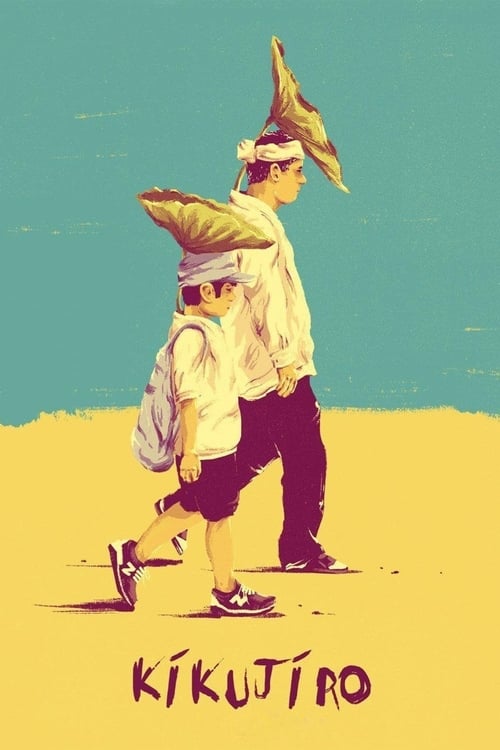
Kikujiro
1999 · Takeshi Kitano
For a gentle night when you want to laugh and get a little misty — comfort viewing with a melancholy center, perfect when you need a film that's kind to you.
What it's about
A lonely nine-year-old boy in Tokyo, left behind for summer vacation, decides to travel across Japan to find the mother he has never met. His escort is the worst imaginable choice: Kikujiro, a loud, lazy, small-time ex-tough-guy who cheats at gambling, bullies strangers, and slowly reveals a battered heart. Their hitchhiking journey collects oddball companions, ridiculous games, and moments of unexpected grace.
The experience
Sweet and deadpan at once — long stretches of silence and absurd sight gags give way, without warning, to scenes of real ache. It ambles like a summer afternoon and leaves you with a lump in your throat you didn't see coming.
Performances
Takeshi Kitano, acting under his comedian's name Beat Takeshi, plays Kikujiro as a glorious jerk whose gruffness keeps cracking open, and the untrained Yusuke Sekiguchi is quietly heartbreaking as the boy — a comic double act that earns every tear.
The craft
Kitano structures the trip as a child's picture diary, complete with chapter cards, and stages comedy in held, symmetrical wide shots where the joke blooms slowly inside the frame. Joe Hisaishi's piano theme is one of the most beloved pieces of film music of its era — worth good speakers on its own.
Why it matters
This was Kitano's deliberate pivot away from the stoic gangster films that made his name, proving the same stone face could carry tenderness; Hisaishi's theme escaped the film entirely and became a global earworm.
Snapshot
Kikujiro (Japanese title Kikujiro no natsu, "Kikujiro's Summer") is Takeshi Kitano's seventh feature as director, and the film with which he deliberately turned away from the laconic gangster violence that had made his international reputation. Released in 1999, two years after Hana-bi had won the Golden Lion at Venice, it is a picaresque road movie about a lonely nine-year-old Tokyo boy, Masao, who sets out during summer vacation to find the mother he has never met, and the crude, feckless ex-gangster, Kikujiro, who is press-ganged into escorting him. Kitano plays Kikujiro himself, under his comedian's stage name Beat Takeshi; the boy is played by the non-professional child actor Yusuke Sekiguchi. The film is structured as a child's picture diary, divided into chapter cards, and scored by Joe Hisaishi with a piano theme, "Summer," that became one of the most recognizable pieces of music in late-twentieth-century Japanese cinema. The title is the name of Kitano's own father, a fact the director has acknowledged, lending the project an oblique autobiographical charge even though the narrative is not literally biographical. Premiering in competition at the 1999 Cannes Film Festival, Kikujiro consolidated Kitano's standing as an auteur capable of registers beyond the deadpan ultraviolence of Sonatine and Hana-bi.
Industry & production
Kikujiro was produced through Office Kitano, the management and production company Kitano had built around his own career as a television personality, comedian, and filmmaker, in partnership with the kinds of financing entities typical of prestige Japanese cinema at the turn of the millennium — figures associated with Bandai Visual, Tokyo FM, and Nippon Herald Films are part of the film's backing, reflecting the consortium model of media-company co-financing then standard for a director of Kitano's stature. The film arrived at a moment of maximum leverage for Kitano: Hana-bi's Venice triumph in 1997 had made him a festival fixture and an art-house draw in Europe, so the production could plausibly count on international distribution before a frame was shot. That security mattered, because Kikujiro was a commercial gamble in domestic terms — a sentimental comedy with no gangster shootouts from a director the Japanese public still primarily knew as the abrasive television comic "Beat" Takeshi. Precise budget and box-office figures are not something I can state reliably here, and I will not invent them; what is securely on the record is the film's pedigree as an Office Kitano production and its selection for Cannes competition, where it did not take a prize (the Palme d'Or that year went to the Dardenne brothers' Rosetta). The production reunited Kitano's established creative team, an unusually stable repertory company of collaborators that gives his filmography its consistency of texture.
Technology
Kikujiro is a film shot on 35mm photochemical film and finished by traditional means, made just before digital intermediate workflows became standard. Its technological interest lies less in any novel apparatus than in Kitano's characteristic restraint with the tools available: he and cinematographer Katsumi Yanagijima favor a largely static or minimally mobile camera, natural and naturalistic lighting, and long takes that depend on staging rather than coverage. There is little reliance on optical effects; the film's handful of overtly fantastical or stylized moments — dream sequences, the recurring imagery of angels and an octopus-headed figure, the surreal games the men devise to amuse Masao — are achieved through production design, performance, and editing rather than through any conspicuous technical trickery. In this sense the film is deliberately anti-spectacular, its technological signature being the very plainness with which the image is rendered, so that color, the summer light, and Hisaishi's score carry the emotional load.
Technique
Cinematography
Katsumi Yanagijima, Kitano's regular director of photography from the early features onward, shoots Kikujiro in the frontal, frieze-like manner that defines the Kitano look: compositions are often flat and symmetrical, the camera planted at a slight remove, characters arranged across the horizontal of the frame as if for a snapshot. This stillness is thematically apt for a film built around a child's photo album — the images frequently resemble pictures pasted onto a page. The palette is saturated with summer: blue skies, green countryside, the primary colors of festival stalls and beachwear. Yanagijima withholds the restless camera movement and shallow-focus emphasis of conventional sentimental cinema, so that emotion is generated by what is held in the frame rather than by how the lens directs the eye. When the film does move toward the dreamlike, it tends to do so through composition and color rather than through camera pyrotechnics, keeping the visual grammar consistent with Kitano's broader work.
Editing
Kitano is famous for editing his own films, and the cutting of Kikujiro bears his unmistakable rhythm: abrupt elisions, scenes that begin late and end early, comic beats delivered through a hard cut to the aftermath of an action rather than the action itself. This "ellipsis comedy" — we frequently see the consequence (a bruise, a wrecked vehicle, a defeated expression) instead of the event — is the same technique that, in his gangster films, makes violence land as a sudden shock; here it is repurposed for slapstick and pathos. The chaptered, diary-like structure is reinforced editorially by the recurring title cards that segment the journey, each functioning like a turned page. The overall tempo is unhurried, even meandering, mimicking the shapelessness of a child's summer, but the internal cutting within scenes remains crisp and economical.
Mise-en-scène / staging
The film's staging is built around the contrast between two bodies: the small, watchful, near-silent boy and the loud, lumbering, ill-tempered adult. Kitano repeatedly frames them as a comic pair moving through indifferent or hostile spaces — bus stations, roadside hotels, a seaside resort, an empty stretch of countryside. The episodic structure introduces a gallery of eccentric secondary figures (a pair of bikers, a wandering poet, a gentle traveling salesman) who are staged as discrete vignettes, each a self-contained encounter in the manner of picaresque tradition. Kitano's blocking favors the tableau: characters held in stable arrangements that the action periodically disrupts. Props recur with talismanic weight — a guardian-angel bell given to Masao, a backpack, the toys and games the adults improvise — anchoring the film's emotional motifs in physical objects.
Sound
Joe Hisaishi's score is, for most viewers, the film's defining element. His principal theme, "Summer," a lilting piano melody, recurs throughout to bind the episodic journey into an emotional whole and has since had an independent cultural life in Japan and abroad. Hisaishi's music does the sentimental work that Kitano's spare, deadpan staging deliberately refuses to do on its own, creating the bittersweet tone — laughter shadowed by loneliness — that the film's marketing promised. Beyond the score, the sound design is naturalistic and often quiet, with Kitano exploiting silence and the absence of dialogue, especially around the near-mute Masao, so that the music's entrances carry maximum weight.
Performance
Kitano's own performance as Kikujiro is a calculated inversion of his gangster persona: the same impassive face and capacity for sudden aggression, but redirected into petty bullying, incompetence, and an unexpected tenderness that surfaces only obliquely. He plays the character as a man who is barely more mature than the child he is minding, and much of the comedy derives from the adult's selfishness being gradually, grudgingly worn down. Yusuke Sekiguchi, a non-professional, gives Masao a flat, watchful reticence that suits Kitano's anti-sentimental method — the boy rarely emotes in the expected ways, which makes the few moments of feeling register sharply. The supporting players, many of them recurring faces from Kitano's repertory company, deliver broad comic turns within the vignette structure.
Narrative & dramatic mode
The narrative mode is the road movie crossed with the picaresque: a journey structured as a string of episodic encounters, framed as the contents of Masao's summer-vacation picture diary. The diary device, with its chapter cards, foregrounds the film as a remembered, constructed account — a child's-eye chronicle in which adult failures are softened into adventure. The dramatic engine is a quest (find the mother) that the film ultimately treats as almost beside the point; the emotional resolution lies not in reunion but in the surrogate bond that forms between man and boy. Kitano withholds conventional catharsis, refusing the big tearful payoff the premise invites, and instead distributes feeling across small gestures and Hisaishi's recurring theme. The tonal mode is tragicomedy: slapstick and crudeness on the surface, loneliness and the ache of parental absence underneath.
Genre & cycle
Kikujiro sits at the intersection of the road movie, the odd-couple comedy, and the sentimental child's-journey film, while drawing on the much older picaresque tradition of the rogue and his episodic adventures. Within Kitano's own filmography it belongs to a "softer" cycle — works concerned with childhood, play, and male tenderness — that runs alongside and against his gangster films, and it is often paired with A Scene at the Sea (1991) and Kids Return (1996) as evidence of his lyrical, non-violent register. In the broader landscape of 1990s Japanese cinema it can be read against a vein of films about damaged or improvised families and lonely children, though Kikujiro is distinguished by its comic frame and its refusal of melodrama.
Authorship & method
Kikujiro is a thoroughgoing auteur work: Kitano wrote, directed, edited, and starred in it, exercising the near-total control that defines his method. His authorship is legible in every department — the frontal compositions, the elliptical cutting, the deadpan-into-violence rhythm here softened into deadpan-into-tenderness, the recurrence of the sea and of childlike games, and the casting of himself in a role that interrogates his own star image. Crucial to the method is his stable team of collaborators: cinematographer Katsumi Yanagijima, who gives the films their flat, painterly stillness, and composer Joe Hisaishi, whose lush, romantic scores supply the emotion Kitano's images withhold — a productive tension between austere image and sentimental music that is central to the late-1990s Kitano style. (Hisaishi and Kitano's collaboration spanned several films of this period before later parting ways.) Kitano's practice of editing his own material is integral to his authorship, since the comedy and the pathos alike are largely created in the cut. The choice to name the film after his father, Kikujiro, signals the personal stakes beneath the comic surface, though the director has been careful not to claim the story as literal autobiography.
Movement / national cinema
The film belongs to the international art-cinema export of Japanese filmmaking in the 1990s, a moment when Kitano, alongside figures such as Hirokazu Kore-eda and Shinji Aoyama, was carried to Western festivals and art houses as the face of a revitalized national cinema. Kitano's formal vocabulary draws on recognizably Japanese antecedents — the static, frontal compositions and contemplative stillness invite comparison with Ozu, however much Kitano disclaims direct influence — while his comic sensibility is rooted in his own background in manzai television comedy and the broader culture of Japanese popular entertainment. Kikujiro thus straddles two systems of value: the domestic mass-media celebrity of "Beat" Takeshi and the international auteurism of "Takeshi Kitano," and part of its interest lies in how it negotiates between them.
Era / period
Made at the very end of the 1990s, Kikujiro is a product of the period in which Japanese art cinema had re-entered the global festival circuit and Kitano was at the height of his international prestige following Hana-bi. It is a pre-digital film, finished photochemically, and its leisurely, analog rhythms feel of a piece with its nostalgic, diary-like evocation of childhood summer. The film looks both backward, to mid-century traditions of the road movie and the sentimental comedy, and sideways, to the contemporaneous wave of Japanese films about fractured families, while remaining stylistically anchored in the specific Kitano idiom he had refined across the decade.
Themes
The film's central theme is surrogate fatherhood and the improvised family: an unfit man and an unmothered boy who, over a summer, become something to each other that neither sought. Around this cluster childhood and loneliness, the absent mother, and the gap between adult selfishness and the capacity for care. Summer itself is a theme — a season of suspended time, freedom, and the bittersweet knowledge that it will end — reinforced by Hisaishi's "Summer" and by the diary framing that treats the journey as a memory already in the past. The recurring angel imagery and the guardian bell introduce a note of fragile protectiveness, while the games and toys the adults devise dramatize the film's belief that play, and the willingness of grown men to be foolish, is itself a form of love. Underlying all of this is Kitano's interrogation of masculinity: the gangster's hardness reimagined as a brittle shell over a wounded, childlike interior.
Reception, canon & influence
Critically, Kikujiro was received as a notable and somewhat surprising departure for Kitano — proof of range beyond the violence of Sonatine and Hana-bi — and its Cannes competition slot confirmed his festival standing, even though it won no award there. Western critics tended to register both the charm of the man-and-boy dynamic and a divided response to the film's sentimentality and length, with Hisaishi's score singled out almost universally for praise; I should note that the granular critical record varies and I am summarizing the broad tenor rather than citing specific reviews. Looking backward, the film draws on a deep lineage of road movies and of the tramp-and-child pairing that reaches back to Chaplin's The Kid, on the picaresque tradition of episodic rogue's-progress narratives, and on the quiet observational mode associated with classical Japanese cinema; its comedy is inseparable from Kitano's own roots in television manzai. Looking forward, its most durable legacy is arguably musical: Hisaishi's "Summer" became a cultural touchstone, widely re-used and recognized far beyond the film. Within Kitano's career, Kikujiro stands as the fullest expression of his gentle register and a key text for critics seeking to read his violent films and his tender ones as two halves of a single preoccupation with childhood, loss, and masculine vulnerability. Its broader influence on other filmmakers is harder to document with confidence, and I will not overstate it; the film's secure place is as a beloved entry in the Kitano canon and a touchstone of late-1990s Japanese art cinema.
A Deleuzian reading
A man picks himself up off the ground.
The full Deleuzian reading of Kikujiro →
Reception
Cannes 1999 didn't quite know what to do with it — critics expecting another stone-faced Kitano crime film found a gentle road comedy instead, and it left the festival empty-handed. It's since become one of his most beloved films, a reappraisal helped enormously by Joe Hisaishi's score seeping into the wider culture.
How Kikujiro was received, from release to now →
Influences: the films it descends from and the films it influenced
- The Kid (1921) — Establishes the gruff-vagabond-shepherding-an-orphan template Kitano works in, alternating broad slapstick with sudden pathos — the comic-into-tender rhythm he substitutes for his usual comic-into-violence cut.
- Tokyo Story (1953) — Source of the low static camera, frontal symmetrical framing, and elision of dramatic peaks that give Yanagijima's photography its flat, painterly stillness.
- Good Morning (1959) — Ozu's comic register staged around children, with repeated gags built in static frontal compositions, models how Kitano runs deadpan humor through rigid, tatami-level framing.
- Bicycle Thieves (1948) — Father-and-child walking the city in an episodic search, carried by non-professional performers, grounds the surrogate-parent road structure in observed everyday texture rather than plot.
- Paper Moon (1973) — Con-man-and-orphan road movie whose picaresque episode-by-episode structure and prickly surrogate-father bond softening across the journey directly prefigure Kitano-and-the-boy.
- A Scene at the Sea (1991) — Kitano's own prototype: a Hisaishi score laid over near-silent protagonists, static frontal compositions, the recurring sea motif, and emotion withheld from the image and supplied by music.
- Sonatine (1993) — Introduces the childlike beach games and play that interrupt the narrative, plus the elliptical self-editing where feeling erupts from stillness — the persona Kikujiro inverts from gangster to caretaker.
- Kids Return (1996) — Paired-protagonist drift through failure, scored by Hisaishi and cut by Kitano himself, rehearses the tender-deadpan tone and diaristic episode structure of Kikujiro.
- Hana-bi (1997) — Demonstrates Kitano's director-as-editor method — pathos manufactured in the cut — over tableau blocking and Yanagijima's flat stillness, with lush Hisaishi set against austere images.
- Dolls (2002) — Extends the same method — Hisaishi score, frontal painterly tableaux, withheld emotion — pushing the static composition and formal stillness of Kikujiro to a more stylized extreme.
- Nobody Knows (2004) — Carries a whole film on non-professional child actors observed by a patient static camera, withholding catharsis around abandoned childhood — the observational mode Kikujiro's casting and stillness point toward.
- C'mon C'mon (2021) — A gruff solitary man learning to parent a child across an episodic trip, organized by a diaristic frame and deliberately withheld sentiment — the surrogate-fatherhood road structure in a later register.
- The Taste of Tea (2004) — Chapters a plotless rural summer into deadpan comic vignettes punctuated by surreal dream inserts and frozen static framing — the structural and tonal blueprint for Ishii's episodic countryside idyll.
- Hunt for the Wilderpeople (2016) — A gruff loner and a lost boy on the road, built from deadpan static compositions, vignette-title chaptering, and a warm synth-and-piano score (Hisaishi) — a structural blueprint for Wilderpeople's odd-couple journey and Moniker's emotional bed.
- Stranger Than Paradise (1984) — Builds deadpan comedy from static frontal long takes separated by blackout ellipses — the same withholding cut-on-emptiness rhythm and aimless picaresque drift Kitano edits into.
- Central Station (1998) — Contemporaneous adult-and-orphan-boy road movie whose abrasive surrogate parent thaws across an episodic journey, anchored by an unschooled child performance.
- The Straight Story (1999) — A quiet episodic road film built on patient static compositions and withheld sentiment, reaching catharsis only obliquely — the same restraint Kitano applies to the man-and-boy trip.
- Songs from the Second Floor (2000) — Pushes deadpan tragicomedy into rigorously symmetrical static frontal tableaux, generating both comedy and melancholy from held wide shots rather than coverage — the tableau-blocking logic Kitano shares.
- The Man Without a Past (2002) — Tragicomedy of a wounded man told through deadpan static frontal framing and expressive silence, with music supplying the warmth the austere images deliberately withhold.
- Kolya (1996) — An abrasive man escorting a small child, built on scale-disparity framing and deadpan observational stretches that thaw into tenderness without sentimental scoring.
- My Sunshine (2024) — A summer-structured road of a child paired with an unreliable adult, told in static, painterly frames and a recurring folk-inflected score — kin to Okuyama's seasonal shape and folk scoring.
- Departures (2008) — Joe Hisaishi's piano-and-strings leitmotif carries the entire emotional arc of an episodic journey, the same composer-as-emotional-engine method that makes the cello motif Departures' single most memorable formal element.
Similar films
- Sonatine (1993) — influence & lineage
- A Scene at the Sea (1991) — influence & lineage
- Fireworks (1997) — influence & lineage
- Tokyo Story (1953) — influence & lineage
- Dolls (2002) — influence & lineage
- Nobody Knows (2004) — influence & lineage
- The Straight Story (1999) — influence & lineage · same viewing thread
- The Taste of Tea (2004) — same viewing thread
All the films related to Kikujiro →
Watch it with: curated runs of related films
- Unlikely Companions, Gentle Roads — Watch these together for the way a mismatched pair — a yakuza and a lost boy, an old man on a lawnmower bound for his brother, a runaway kid and a grizzled uncle, two frontier drifters with a stolen cup of milk — becomes a whole small world; they rhyme on tenderness carried at walking pace.