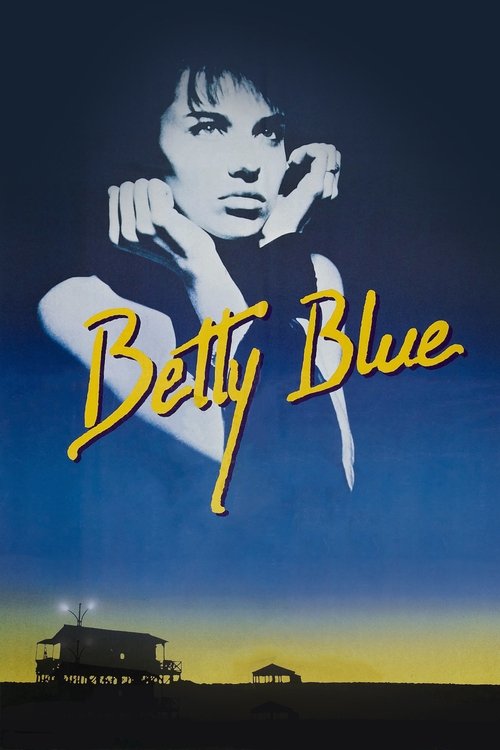
Betty Blue
1986 · Jean-Jacques Beineix
For when you want a love story that burns all the way down — passionate, sensual, and devastating. This is a challenge, not a comfort; save it for a night you're willing to feel too much.
What it's about
On the Languedoc coast, a handyman quietly writing a novel in his spare hours falls hard for Betty, a young woman whose passion runs hotter than anything he's ever known. She believes in his writing more than he does, and her ferocity — erotic, generous, volatile — sweeps them from a beach shack to Paris to a sleepy provincial piano shop. But the same intensity that makes her thrilling begins to shade into something darker, and loving her means watching a mind come apart.
The experience
It's rapturous and reckless at first — sun, skin, saturated color — then the joy starts to fray and a dread creeps in that never lets go. You come out wrung out, half in love and half in mourning.
Performances
Béatrice Dalle, in her screen debut, is a force of nature — carnal, funny, and frightening by turns, so alive that the film's tragedy lands entirely on her face. Jean-Hugues Anglade matches her with a tender, watchful patience that makes the devotion believable.
The craft
Beineix shoots emotion as pure color — blazing oranges, electric blues, sunsets that look painted — and Gabriel Yared's aching score threads it all together. It's one of the defining works of the glossy, image-drunk French style of the 1980s, and its widescreen sensuality genuinely rewards a big screen.
Why it matters
An international sensation and an Oscar nominee for Best Foreign Language Film, it became a dorm-room-poster icon of doomed romance and the film that defined Beineix's career, for better and worse. Dalle's Betty remains one of French cinema's most indelible screen debuts.
Snapshot
37°2 le matin — released internationally as Betty Blue — is Jean-Jacques Beineix's adaptation of Philippe Djian's 1985 novel of the same title, and the film that fixed his reputation for a generation of viewers outside France while consolidating his critical reputation inside it as the standard-bearer of a style his detractors had already named cinéma du look. It is a love story that curdles into a clinical case study: Zorg, a handyman patching up beach bungalows on the Languedoc coast and secretly filling notebooks with a novel, takes up with Betty, a young woman whose ferocity — erotic, generous, and eventually psychotic — organizes the film's entire emotional weather. The narrative moves them from the beach shack to a Paris apartment to a piano shop in a provincial town, and then to institutional confinement and an act of mercy that the film refuses to soften.
What makes the film durable is the friction between its surfaces and its subject. Beineix shoots mental collapse in saturated primaries — the famous pink-and-blue bungalow façade, the blue of the sea and the sky, Betty's red — with a compositional gloss borrowed from advertising and album art, and scores it with Gabriel Yared's melancholic, harmonica-and-piano-inflected theme. The result was widely read as beautiful packaging for ugly material, and that charge has followed the film ever since. Retrospective assessments have been kinder, partly because Béatrice Dalle's debut performance survives any argument about the style around it, and partly because the 185-minute version intégrale Beineix assembled in the early 1990s — long enough to be released theatrically in some territories and on disc thereafter — restores the domestic ordinariness that the shorter cut's compression made look like mere hysteria.
The film also occupies a specific commercial position: a French art film that became a genuine international crossover, played long runs in American and British arthouses, earned a nomination for the Academy Award for Best Foreign Language Film, and produced one of the most reproduced pieces of dorm-room poster iconography of the late 1980s. That last fact is not trivial to its reception history; Betty Blue was consumed as an image before and often instead of being consumed as a film.
Industry & production
Beineix came to 37°2 le matin from a difficult decade. Diva (1981) had been a commercial disappointment in France before an unexpected success abroad and a subsequent domestic revival — a trajectory that made him famous and, in the eyes of a hostile segment of the French press, suspect. La Lune dans le caniveau (The Moon in the Gutter, 1983), an expensive, studio-bound adaptation of David Goodis with Gérard Depardieu and Nastassja Kinski, was received at Cannes with open derision and became a byword for the perceived excesses of the look. Betty Blue was, in the plainest industrial terms, a recovery project: a contemporary novel adapted quickly, shot largely on location and in real interiors rather than on constructed sets, and cast with an unknown in the title role.
The source was well chosen. Philippe Djian's 37°2 le matin had been a substantial success in France, a novel written in a loose, first-person, American-inflected voice that critics readily traced to Djian's admiration for Bukowski, Kerouac, and Salinger. Its readership skewed young; its sensibility — anti-institutional, sexually frank, contemptuous of literary gatekeeping — mapped directly onto the audience Beineix had already reached with Diva. Beineix wrote the screenplay himself, retaining Zorg's first-person narration in modified form and preserving the novel's episodic structure.
The casting of Béatrice Dalle is the production's decisive act. Dalle had no acting training and no screen credits; accounts of her discovery consistently place its origin in a magazine cover photograph that brought her to the production's attention. Jean-Hugues Anglade, by contrast, was an established younger actor who had worked with Beineix before, appearing in La Lune dans le caniveau. The imbalance — a trained professional opposite a complete newcomer — is legible in the finished film and arguably productive: Anglade's Zorg absorbs and reacts, Dalle's Betty detonates.
Production was mounted through Constellation, Cargo Films, and Gaumont, with Claudie Ossard among the producers; Gaumont's involvement gave the film substantial domestic distribution muscle. Shooting took place on the Mediterranean coast (the bungalow settlement at Gruissan-Plage in the Aude, with its distinctive stilt houses, is the film's most recognizable location), in Paris, and in provincial locations for the piano-shop section. The film opened in France in April 1986 and became a major domestic hit, then traveled: an Oscar nomination for Best Foreign Language Film, a César nomination profile, and long international runs, particularly in the United Kingdom and United States, where it became one of the highest-profile French releases of the decade.
The later version intégrale, running roughly three hours against the original release version's approximately two, was assembled by Beineix from material shot for the original production. It is not a director's cut in the sense of restoring a suppressed vision — Beineix has been clear that the theatrical version was his — so much as an alternative, more novelistic assembly, and it materially changes the film's balance.
Technology
Betty Blue is a 35mm, anamorphic-widescreen production, and its technical identity rests less on novelty than on the deliberate exploitation of mature tools. Beineix and cinematographer Jean-François Robin shot in a 2.35:1 scope ratio, which is itself an argument: scope was, by the mid-1980s, associated in Hollywood with spectacle and in Europe increasingly with prestige, and applying it to a story of two people in small rooms produces a constant tension between the frame's promise of scale and the intimacy of what it contains.
The film's color is the technological question that matters. This is a late-period Eastmancolor-era production working with fast, fine-grained 1980s emulsions capable of holding saturated primaries without the muddiness that would have compromised the same palette a decade earlier. The pinks, turquoises, and reds that define the bungalow sequence are largely production design and location choice — the Gruissan houses were painted for the film — rather than laboratory manipulation, and the negative's ability to render them cleanly under strong Mediterranean daylight is the enabling condition for the whole aesthetic.
Equally important is what the film does not do. There is no optical trickery of note, no significant process work, no reliance on the emerging video and electronic post-production tools that were beginning to affect European production at the time. The gloss is achieved in front of the camera and in the grade, and this is a meaningful distinction from the contemporaneous look of music video and advertising to which the film was so frequently compared: the look here is photographic and architectural, not electronic.
Technique
Cinematography
Jean-François Robin's photography is the film's most contested element and its most accomplished. The governing strategy is to shoot a psychologically deteriorating situation in consistently gorgeous, high-key, color-forward images, and to refuse the conventional grammar by which cinema signals interiority through darkness, desaturation, or handheld instability.
Three habits recur. First, the frontal, planimetric composition: characters set against flat painted walls, the widescreen frame organized as a graphic field with the figure placed off-center against large areas of unmodulated color. The opening bungalow material is the clearest instance, and the pink-and-blue exterior functions almost as a title card for the film's method. Second, an emphasis on Mediterranean natural light — hard, high, and clarifying — that gives the early sequences an almost documentary luminosity even as the compositions remain highly designed. Third, a nocturnal register in the Paris and piano-shop sections that trades daylight clarity for pooled practical sources: lamps, neon, headlights, the sodium wash of provincial streets.
The Panavision-format anamorphic scope is used with unusual restraint. Robin frequently centers or near-centers the two figures and lets the horizontal excess become dead space — sea, sky, wall — which reads first as luxury and progressively as isolation. Camera movement is measured: crane and dolly work exists but is rarely showy, and the film's most memorable images are held rather than swept.
Editing
Monique Prim's cutting sustains a long, unhurried rhythm that is closer to the novelistic than to the music-video pacing the film's critics assumed. Scenes are permitted to run past their narrative function into a kind of behavioral drift — meals, arguments, work, sex — and the film's structure is episodic and cumulative rather than causally tight.
This is precisely where the two versions diverge most sharply. In the roughly two-hour theatrical cut, Betty's deterioration arrives at a pace that can read as arbitrary: the violent outbursts punctuate a compressed timeline and the intervening domestic life is thinned. The three-hour version intégrale restores substantially more of that connective tissue — the ordinary business of the couple's life, the secondary characters, the texture of the piano shop and the pizzeria — and the collapse consequently acquires a gradient. Viewers who find the shorter cut sensationalist and the longer cut tragic are responding to a real difference in editorial strategy, not to a projection.
Mise-en-scène / staging
The film's spaces are its argument. The Gruissan bungalow on stilts, painted in candy tones and half-derelict, is a genuinely strange environment: a vacation architecture built for transience, occupied year-round by people with nowhere else to go. The Paris apartment, the pizzeria, and finally the piano shop constitute a downward-drifting itinerary through French provincial and metropolitan low-rent life.
Beineix stages within these spaces with a designer's eye — objects are placed, colors are coordinated, the frame is composed — but the spaces themselves are shabby, cluttered, and lived-in. This is the productive contradiction at the center of the look: not glamour but the aestheticization of the unglamorous. The famous early shot of the burning bungalow, the piano hauled into inappropriate rooms, the mirror and window motifs — each is a designed image built out of found material.
Staging of the couple is consistently physical. Zorg and Betty are shown touching, colliding, carrying, and fighting; the blocking assumes bodies in contact as the default state and registers the moments of separation as breakdown.
Sound
Gabriel Yared's score is inseparable from the film's international identity. Written for a small ensemble with piano and harmonica prominent, its principal theme is a slow, minor-inflected melody of considerable simplicity, and it recurs with a persistence that some critics found manipulative. Its function is counterpoint: it is elegiac from the first bars, mourning the relationship while the film is still in its comic-erotic opening movement, and this pre-emptive grief is one of the few overt signals that the images themselves withhold. Yared had scored La Lune dans le caniveau for Beineix; Betty Blue made his name internationally and preceded the career that would lead to The English Patient.
The sound design otherwise favors environmental specificity: sea, wind, traffic, the mechanical noise of tools and vehicles, the sound of typewriter keys. Zorg's voice-over narration, carried over from Djian's first-person prose, threads the film with a laconic, retrospective male voice that has become a point of feminist critique — the film's access to Betty is always mediated by the man who survives her.
Performance
Béatrice Dalle's performance is the film's engine and its lasting achievement. Untrained, she plays Betty with a physical availability and a refusal of psychological modulation that a schooled actor would likely have smoothed: the shifts between tenderness, hilarity, and violence arrive without transition, which is both the performance's realism about certain kinds of illness and the source of the charge that the film is exploiting a spectacle of female madness. Dalle's screen presence — the gap-toothed smile, the direct address of the camera in several key shots — was immediately iconic and has remained so; the film launched a durable career in French cinema.
Jean-Hugues Anglade's Zorg is the necessary counterweight: watchful, passive, comic, and increasingly exhausted. Anglade plays the character's devotion without heroism, and the film's final act depends entirely on his having established a plausible ordinariness. Consuelo de Haviland as Lisa and Gérard Darmon as Eddy supply the film's warmth and its sense of a wider social world; the version intégrale substantially expands their presence and, with it, the film's texture of friendship.
Narrative & dramatic mode
The film is structured as a picaresque that turns into a tragedy. Its first movement is episodic and comic — odd jobs, sex, a landlord humiliated, a flight from the beach — organized by Zorg's narration and by an implicit logic of freedom: the couple move because they can. The second movement, in Paris and then the piano shop, replaces mobility with attempted settlement, and it is here that the film's material begins to darken: Betty's investment in Zorg's manuscript, her collisions with publishers, the false pregnancy, the escalating violence.
The dramatic mode is what one might call romantic naturalism. There is no mystery to be solved and no antagonist; the film's causality is biological and psychiatric, and Beineix conspicuously declines to supply a psychological aetiology. Betty is not explained by childhood trauma or social circumstance. This refusal is both the film's integrity — it does not pretend to know — and its central vulnerability, since a condition without a cause can slide toward being a condition without a subject, a force of nature rather than a person.
The narration is retrospective and unreliable in the ordinary way of first-person accounts: everything is Zorg's, including the film's final image and the ambiguity around whether the voice we hear at the close belongs to the living Betty or to the manuscript Zorg is writing. The ending — Zorg's smothering of the institutionalized Betty, and his return to the typewriter — closes the loop between love and authorship in a way that is legible either as the film's deepest insight or as its most self-serving move.
Genre & cycle
Betty Blue sits at the intersection of the amour fou tradition and the late-twentieth-century "madwoman" film. The amour fou lineage in French cinema runs back through surrealism to Buñuel and reaches the 1980s having absorbed the New Wave's version of the doomed couple; Betty Blue is recognizably an inheritor of that line, and its structure — the couple against the world, the world winning — is old.
The second cycle is more troubled: films that make mental illness in a young woman the object of the camera's fascination. The film belongs, uncomfortably, alongside a body of work in which feminine madness is rendered as erotic and photogenic. Feminist criticism of the film has pressed exactly here, and the point is difficult to argue away: Betty's illness has no interiority accessible to the viewer, and her self-mutilation is filmed with the same compositional care as her body.
As a cycle marker, the film is also the terminal statement of the cinéma du look. Critics have generally grouped Beineix with Luc Besson and Leos Carax under that label, coined in the 1980s by French critics to describe a cinema of surface, youth, marginality, and design-consciousness that stood against both the naturalist tradition and the political cinema of the 1970s. Betty Blue is the most commercially successful film of that grouping and, in retrospect, its high-water mark.
Authorship & method
Beineix's method is best described as adaptive design. He was a director who came up through assistantship in mainstream French production — including work with Claude Berri and Jerry Lewis — before Diva, and his sensibility was formed at least as much by advertising, comics, and popular music as by cinephile canon. His characteristic move is to take a source text with pulp or countercultural credentials (Delacorta for Diva, Goodis for La Lune dans le caniveau, Djian here) and to render it in a high-design visual register that is at odds with the material's grubbiness.
His key collaborators on this film form a coherent unit. Jean-François Robin's cinematography supplies the saturated, scope-format clarity; Gabriel Yared's score supplies the elegiac counter-voice; Monique Prim's editing supplies the patience. Carlos Conti's production design is the least discussed and among the most consequential contributions, given how much of the film's meaning is carried by painted surfaces and cluttered interiors. Philippe Djian's novel supplies not only the plot but the voice — the laconic, profane, first-person register that Beineix preserved and that gives the film its distinctive verbal texture. Djian and Beineix's relationship around the adaptation has been discussed in French interviews over the years; the record on the specifics of their collaboration during writing is thinner in English-language sources than one would want, and I will not characterize it beyond noting that Beineix took sole screenplay credit.
The film's authorship question is complicated by its afterlife. The 1991 version intégrale means there are two authorized Beineix films under this title, with materially different tones. Beineix's own later career — documentary work, IP5 (1992), a long absence from features — never returned to this register, and Betty Blue stands as the fullest realization of a method he did not sustain.
Movement / national cinema
The cinéma du look was less a movement than a critical construction, and Beineix, Besson, and Carax never operated as a collective. But the label identifies something real about 1980s French production: a generation of directors who arrived without the Cahiers apprenticeship, who were fluent in advertising and music video, who cast young unknowns, and who located their films in marginal urban and coastal spaces — the metro, the beach, the squat, the canal.
The reaction against them within French criticism was fierce and specifically political. To a critical establishment formed by the New Wave and by the post-1968 turn toward political modernism, films that looked expensive and felt apolitical were an abdication. The charge of "publicité" — advertising — was the standard weapon. That framing has softened considerably; subsequent scholarship has argued that the look films are legible as responses to Mitterrand-era France, to the culture-ministry investment in spectacle and heritage, and to a youth culture with declining faith in political solutions. Betty and Zorg's refusal of work, property, and institutional literary success reads differently in that frame.
Internationally, the film functioned as ambassador for French cinema in a way that complicates the domestic critique: for a large Anglophone audience, Betty Blue was French cinema in the late 1980s, a role it shared with Jean de Florette and Diva itself.
Era / period
The film is precisely dated by its material conditions: a moment of European prosperity coexisting with structural youth unemployment, when dropping out into casual labor on the coast was a plausible life and also a dead end. Zorg's handyman work, the pizzeria, the piano shop, the absence of any institution that helps — these constitute a low-level social portrait that the film's gloss tends to obscure but does not erase.
The psychiatric material is also period-specific. The institutional depiction — the ward, the restraints, the sedation — reflects a French mental-health system in a particular late stage, and the film's fatalism about it (there is no suggestion that treatment might help) belongs to a post-antipsychiatry sensibility in which the asylum is understood primarily as a place of confinement.
Aesthetically, 1986 is peak moment for the film's visual language: the saturated primaries, the widescreen graphic composition, the flat painted planes are contemporaneous with the design vocabulary of the period across album covers, fashion photography, and advertising. The film reads as of its year with unusual precision.
Reception, canon & influence
French critical reception was sharply divided. The film was a major popular success domestically and drew defenders who read it as the fullest realization of Beineix's talent, but the critical establishment that had savaged La Lune dans le caniveau was largely unmoved, and the standard objections — style over substance, advertising aesthetics, the aestheticization of madness — were repeated. Anglophone reception was warmer on the whole and more commercially consequential: the film played long theatrical runs, secured the Academy Award nomination for Best Foreign Language Film, and established Dalle as an international presence. Reviews in the American press frequently paired admiration for the photography and for Dalle with reservations about the film's length, its treatment of Betty, or its ending.
The influences running into the film are legible and various. Djian's novel imports an American vernacular literary tradition — the Bukowski/Kerouac line of the male drifter-writer — into French fiction, and Beineix preserves it. The amour fou strand of French cinema, and behind it surrealism's investment in destructive passion, supplies the narrative shape. Beineix's own Diva establishes the visual method. And the broader visual culture of 1980s advertising and music video, which Beineix knew professionally, supplies the compositional vocabulary that his critics identified correctly even as they undervalued what he did with it.
The influence running out is strongest in three directions. First, on the image economy: the Betty Blue poster and its associated stills became a fixture of student and youth-cultural decor internationally through the late 1980s and 1990s, an unusual instance of a subtitled art film achieving mass iconographic penetration. Second, on performance: Dalle's Betty established a type — the volatile, sexually forthright, unglamorously beautiful young woman — that recurs across subsequent French cinema, and Dalle's own later work with Claire Denis (Trouble Every Day, 2001) and others extended it. Third, on the ongoing critical argument about the look: Betty Blue is the film around which the reassessment of Beineix, Besson, and Carax has largely turned, and academic writing on 1980s French cinema treats it as the necessary case study.
Its canonical position remains unsettled and interestingly so. It is not securely in the French critical canon; it is durably in the international popular memory of French cinema; and it has accumulated a serious body of scholarly attention, much of it feminist and much of it critical, that has kept it in circulation as a problem rather than a monument. The version intégrale's availability has slowly shifted the terms of that argument. Beineix's death in 2022 prompted a round of reassessment in which Betty Blue was consistently named as his most complete film — a judgment that would have surprised the critics of 1986, and that says as much about the durability of Dalle's performance as about any settlement of the questions the film raises.
A Deleuzian reading
The house was painted for the film.
The full Deleuzian reading of Betty Blue →
Reception
A massive hit in 1986 France and an Oscar nominee for Best Foreign Language Film, yet critics sneered at it as 'cinéma du look' — all neon surface, no depth. The 3-hour 1991 director's cut prompted a genuine reappraisal, and many now insist the long version is the real film.
How Betty Blue was received, from release to now →
How to watch Betty Blue: what to notice on a first viewing
- Notice the pink and turquoise bungalow painted for the film. Beineix had the beach shack repainted so the widescreen frame holds two blocks of unbroken color around two small figures against the sea. The prettiest image in the film is also the first sign of how it will see everything else.
- Watch how much hard daylight the film uses throughout. Robin shoots even the darkest turns in bright, clarifying Mediterranean light instead of the shadow or desaturation you would expect for a mind coming apart. Nothing here is hidden from you by darkness. The light refuses to look away.
- Notice how much empty space surrounds the couple in wide shots. Robin often centers Zorg and Betty and lets the horizontal width of the scope frame go dead, filled only with sea, sky, or wall. The same empty space reads as luxury early on and as isolation later.
- Watch how constantly the couple touches, collides, and carries each other. Zorg and Betty are shown in near-constant physical contact throughout, with separation itself registering as a kind of breakdown. Their bodies stay in contact as the default state of this relationship, almost without exception.
- Watch Zorg's competence stay limited to fixing small, broken things. He works as a handyman across the film, a man defined by small, effective repairs, set against a problem no repair can reach. He can fix a door or a window and nothing about the person he loves.
The whole guide to watching Betty Blue, with the keys for a rewatch →
Influences: the films it descends from and the films it influenced
- Diva (1981) — Beineix's own template: a pulp paperback source staged in scope with color-blocked, near-empty designed interiors where one saturated primary carries the frame — the exact grammar Betty Blue transfers from Parisian loft sets to real coastal locations.
- La Lune dans le caniveau (1983) — Supplies the chromatic scheme Betty Blue inherits — electric blue set against ochre and red — while demonstrating the failure mode Beineix corrects by abandoning Cinecittà's built sets for natural light on location.
- Pierrot le fou (1965) — The structural ancestor: Coutard's primary-color scope frames carrying an episodic southward flight of a bookish man and a volatile woman, organized by his literary first-person voice and ending in coastal self-destruction.
- Le Mépris (1963) — Delerue's single lush string theme returning over the couple's disintegration establishes the score-as-elegiac-counter-voice function that Yared's recurring piano theme performs against Zorg and Betty.
- L'Atalante (1934) — Builds a two-hander entirely from lyrical domestic episodes — meals, quarrels, sleep, digression — with plot subordinated to texture, the accretive episodic method Beineix uses in place of dramatic construction.
- Le Samouraï (1967) — Decaë's rigorously designed monochrome palette and frontal, planimetric staging of a figure against near-empty rooms proved a disreputable genre source could be shot as pure design — the founding premise the look generation inherited.
- A Woman Under the Influence (1974) — Rowlands plays derangement as unmodulated physical excess and the camera holds the take through the escalation rather than cutting away — the acting register and shooting discipline Beineix hands to Dalle.
- L'Été meurtrier (1983) — Adjani's sexually forthright, unpredictable provincial young woman, shot in hot southern location light against small-town negative space, is the immediate French type Dalle's Betty inherits and coarsens.
- L'Histoire d'Adèle H. (1975) — Stages female erotomania as a documented, legible clinical descent narrated from the sufferer's own writing — the precedent for organizing madness as an arc inside a first-person literary account.
- Les Amants du Pont-Neuf (1991) — Extends the amour fou of two marginals into physical spectacle on a constructed location, with the woman's affliction driving the escalation and the couple's grubby domesticity rendered in high-design color.
- Camille Claudel (1988) — Yared redeploys the Betty Blue piano-and-strings elegy for another narrative of a woman's institutionalization, carrying the composer's counter-voice method directly forward.
- Wild at Heart (1990) — The American extension of the picaresque-to-doom couple film: episodic flight escalating into erotic-violent extremity, keyed throughout to a single recurring saturated color motif.
- Trouble Every Day (2001) — Agnès Godard shoots Dalle in close natural-light skin texture with her appetite left unexplained and unpsychologized — the actor extending her own Betty persona, with Tindersticks' score occupying Yared's position.
- Breaking the Waves (1996) — Builds a chaptered episodic descent around an unknown lead pitched at unmodulated affect, ending in the woman's destruction framed as transfiguration — the Dalle-debut model exported and formalized.
- La Vie de Jésus (1997) — Casts non-professionals from a provincial town and frames them planimetrically in scope against emptied landscape, staging sex and violence as blunt physical fact — Betty Blue's casting and framing stripped of its color.
- La Vie d'Adèle (2013) — A literary adaptation built as years-long episodic accretion of eating, sex and crying, held in handheld natural-light close-up on a newcomer's face until her physical presence displaces plot entirely.
- Subway (1985) — Varini's scope photography lights the real métro as graphic blocks of flat color with Serra's pop score pushed forward in the mix — the same year's parallel formulation of designed-image-over-real-location.
- Mauvais Sang (1986) — Escoffier's saturated reds and blues held against wide negative space, frontal planimetric blocking, and Lavant's body used as kinetic event — released within months of Betty Blue and built from the same compositional vocabulary.
Similar films
- Pierrot le Fou (1965) — influence & lineage
- Day for Night (1973) — shared sensibility
- Blue Is the Warmest Color (2013) — shared sensibility
- Rendez-vous (1985) — shared sensibility
- Breathless (1960) — shared sensibility
- Jules and Jim (1962) — shared sensibility
- Belle de Jour (1967) — shared sensibility
- Happiness (1965) — shared sensibility