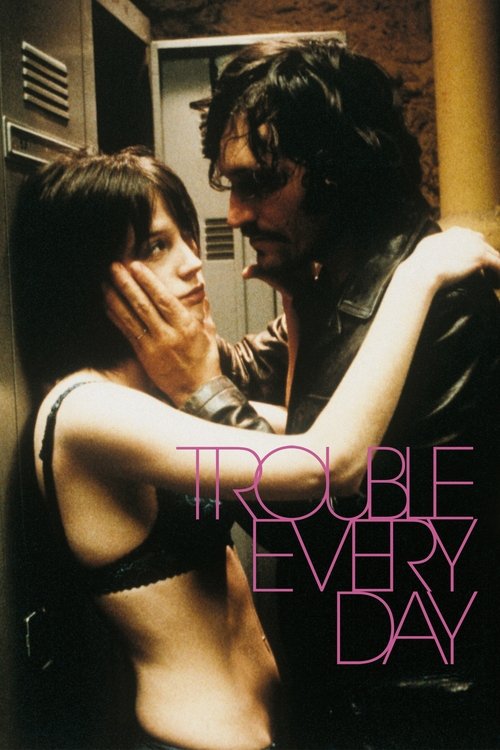
Trouble Every Day
2001 · Claire Denis
For when you want cinema at its most confrontational — an art film that goes places most horror won't. Strictly challenge viewing; approach only when you're ready to be disturbed and sit with it.
What it's about
An American scientist arrives in Paris on his honeymoon, but the trip is a cover: he's hunting a discredited French researcher whose work might explain the condition he's hiding from his new wife — a disease that turns desire into a compulsion to bite and devour. Across the city, the researcher keeps his own afflicted wife locked in their house, and she keeps getting out.
The experience
Slow, sensual and genuinely shocking — long stretches of near-silent texture, skin and breath, broken by scenes of intimate violence that are hard to shake. It works on you like a mood, not a plot, and it leaves a bruise.
Performances
Béatrice Dalle is unforgettable as a woman reduced to pure appetite — feral, wordless and strangely mournful. Vincent Gallo matches her with a performance of coiled, miserable restraint.
The craft
Claire Denis builds the film from texture: Agnès Godard's camera lingers on skin and surfaces until they feel charged, and the Tindersticks' aching score wraps the horror in melancholy. The violence, when it comes, is staged with an intimacy that's far more upsetting than gore for its own sake.
Why it matters
Booed at its premiere and defended ever since, it became a touchstone of the New French Extremity and proof that a major art-house director could take horror's materials seriously.
Snapshot
Trouble Every Day is Claire Denis's only full venture into horror, and one of the most divisive films of her career. Shane Brown (Vincent Gallo), an American scientist, arrives in Paris on his honeymoon with his wife June (Tricia Vessey). The trip is cover: Shane is looking for Léo Sémeneau (Alex Descas), a French researcher whose discredited work on the neurology of libido Shane once followed. Shane's interest is personal. He suffers from a condition in which sexual arousal turns into a compulsion to bite, tear and eat. Léo's wife Coré (Béatrice Dalle) has the same condition in a more advanced form. Léo keeps her locked in their suburban house, and when she gets out she seduces and kills men.
The film has little plot and a great deal of texture. Long passages of near silence, close-ups of skin, hair and breath, and a melancholy score by Tindersticks are interrupted by two scenes of startling, prolonged violence. It premiered out of competition at Cannes in 2001, where it was received with hostility and walkouts. It has since been reappraised as a key film of the turn of the millennium: a love story told as a body-horror film, and a central reference point in the debate over what came to be called the New French Extremity.
Industry & production
The film was a mid-budget French art-house production, co-financed in the way typical of French auteur cinema at the time. The production companies included Rézo Productions and Messaouda Films, with Arte France Cinéma among the partners and German co-production involvement. Georges Benayoun and Philippe Liégeois are credited as producers. Exact budget figures are not reliably documented in the public record, so none is given here.
Denis made it after Beau Travail (1999), which had brought her the widest international acclaim of her career so far. In that context, Trouble Every Day looked like a deliberate swerve. Funders and audiences expected another meditative, prestige art film. Denis took French art-cinema financing and spent it on a film of cannibalism and sexual horror. The cast was international and partly English-speaking. Gallo and Vessey are Americans, and much of their dialogue is in English, which also reflects the film's wider reach for co-production and distribution. The Cannes premiere put it at the centre of that year's arguments about explicit sex and violence in French cinema. It was then released theatrically in France and internationally to a polarised press.
Technology
The film was shot on 35mm film, in the analogue photochemical workflow still standard for European art cinema in 2001. Its technological interest is not in innovation but in how it uses film stock and low light. Agnès Godard shoots night interiors, hotel corridors and the boarded-up Sémeneau house in deep, grainy darkness, so that bodies emerge from the black in fragments. Laboratory sequences use clinical fluorescent light and show real scientific apparatus: brain specimens, test tubes, microscopes. This places the horror in pharmaceutical research rather than the supernatural.
The gore effects are practical: prosthetics and stage blood, used sparingly but held on screen for a long time. The film avoids the quick-cut shock grammar of the American horror of its day. Its effects work matters because of how long it lasts, not how spectacular it is. Detailed records of the makeup and effects crew's methods are thin in the published literature.
Technique
Cinematography
Agnès Godard, Denis's regular cinematographer since J'ai pas sommeil (I Can't Sleep, 1994), photographs the film as an essay on skin. Extreme close-ups of necks, forearms, napes, lips and hair turn the body into a landscape. The camera seems to share Shane's appetite, lingering on flesh with a closeness that moves between the erotic and the predatory. In the opening, a couple kiss in a car in the dark, lit by passing sodium light. This establishes the film's main visual idea: desire glimpsed in shadow, its source never fully lit.
Godard sets these close-ups against wider, cooler frames of Paris: the Seine, hotel interiors, and the gargoyles of Notre-Dame that Shane and June visit, the stone chimeras standing in for Shane's divided nature. Night scenes are under-lit, which forces the viewer to read shapes rather than see events clearly. The violence, by contrast, is often lit plainly enough to be seen, so it cannot be dismissed as suggestion.
Editing
Nelly Quettier, who also cut Beau Travail, edits by ellipsis. Backstory is withheld or delivered in fragments: what happened between Shane and Léo, the research in the tropics, the nature of the illness, the pharmaceutical interests behind it. The audience has to build the situation from glances, documents and silences. Scenes often begin late and end early, and the narrative moves forward in jumps between the two couples.
The film then slows sharply for its set pieces. Coré's killing of a young intruder and Shane's attack on the hotel maid are allowed to unfold almost in real time. The contrast between elliptical narrative and long, unblinking violence is the film's structural signature. It is the main reason audiences reported the violence as unbearable when the quantity of gore is not excessive by genre standards.
Mise-en-scène / staging
The film is built on paired spaces. The Sémeneau house is a decaying villa on the edge of the city, its windows boarded and its rooms bare, half home and half cage. The hotel where Shane and June stay is anonymous international luxury: corridors, a basement staff locker room, a bathroom with a bathtub where Shane hides his arousal from his wife. Laboratories and archives are a third zone, where the illness is turned into data.
Denis places her characters at the edges of frames and in doorways, and often keeps them apart in the same shot. June is repeatedly framed alone, waiting and watching, with her husband absent or turned away. Coré's escapes are staged as a kind of feral liberation, roaming fields and roadsides, but every space she enters becomes a trap for someone else. Blood is placed with care: on walls, on Coré's face and hands, and in the final shower scene, where it marks June's realisation.
Sound
The Tindersticks score, and the title song sung by Stuart Staples, is one of the film's defining elements. Over the opening credits, the song gives the film its romantic, mournful key before any horror appears, and frames everything that follows as a love story. Elsewhere the score uses strings and sparse, repeated figures, closer to an ache than to the stingers of genre cinema.
Denis's sound design pushes breathing, kissing, the rustle of sheets and the wet sounds of flesh into the foreground. Dialogue is minimal, and many of the most important exchanges happen without words. In the attack scenes, the sound of the body under assault is more upsetting than the images. The near-silence of large stretches of the film makes these moments land with particular force.
Performance
Vincent Gallo plays Shane as a man walled up inside himself: courteous, distracted and sexually withdrawn from his bride, with an intensity that comes out in sidelong looks and sudden stillness. The performance draws on Gallo's established screen persona, abrasive, vulnerable and slightly alien. Denis uses it to make Shane both sympathetic and frightening.
Béatrice Dalle's Coré is the film's most famous performance. She is almost wordless, and her physicality swings between feline seduction, childlike confusion and ferocity. Dalle's star image since Betty Blue (1986), of untamed sexuality, is recast here as pathology and grief. Alex Descas plays Léo with exhausted tenderness, a husband who loves and imprisons his wife at once. Tricia Vessey's June is an open, trusting presence whose growing unease the audience shares. Florence Loiret-Caille as the hotel maid and Nicolas Duvauchelle as the youth who breaks into the Sémeneau house give the victims a specific human presence, which makes their deaths harder to treat as genre fodder.
Narrative & dramatic mode
The film is built as a parallel narrative. Two couples, each defined by the same illness, move through Paris on courses that converge, and Shane's search for Léo is the thread connecting them. The dramatic mode is withholding, close to anti-expository. Causes are hinted at rather than explained, and the medical and corporate backstory stays deliberately murky. Characters rarely say what they feel.
The film works through mood and accumulation rather than suspense. Its question is not whether Shane will give in but when, and what the giving in will cost June. The climax at the Sémeneau house, which ends in fire, brings the two narratives together without resolving the medical mystery. The coda returns to the hotel: blood traced down a shower wall, and June's look of comprehension. It suggests continuation rather than closure. The disease is not cured, only hidden again within the marriage.
Genre & cycle
Trouble Every Day belongs at the meeting point of the art film and the horror film. Its clearest genre lineages are:
- Vampire and predatory-woman cinema: the erotic vampire tradition and the "sexual monster" film. Coré in particular recalls the doomed, desiring women of earlier horror.
- Body horror: the medical, viral and sexual anxieties associated with David Cronenberg's 1970s films, in which the body's appetites are biological catastrophes rather than supernatural curses.
- The Val Lewton–Jacques Tourneur tradition: critics frequently compare the film to Cat People (1942), with its story of a woman whose sexual arousal brings out a murderous animal nature, its American-European marital pairing, and its reliance on shadow and suggestion.
In its own moment, the film was quickly grouped with a cycle of French films around 1998–2004 that brought explicit sex and graphic violence into art cinema, by directors including Gaspar Noé, Catherine Breillat, Bruno Dumont, François Ozon and Philippe Grandrieux. James Quandt's 2004 Artforum essay "Flesh & Blood: Sex and Violence in Recent French Cinema" named and criticised this tendency as the "New French Extremity," and Trouble Every Day was one of the films he discussed. The label has been widely adopted and widely contested since. Denis's film fits it awkwardly: its violence is tender and grief-stricken rather than provocative, and its sensibility is closer to romantic melancholy than to confrontation.
Authorship & method
Claire Denis wrote the screenplay with Jean-Pol Fargeau, her long-standing co-writer. Their collaboration typically produces scripts that are spare in dialogue and built on situations and bodies rather than psychological explanation. Trouble Every Day follows that method: its characters are defined by gesture and appetite, not backstory.
The film's main collaborators are all members of Denis's recurring company:
- Agnès Godard (cinematography) brings her signature attention to skin and texture, developed on Nénette et Boni (1996) and Beau Travail.
- Nelly Quettier (editing) uses the elliptical, rhythm-led cutting she brought to Beau Travail.
- Tindersticks (music) began here their lasting partnership with Denis. Stuart Staples and the band, together and separately, went on to score many of her later films. Their contribution is often cited as the start of one of the defining director-composer relationships in contemporary European cinema.
- Alex Descas is one of Denis's most frequent actors, appearing across her work from the early 1990s to 35 Shots of Rum (2008) and beyond.
- Vincent Gallo had worked with Denis before, on her mid-length New York film Keep It for Yourself (1991).
- Béatrice Dalle and Nicolas Duvauchelle both returned for L'Intrus (The Intruder, 2004).
Thematically, the film extends Denis's lasting concerns: the body as the site of meaning, desire as something both binding and destructive, the outsider moving through a city, and the colonial and postcolonial shadow. That shadow appears here in the hints that Léo's research came from expeditions to the tropics, a past the film never fully explains. Denis treats genre as a way to reach these preoccupations, not as an end in itself. She would return to genre and the extremes of the body in High Life (2018).
Movement / national cinema
The film sits within the French cinéma d'auteur of the late 1990s and early 2000s, a system that supported formally ambitious directors through public funding, television pre-sales (notably Arte) and festival exposure. Denis's place in that system had been secured by Chocolat (1988), J'ai pas sommeil and Beau Travail. Trouble Every Day tested how far the system would follow her into disreputable genre territory.
It also belongs to the larger moment, discussed above, in which French art cinema turned toward the body, explicit sexuality and transgression. Critical accounts tie that turn to a wider European cinema of corporeality and to a weakening of the line between art film and exploitation. The film's partly American cast and English dialogue, and its Paris seen through visitors' eyes, also link it to the transnational turn in French production during these years.
Era / period
Released in 2001, the film belongs to a period in which anxieties about the body were shaped by biotechnology, the pharmaceutical industry and the cultural aftermath of the AIDS epidemic. Many critics read the illness as a figure for a sexually transmitted affliction: a desire that is itself contagion, and a marriage hiding a dangerous secret. The film's setting of corporate labs, rival researchers and patented knowledge reflects the period's unease about who owns science and the body.
In film history, it arrived as horror was being revived in several directions: J-horror's international spread, the start of the more explicit "torture" cycle in American horror, and the growing acceptance of horror in art cinema. Trouble Every Day anticipated the later fashion for "elevated" or art-house horror by more than a decade.
Themes
- Desire as devouring. The film takes literally the old link between erotic love and consumption. Kissing becomes biting, and possession becomes ingestion. Desire is not a metaphor for hunger here; it is hunger.
- Love and care as imprisonment. Léo's caretaking of Coré, locking her in and cleaning up after her killings, is devotion and captivity at once. Shane's withdrawal from June is a form of protection that is also a betrayal. Both marriages are organised around a secret that must be contained.
- The body as unknowable. Science in the film cannot explain or cure the condition. The body overflows medical knowledge, and the labs, specimens and archives in Paris look helpless against it.
- Science, property and exploitation. The vague backstory of research in the tropics and competition between scientific and commercial interests suggests knowledge extracted from colonial peripheries and turned into intellectual property. It is a quiet thread connecting the film to Denis's career-long attention to colonial history.
- Loneliness and the outsider. Shane, Coré and June are all isolated. The city is beautiful but impersonal, a backdrop for people who cannot reach one another.
- Grief. The Tindersticks score and Denis's tender framing make the film as much a lament as a horror story. The killers are pitied as well as feared.
Reception, canon & influence
Critical reception. At its Cannes 2001 premiere the film was received with open hostility, including walkouts and boos, and many reviewers dismissed it as pretentious, gratuitous or a failed genre experiment. Others defended it as a daring, poetic film from a major director. In both France and the English-speaking press, the response was polarised. Quandt's 2004 Artforum essay was critical of the extremity trend it was grouped with, and that framing shaped its reputation for some years.
Over the following two decades the film's standing rose markedly. Retrospectives of Denis's work, writing on the New French Extremity, and the wider critical acceptance of art-horror have all repositioned it as one of her essential films and a landmark of 21st-century horror. It now appears regularly in critical surveys of modern horror and in discussions of women directors working in the genre. The Tindersticks soundtrack has its own following.
Influences on the film. Critics regularly connect Trouble Every Day to:
- Jacques Tourneur and Val Lewton's Cat People, for the woman whose desire unleashes a murderous nature, and for its suggestive darkness;
- David Cronenberg's early body-horror films (Shivers, Rabid), where sexual appetite works as biological contagion;
- the European erotic-vampire tradition;
- Denis's own earlier films, especially J'ai pas sommeil, a film about a serial killer in Paris told with the same detachment and attention to the body.
How far each of these was a conscious model for Denis, as opposed to a critical comparison, is not consistently documented in her own statements.
Legacy. The film's forward influence is felt mostly in the later wave of art-house horror centred on female desire, appetite and the body. Critics have compared it often to Julia Ducournau's Raw (Grave, 2016), a French film about cannibal hunger and awakening sexuality, and to Jonathan Glazer's Under the Skin (2013), with its predatory seductress and sensory, near-wordless style. These are comparisons drawn by critics; claims of direct influence should be treated with caution. More broadly, the film helped show that a major art-cinema director could work fully within horror without irony, a possibility that the "elevated horror" boom of the 2010s took for granted.
Within Denis's career, the film began the Tindersticks collaboration and anticipated the genre-bending of L'Intrus, Bastards (2013) and High Life. Its scandalous first reception has largely given way to a view of it as one of her most personal films: a love story whose lovers cannot touch without destroying each other.
Influences: the films it descends from and the films it influenced
- Cat People (1942) — Tourneur and Lewton's structure of a woman whose sexual arousal sets off a predatory transformation, kept mostly off-screen in shadowed interiors, is the template for Denis's suggestive underlit staging of Coré's appetite.
- I Walked with a Zombie (1943) — A woman's affliction is cared for by a husband inside a house, and the film's somnambulant night walks through near-darkness anticipate Coré roaming at night while Léo keeps her locked in their suburban home.
- Shivers (1975) — Cronenberg's lab-made parasite that turns libido into contagion supplies the biotech premise of Trouble Every Day, where research on the libido produces a cannibal hunger set off by sexual arousal.
- Rabid (1977) — After experimental surgery, a woman has to feed on blood through an orifice that opens during intimate embraces, the direct model for Coré's seduction-then-feeding set pieces and for a medical-researcher partner who covers for her.
- Vampyr (1932) — Dreyer's dreamlike, nearly dialogue-free vampire film, in which meaning comes from texture, light and ellipsis rather than exposition, is the art-cinema precedent for Denis's anti-expository horror.
- Daughters of Darkness (1971) — A European erotic-vampire film in which a honeymoon couple in an off-season hotel is drawn into predatory desire, prefiguring the Browns' Paris honeymoon set in an empty hotel where Shane's hunger closes in on his wife and a chambermaid.
- Possession (1981) — Żuławski's fusion of marital breakdown with a woman's monstrous, sexually charged other life is a precedent for Denis treating horror as a couple's love story pushed to bodily catastrophe.
- J'ai pas sommeil (1994) — Denis's earlier Paris serial-killer film, shot by Agnès Godard, sets out the detached, unpsychologised view of a killer's body moving through the city at night that Trouble Every Day carries into horror.
- Beau Travail (1999) — With the same team (Godard's sensual close-ups of skin and Nelly Quettier's elliptical, rhythmic cutting), Denis found here the wordless, body-first grammar she turns toward horror in Trouble Every Day.
- Nénette et Boni (1996) — Godard's tactile close-ups of flesh and food and Boni's sexual-appetite fantasies anticipate how Trouble Every Day films desire and eating in the same close-up register.
- Betty Blue (1986) — Agnès Godard shoots Dalle in close natural-light skin texture with her appetite left unexplained and unpsychologized — the actor extending her own Betty persona, with Tindersticks' score occupying Yared's position.
- L'Intrus (2004) — Denis carries over the Tindersticks/Stuart Staples score, Godard's night-time body imagery and the extreme elliptical plotting, and makes a failing organ (a heart transplant) the film's dreamlike, bodily driving force.
- Under the Skin (2013) — Glazer's near-wordless predatory seductress, who lures men to bodily dissolution in sequences driven by sound, extends Trouble Every Day's model of the woman as a mute, feral consumer seen with observational detachment.
- Only Lovers Left Alive (2013) — It takes over Denis's languid, music-led treatment of a vampiric couple in decaying night interiors, built on a moody rock score and on mood over plot.
- Raw (2016) — Ducournau's French art-horror ties a young woman's sexual awakening to an inherited cannibal hunger, with practical gore of torn flesh in close-up, the clearest heir to the desire-as-cannibalism device of Coré and Shane.
- Titane (2021) — It carries on the line of a near-mute, feral female lead (Agathe Rousselle in a Dalle-like register) whose sexuality and violence play out in tactile, bodily-sound-heavy set pieces.
- High Life (2018) — Denis returns to genre with a biomedical experiment on human reproductive fluids, a confined space that works as a cage, an elliptical backstory and a Stuart Staples score, restating Trouble Every Day's science-of-desire premise in space.
- In My Skin (2002) — A New French Extremity contemporary, it films a woman's growing need to cut and eat her own skin in clinical close-ups and long takes, and like Trouble Every Day it treats self-cannibalism as a private hunger rather than spectacle.
- Irréversible (2002) — Released in the same Cannes-scandal moment, it has the same structural device of one unbroken real-time take of violence that refuses to cut away, the method of Coré's and Shane's killing scenes.
- Crash (1996) — Denis applies Crash's observational tempo, surface-dwelling camera, and anti-cathartic elongation to transgressive body-desire — flesh meeting surface staged with clinical distance — using editing that refuses conventional horror payoff in the same mode of sustained, non-judgmental inquiry.
- The Piano Teacher (2001) — Denis uses observational static framings, withheld catharsis, and near-total absence of expository dialogue to render sexual violence as clinical fact rather than dramatic event, occupying the same art-horror formal register as The Piano Teacher and releasing in the same year.
- Thirst (2009) — Denis's complete refusal of vampire-genre conventions — no folklore, no fangs, just pathological compulsion rendered through extreme close-up and body-sound design — is the most rigorous formal parallel to Thirst's replacement of genre spectacle with visceral physicality; both films make the vampire's condition legible through sound texture rather than visual effect.
- Antichrist (2009) — Denis fuses sexual desire and bodily mutilation into clinical art-house body horror, the eros-becomes-evisceration dialectic that Antichrist pushes to its genital climax.
- The Ice Tower (2025) — New French Extremity's bodily dread rendered through Agnès Godard's tactile, skin-close cinematography and elliptical editing that withholds motive.
- Martyrs (2008) — Renders flesh horror through contemplative tonal descent and scoreless restraint rather than shock cutting, the arthouse pole of the extremity cycle Martyrs occupies.
- 35 Shots of Rum (2009) — Its horror-inflected corporeal cinema shares 35 Shots' method — attention to skin, appetite, and desire in telephoto close-up — but pushes toward rupture where the later film channels the same body-focus into reconciliation.
- Ravenous (1999) — Like Ravenous, it shows cannibal hunger as a chronic, shameful addiction its sufferers try and fail to manage, and its moody Tindersticks score carries the film's tone in the same way.
Similar films
- Possession (1981) — influence & lineage
- Irreversible (2002) — influence & lineage
- Titane (2021) — influence & lineage
- The Taste of Things (2023) — same viewing thread
- Thirst (2009) — shared sensibility
- Raw (2017) — shared sensibility
- High Tension (2003) — shared sensibility
- Crash (1996) — shared sensibility
All the films related to Trouble Every Day →
Watch it with: curated runs of related films
- Love Against the Grain — A run of films where desire refuses the shape its world demands — opera stages, drought-struck Taipei, an honor-bound Lahore household, drenched Buenos Aires — and burns brighter, and more dangerously, for the refusal.