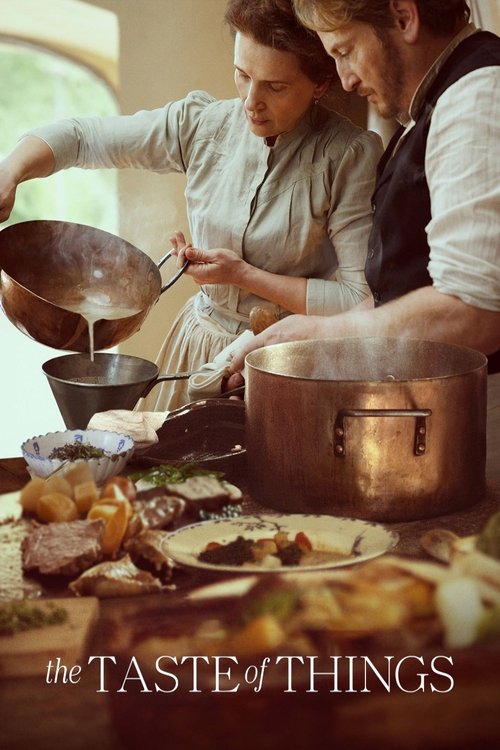
The Taste of Things
2023 · Trần Anh Hùng
For a slow, luxurious night in when you want to fall in love and eat well — ideally with a good meal before or after. Pure comfort with real emotional depth underneath.
What it's about
In 1889 provincial France, the celebrated gourmet Dodin and his cook Eugénie have shared a kitchen, a table, and a bed for twenty years — but she keeps refusing to marry him. Their love story plays out almost entirely through cooking: stocks, sauces, and elaborate meals prepared together, until Dodin decides to do the one thing he never has and cook for her.
The experience
Warm, unhurried, and ravishing — long stretches are simply two people cooking, and it's mesmerizing. It's tender rather than tense, deeply romantic in a grown-up way, and it will absolutely make you hungry.
Performances
Juliette Binoche and Benoît Magimel are quietly extraordinary together — decades of intimacy conveyed in glances and the wordless choreography of shared work, affection expressed through hands as much as words.
The craft
Trần Anh Hùng stages the kitchen scenes like dance — long, gliding takes through steam and copper pots, sunlight pouring through windows, food photographed with almost scandalous beauty. The sound of simmering and chopping largely replaces a score; it rewards a big screen and an empty stomach at your peril.
Why it matters
It won Trần Anh Hùng Best Director at Cannes and was France's Oscar submission, instantly joining the canon of great food films and proving that a romance could be carried almost entirely by the act of cooking.
Snapshot
The Taste of Things (French title La Passion de Dodin Bouffant) is a French period romance in which love is conducted almost entirely through the labor of cooking. Adapted by Trần Anh Hùng from Marcel Rouff's 1924 novel La Vie et la passion de Dodin-Bouffant, gourmet, the film follows Dodin (Benoît Magimel), a renowned gourmet in late-nineteenth-century provincial France, and Eugénie (Juliette Binoche), the cook who has shared his kitchen and his bed for two decades. Their bond is expressed in stocks, sauces, and the choreography of a working kitchen rather than in declaration; when Eugénie's health falters, Dodin reverses their roles and cooks for her. The film premiered in competition at the 2023 Cannes Film Festival, where Trần won the award for Best Director, and it was selected as France's entry for the Best International Feature Film Oscar at the 96th Academy Awards (it was not among the final nominees). It stands as one of the most sustained recent attempts to make sensory process — the transformation of raw ingredients over time — carry the full emotional weight of a narrative.
Industry & production
The film was produced within the French auteur-cinema system, financed and shepherded by Curiosa Films under producer Olivier Delbosc, with the kind of mid-budget artisanal footing typical of prestige French literary adaptations. It was shot on location in France, notably using a château and its grounds and kitchens to ground the domestic world of a nineteenth-century gourmet's household. The production leaned heavily on culinary expertise: the celebrated chef Pierre Gagnaire served as culinary consultant and designed the dishes, lending the on-screen cooking a verifiable authority rather than decorative approximation. The casting carried its own resonance for French audiences — Binoche and Magimel had been a couple earlier in their lives and share a daughter, a biographical fact widely noted in coverage that gave the on-screen intimacy an added charge. Internationally, the film was distributed in the United States by IFC Films, part of a familiar art-house release pattern for subtitled prestige titles. Its Cannes directing prize functioned as the principal engine of its commercial and awards visibility.
Technology
The film was photographed digitally and finished for conventional theatrical release; there is no indication that it pursued celluloid or any novel capture format, and the record on precise camera and lens packages is thin. Its technological interest lies less in acquisition hardware than in the demands the material placed on production design and lighting: the recurring cooking sequences required continuity across dishes at various stages of preparation, working stoves and open flame, and steam and smoke as practical atmosphere within the frame. Lighting appears to have been organized to read as motivated by period sources — window light and fire — favoring a naturalistic, low-key palette. The most demanding technical problem was less optical than logistical: sustaining long, unbroken takes in a hot, active kitchen while real food was genuinely cooked, plated, and served in real time.
Technique
Cinematography
Cinematographer Jonathan Ricquebourg is the film's defining technical author alongside the director. His camera is mobile and observational, drifting through the kitchen in long fluid takes that follow hands, pans, and bodies as they cross and re-cross the workspace. The opening cooking sequence — an extended, near-wordless passage of preparation and plating — establishes the grammar: the frame behaves less like a spectator than like another participant moving among the cooks. Ricquebourg favors warm, naturalistic light keyed to windows and hearth, with the burnished tonality of period painting; the imagery is frequently likened to Dutch and French genre and still-life painting, though the film earns the comparison through attention to surface, texture, and the fall of daylight rather than through overt tableau. The camera's restlessness is purposeful: it keeps the cooking continuous and embodied rather than cutting food into abstracted inserts.
Editing
The editing is subordinated to the long take: rather than building sequences from many short shots, the film lets extended actions play out and cuts sparingly, so that the rhythm of the picture tracks the rhythm of the work — the slow patience of a reduction, the sudden coordinated flurry of service. The precise editing credit and the editor's other collaborations are a point on which I am not certain enough to name specifics; what is clear from the film itself is a cutting philosophy that resists fragmentation and trusts duration.
Mise-en-scène / staging
The kitchen is the film's central set and its principal dramatic instrument. Staging is organized around the flow of labor: the geography of stove, table, larder, and garden is kept legible so that the audience understands cooking as spatial choreography. Props are functional and period-appropriate — copper, ceramic, live produce — and the dishes themselves, designed by Gagnaire, are staged as events. The film also opens the household outward to a kitchen garden and dining room, situating the intimate two-hander within a small social world of apprentices, a young girl with a precocious palate, and visiting gourmets.
Sound
Sound is one of the film's most deliberate choices. It foregrounds the diegetic textures of cooking — sizzle, simmer, the scrape of pans, the crackle of fire, running water — and largely forgoes a conventional non-diegetic score, letting silence and kitchen noise carry the mood. This restraint makes the food sensory by ear as much as by eye, and it lends the quieter, more sorrowful passages an unscored bareness. I would not want to overstate the precise music cues without certainty, but the film's governing decision to privilege ambient, in-world sound over orchestral underscoring is a defining and much-remarked feature.
Performance
Binoche and Magimel give closely matched, understated performances built on competence and habit rather than expressive outburst. Much of their acting is manual — the confidence of hands that know the work — and the intimacy reads through shared routine, glances, and the ease of long companionship. Magimel's Dodin is courtly and appetitive; Binoche's Eugénie is self-possessed, guarding her independence by refusing marriage. Their real-life history informs a lived-in quality that the film uses without underlining.
Narrative & dramatic mode
The film operates in a quiet, elliptical, largely plot-light mode. Its dramatic engine is not incident but process and mortality: the first movement is a near-plotless immersion in the pleasures of cooking and companionship, and the turn comes when Eugénie's health declines and the relationship's terms are altered. Conflict is muted and internalized — Eugénie's refusal to marry, Dodin's wish to honor and keep her — and resolved through gesture (his cooking for her) rather than confrontation. The structure privileges mood, sensory detail, and the passage of seasons over conventional rising action, trusting the accumulation of small domestic moments to build feeling.
Genre & cycle
Formally the film is a period romance and a drama of domestic partnership, but it belongs most vividly to the "food film" — the lineage of cinema in which cooking and eating carry emotional and cultural meaning. It sits comfortably beside touchstones such as Babette's Feast and Eat Drink Man Woman, films in which a meal is the vehicle of love, memory, and reconciliation. It also participates in the broader tradition of the literary heritage adaptation in French cinema. What distinguishes it within the cycle is its patience and its near-documentary attention to technique, pushing the food film toward contemplative sensory realism rather than comedy or spectacle.
Authorship & method
Trần Anh Hùng is the film's clear author, and its method reflects a career-long sensibility. Across his work he has pursued sensuous, painterly, slow-cinema textures and the everyday poetry of domestic and physical labor. Here that sensibility fuses with a specifically French literary source and cuisine, and with an unusually collaborative culinary authorship: Pierre Gagnaire's involvement makes the cooking an act of genuine gastronomy rather than a set-dressed illusion, and the dishes function almost as a second screenplay. Jonathan Ricquebourg's mobile, light-sensitive cinematography is the other pillar of the film's method — the long observational take is as much his signature contribution as the director's. The screenplay is Trần's own adaptation of Rouff. On the music and editing credits I am deliberately reserved, noting only that the film's authored choice to suppress conventional scoring is central to its method; I will not attribute specific names where I am not certain.
Movement / national cinema
The film is a work of contemporary French cinema, but its authorship complicates any simple national label. Trần Anh Hùng is a French filmmaker of Vietnamese birth whose earlier films — The Scent of Green Papaya, Cyclo, The Vertical Ray of the Sun — are landmarks of a diasporic Franco-Vietnamese cinema attentive to sensory ritual and domestic life. The Taste of Things turns that same eye onto the French gastronomic heritage, making it both a French national-cinema product (period, literary, culinary) and the work of a transnational auteur bringing an outsider's contemplative attention to a quintessentially French subject. It aligns broadly with the international currents of slow, sensory art cinema rather than with any organized movement.
Era / period
The story is set in provincial France in the late nineteenth century — the synopsis places it in 1889, within the belle-époque flourishing of French gastronomic culture and the codification of haute cuisine. The film reconstructs this world through period kitchens, dining rituals, and the figure of the gentleman-gourmet, evoking a moment when French cooking was being consecrated as an art. Produced and released in 2023, it belongs to a present-day art-cinema context in which slow, sensory, process-attentive filmmaking has found renewed critical favor, and in which food and craft have become recurrent subjects of prestige cinema.
Themes
The film's governing theme is love expressed through labor and care rather than words — cooking as courtship, service, and mourning. Bound to this are the pleasures and the transience of the senses: appetite and mortality are held together, so that the celebration of taste is shadowed by loss. It meditates on time — the slowness of good cooking, the accumulation of a shared life, the seasons of a garden — and on memory, since a dish can hold a relationship's whole history. Eugénie's refusal of marriage introduces a quieter theme of female autonomy sustained within intimacy. Underlying all of it is the film's central proposition that artistry and love are the same discipline of attention.
Reception, canon & influence
Critical reception was strongly favorable, anchored by the Best Director award at Cannes 2023 and sustained by the film's selection as France's Oscar submission for the 96th Academy Awards, though it did not reach the final shortlist of nominees. Critics widely praised the sensory cinematography, the immersive cooking sequences, the restraint of the (largely unscored) sound design, and the lived-in performances of Binoche and Magimel; the most common line of appreciation framed the film as a rare success at making culinary process bear genuine emotional weight. Where reservations appeared, they tended to concern the film's deliberate quietness and thin plotting.
The influences on the film run backward along two lines: the literary source in Marcel Rouff's 1924 novel and the earthy gastronomic culture of belle-époque France; and the cinematic lineage of the food film — Babette's Feast, Eat Drink Man Woman — together with Trần's own sensory, painterly body of work stretching back to The Scent of Green Papaya. Its forward legacy is still being written; as a recent release its measurable influence is limited, but it has already become a reference point in discussions of the contemporary food film and of slow, sensory art cinema, and it reaffirmed Trần Anh Hùng's international standing after a relatively quiet period. Any claim about a deeper, lasting imprint on filmmakers would be premature, and the honest position is that its canonical place remains to be settled.
Reception
It premiered at Cannes 2023 to warm reviews and a Best Director prize for Trần Anh Hùng, but its reception got tangled up in Oscar politics when France chose it as its submission over Palme d'Or winner Anatomy of a Fall — it made the shortlist but missed the nomination, and the 'wrong pick' discourse followed it for months. Now that the awards dust has settled, it's simply beloved as one of the great modern food films.
How The Taste of Things was received, from release to now →
Influences: the films it descends from and the films it influenced
- Babette's Feast (1987) — Establishes the film's central structural device — a long, quasi-real-time cooking sequence in which the labor of preparing and plating each course carries the entire emotional climax, rather than dialogue or plot resolution.
- The Scent of Green Papaya (1993) — Trần's own template: patient observational takes on hands performing domestic and culinary labor, hushed diegetic-only sound, and a painterly attention to the fall of light on skin, food and surfaces — the method he simply transposes to a French kitchen.
- Eat Drink Man Woman (1994) — Its virtuoso opening — knife, wok and steamer edited as gestural choreography — is the direct model for treating food preparation as a performable sequence of expressive physical action rather than mere set-dressing.
- Jeanne Dielman, 23 quai du Commerce, 1080 Bruxelles (1975) — Pioneers the plotless-process grammar the film adopts: kitchen tasks rendered in unhurried duration so that the rhythm of domestic labor itself becomes the narrative content.
- Barry Lyndon (1975) — The reference for period images composed and lit like paintings — natural and practical-source light modeling faces and interiors into belle-époque canvases, which Ricquebourg's light-sensitive camerawork echoes.
- Days of Heaven (1978) — Model for naturalistic magic-hour lighting and a soundscape that foregrounds ambient diegetic texture over conventional score, letting weather and daylight dictate the painterly look.
- Tampopo (1985) — Foundational food-film that dignifies culinary technique on screen — the pursuit and perfection of a dish as legitimate dramatic material — a genre precedent Trần inherits and strips of comedy.
- Like Water for Chocolate (1992) — Codifies cooking-as-emotional-transmission for the modern food film: dishes made by one character to express feeling that cannot be spoken, the exact affective logic behind the kitchen courtship here.
- Big Night (1996) — Shares the commitment to real, non-faked gastronomy — an actual timpano cooked and served — so that culinary craft depicted with technical fidelity becomes the vessel for character and relationship.
- Estômago: A Gastronomic Story (2008) — Advances the meal-as-narrative-structure inheritance, letting extended cooking process itself carry plot and power dynamics rather than functioning as backdrop.
- Portrait of a Lady on Fire (2019) — Extends the same craft cluster: a scoreless, diegetic-only period romance in naturalistic candle-and-daylight, where romance is built through the shared labor of an art (painting) observed in patient long takes.
- First Cow (2019) — Carries forward food-as-tender-labor: the quiet, tactile process of making a simple baked good filmed with patient attention becomes the emotional and relational core, in slow-cinema register.
- The Vertical Ray of the Sun (2000) — Trần's companion piece in sensory domesticity: slow, tactile scenes of meal preparation as intimacy, shot with the same mobile, light-chasing observational camera and reliance on ambient household sound.
- Phantom Thread (2017) — Parallel study of love-through-labor and mortality staged around a master's craft and the ritual meals that sustain it, with understated performance and care expressed through the daily rituals of service and appetite.
- Drive My Car (2021) — Contemporary slow-cinema sibling built on durational takes and deliberately understated, restrained performance, letting process and routine — rather than plot incident — accumulate emotional weight.
- The Wind Will Carry Us (1999) — Exemplar of the plotless, observational slow-cinema mode Trần works within — everyday activity and landscape rendered in unhurried diegetic takes, refusing conventional dramatic incident.
Similar films
- Eat Drink Man Woman (1994) — influence & lineage · same viewing thread
- Portrait of a Lady on Fire (2019) — influence & lineage · often watched together
- Babette's Feast (1987) — influence & lineage
- Like Water for Chocolate (1992) — influence & lineage
- Big Night (1996) — influence & lineage
- Tampopo (1985) — influence & lineage
- In the Mood for Love (2000) — same viewing thread · often watched together
- Barry Lyndon (1975) — influence & lineage · often watched together
All the films related to The Taste of Things →
Watch it with: curated runs of related films
- Love Against the Grain — A run of films where desire refuses the shape its world demands — opera stages, drought-struck Taipei, an honor-bound Lahore household, drenched Buenos Aires — and burns brighter, and more dangerously, for the refusal.