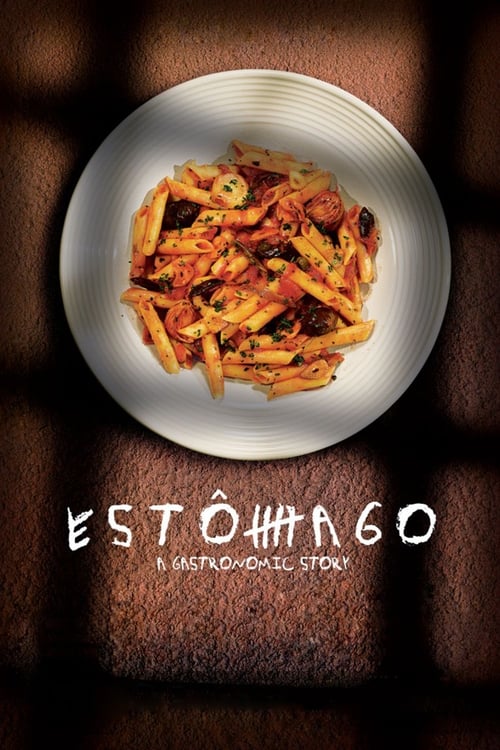
Estômago: A Gastronomic Story
2008 · Marcos Jorge
When you want something savory and a little wicked — a foodie film that's really about power, best for a night when you're up for a story that keeps you guessing without punishing you.
What it's about
Raimundo Nonato, an illiterate young migrant in Brazil, discovers the one talent that opens every door: he can cook. The film braids two ascents — his rise from frying snacks in a grimy bar to the kitchen of an Italian restaurant, and his climb through the pecking order of a crowded prison cell, where a well-seasoned meal buys protection — while a romance with a pragmatic prostitute who takes her payment in dinners complicates everything.
The experience
Wry, earthy, and quietly suspenseful — the two timelines circle each other, and much of the pleasure is wondering how a man travels from the sauté station to the cellblock. It's a comedy with a knife tucked in its apron: funny, sensual about food, and darker than it first lets on.
Performances
João Miguel plays Nonato with a sly, deceptive innocence — a man who seems harmless right up until you realize how carefully he's been watching — and Fabiula Nascimento gives his love interest a clear-eyed pragmatism that never begs for sympathy.
The craft
Marcos Jorge intercuts restaurant and prison with a watchmaker's patience, letting each timeline season the other, and the food itself is shot with real appetite — you can practically smell the coxinhas. It's a debut with the structural confidence of a veteran.
Why it matters
It swept Brazil's festival circuit, took the top prize at Rio, and announced a distinctively Brazilian voice in dark comedy — a small film that traveled far on word of mouth.
Marcos Jorge's debut, a Brazil–Italy coproduction adapted from Lusa Silvestre's short story, is a fable about cooking as the universal solvent of power. Raimundo Nonato, an illiterate migrant played with sly innocence by João Miguel, discovers he has a gift: first frying coxinhas at a grimy snack bar, then rising through an Italian restaurant kitchen, and — in the film's braided second timeline — cooking his way up the hierarchy of a crowded prison cell, where a well-seasoned meal buys protection. Jorge intercuts the two ascents with a watchmaker's patience, letting us wonder how a man travels from sauté station to cellblock, and folds in a love story with Fabiula Nascimento's pragmatic prostitute, who takes her payment in dinners. The film swept Brazil's festival circuit and took the top prize at Rio, announcing a wry comic voice in a national cinema then dominated by favela realism. Its politics arrive on a plate: at every altitude of society, whoever controls the food controls the room.
Reception
At home it arrived a festival darling — it swept Festival do Rio 2007, taking four of the six competition prizes — but abroad it spread slowly as a word-of-mouth discovery; the 2024 sequel pulled the original back into circulation for a new round of 'why did nobody tell me about this' reviews.
How Estômago: A Gastronomic Story was received, from release to now →
Influences: the films it descends from and the films it influenced
- Tampopo (1985) — Codifies the culinary-fable form Estômago adopts: cooking staged as a discipline of mastery and seduction, with appetite recast as a currency of desire and social power rather than mere sustenance.
- La Grande Bouffe (1973) — Establishes the grotesque-gastronomic register the Brazil-Italy coproduction leans on, where eating is pushed past pleasure into consumption-as-domination, foreshadowing the film's cannibal punchline.
- The Cook, the Thief, His Wife & Her Lover (1989) — Models the restaurant kitchen as an arena where culinary skill translates directly into class power and bodily violence, culminating in a cannibalistic reckoning—Estômago's exact structural endpoint.
- Babette's Feast (1987) — A literary adaptation in which an unassuming cook's technical mastery becomes quiet authority, staging the meal itself as narrative climax—the template for Raimundo's dishes as instruments of leverage.
- Like Water for Chocolate (1992) — Latin American literary adaptation that fuses recipes with plot mechanics, making food the concrete vehicle of emotion, seduction, and control that Estômago transposes into a class idiom.
- Big Night (1996) — Frames Italian cooking as immigrant self-worth and identity, the kitchen as the one space where a marginal man commands respect—Nonato's Italian-restaurant apprenticeship echoes it.
- City of God (2002) — Supplies the kinetic Brazilian editing grammar—propulsive parallel cross-cutting and interlocked timelines—that Estômago borrows even as it positions itself 'against favela realism.'
- Delicatessen (1991) — A dark comedy built on food, hunger, and cannibalism in a cramped enclosed world, pairing culinary craft with deadpan grotesquerie the way Estômago does across its cell and kitchen.
- Goodfellas (1990) — Its lovingly detailed prison-cooking sequence establishes food as social currency among incarcerated men—the exact mechanism by which Raimundo buys standing inside his cell.
- Un Prophète (2009) — Extends the prison-as-class-ladder engine: an unschooled inmate ascends the internal hierarchy through cultivated skill and cunning, mirroring Raimundo's rise via cooking behind bars.
- The Platform (2019) — Pushes food-as-class-hierarchy into literal allegory within a vertical prison, systematizing Estômago's premise that who eats and who feeds encodes the whole social order.
- The Menu (2022) — Weaponizes haute cuisine as a chef's instrument of revenge and control over a captive dining class, the endgame extension of food-as-power staged in a kitchen.
- The Taste of Things (2023) — Advances the meal-as-narrative-structure inheritance, letting extended cooking process itself carry plot and power dynamics rather than functioning as backdrop.
- Ratatouille (2007) — Same-year parable of class ascent through pure culinary talent, in which a lowly outsider breaches a gated hierarchy solely by the authority of what he can cook.
- Julie & Julia (2009) — Builds its narrative on dual-timeline cross-cutting between two food-driven lives, the same braided parallel-editing device Estômago uses to intercut restaurant past and prison present.
Similar films
- The Taste of Things (2023) — influence & lineage
- Ratatouille (2007) — influence & lineage
- Tampopo (1985) — influence & lineage
- The Menu (2022) — influence & lineage
- Babette's Feast (1987) — influence & lineage
- Big Night (1996) — influence & lineage
- Delicatessen (1991) — influence & lineage
- Like Water for Chocolate (1992) — influence & lineage