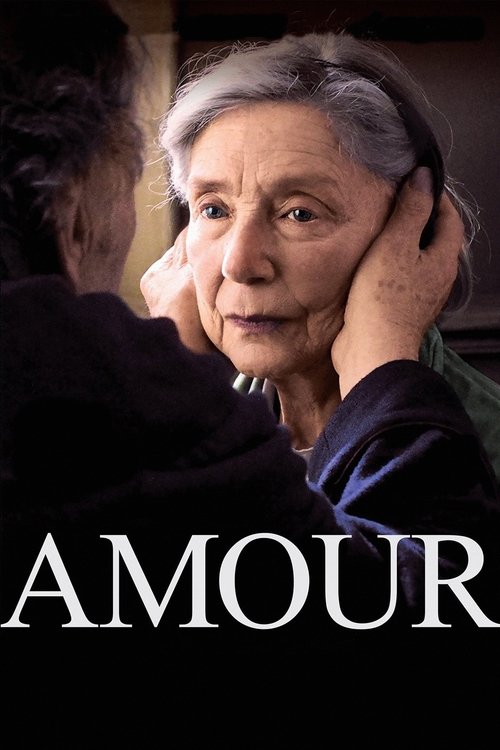
Amour
2012 · Michael Haneke
For when you're ready to be wrecked by something true — not a casual watch, but one of those films you're grateful to have sat through. Reach for it when you want cinema to face what most films politely avoid.
What it's about
Georges and Anne are in their eighties — retired music teachers, devoted to each other, living among books and a piano in their Paris apartment. Then Anne has a stroke, and the film stays inside those rooms with them as her health declines and Georges takes on her care, watching what love actually asks of a person at the end of a long marriage.
The experience
Unflinching, patient, and quietly shattering. There's no music telling you what to feel and no looking away — it's intense not through incident but through honesty, and it will stay with you for a long time.
Performances
Jean-Louis Trintignant and Emmanuelle Riva, two giants of French cinema in their eighties, give performances of staggering courage and precision — Riva's physically fearless portrayal of Anne's decline earned an Oscar nomination, and Trintignant matches her with granite restraint.
The craft
Haneke's direction is rigorous almost to the point of severity: long, still shots, a single apartment, natural sound, two faces. That discipline is the point — nothing softens or sentimentalizes what you're watching, and the apartment becomes a whole world slowly closing in. It's chamber filmmaking at its most exacting.
Why it matters
Winner of the Palme d'Or and the Foreign Language Oscar, it stands as a rare thing — a late-career masterpiece that put old age and caregiving at the center of world cinema's conversation, and the most humane film of Haneke's career.
Snapshot
Amour is Michael Haneke's chamber study of a marriage entering its final passage. Georges and Anne Laurent, retired music teachers in their eighties, share a cultivated, book-lined Parisian apartment until Anne suffers a stroke; the film follows, with unflinching patience, her physical decline and the slow narrowing of the world the couple has built together. It is at once the least characteristic and the most distilled of Haneke's films — stripped of the social provocations and reflexive games of Funny Games or Hidden, and concentrated almost entirely on two faces, two bodies, and a single set of rooms. Winner of the Palme d'Or at Cannes in 2012 (Haneke's second in three years) and the Academy Award for Best Foreign Language Film, with an additional Best Actress nomination for Emmanuelle Riva, it stands as the rare late-career work that both crowned a major auteur's reputation and reached audiences well beyond his usual art-house constituency. Its title is unironic, which from Haneke is itself a kind of shock.
Industry & production
Amour was a tripartite European co-production, financed and produced across France, Germany, and Austria — the configuration that had underwritten much of Haneke's mature career. Margaret Ménégoz's Les Films du Losange led on the French side, with Stefan Arndt's X-Filme Creative Pool (Berlin) and Haneke's longtime Austrian home Wega Film among the partners, supported by public funding bodies including, in the customary pattern for such productions, France's CNC and the broadcaster-backed schemes typical of European art cinema. The film was shot largely on a constructed set: the Laurents' apartment was built in studio in the Paris region, a decision that gave Haneke total control over the unbroken spatial geography on which the film depends. Casting was central to the film's conception and, by Haneke's own account in interviews around the release, he wrote with Jean-Louis Trintignant specifically in mind, coaxing the actor out of a long retreat from leading screen roles; the part of Anne went to Emmanuelle Riva, herself an icon of an earlier French cinema. Isabelle Huppert — Haneke's most frequent collaborator, from The Piano Teacher onward — took the supporting role of the daughter, Eva. The production carried the prestige and the modest budgets characteristic of European auteur cinema rather than international scale, and its commercial afterlife was driven by festival momentum: the Palme d'Or in May 2012 launched a long, awards-laden release that culminated in the Oscar the following winter. Precise budget and box-office figures I would not state from memory; the film was, by the standards of subtitled drama, a substantial art-house success.
Technology
Technologically Amour is deliberately unostentatious, but it sits at a meaningful hinge. It was photographed by Darius Khondji on the cusp of cinema's full transition to digital capture; the film's look — fine-grained, low-contrast, naturalistically lit — is consistent with high-end image-making of the early 2010s, though I would not assert a specific camera or whether it was shot on film or digitally without confirming, as accounts vary and I do not want to invent the record. What matters is the restraint: no stabilized camera movement that calls attention to itself, no digital grading toward stylization, no visual effects. The most technologically pointed choice is the refusal of technology's usual comforts — there is no musical scoring layered in post to cue emotion, and the sound design is built from the literal acoustics of the apartment. The film's engagement with the apparatus is, characteristically for Haneke, ethical rather than spectacular: the long take and the locked frame are used precisely because they resist the manipulations that editing and score make available.
Technique
Cinematography
Khondji's images are the film's spine. The camera is overwhelmingly static, mounted at a respectful middle distance, and the cutting rate is slow enough that individual shots acquire the weight of duration — we are made to wait inside rooms, to watch a meal prepared or a body lifted, in something close to real time. Light is sourced naturalistically from windows and lamps, with the apartment's interiors rendered in muted, autumnal tones that match the couple's age and circumstance without sentimentalizing them. The framing repeatedly subordinates the characters to the architecture: doorways, corridors, and the recurring geometry of rooms enclose the figures, so that the apartment becomes a measure of their shrinking horizon. A celebrated early sequence views a concert audience head-on, the screen filled with a crowd among whom we must locate Georges and Anne — implicating the viewer in the act of looking, and quietly establishing that we, too, are spectators at this performance of a life. The fixed frame is not coldness for its own sake; it is a discipline of attention that forces us to confront what a more mobile, more "expressive" camera would let us look away from.
Editing
Cut by Monika Willi and Nadine Muse, the film's editing is governed by withholding. Haneke ellipses are famously hard: scenes end before resolution and resume after a development we are left to reconstruct, so that Anne's decline registers not as a continuous slide but as a series of stations, each worse than the last, with the connective tissue removed. The opening, which discloses the ending — the apartment broken into, Anne's body laid out — places the entire film under the sign of an outcome already known, converting suspense into dread and the viewer's experience into a kind of mourning-in-advance. Within scenes the cutting is sparing; the rhythm is dictated less by dramatic beats than by the duration of physical tasks, and the absence of music means the edit cannot lean on a score to bind shots emotionally. The result is a structure that feels both inexorable and full of gaps — time as the aged and the grieving experience it.
Mise-en-scène / staging
The single apartment is the film's whole world, and its design (production design by Jean-Vincent Puzos) is a portrait by inventory: the grand piano, the crowded bookshelves, the paintings, the worn furniture of a long cultivated life. Haneke stages the drama within this fixed geography with rigorous consistency, so that we come to know the apartment's spatial logic — which room gives onto which — and feel its progressive contraction as Anne is confined first to a wheelchair, then to a bed. Objects accrue meaning through repetition: the piano falls silent, a pigeon strays in from the light-well, photo albums are leafed through. The staging is theatrical in its unity of place but anti-theatrical in its refusal of crescendo; bodies are arranged with documentary plainness, and the labor of care — washing, feeding, lifting — is staged in full, neither aestheticized nor spared.
Sound
Amour has no original score; its only music is diegetic, performed or played within the story — Schubert, Beethoven, Bach drawn from the couple's vocation, including a passage played by the pianist Alexandre Tharaud, who appears as Anne's former pupil. When the piano music stops, the silence is total and meaningful: the soundtrack becomes the literal ambience of the apartment — clocks, water, footsteps, breath, the wet effortful sounds of a failing body. This acoustic literalism is one of Haneke's signature ethical instruments. By denying the audience the consolation of underscoring, he refuses to tell us how to feel and leaves the sounds of decline nakedly present. The contrast between the high European art music the Laurents have given their lives to and the bare household noise that replaces it is among the film's most devastating effects.
Performance
The film rests on two performances of extraordinary courage. Emmanuelle Riva charts Anne's deterioration with a physical and vocal precision that spares nothing — the loss of speech, mobility, and finally selfhood is enacted in the body rather than indicated, and Riva's willingness to be seen in helplessness is the film's moral center; her Best Actress Oscar nomination, at an advanced age, recognized one of the great late performances in screen acting. Jean-Louis Trintignant, as Georges, plays the harder, quieter part: the watcher, the carer, whose love curdles into exhaustion and whose tenderness contains the seed of the film's terrible act. His restraint — a face that holds devotion and despair in the same set — gives the film its gravity. Isabelle Huppert, in the smaller role of the daughter Eva, embodies the well-meaning helplessness of those outside the room, her distress real but unable to enter the sealed world of the marriage.
Narrative & dramatic mode
The dramatic mode is tragedy stripped to two people. The narrative is linear save for its prologue, which forecloses the ending and thereby reframes everything as the unfolding of a known fate. There is almost no plot in the conventional sense — no subplot, no external antagonist, no relief; the "action" is decline, and the only event that breaks its rhythm is Georges's final, merciful, transgressive act. Haneke builds dread not through suspense but through inevitability and ellipsis, and he refuses catharsis: the closing images are ambiguous and quiet rather than resolving. The mode is closer to chamber drama or even to a secular Passion than to melodrama — a form Haneke pointedly avoids, denying the genre's tears and swelling music even as he treats its central material of suffering and death.
Genre & cycle
Nominally a drama and a love story, Amour belongs to a small and demanding category — the serious art-cinema treatment of aging, illness, and death, kin to films that confront mortality without recourse to uplift. Within Haneke's own filmography it forms part of a late cycle preoccupied with the bourgeois interior and its fragilities, alongside Hidden and The White Ribbon, but it turns the director's habitual cruelty inward and domestic. As a "love story," it is anti-romantic in method and devastatingly romantic in substance: it takes the genre's promise — till death do us part — and dramatizes it literally, asking what love actually requires when tested to its end.
Authorship & method
Amour is fully a Haneke film — written and directed by him, controlled to the frame. His method is well documented across his career: meticulous scripting, precise long takes, refusal of non-diegetic music, hard ellipses, and a moral interrogation of the spectator's position. Here that apparatus is turned to intimate rather than provocative ends, but the discipline is identical. His key collaborators were essential: cinematographer Darius Khondji, whose naturalistic light and patient fixed frames realize Haneke's spatial ethics; editors Monika Willi (a long-standing Haneke collaborator) and Nadine Muse, who execute the withholding structure; production designer Jean-Vincent Puzos, who built and dressed the apartment that is effectively the film's third character; and the actors themselves, whose presences Haneke wrote toward. There is no composer credit because there is no score — the "music department" is the canon of Schubert and Beethoven, performed in the diegesis. The casting of Trintignant and Riva, two faces carrying the memory of French cinema's own history, is itself an authorial gesture.
Movement / national cinema
Haneke is an Austrian director working principally in French and German co-production, and Amour sits at the confluence of those traditions while belonging most visibly to a French art-cinema lineage — it was France's submission for the foreign-language Oscar and is set, cast, and language-rooted in Paris. He is among the central figures of a rigorous European auteurism descended from the modernist art film, and the casting deliberately invokes that heritage: Trintignant and Riva are living links to the French New Wave and its surrounding cinema (Riva indelibly associated with Hiroshima mon amour). The film thus reads as both a contemporary European co-production and a quiet act of homage to the national cinema whose faces it borrows.
Era / period
Made and set in the present of the early 2010s, Amour arrives at a moment when European societies were increasingly preoccupied with aging populations and the ethics of end-of-life care, and the film speaks directly, if without polemic, to those anxieties. It also marks a particular juncture in Haneke's own era — the apex of his international standing, following The White Ribbon's Palme d'Or, when his austere method had achieved both critical canonization and unusual reach. Technologically and industrially it belongs to the late period of subtitled art cinema's awards prominence, when a film this uncompromising could still command global distribution and Academy recognition.
Themes
The film's overt subject is mortality and the body's betrayal — the indignity of decline rendered without euphemism. Beneath it runs the deeper theme named by the title: the meaning of love at the limit, where devotion shades into burden, and where the promise to care collides with the impossibility of relieving suffering. Haneke probes the ethics of dependency and dignity — who decides when a life has become unbearable, and what mercy and cruelty come to share. The apartment as sealed world dramatizes isolation: the failure of the outside (the daughter, professionals, neighbors) to truly enter the couple's private ordeal. And reflexively, the film interrogates spectatorship itself — its opening look at the audience, its insistence that we watch what we would rather not, make our witnessing part of the subject. Culture and its consolations recur as a bitter motif: a lifetime of art and music offers refinement but no protection.
Reception, canon & influence
Amour was received as a major work almost immediately, taking the Palme d'Or at Cannes in 2012 and going on to win the Academy Award for Best Foreign Language Film, with a Best Picture nomination among its other Oscar nods and Riva's celebrated Best Actress nomination — a near-unprecedented level of mainstream recognition for a film so austere. Critics widely regarded it as among the finest films of its year and a culminating statement in Haneke's career; I will not quote specific reviews or fabricate awards beyond those I am confident of, but its standing in end-of-decade critical canons of the 2010s is secure.
Looking backward, the film draws on Haneke's own long method and on the European modernist tradition of the static long take and the morally implicated spectator; its casting consciously summons the history of French cinema, and its refusal of score connects it to a lineage of art-film austerity that runs through Bresson and beyond. Looking forward, Amour helped legitimize and embolden a wave of serious cinema about aging and death, demonstrating that the subject could command both the highest festival honors and broad audiences. It reaffirmed the fixed-frame, no-score discipline as a viable contemporary language for emotional gravity, and it stands as a reference point — the film against which subsequent dramas of dementia, caregiving, and the end of a marriage are measured. For Haneke, it consolidated a reputation as one of the defining auteurs of his generation; for the actors, it offered late-career capstones that recast their whole careers in retrospect. Its influence is less a matter of imitable style than of permission: proof that a film can look directly at the worst, refuse all comfort, and earn the word it dares to use as a title.
A Deleuzian reading
The camera faces the wrong way.
The full Deleuzian reading of Amour →
Reception
No reappraisal needed — it arrived canonized, winning the Palme d'Or in 2012 and the Foreign Language Oscar months later. If anything has shifted, it's that a film once discussed as awards-season event cinema is now discussed as an endurance test: the masterpiece people admit they can't bring themselves to rewatch.
How Amour was received, from release to now →
Influences: the films it descends from and the films it influenced
- Tokyo Story (1953) — Establishes the fixed low camera and unity of the domestic interior to render aging and generational dependency as a portrait built by everyday inventory rather than incident — the staging grammar Haneke confines to the apartment.
- Umberto D. (1952) — Pioneers the patient, undramatized observation of an old man's bodily routine and decline — the 'portrait-by-inventory' of small gestures (eating, dressing, failing) that Amour adopts as its method of registering deterioration.
- Au Hasard Balthazar (1966) — Models the austere refusal of expressive performance and non-diegetic emphasis — restraint as moral discipline and diegetic-only sound — that underwrites Riva's and Trintignant's affectless precision.
- Cries and Whispers (1972) — The chamber deathbed drama sealed in unity of place, filming physical suffering and dying with unflinching duration — the confined architecture of mortality Amour inherits wholesale.
- Gertrud (1964) — Extends the static long take with figures held in architectural framing for uncomfortable durations, treating the room as a stage — the fixed-frame austerity Khondji and Haneke deploy.
- L'Eclisse (1962) — Codifies architectural framing and the long take in which built space dominates the human figure, the spatial ethics behind Puzos's apartment functioning as a third character.
- The Seventh Continent (1989) — Haneke's own template: hard ellipsis, foreclosed fate, and portrait-by-inventory of objects and routine in static frames — the withholding structure later turned to a marriage's end.
- The Piano Teacher (2001) — Establishes the clinical fixed frame and embodied performance under total directorial control — and the Huppert collaboration — that Amour redeploys in an intimate register.
- Caché (2005) — Perfects the static surveillance-like frame that implicates the spectator's gaze and the disclosed-yet-withholding structure — the spectatorship interrogation Amour carries into the sickroom.
- Wild Strawberries (1957) — Casts an aged icon of the national cinema to reckon with mortality, a casting-as-authorship gesture mirrored in Trintignant and Riva carrying the memory of French film history.
- Ikiru (1952) — Haneke's static medium-shots of an apartment as geometric entrapment — compositions that refuse camera movement even at moments of extreme suffering — and his strict refusal of the close-up at the moment of dying directly extend Nakai and Kurosawa's decision to hold the park-swing death scene at restrained distance rather than move in.
- The White Ribbon (2009) — Haneke transposes the White Ribbon's formal system — locked-off mid-distance compositions, no non-diegetic score, systematically withheld catharsis — into a domestic chamber drama, replacing the village community with a single Parisian apartment.
- Still Alice (2014) — Centers an embodied-decline performance of cognitive loss carried by restraint and close observation — a film legible only in the space Amour opened for serious dementia drama.
- 45 Years (2015) — A chamber two-hander on a marriage's quiet collapse using naturalistic fixed framing, refusal of score, and a foreclosed ending withheld until the final beat.
- The Father (2020) — Confines dementia to a single shifting apartment treated as an unstable 'third character,' enforcing unity of place — the architectural confinement Amour established as the form's signature.
- Vortex (2021) — Films an elderly couple's dementia and death with unflinching, diegetic-only real-time observation and refusal of catharsis, explicitly extending Amour's mortality-and-dependency gaze.
- Loveless (2017) — Anti-redemptive durational domestic observation refusing audience consolation at the level of form — static camera, minimal score, no cathartic release, confined setting — the same template Loveless applies to a younger couple in marital rather than terminal dissolution.
- Away from Her (2006) — Builds a restrained two-hander on dementia and caregiving within a long marriage, registering decline through performance economy rather than melodrama — the same anti-cathartic discipline.
- Force Majeure (2014) — Extends Haneke's method directly: composed static wide frames and a moral interrogation of the viewer staged through a couple's discomfort, the spectator left implicated and unconsoled.
- The Death of Mr. Lazarescu (2005) — Shares the scoreless, real-time domestic confinement of a deteriorating body, observing dying plainly and frontally without melodramatic intervention.
- The Iron Lady (2011) — Parallel treatment of cognitive-and-physical decline in old age as the dramatic core, the dignity-stripping intimacy of dementia observed at close range.
- Poetry (2010) — Austere, unscored observation of cognitive decline anchored by a late-career actress (Riva), extending the beauty/dignity-in-erosion register of Poetry.
- Biutiful (2010) — Sibling in mortality-as-process: a single domestic space becomes an unbroken deathwatch that presses the audience into grief through duration, the same 'how far can drama press us' debate Biutiful provoked.
- The Sea Inside (2004) — Immobility-as-formal-engine taken to austerity: a euthanasia endpoint staged inside a single confined apartment with patient dialogue rhythm, the same interior drama minus Amenábar's operatic release.
- The Amazing Catfish (2013) — Stages terminal decline and daily caregiving within the fixed geography of a single dwelling, using unsentimental observational duration — the same anti-melodrama contract Catfish makes with illness.
- Maudie (2016) — The single-dwelling confined two-hander of care and endurance — an entire late-life relationship staged within four walls, decline registered through faces and restraint, no coverage of the outside world.
Similar films
- The Father (2020) — influence & lineage · same viewing thread
- The Piano Teacher (2001) — influence & lineage
- Vortex (2021) — influence & lineage
- Caché (2005) — influence & lineage
- Gertrud (1964) — influence & lineage
- 45 Years (2015) — influence & lineage
- A Separation (2011) — same viewing thread
- Anatomy of a Fall (2023) — same viewing thread
All the films related to Amour →
Watch it with: curated runs of related films
- When the Family Comes Undone — Watch these when you want intimate, one-household dramas where love and grief are the same thing — a parent fading, a marriage on trial, a child at the center of the wreckage.