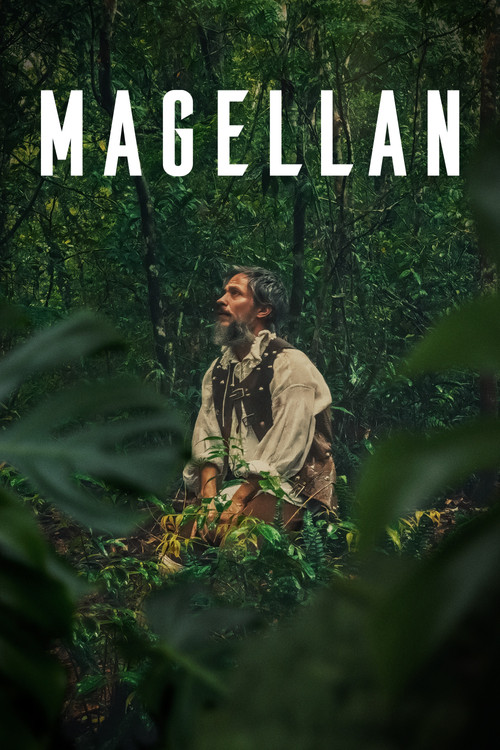
Magellan
2025 · Lav Diaz
For when you want epic cinema that doesn't mistake spectacle for depth — a film about the human and historical cost of conquest, not its glory. When you want something that will sit with you for days.
What it's about
Ferdinand Magellan — Portuguese-born, sailing under the Spanish crown — sets out on the first westward expedition to the Spice Islands, an attempt that will become history's first circumnavigation of the globe. Lav Diaz follows him from the violence of Portugal's Asian campaigns through his defection to Spain, the harrowing Pacific crossing with its starvation and near-mutiny, and the landfall at Cebu in the Philippines where a fatal conflict with local forces awaits. The film tells this founding myth of European exploration from the far side of the encounter the explorer did not survive.
The experience
Austere, vast, and meditative — a film that insists you feel the weight of the ocean and the grinding cost of empire. Diaz compresses his usual durational form without losing its contemplative gravity; patience is required and rewarded.
Performances
Gael García Bernal brings a quality of driven, corrosive faith to Magellan — a man so certain of his mission that he becomes blind to what it demands of everyone around him.
The craft
Diaz shoots in long, patient takes, but the film carries more incident than his usual work. The Pacific sequences conjure genuine disorientation and scale — the sensation of the sea as abyss rather than route. A multilingual script (Portuguese, Spanish, Cebuano, and others) underscores the Babel-like chaos of conquest and encounter.
Why it matters
Marks a significant pivot for Diaz — working with an internationally recognized star and a more legible historical form while remaining formally himself — and signals that slow cinema can inhabit the historical epic without abandoning its principles.
Snapshot
Magellan (released in some territories as Magalhães) is Lav Diaz's reckoning with the man whose 1521 landfall opened the Philippine archipelago to three and a half centuries of Spanish colonization. Working for the first time with a globally recognized lead — Gael García Bernal as Ferdinand Magellan — Diaz turns the founding myth of European circumnavigation into something closer to a tragedy of faith, ambition, and conquest, narrated from the far side of the encounter the explorer did not survive. The film follows Magellan from the violence of Portugal's Asian campaigns through his defection to the Spanish crown, the harrowing Pacific crossing, and the landfall at Cebu that culminates in his death at Mactan. For a filmmaker whose name is synonymous with durational "slow cinema" running to four, eight, even nine hours, Magellan is conspicuously compact — reportedly a little over two and a half hours — and it folds Diaz's austere, contemplative grammar into the unfamiliar architecture of an international historical co-production. It premiered at the 2025 Cannes Film Festival, the most visible berth yet for a director long fêted at Venice, Berlin, and Locarno but rarely positioned at this scale.
Industry & production
Magellan is, by Diaz's standards, an unusually large and international undertaking. Where his canonical works were shot quasi-independently in the Philippines on minimal budgets, this is a multi-country European-Asian co-production drawing Portuguese, Filipino, and other partners together around a subject that is, fittingly, transnational. The financing logic is legible in the material: a Portuguese explorer, a Spanish royal commission, an Italian chronicler in the historical record, and a Filipino terminus make the project a natural candidate for the kind of pan-European co-production funds and Lusophone cultural investment that a purely domestic Diaz film could never command. The casting of Gael García Bernal — a Mexican star with a long auteur résumé — is the clearest signal of this shift in scale, supplying the festival and sales visibility that an art film of this length and severity needs to travel.
The exact slate of production companies, funders, and below-the-line credits is not something I can enumerate reliably, and I will not invent names or figures. What can be said with confidence is structural: the film represents Diaz's migration from artisanal self-production toward the apparatus of subsidized European art cinema, and the friction (and the gains) of that migration are visible in the finished work — larger cast, period reconstruction, maritime logistics, and a runtime trimmed toward something a festival and a distributor can program in a single sitting.
Technology
Diaz has been one of the most committed exponents of lightweight digital cinema, and his career is in many ways a parable about what cheap, high-resolution digital capture made possible: the freedom to shoot enormously long takes without film-stock anxiety, to work with tiny crews, and to control image and edit himself. That technological disposition — image as a patient, accumulating record rather than a composed effect — underlies everything in his filmography, and there is no reason to think Magellan abandons it. The historical-epic remit, however, introduces demands his chamber dramas never faced: ships, period costume and weaponry, coastal and shipboard environments, and the staging of battle. How the production reconciled Diaz's minimalist capture philosophy with the physical scale of a 16th-century maritime expedition is one of the more interesting technical questions the film raises; specific information on its capture format and post pipeline is thin in the public record, and I will not guess at it.
Technique
Cinematography
Diaz's visual signature is among the most recognizable in contemporary cinema: long, often static wide shots; deep, patient compositions in which figures are small against landscape, weather, and time; and a refusal of coverage, camera movement, and close-up emphasis. He has worked predominantly in high-contrast black and white — the monochrome of From What Is Before, A Lullaby to the Sorrowful Mystery, and The Woman Who Left — though he is not doctrinaire about it, having shot Norte, the End of History (2013) in color. Magellan's historical and geographic sweep — open sea, tropical coast, the textures of period life — invites the question of whether Diaz extends his monochrome austerity to this material or modulates it; I cannot confirm the film's palette with certainty and so leave it open rather than assert. What is safe to say is that his compositional ethic — the held frame, the human figure dwarfed by environment and history — is precisely the grammar best suited to a story about men consumed by oceans, distance, and the indifference of the world they presume to chart.
Editing
Cutting is, for Diaz, almost a moral position. He typically edits his own films, and the long take is less a stylistic flourish than a way of restoring real duration — of making the viewer feel the passage of time as the characters feel it. In a story whose central ordeal is the Pacific crossing — months of starvation, scurvy, becalmed seas, and psychological erosion — duration is the subject, not merely the method. The compression of Magellan to a relatively short runtime is therefore notable: it suggests either a more elliptical structure than Diaz usually permits or a disciplining of his maximalism to the demands of historical narrative. Either way, the rhythm of withholding and waiting that defines his editing is the natural instrument for conveying the tedium and dread of a voyage into the unknown.
Mise-en-scène / staging
Diaz stages action in depth and in full, trusting the long shot to let behavior unfold without directorial underlining. Bodies move through space in real time; violence, when it comes, tends to be sudden, unglamorized, and observed from a distance that denies catharsis. For Magellan this approach carries an argument: the conquest, the conversions, the killings, and finally Magellan's own death at Mactan are presented not as spectacle but as events occurring within a continuous, unsentimental world. The staging of the Cebu landfall and the Mactan confrontation — where Magellan's drive to impose Catholicism collides with local resistance — is where Diaz's distanced mise-en-scène becomes a political instrument, refusing to grant the European protagonist the heroic framing the genre conventionally supplies.
Sound
Diaz's soundtracks are characteristically built from location ambience — wind, water, insects, the human voice unsweetened — with non-diegetic scoring used sparingly or withheld entirely; several of his films have essentially no music at all. (He has also, in Season of the Devil, gone to the opposite extreme of an a cappella "rock opera," so the absence of score is a choice, not an incapacity.) For a sea voyage, this naturalist soundscape is potent: the creak of rigging, the slap of water, the silence of the becalmed Pacific, and the diegetic liturgy of Catholic ritual would do the expressive work that an orchestral score does in conventional epics. I cannot confirm the specific sound or music credits for Magellan and will not invent them.
Performance
Diaz tends to direct performance toward restraint and endurance rather than display, favoring actors who can hold the frame without conventional emoting. The casting of Gael García Bernal is the production's boldest variable: a charismatic international star asked to submit to Diaz's deliberate tempo and distanced camera. Bernal's screen history — including, resonantly, his young traveler in The Motorcycle Diaries — has often involved men in motion across continents, and his presence imports a recognizability that Diaz's usual ensembles do not have. How that star wattage is metabolized by Diaz's anti-heroic method — whether Bernal's Magellan is granted interiority or held at the same cool remove as everything else — is central to the film's effect. The surrounding cast, including the Filipino figures of the Cebu and Mactan episodes, carries the counterweight: the perspective of the colonized against whom Magellan's faith and ambition break.
Narrative & dramatic mode
The film's dramatic mode is tragedy in the older, almost classical sense: a man of formidable will undone by the very drive that defines him. Magellan's ambition opens a westward route and his Catholic zeal seals his fate, the two impulses revealed as aspects of a single colonizing compulsion. Diaz characteristically structures narrative as moral process rather than plot mechanics — long stretches of ordeal and waiting punctuated by decisive, often violent events — and the Magellan story supplies a ready-made arc of hubris and nemesis. Crucially, the telling is positioned to deny the audience the triumphalism of "discovery." The expedition's nominal achievement (the first westward route, the proof of a circumnavigable globe) is shadowed throughout by its human cost — mutiny, starvation, executions — and by the knowledge that the protagonist will not live to see the voyage completed. The result is an anti-epic: the form of the heroic conquest narrative inhabited and hollowed out from within.
Genre & cycle
Nominally Magellan sits within the historical adventure and the period epic — the cycle of voyage-and-conquest films stretching from Hollywood's swashbucklers to the revisionist conquistador cinema of Herzog's Aguirre, the Wrath of God and Cobra Verde. It belongs most naturally to that revisionist lineage: films that take the iconography of European expansion and turn it toward madness, futility, and critique rather than glory. Where it diverges from even that tradition is in its vantage. Diaz is a Filipino filmmaker telling the story of the man whose arrival inaugurated his own nation's colonization, which aligns Magellan with a broader contemporary cycle of postcolonial historical cinema that reclaims the encounter from the colonizer's perspective. The film thus straddles two genres that rarely meet: the European art-house epic and the decolonial national-history film.
Authorship & method
Lav Diaz (b. 1958) is the central figure of contemporary Philippine art cinema and the most internationally garlanded exponent of "slow cinema," with a body of work that includes Evolution of a Filipino Family, Norte, the End of History (Cannes, 2013), From What Is Before (Locarno Golden Leopard, 2014), A Lullaby to the Sorrowful Mystery (Berlin, 2016), and The Woman Who Left (Venice Golden Lion, 2016). His method is famously total: he frequently writes, directs, shoots, and edits his own films, and sometimes contributes music, producing an authorship as concentrated as any in world cinema. That concentration is the lens through which Magellan's collaborative, co-produced nature should be read — it is a test of how much of Diaz's solitary, durational practice survives translation into a larger industrial frame.
On Magellan's specific key collaborators — cinematographer, composer, editor, co-writers — the reliable public record available to me is thin, and I will not attribute roles I cannot verify; given his history, it is plausible Diaz retained several of these functions himself, but I flag that as inference, not fact. The one collaboration that is certain and consequential is with Gael García Bernal, whose star presence is itself an authorial decision, marking Diaz's willingness to bend his hermetic system around a recognizable face for a story that demanded international reach.
Movement / national cinema
Diaz is inseparable from the Philippine New Wave and from the global slow-cinema tendency theorized around filmmakers such as Tsai Ming-liang, Béla Tarr, and Apichatpong Weerasethakul. His project has always been national in the deepest sense: an attempt to write Philippine history — the Marcos dictatorship, rural poverty, colonial trauma, the long aftermath of violence — in a cinematic form commensurate with that history's weight. Magellan reaches back to the origin point of that history, the moment of first contact and the beginning of Spanish rule, and so functions almost as a prequel to the colonial wound that Diaz's other films trace forward into the present. The figure of Lapulapu and the Battle of Mactan — foundational to Philippine national memory as the first successful resistance to European conquest — give the film its decolonial charge and root it firmly in a Filipino reckoning, even as its protagonist and much of its financing are European.
Era / period
The film is set at the dawn of the modern era, 1519–1521, in the age of the Iberian maritime expansion that bound Europe, the Americas, and Asia into a single circuit of commerce, faith, and conquest. Its historical scaffolding is well documented: Magellan's Portuguese origins and service in the East, his defection to Charles I of Spain, the 1519 departure in search of a westward passage to the Spice Islands, the strait that bears his name, the brutal Pacific crossing, and the 1521 landfall at Cebu where the conversion of local rulers preceded his death at Mactan on 27 April 1521. The expedition would be completed without him, the first circumnavigation of the globe achieved by the survivors. Diaz mines this period not for pageantry but for its inaugural violence — the instant at which the modern, globalized, Christianized world order began to impose itself on the archipelago.
Themes
The film's governing themes are faith and conquest as a single force. Magellan's Catholicism is not incidental to his colonialism but its engine; the synopsis's framing — that his drive to spread Catholicism pulls him into the fatal conflict at Mactan — locates the film's tragedy precisely in the marriage of cross and crown. Around this sit Diaz's enduring preoccupations: the corrosive nature of ambition, the psychological disintegration produced by isolation and ordeal (here, the endless seas), and the moral cost of empire. The Pacific crossing dramatizes a second theme — the body and mind under extremity, starvation and mutiny stripping the expedition to its desperate core. And underneath all of it runs the postcolonial counter-narrative: the insistence that this "discovery" was an invasion, that the natives who killed Magellan were defending a world, and that the heroic European arc is, seen from Cebu and Mactan, a story of catastrophe. Time, memory, and historical reckoning — Diaz's perennial concerns — convert the period film into a meditation on origins.
Reception, canon & influence
As a 2025 Cannes premiere headlined by Gael García Bernal, Magellan arrived as the most prominent platform of Diaz's career, and the basic terms of its reception are legible even where I cannot responsibly quote specific reviews, ratings, or box-office figures: it was received as a major auteur's encounter with a major historical subject, and its sharply reduced runtime was widely read as a significant adjustment of his durational signature. I will not fabricate critical verdicts or numbers; what can be stated is the discourse it necessarily entered — the question of whether Diaz's austere method gains or loses by scaling up, and whether a star-led, co-produced epic can preserve the radical patience that made his reputation.
Looking backward, the film's influences are clear and acknowledgeable: the revisionist conquistador cinema of Werner Herzog (Aguirre, Cobra Verde) as a template for the European-madness-in-the-tropics narrative; the slow-cinema lineage of Tarr and Tsai that shaped Diaz's grammar; and the historical record itself — the documented voyage and the Filipino national memory of Lapulapu and Mactan — as its primary source material. Looking forward, its legacy is best understood as part of Diaz's larger ongoing project of rewriting Philippine history on screen, and as a high-profile instance of postcolonial cinema repatriating a colonial founding myth. Whether Magellan becomes a turning point toward a more internationally scaled Diaz, or a singular experiment within an otherwise hermetic body of work, is a judgment the historical record is still too young to render, and I will not pretend otherwise.
A Deleuzian reading
A ship sits on a flat sea.
The full Deleuzian reading of Magellan →
Reception
Premiered out of competition at Cannes 2025 to a five-minute standing ovation, then kept climbing: Janus Films picked it up for North America and the Philippines chose it as its 2026 Oscar entry — an instant arthouse event rather than a slow-burn discovery.
How Magellan was received, from release to now →
How to watch Magellan: what to notice on a first viewing
- Watch the camera hold still on a flat, empty sea. Long static wide shots let the ship sit on open water without a cut, so nothing visibly happens for stretches at a time. Waiting becomes the actual event here, not a gap between events the plot needs to fill.
- Notice how small the men look against the ocean. Figures are staged deep within the frame, dwarfed by water and horizon rather than placed close to the lens for emphasis. The scale tells you something the dialogue doesn't: how little any one man's will matters against this much indifference.
- Listen for wind, water, and rigging instead of music. The soundtrack stays built from location ambience with almost no score, so the ship's own noise fills the silence the story leaves. The absence of music keeps the voyage feeling endured rather than scored for effect.
- Watch for restraint rather than display in every performance. Even the film's recognizable star is directed toward endurance and stillness, holding the frame without conventional emoting. A famous face submitting to this tempo is itself part of what the film argues about the man he plays.
The whole guide to watching Magellan, with the keys for a rewatch →
Influences: the films it descends from and the films it influenced
- Aguirre, the Wrath of God (1972) — Establishes the template Diaz openly borrows: the conquistador expedition framed in static or slowly-drifting wide shots where the tropical landscape physically grinds down the European mind, letting environment and duration—not editing—dramatize colonial delirium.
- Cobra Verde (1987) — Models the colonizer-as-tragic-monster protagonist, staging the European adventurer against indigenous terrain in long held compositions that refuse heroic montage, the same anti-adventure framing Diaz applies to Magellan.
- Sátántangó (1994) — Source of Diaz's core grammar—extended black-and-white long takes, glacial lateral tracking and locked-off wides where narrative is paced by walking-time rather than cuts, with the director controlling tempo as the primary expressive instrument.
- Werckmeister Harmonies (2000) — Demonstrates monochrome philosophical tragedy built from a small number of choreographed long takes, the depth-staged procession through space that Diaz adapts for his historical processions.
- Goodbye, Dragon Inn (2003) — Codifies the static-wide, no-score, location-ambience method—holding empty or near-still frames so long that diegetic sound and architecture become the drama, a discipline Diaz shares with Tsai's wing of slow cinema.
- Andrei Rublev (1966) — Precedent for the black-and-white anti-epic of national history: treating a founding-era subject through long, contemplative tableaux and episodic restraint rather than the spectacle and forward drive of the costume epic.
- Embrace of the Serpent (2015) — Inherits the Aguirre-via-Diaz line into postcolonial cinema: black-and-white encounter between European travelers and indigenous worlds, reframed from the colonized vantage rather than the explorer's, as Magellan does with Lapulapu and Mactan.
- Zama (2017) — Extends the colonizer-in-decay study with rigorous off-center static framing and dense location ambience, dramatizing imperial waiting and madness through duration and sound design rather than event—Diaz's tactics in a different sensory key.
- Balikbayan #1: Memories of Overdevelopment (2015) — The most direct lineage in subject: a Filipino retelling of the circumnavigation through Enrique of Malacca, Magellan's enslaved interpreter—the same postcolonial repatriation of the conquest myth Diaz undertakes, from Philippine New Wave roots.
- Evolution of a Filipino Family (2004) — Diaz's foundational durational rewriting of Philippine history, where his total-authorship method (writing/shooting/editing himself) and extreme runtime first turn national memory into long-take cinema—the project Magellan extends at festival scale.
- Norte, the End of History (2013) — Same authorial signature applied to classical-tragedy structure (here Dostoevsky), proving Diaz's habit of grafting a borrowed literary/historical tragic architecture onto static-wide Filipino landscapes.
- From What Is Before (2014) — Closest formal cousin: black-and-white, no-score, location-ambience period reconstruction staged in depth across rural Philippine terrain, with performance pitched to restraint inside the wide frame.
- A Lullaby to the Sorrowful Mystery (2016) — Diaz's prior colonial-era national epic—revolution against Spain rendered in monochrome long takes—directly continuous with Magellan's project of filming the Iberian-conquest chapter of Philippine history.
- The Woman Who Left (2016) — Refines the high-contrast black-and-white static-wide aesthetic and the morally weighted restrained performance that Diaz carries into Magellan's star-led frame.
- Jauja (2014) — Contemporary slow-cinema conquest film built from boxy static tableaux of a European officer dissolving into colonial wilderness—an exact parallel in method (held wides, location sound, anti-narrative drift) and subject to Magellan.
- Tabu (2012) — Black-and-white reckoning with a colonial founding myth that foregrounds ambient sound and the texture of memory over score and spectacle, a parallel formal strategy for repatriating an imperial story.
Similar films
- Evolution of a Filipino Family (2004) — influence & lineage · same viewing thread
- From What Is Before (2014) — influence & lineage
- Zama (2017) — influence & lineage
- Embrace of the Serpent (2015) — influence & lineage
- Satantango (1994) — influence & lineage · same viewing thread
- Norte, the End of History (2014) — same viewing thread
- Batang West Side (2001) — shared sensibility
- Heneral Luna (2015) — shared sensibility
All the films related to Magellan →
Watch it with: curated runs of related films
- The Long Shadow of the Coup — A run of films tracing political violence from the mutiny and the massacre through martial law to the decades-long reckoning that follows — watch them near each other and the same machinery of power keeps rhyming across continents and eras.