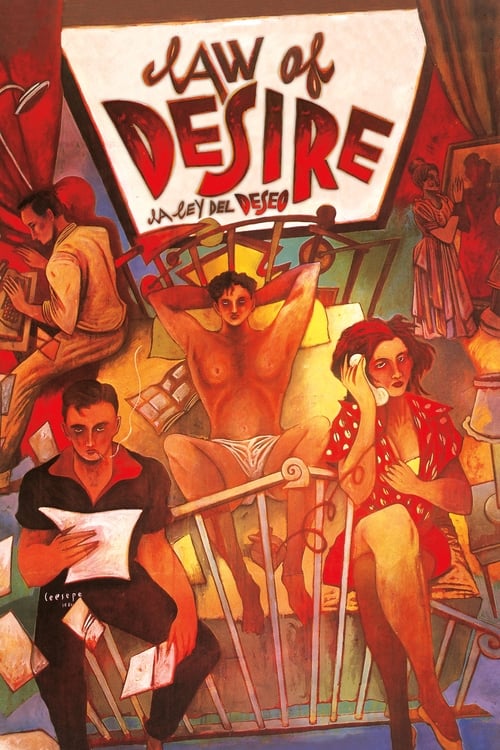
Law of Desire
1987 · Pedro Almodóvar
Spain's institution entered his English-language era (The Room Next Door, Venice Golden Lion) amid discourse about late style and euthanasia on film; his refusal to soften political statements at ceremonies keeps him quotable.
For when you want passion turned up past reasonable — a hot-blooded, stylish night of desire and danger rather than a safe romance. Great for viewers ready to be swept somewhere reckless.
What it's about
Pablo, a successful gay film director in post-Franco Madrid, is nursing a bruised heart over Juan, a young lover who can't return his intensity, and pouring himself into a stage project starring his sister Tina, a transgender actress with wounds of her own. Into this charged family orbit walks Antonio, a rigid young man from a conservative background whose first taste of desire for Pablo tips into total possession. What begins as a fling becomes a dangerous triangle of longing, jealousy, and obsession.
The experience
Lurid, funny, and genuinely dangerous — it swerves from campy comedy to full-blooded melodrama to nail-biting thriller, sometimes within a single scene, and plays every register with complete conviction. You come out exhilarated and a little scorched.
Performances
Carmen Maura is astonishing as Tina — ferocious, wounded, and hilarious, in what many consider her greatest role. A young Antonio Banderas is riveting as the obsessive Antonio, all coiled politeness over something frightening, and Eusebio Poncela holds the center with weary, sensual intelligence.
The craft
This is Almodóvar's sensibility arriving fully formed: saturated colors, bold production design, pop songs deployed like emotional depth charges, and a script that treats outrageous plotting with total sincerity. The Madrid nightscapes and interiors are gorgeous, and the tonal control — steering camp and tragedy through the same curve — is the real virtuoso act.
Why it matters
A landmark of queer cinema for putting gay and trans desire at a story's emotional center without apology or punishment, it broke Almodóvar internationally and set the template for the melodramas that made him Spain's most celebrated director.
Snapshot
La ley del deseo is Pedro Almodóvar's sixth feature and, by common critical agreement, the film in which his sensibility fully crystallized — the point where the anarchic provocation of his early Movida comedies fused with the melodramatic seriousness that would define his mature work. A three-cornered story of obsessive love among a gay film director, his sister (a transgender woman), and the young stranger whose desire curdles into murder, it is at once a Douglas Sirk–inflected weepie, a Hitchcockian thriller of possession, and a manifesto: the title's "law" is that desire brooks no legislation, no reciprocity, no restraint. It is historically significant as one of the first films by a major emerging European director to place gay male passion at its emotional center without apology or tragedy-as-punishment, and as an early showcase for Antonio Banderas. It was also the inaugural production of El Deseo, the company Almodóvar founded with his brother Agustín — the institutional birth of Almodóvar as a self-governing auteur.
Industry & production
Law of Desire marks a decisive shift in Almodóvar's production circumstances. After making his earlier features under precarious, patchwork financing, he and his brother Agustín Almodóvar established El Deseo S.A. specifically to gain control over the means of production; Law of Desire was the company's first film, and Agustín's role as producer inaugurated a fraternal partnership that has underwritten every subsequent Almodóvar feature. This is the moment Almodóvar ceased to be a scrappy underground figure and became the head of an ongoing enterprise.
The film emerged from the post-Franco Spanish film culture of the mid-1980s, a period when state subsidy structures (associated with the Socialist government's cultural policy) and a liberalized censorship regime made frank material commercially viable in a way unimaginable a decade earlier. The picture was shot in Madrid, and its milieu — theater, cinema, nightlife — is drawn directly from the artistic subculture Almodóvar himself inhabited. Precise budget and box-office figures for the film are not something I can state with confidence, and I will not invent them; the record most reliably attests to its cultural rather than commercial impact. It premiered in 1987 and traveled the festival circuit, where its explicit subject matter made it both a cause célèbre and a breakthrough for its director's international profile.
Technology
Technologically the film is conventional for its moment: 35mm color photography, sync-sound production, a compilation-heavy music track laid in post. What is worth noting is not any novel apparatus but Almodóvar's thematized attention to media technology itself. The film is saturated with the instruments of mediated communication — the typewriter on which Pablo composes the love letters he wishes to receive, and even signs in his lover's name; the telephone as the umbilical of longing; the dubbing booth; the movie screen. These are the ordinary technologies of 1980s life pressed into service as metaphors for desire's circulation and its falsifications. The film's interest is less in cinema's machinery than in its capacity to author reality, a preoccupation announced in the very first scene.
Technique
Cinematography
The photography is credited to Ángel Luis Fernández, who shot several of Almodóvar's earlier films and was a key collaborator in forging the director's early look. The visual style prizes saturated, near-hallucinatory color — reds especially — and clean, frontal, poster-like compositions that owe something to pop art and to the graphic flatness of comic strips and advertising. Where a Hollywood melodramatist might soften emotion in diffusion, Fernández and Almodóvar tend toward hard, bright legibility, so that the artificiality of the surfaces reads as expressive rather than concealing. Nocturnal Madrid is rendered with a warm, sweltering palette; the famous moment in which Tina, overheated on a summer street, asks a municipal street-cleaner to hose her down is staged as an almost ecstatic image of relief and exposure.
Editing
Editing is by José Salcedo, Almodóvar's near-lifelong cutter, who worked on nearly all of his features until Salcedo's death. The film's construction is characteristically bold in its tonal modulation — Salcedo and Almodóvar cut between farce, erotic reverie, and thriller suspense with a confidence that keeps the melodrama from tipping into either camp or bathos. The escalating final act, a siege-and-standoff, is built with genre efficiency, while the flashback architecture that gradually discloses Tina's history is managed so that revelation lands as emotional detonation rather than mere plot mechanics.
Mise-en-scène / staging
Almodóvar's mise-en-scène is already, here, the densely designed environment that would become his signature: apartments crowded with art, kitsch, and pointed props; costume and décor keyed to character psychology. The stage is a recurring space — Pablo directs Tina in a theatrical production, and the film repeatedly frames performance within performance. The most celebrated instance is the play-within-the-film built around Jean Cocteau's monologue La Voix humaine (The Human Voice), a woman alone with a telephone and an absent lover, which Almodóvar embeds as a mirror of the whole film's themes of abandonment and one-sided passion. Objects carry the drama: the typewriter, the letters, a gun, and — in the opening — the disembodied instruction of a director's voice.
Sound
The soundtrack leans on the bolero and torch-song traditions Almodóvar loved, using Spanish- and other-language ballads of longing as ironic and sincere emotional counterpoint. (I'd caution that I can't verify every individual track from memory, so I won't list a discography I'm not certain of.) The film's most conceptually charged use of sound is its opening: a dubbing session in which an off-screen director dictates the words and moans an actor must perform, foregrounding the constructedness of desire's very expression — the erotic voice as something authored, staged, ventriloquized. Sound in Law of Desire is rarely innocent; it is always, potentially, someone else's script.
Performance
The performances are the film's engine. Carmen Maura, Almodóvar's central muse of the period, plays Tina — a transgender woman with a wounding backstory involving her father and her transition — and invests a role that could have been sensational with dignity, fury, and pathos; it is one of the great performances of the early Almodóvar cycle. Eusebio Poncela plays Pablo with a bruised, self-lacerating intensity. And Antonio Banderas, then a young actor at the start of his association with the director, plays Antonio, the possessive obsessive, with a smoldering blankness that makes his violence both frightening and pitiable. Banderas's willingness to play gay desire frankly — including physical intimacy with another man — was notable for a rising male star and became part of the film's legend.
Narrative & dramatic mode
The dominant mode is melodrama in the fullest sense: a drama of excessive feeling, coincidence, and moral extremity in which emotion overrides plausibility by design. Onto that Almodóvar grafts the thriller — obsession, murder, an amnesiac survivor, a police investigation, a hostage climax — so that the film oscillates between the register of the "woman's picture" and that of the crime story. The narrative is structured around a triangle and around gradual disclosure, with Tina's past withheld and then revealed to recontextualize everything. A self-reflexive frame runs throughout: the film opens on a shoot, returns repeatedly to stages and screens, and treats writing (the forged love letters) as an act that manufactures reality. Desire, in this dramatic scheme, is not a feeling one has but a law one obeys, and the plot is the record of what obedience costs.
Genre & cycle
Law of Desire sits at the hinge of Almodóvar's own genre evolution. It belongs to the cycle of his 1980s work that moved from the pure comedic anarchy of Pepi, Luci, Bom (1980) and Labyrinth of Passion (1982) toward the melodrama-thriller hybrids of Matador (1986), Law of Desire (1987), and Women on the Verge of a Nervous Breakdown (1988). Within the broader field it can be read as queer melodrama, as an inheritor of the Hollywood family melodrama (Sirk, Ray) refracted through a specifically Spanish and specifically gay sensibility, and as a thriller in the possessive-love tradition that runs from Hitchcock forward. It is frequently cited in histories of New Queer Cinema's prehistory, arriving a few years before that movement was named and prefiguring its refusal of the "tragic homosexual" formula.
Authorship & method
The film is a total Almodóvar authorship: he wrote and directed it, and it was the first fruit of the production company he built to keep such authorship intact. His method here — recognizable across his career — combines meticulous visual design, a compilation soundtrack used as emotional architecture, and a repertory of trusted collaborators. Chief among them on this film: cinematographer Ángel Luis Fernández, whose saturated palette helped define the early look; editor José Salcedo, whose tonal control held the genre-mixing together; producer Agustín Almodóvar, whose stewardship of El Deseo freed his brother's hand; and, above all, Carmen Maura, the actress most identified with this phase of his work. On the question of an original score I'd rather flag uncertainty than overstate: Almodóvar's early films typically foreground pre-existing songs, and I can't reliably attribute a specific composer credit here without risking error. What is certain is that the authorial signature — the fusion of pop surface with genuine feeling, the queer content treated as ordinary passion, the reflexivity about cinema itself — is fully present.
Movement / national cinema
Law of Desire is a landmark of the Movida Madrileña, the explosion of countercultural creativity in Madrid after Franco's death in 1975, and of the new Spanish cinema that democratization made possible. Almodóvar was the Movida's most internationally visible cinematic product, and this film carries the movement's DNA: its hedonism, its embrace of nightlife and marginal identities, its exhilarated sense that anything previously forbidden was now expressible. At the same time it participates in the reinvention of Spanish national cinema after decades of dictatorship-era censorship, offering a portrait of Madrid — urban, permissive, cosmopolitan — that stood as a deliberate rebuke to the repressive, Catholic, patriarchal Spain that had preceded it.
Era / period
The film is a document of the mid-to-late 1980s: a specific Madrid of summer heat, discos, artists' flats, and a culture testing the limits of its new freedoms. It belongs to the moment before AIDS had fully reshaped the representation of gay life on screen internationally, and its frank, largely un-anxious treatment of gay male desire reads as a product of that particular window. Period-wise it also sits at the threshold of Almodóvar's crossover: within a year Women on the Verge of a Nervous Breakdown would carry him to global art-house stardom, making Law of Desire the last film of his purely "cult" period and the first of his mature institutional one.
Themes
The film's governing theme is desire as sovereign, ungovernable law — the conviction, stated by the title, that love obeys no principle of proportion or return. Around it cluster Almodóvar's abiding preoccupations: the fluidity and constructedness of identity, most powerfully through Tina, whose gender, faith, and family history are all narratives she has authored or survived; the entanglement of cinema and reality, dramatized in the forged letters, the dubbed voices, and the plays-within-the-film; Catholicism and its residue, present in Tina's spiritual longing and the imagery of devotion turned toward human objects; and the family as chosen and improvised rather than given by blood. Obsession, possession, jealousy, and the violence latent in absolute love drive the plot, while the film insists throughout on the dignity and ordinariness of queer and trans lives that mainstream cinema had long consigned to pathology or punchline.
Reception, canon & influence
Critically, Law of Desire has come to be regarded as a pivotal Almodóvar film and a milestone in queer cinema. Its explicit content generated controversy on release, but over time the consensus settled on its importance as the work in which Almodóvar's melodramatic maturity announced itself and in which gay desire was granted the full apparatus of romantic seriousness. It is credited with winning a Teddy Award — the LGBT prize inaugurated at the Berlin International Film Festival in 1987 — which situates it at the very origin of that institutional recognition of queer film.
Looking backward, the film's influences are legible and often acknowledged within the text: Jean Cocteau, whose The Human Voice Almodóvar stages here and would return to across his career (its echoes shape Women on the Verge and he directed an outright short adaptation decades later); the Hollywood melodrama of Douglas Sirk and Nicholas Ray; Hitchcock's studies of obsessive possession; and the Spanish bolero and torch-song tradition that supplies the film's emotional grammar. Looking forward, its legacy is substantial. It consolidated the Almodóvar–Maura and Almodóvar–Banderas partnerships that defined his 1980s output and helped launch Banderas toward international stardom. It stands as a crucial precursor to the New Queer Cinema of the early 1990s, modeling a cinema in which homosexuality is neither closeted nor doomed but simply the medium of a grand passion. And within Almodóvar's own filmography it is the template for the reflexive, melodrama-thriller mode he would refine in later masterworks — a film whose concerns with performance, identity, and the tyranny of longing he has never stopped rewriting.
A Deleuzian reading
A woman on a summer street in Madrid, too hot to stand it, asks the municipal street-cleaner to turn his hose on her.
The full Deleuzian reading of Law of Desire →
Reception
A scandal-tinged hit in 1987 Spain that put Almodóvar on the international map a year before Women on the Verge — now it's canonized as a landmark of queer cinema and the moment his career turned serious.
How Law of Desire was received, from release to now →
How to watch Law of Desire: what to notice on a first viewing
- Watch how saturated and red the color gets indoors. Fernández shoots in hard, bright, poster-flat color, especially red, rather than the soft diffusion a Hollywood melodrama would use to cushion emotion. The color carries the feeling of a scene directly, out in the open, instead of hiding it in shadow.
- Listen for the opening dubbing session before anyone appears. An unseen director dictates an actor's words and moans from off screen, so the most intimate sound in the film is revealed as scripted by somebody else. The film tells you right away that voice and desire in this world are rarely anyone's own.
- Watch for the typewriter and the letters Pablo writes. Pablo, dissatisfied with his lover Juan, types letters and signs them in Juan's name, an object that keeps returning at key moments in the story. He is writing the lover he wants into existence rather than accepting the one he has.
- Watch how often the film stages a performance inside itself. Pablo directs Tina in a play built from Cocteau's monologue, a woman alone with a phone and an absent lover, staged within the larger film about absent lovers. The play is not commentary on the story, it is the story again, in miniature, on a stage.
The whole guide to watching Law of Desire, with the keys for a rewatch →
Influences: the films it descends from and the films it influenced
- Written on the Wind (1956) — Supplies the melodramatic grammar Almodóvar inherits — emotional states externalized through saturated Technicolor and loaded interior décor, so that a lamp or a color can carry the hysteria the dialogue withholds.
- Johnny Guitar (1954) — Models the hysterical, gender-inverted melodrama pitched past realism into pure feeling — Ray's willingness to let color and performance run to operatic excess is exactly the register Almodóvar reaches for.
- L'Amore (Una voce umana) (1948) — The direct source-text model: it films Cocteau's 'The Human Voice' — a woman alone performing abandonment into a telephone — the very monologue Almodóvar stages for Tina inside the film.
- Les Parents terribles (1948) — Provides the theatricalized, incestuous-possessive family melodrama and the device of cinema-as-filmed-performance that underwrites Law of Desire's staging of passion as something acted and framed.
- Vertigo (1958) — The template for obsessive erotic possession as suspense architecture — the lover who would remake, control, and destroy the beloved — which Almodóvar rebuilds in Antonio's fatal fixation on Pablo.
- In a Year of 13 Moons (1978) — Applies Sirkian melodrama to a trans protagonist with full romantic seriousness rather than pathology, the precise move Almodóvar makes with Tina — melodrama as the natural medium for queer and trans lives.
- The Bitter Tears of Petra von Kant (1972) — Recodes Sirkian saturated melodrama as overt queer desire-as-domination, inheriting the Fassbinder move of treating the woman's-picture template as a vehicle for transgressive, stylized passion.
- Kiss of the Spider Woman (1985) — Extends Puig's melodrama-as-refuge sensibility, deploying heightened Sirkian artifice to render queer desire with mainstream emotional seriousness.
- Women on the Verge of a Nervous Breakdown (1988) — Grows directly out of the Cocteau 'Human Voice' material seeded here, again built around Carmen Maura as a woman monologuing into a phone at an absent lover, with Salcedo's tonal editing carrying the comic-melodramatic modulation.
- Bad Education (2004) — The mature reworking of the reflexive queer melodrama-thriller — a film-within-a-film, a trans/drag performer at its center, and a noir plot of impersonation and desire that is Law of Desire's structure refined.
- Pain and Glory (2019) — Completes the Almodóvar–Banderas arc begun here by casting Banderas as an explicit director-surrogate, turning the earlier film's reflexivity about the filmmaker's own desire into full autofiction.
- The Human Voice (2020) — His outright short adaptation of the same Cocteau text Tina performs, closing the loop on the monologue-of-abandonment device that has run through his cinema since Law of Desire.
- Poison (1991) — A founding New Queer Cinema work that, like its precursor, treats homosexual desire as ordinary passionate material and braids genre pastiche with transgression rather than closeting or dooming it.
- The Living End (1992) — Extends the pre-AIDS/AIDS-era queer lovers-on-the-run melodrama-thriller with the same refusal of the doomed-homosexual template, desire driving the plot as an unapologetic engine.
- Far From Heaven (2002) — The most literal Sirk revival of the same lineage — saturated color, décor-as-emotion, and forbidden queer longing given melodramatic dignity — running the Sirk-to-queer-melodrama pipeline Almodóvar opened.
- All About My Mother (1999) — Deepens the film's device of performance-within-performance and the trans character rendered with melodramatic seriousness, again using a staged play (here Streetcar) as the mirror for the characters' desires.
- La bola negra (2026) — El Deseo's founding production, which set the house grammar of queer melodrama played without irony through saturated colour, theatricality and a playwright protagonist whose work and desire blur together.
- Bitter Christmas (2026) — Almodóvar's first protagonist who is a writer-director using the people closest to him as raw material, so the film is first a film about filmmaking and then a reckoning with what that use costs.
- Matador (1986) — Its immediate companion piece — same Banderas discovery, same El Deseo/Fernández saturated look, same equation of desire with death — the thriller-melodrama fusion Law of Desire perfects a year later.
- Carol (2015) — Shares the project of granting same-sex desire the full romantic apparatus of classical melodrama — controlled color, torch-song emotional scoring, and longing treated as grand passion rather than problem.
Similar films
- Women on the Verge of a Nervous Breakdown (1988) — influence & lineage
- Pain and Glory (2019) — influence & lineage
- All About My Mother (1999) — influence & lineage
- Bad Education (2004) — influence & lineage
- Last Tango in Paris (1972) — shared sensibility
- Tie Me Up! Tie Me Down! (1990) — shared sensibility
- Cria! (1976) — shared sensibility
- Talk to Her (2002) — shared sensibility