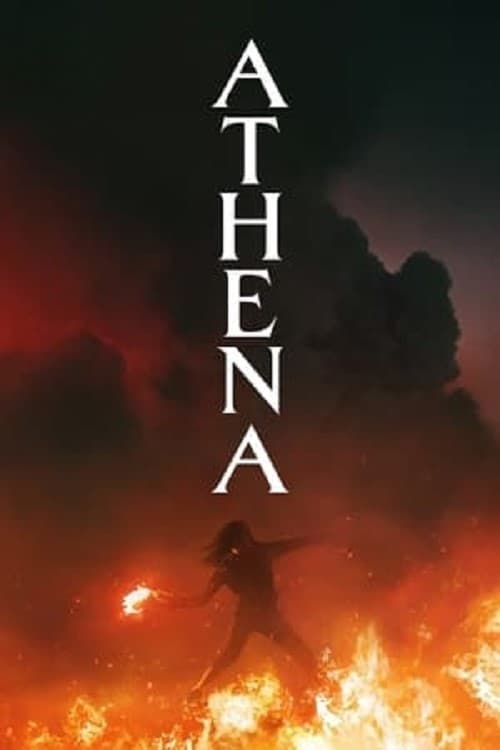
Athena
2022 · Romain Gavras
For when you want pure adrenaline with real emotional stakes — an intense, immersive spectacle rather than a relaxing watch. Demands the biggest screen and loudest speakers you can give it.
What it's about
Hours after a young boy dies, apparently at the hands of police, the Parisian housing estate of Athena explodes into open revolt. The film follows his three surviving brothers — a soldier home from the front lines, an insurgent leading the uprising, and a drug dealer trying to protect his business — as the estate becomes a battlefield and their loyalties tear along the lines of grief and revenge.
The experience
Breathless is the literal word: it's staged in colossal, minutes-long unbroken takes that sweep you through riots, sieges, and firelit crowds like you're inside them. Overwhelming, operatic, and heavy with tragedy even at full sprint.
The craft
Romain Gavras stages a modern uprising with the grammar of a war film and the choreography of a ballet — the bravura opening long take alone is worth the watch, and the pounding electronic score turns the siege into something mythic. Co-written with Ladj Ly, it compresses a national crisis into twenty-four hours and one location.
Why it matters
Its Venice premiere set off a real argument about staging civil unrest as grand spectacle, and its long-take craft immediately became a reference point for ambitious action filmmaking.
Snapshot
Athena is a French action-tragedy that compresses a national crisis into roughly twenty-four hours and a single besieged housing estate. After the death of a young boy, apparently at the hands of police, the fictional Parisian banlieue of Athena erupts; the film follows three surviving brothers — the soldier Abdel, the insurgent Karim, and the dealer Moktar — as their loyalties fracture along the fault lines of grief, revenge, and survival. Romain Gavras, co-writing with Les Misérables director Ladj Ly and Elias Belkeddar, stages the unrest not as social realism but as classical tragedy rendered in the grammar of the war film and the music video: bravura long takes, balletic crowd choreography, and a propulsive electronic score. Premiered in competition at the 79th Venice International Film Festival in September 2022 and released worldwide on Netflix that same month, the film is best understood as an attempt to fuse the banlieue cinema lineage of La Haine with the scale and kinetic spectacle of large-format action filmmaking — an ambition that drew both admiration for its formal audacity and skepticism about its politics.
Industry & production
Athena was produced for Netflix, which financed and distributed it globally, a fact that shapes nearly everything about the project's scale and visibility. The streaming model allowed an unusually expensive and technically demanding French-language film — one built around large crowd scenes, pyrotechnics, and an estate-sized practical set — to reach an international audience simultaneously rather than through the slower festival-and-arthouse pipeline that has historically carried French banlieue films abroad. The production was associated with Iconoclast, the production house with which Gavras has long been linked through his commercial and music-video work, alongside Belkeddar's involvement.
The film was shot largely on a purpose-built or substantially dressed location standing in for the Athena estate; the production designed the cité as a coherent, defensible architectural space — a courtyard, stairwells, and towers that function almost as a fortress in the film's siege logic. This emphasis on a unified, navigable geography was a production necessity rather than decoration: the film's signature unbroken sequences require that space be real, continuous, and rehearsable. The record on precise budget figures and shooting-day counts is not something I can state with confidence, and I will not invent numbers; what is clear from the finished film and from the nature of its long takes is that production planning was organized around extended, heavily choreographed single shots involving large numbers of performers, stunt work, and controlled fire.
The Venice competition slot signaled Netflix's positioning of the film as a prestige title rather than disposable content, and the September 2022 release date placed it within the festival's awards conversation even as its primary life would be on the platform.
Technology
The defining technological proposition of Athena is sustained camera mobility over long durations through complex, multi-level space. The film opens with a celebrated extended take — frequently cited as running roughly ten to eleven minutes — that moves from a press conference outside a police station, through the storming of the precinct, onto a commandeered vehicle, and into the estate. Achieving this required the camera to transfer fluidly between operators and rigs: handheld, Steadicam, vehicle mounts, and likely drone or cable work for the elevated passages. Such shots depend on contemporary lightweight digital cinema cameras and stabilization systems that permit the operator to run, climb, ride, and hand off the camera without the cuts that older technology would have forced.
Whether these sequences are genuinely single unbroken takes or are composites stitched from multiple passes with hidden cuts — the now-standard "invisible edit" technique popularized by films like Birdman and 1917 — is a question the film does not resolve on screen, and I will not assert one method over the other as fact. What matters technologically is that the production committed to the appearance of continuity at a scale and in an environment (crowds, fire, vertical movement) that makes the achievement notable regardless of how many concealed seams exist. The choreography of pyrotechnics, fireworks used as weapons, and stunt performers within these continuous frames represents the more demanding technical accomplishment than any single camera trick.
Technique
Cinematography
Matias Boucard's photography is the film's primary authorial signature alongside Gavras's staging. The camera is almost never static; it is a participant, swept up in the surge of bodies, pushed forward in the charge and dragged backward in the retreat. The visual strategy privileges immersion over legibility-from-distance: rather than cutting to wide masters that explain the geography, the film keeps the viewer inside the action at body height, so that space is understood kinesthetically, through movement, the way the characters experience it. Fireworks and flames provide much of the light and color in the night sequences, lending the estate an infernal, almost mythological glow — embers, smoke, and tracer-like arcs of light that elevate a riot into something closer to a vision of hell or a battlefield from epic. The palette leans toward warm sodium oranges and reds against the cold blue-gray of concrete, a contrast that reinforces the film's tension between human heat and institutional architecture.
Editing
Benjamin Weill is credited with the editing, and the film's cutting philosophy is paradoxical: its most discussed passages are defined by the suppression of the cut. The editorial work in the long-take sequences is therefore partly invisible — concerned with concealing transitions and sustaining momentum — while in other passages the film does deploy more conventional découpage. The rhythm overall is relentless, organized around escalation; the structure marches toward catastrophe with the inevitability of tragedy, and the editing serves that forward pressure rather than reflective pause. The film largely refuses the breathing room that would allow contemplation, a choice that is both its formal strength and the source of complaints that it leaves no space for the political reflection its subject demands.
Mise-en-scène / staging
This is the film's deepest achievement. Gavras choreographs hundreds of bodies through vertical and horizontal space with a clarity that recalls battle staging in epic cinema and the precision of large-scale dance. The estate functions as a stage with defined zones — the courtyard as arena, the stairwells as channels of advance and retreat, the apartments as redoubts. Crowd movement is legible as tactics: charges, flanks, regroupings. The recurring use of fireworks as projectiles is staged as ritualized combat, beautiful and lethal at once. The mise-en-scène consistently pushes the realist material toward the mythic, framing the brothers within architecture that dwarfs and frames them like figures in a tragedy's chorus and protagonists.
Sound
The score, credited to Gener8ion (the project of producer Surkin, a longtime Gavras collaborator from the French electronic scene), is integral rather than incidental. Driving, percussive, often choral or quasi-liturgical in texture, the music sacralizes the action, pulling it away from documentary toward rite and tragedy. The sound design layers the roar of crowds, the percussive crack of fireworks, sirens, and chanting into an enveloping wall that sustains the film's sense of being inside an unstoppable event. The fusion of contemporary electronic production with choral and orchestral grandeur is consistent with Gavras's music-video sensibility, where sound and image are conceived together.
Performance
The performances are pitched for a heightened, near-operatic register appropriate to tragedy rather than naturalism. Dali Benssalah anchors the film as Abdel, the soldier home from service who is torn between his uniform's discipline and his blood loyalty; his containment provides the still center against which the chaos registers. Sami Slimane, in a notably physical debut as the firebrand Karim, embodies the insurrectionary energy that drives the plot. Ouassini Embarek plays the dealer Moktar, whose pragmatism cuts against his brothers' polarized idealism, and Anthony Bajon appears as a young man swept into the maelstrom. The acting style serves the film's archetypal design: these are less psychologically rounded individuals than tragic functions — the warrior, the rebel, the merchant — caught in a machinery larger than themselves.
Narrative & dramatic mode
Athena is structured explicitly as tragedy, and its title — the name of the estate but also of the Greek goddess of war and wisdom — announces the ambition. The dramatic mode is the unity-of-time, unity-of-place compression of classical tragedy: a single location, a near-continuous timeframe, an action that begins in provocation and proceeds with mounting inevitability toward fratricidal catastrophe. The three brothers function as embodiments of incompatible responses to injustice — institutional faith, violent revolt, and criminal self-interest — and the narrative engine is the impossibility of reconciling them. The film withholds and then reorders crucial information about the precipitating death, and its closing turn recontextualizes the violence in a way intended to complicate any simple reading of who the antagonists are. This late revelation has been among the most debated aspects of the film, read by some as a bold tragic irony and by others as a deflection from the political accusation the film otherwise seems to level.
Genre & cycle
The film sits at a deliberate intersection. It belongs to the French banlieue film — the cycle of cinema concerned with the multi-ethnic working-class suburbs and their relationship to the police and the state, a tradition crystallized by Mathieu Kassovitz's La Haine (1995) and renewed by co-writer Ladj Ly's Les Misérables (2019). But Athena hybridizes that socially-engaged tradition with the action film, the war film, and the disaster-spectacle, importing the siege structure, the kinetic camera, and the scale of contemporary genre cinema. This grafting of art-cinema social subject matter onto blockbuster form is the film's central generic gamble, and it is what distinguishes it within the cycle: where La Haine used cool monochrome realism, Athena uses operatic spectacle.
Authorship & method
Romain Gavras came to the film as one of the most distinctive image-makers of his generation, formed not in features but in advertising and music video. As a co-founder of the directors' collective associated with Kourtrajmé and through Iconoclast, he built a reputation on provocative, large-scale promos — notably M.I.A.'s "Born Free," with its staged persecution, and high-gloss work for artists including Jay-Z and Kanye West and the French act Justice. That background explains Athena's DNA: the synchronization of image to driving music, the appetite for striking single-image spectacle, the choreographing of crowds. He is also the son of Costa-Gavras, the master of the political thriller (Z, State of Siege), and Athena can be read as a dialogue with that inheritance — political subject matter rendered through genre velocity rather than procedural detail.
The script's collaboration is decisive. Ladj Ly brings direct authority on the banlieue and the police-community rupture from Les Misérables, while Elias Belkeddar shares the writing credit. Among collaborators, cinematographer Matias Boucard executes the mobile long-take aesthetic; Gener8ion/Surkin supplies the sacralizing score from within Gavras's longstanding electronic-music milieu; Benjamin Weill handles the editing. The method throughout is one of intensive pre-visualization and rehearsal — the long takes are not improvised but engineered — marrying commercial-production discipline to feature-film tragedy.
Movement / national cinema
Athena is a product of contemporary French cinema's ongoing reckoning with the banlieues, the post-colonial composition of French society, and recurring cycles of urban unrest following deaths involving police. It extends a national-cinema conversation that runs from La Haine through the riots of 2005 and beyond, and it is intimately tied to the Kourtrajmé orbit — the collective and school associated with Ly, Kim Chapiron, and Gavras — that has functioned as a generator of this new banlieue authorship. At the same time, its Netflix financing and international ambition mark a shift in how such national-cinema subjects circulate: Athena is French in subject and language but global in distribution and genre vocabulary.
Era / period
The film is firmly of the early 2020s, both technologically and politically. It depends on lightweight digital capture and stabilization that make its long takes feasible, and on the streaming economy that funds and distributes it. Thematically it speaks to a period of recurring confrontations between police and racialized communities — a context with obvious resonance in France and, after the global protests of 2020, internationally. Its release into that climate ensured that the film was received as a commentary on present conditions, even as its tragic-mythic framing reached for something timeless.
Themes
At its core the film concerns the impossibility of brotherhood — literal and civic — under conditions of injustice and escalating violence. It dramatizes the competing logics of working within the system (Abdel's uniform), burning it down (Karim's revolt), and profiting at its margins (Moktar's trade), and it refuses to grant any of them victory. Cycles of violence, the manipulability of grief and rage, the theatricality of unrest in a media age, and the state's relationship to its abandoned spaces all run through the work. The closing revelation foregrounds a theme of manufactured provocation and the danger of acting before truth is known. The classical-tragedy frame insists that these forces, once set in motion, move toward catastrophe regardless of individual will.
Reception, canon & influence
Critical reception was sharply divided in a characteristic way: near-unanimous awe at the technical and choreographic accomplishment, paired with genuine disagreement about whether the film's spectacle illuminates or aestheticizes its subject. Admirers praised the opening take and the sustained formal control as a landmark of contemporary action staging; skeptics argued that the operatic surface and the late narrative turn evaded the harder political argument the material invited, converting social crisis into pure adrenaline and beauty. I will not attribute specific quotations or awards outcomes I cannot verify, but the broad shape of the debate — formal brilliance versus political ambivalence — is well established in the film's reception.
Looking backward, the film's influences are legible: La Haine and the banlieue tradition; Ly's Les Misérables; the immersive long-take war cinema of Children of Men and the single-take aesthetic of 1917 and Birdman; the kinetic spectacle of contemporary action and Gavras's own music-video idiom; and, structurally, Greek tragedy and the epic battle film. Looking forward, Athena's most durable contribution is likely as a demonstration piece — a high-water mark for streaming-financed, large-scale long-take spectacle in a non-English-language register, and an argument that socially urgent national-cinema subjects can be staged with blockbuster ambition. Its longer influence on the banlieue cycle and on action filmmaking is still settling, and it would be premature to over-claim a legacy that the historical record has not yet fixed; what can be said is that it stands as one of the most formally aggressive entries in the French cinema of urban unrest.
A Deleuzian reading
A firework leaves a boy's hand in the dark and travels — flat, fast, a tracer of orange — across a courtyard and into a line of riot shields.
The full Deleuzian reading of Athena →
Reception
It landed at Venice 2022 to gasps at the craft and shrugs at the script — then went straight to Netflix, where it settled into its real identity: the film everyone tells you to watch 'just for the opening shot,' with a slow-building case that the whole thing deserves more than that.
How Athena was received, from release to now →
Influences: the films it descends from and the films it influenced
- La Haine (1995) — Establishes the banlieue grammar Athena inherits — a kinetic Steadicam gliding through the cité in a compressed pressure-cooker structure that escalates toward a fatal confrontation with police.
- Children of Men (2006) — Pioneers the embedded combat long take — the camera moving on foot through live crossfire, war photographed from inside the throng rather than from a safe master — which Athena's siege sequences directly emulate.
- 1917 (2019) — Models the feature-length continuous traversal of contested terrain, using concealed stitch-cuts to map battlefield geography in unbroken real time.
- Birdman (2014) — Demonstrates the engineered invisible-cut 'single take' feature, where digital seams and exhaustively rehearsed blocking simulate one breath — Athena's core formal proposition.
- Russian Ark (2002) — The proof-of-concept unbroken Steadicam feature, establishing the long take itself as a spectacle and a feat of crowd-and-camera choreography over architectural space.
- Z (1969) — The paternal inheritance Athena dialogues with — political subject matter propelled by thriller velocity and montage energy rather than procedural exposition.
- Battleship Potemkin (1925) — The Odessa Steps blueprint: a monumental staircase staged as a battlefield with mass crowd choreography surging down its tiers — the spatial template for Athena's stepped-estate set-pieces.
- The Battle of Algiers (1966) — Stages urban insurrection with documentary grain and the casbah's stairs and alleys as a defensible warren, modeling the housing complex as a siege-able fortress.
- Atonement (2007) — The Dunkirk beach oner as bravura uninterrupted tracking set-piece, foregrounding elaborate crowd choreography as the very point of the shot — the showpiece-long-take ethos.
- Saving Private Ryan (1998) — Codifies handheld, in-the-fray combat immersion with the camera physically buffeted inside the chaos, a tactile war-photography texture Athena borrows for its riot fronts.
- Come and See (1985) — Sustains a near-subjective, operatic war immersion that pushes performance into a hallucinatory register — the heightened tragic pitch Athena adopts for its protagonists.
- Climax (2018) — A sustained long-take descent into collective chaos within a single location, set to a pulsing electronic score with bodies choreographed as the camera roams unbroken.
- Les Misérables (2019) — Co-writer Ly carries over the drone-and-mobile-camera surveillance of the estate and the build toward an uprising sealed inside a single housing block as architectural fortress.
- City of God (2002) — Imports music-video cutting grammar and saturated, propulsive kineticism into a social-realist territory of urban poverty and gang war — the commercial-promo idiom applied to the underclass.
- Gomorrah (2008) — Uses the brutalist housing estate (Le Vele) as choreographed architecture of menace, staging crime within a single concrete complex whose walkways and voids structure the action.
- Born Free (M.I.A.) (2010) — Gavras's own template: staged persecution and pursuit choreographed to a driving electronic track, with image cut to the beat and crowds marshaled as kinetic mass.
Similar films
- La Haine (1995) — influence & lineage
- Russian Ark (2002) — influence & lineage
- 1917 (2019) — influence & lineage
- The Battle of Algiers (1966) — influence & lineage
- Sirāt (2025) — shared sensibility
- Boiling Point (2021) — shared sensibility
- The Raid 2 (2014) — shared sensibility
- The Travelling Players (1975) — shared sensibility