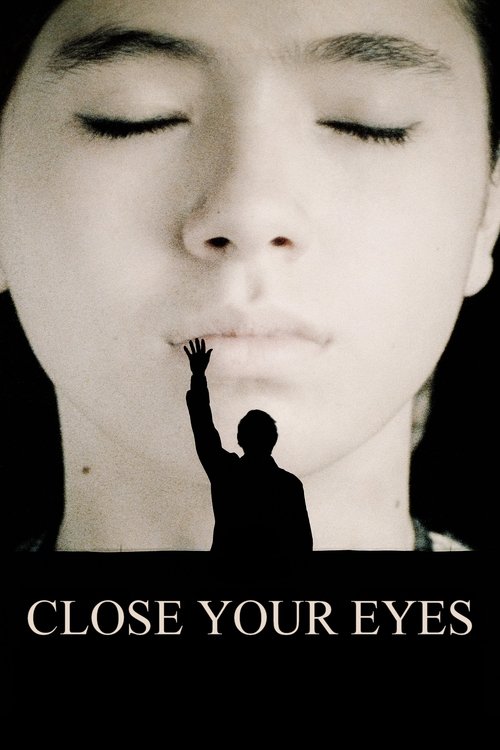
Close Your Eyes
2023 · Víctor Erice
For when you want a slow, wise film about aging, friendship, and the things time takes — something to watch alone, late, and carry around for days afterward. Patience required, and richly repaid.
What it's about
Decades ago, a famous Spanish actor vanished without a trace in the middle of a film shoot, leaving behind two reels of an unfinished movie. When a television program reopens the case, the film's retired director — the missing man's old friend — is drawn back into the mystery, and into everything he left unfinished in his own life.
The experience
Unhurried, autumnal, and quietly devastating — conversations in kitchens and archives, old songs, faces studied at length. It moves at the pace of memory itself and builds to an emotional force that catches you off guard.
Performances
Ana Torrent — the unforgettable child star of Erice's own first film, fifty years on — appears as the missing man's daughter, and her face alone carries half a century of feeling.
The craft
Víctor Erice, returning to features after thirty-one years, directs with total confidence in stillness: long scenes, patient framing, and a rhythm where nothing is rushed because everything matters. The restraint is the craft — it makes the quietest moments land like thunder.
Why it matters
The return of one of Spain's most revered filmmakers — only his fourth feature in half a century — greeted as a late masterpiece and a summation of a life spent thinking about what movies can and cannot restore.
Víctor Erice has directed only four features in half a century, and each is treasured; The Spirit of the Beehive (1973) remains perhaps the greatest film of Franco-era Spain. Returning at eighty-two, thirty-one years after his last feature, he made this long, autumnal mystery about a retired filmmaker drawn back into the case of an actor — his friend — who vanished mid-production decades earlier, leaving behind two reels of an unfinished film. What begins as an investigation becomes a meditation on aging, friendship, and whether cinema can actually restore what time takes; Erice folds in his own unfinished business, casting Ana Torrent — the unforgettable child of Beehive — as the missing man's daughter, her face now carrying fifty years of film history. The unhurried rhythm is the point: conversations in kitchens and archives, songs sung among friends, all tilting toward a final movie-theater sequence of extraordinary quiet power. Snubbed by the Cannes competition, it promptly outshone most of the films that weren't. Erice has said every film is two films — the one shot, and the one the viewer completes.
A Deleuzian reading
Two reels of film in a can.
The full Deleuzian reading of Close Your Eyes →
Reception
It arrived at Cannes 2023 in the shadow of a snub — relegated to the Cannes Premiere sidebar rather than Competition, prompting Erice to skip the festival — and then critics promptly crowned it anyway, topping year-end lists and being hailed as a late-style masterpiece almost overnight.
How Close Your Eyes was received, from release to now →
Influences: the films it descends from and the films it influenced
- The Spirit of the Beehive (1973) — Close Your Eyes recasts Ana Torrent and revives the Beehive conceit that an image is completed only in a spectator's gaze — the climactic cinema screening deliberately rhymes with the traveling projection of Frankenstein that hypnotized the child Ana.
- El Sur (1983) — Inherits the truncated, elliptical form of a film organized around an absent, searched-for man — El Sur was itself famously left unfinished, and Close Your Eyes builds its whole architecture from that poetics of the abandoned/incomplete work.
- The Quince Tree Sun (1992) — Carries over the patient, near-documentary observation of duration and the theme of an artwork defeated by time — the same unhurried rhythm of watching, waiting, and failing to finish.
- Frankenstein (1931) — Supplies the primal 'spectator-completion' image inherited via Beehive — the monster whose meaning is authored by the watching child — which Close Your Eyes reactivates when a face on screen is asked to restore a lost self.
- Cría Cuervos (1976) — Shares Ana Torrent as the living emblem of a haunted, unblinking child's gaze; Erice's craft debt is the deliberate casting of that same iconic face to carry Spanish cultural memory across fifty years.
- Vertigo (1958) — Lends the investigative structure of restaging a lost person to reawaken a buried identity — the search that hopes recognition can be manufactured by reconstructing the past face-to-face.
- 8½ (1963) — Establishes the blocked/retired director as subject — a film built around the very inability to complete a film — which Close Your Eyes literalizes through a filmmaker who quit the medium.
- Day for Night (1973) — Models the meta-cinema of a film about its own making and unmaking, using the abandoned shoot and lost footage as emotional material rather than mere reflexive gimmick.
- Wild Strawberries (1957) — Provides the aging-and-memory craft of an old man's reckoning journey, where revisiting fixed scenes from the past is staged as a formal device for confronting a life's incompletions.
- La Jetée (1962) — Grounds the film's faith that memory and love survive as a single remembered face/image; the craft debt is the reliance on a fixed frozen image to recover an identity dissolved by trauma.
- Dream of Light (1992) — Erice's own late return, extending Dream of Light's meditation on vision, memory and the fading of the image into a reflexive elegy on looking.
- Goodbye, Dragon Inn (2003) — Shares the elegy for cinema-and-loss set in a dying movie house, where the film screened within mourns its own medium and unhurried duration becomes an act of farewell to spectatorship.
- Certified Copy (2010) — Advances the device of role-playing and restaging to summon a real emotional recognition, testing whether a performed identity can become the authentic one — the wager underlying Close Your Eyes's final screening.
- The Beloved (2026) — Conversations are sustained at unfashionable length in static two-shots and the film ends on a projection whose outcome is never confirmed — the immediate Spanish precedent for withheld resolution around an old director.
- Close-Up (1990) — Extends the same craft of collapsing film and life so that cinema itself becomes the instrument that reconstitutes a fractured identity, staged with documentary patience.
- Tren de Sombras (1997) — The closest Spanish sibling: a wholly fictional 'lost' film reconstructed frame by frame, treating cinema as memory-machine and found footage as the medium of mourning — the exact terrain of Close Your Eyes's film-within-a-film.
- I'm Going Home (2001) — Parallels the aging-performer and theater-finale craft — an old actor's dignity and withdrawal staged through theatrical framing, foregrounding performance as a threshold to disappearance.
- The Other Side of the Wind (2018) — The archetype of the unfinished film about an unfinished film and a vanished director, sharing the reflexive melancholy of footage that outlives the project and the man who abandoned it.
Similar films
- El Sur (1983) — influence & lineage
- The Spirit of the Beehive (1973) — influence & lineage
- Cria! (1976) — influence & lineage
- Goodbye, Dragon Inn (2003) — influence & lineage
- Dry Leaf (2026) — same viewing thread
- Pain and Glory (2019) — shared sensibility
- Dream of Light (1992) — shared sensibility
- Open Your Eyes (1997) — shared sensibility
All the films related to Close Your Eyes →
Watch it with: curated runs of related films
- The Land Holds Vigil — Watch these together for the way a thousand-year tree, a wandering donkey, a returned fishing boat, or an emptied countryside becomes the patient witness to human searching and loss.