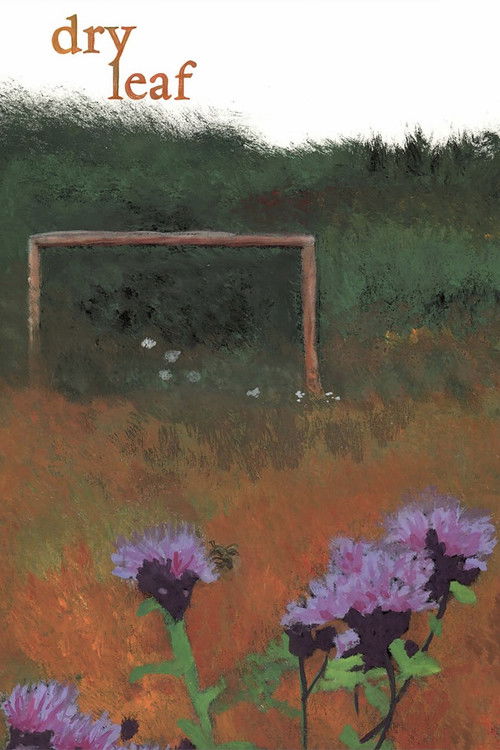
Dry Leaf
2026 · Alexandre Koberidze
For when you want to slow all the way down — a meditative, one-of-a-kind journey for a quiet evening when you'd rather wander than be gripped. Comfort for adventurous viewers; a stretch if you need plot momentum.
What it's about
Lisa, a photographer, has vanished somewhere in rural Georgia, last seen documenting the football pitches of remote villages. Her father Irakli sets out across the country to find her, and Lisa's best friend Levani comes along to help — the catch being that Levani is invisible, a fact the film treats as calmly as the weather. What unfolds is a road movie and a missing-person quest that keeps dissolving into the life of the villages themselves: games, animals, gossip, landscapes.
The experience
Slow, wandering and strangely enchanted — less a mystery to solve than a country to drift through, with gentle humor and a fairy-tale hum under ordinary scenes. It asks for patience and repays it with a mood few films achieve.
The craft
Alexandre Koberidze shoots in a deliberately low-resolution digital image that turns fields and football pitches into something half-remembered, like footage from a dream of the countryside. The loose, digressive structure — fantasy laid gently over documentary observation — is the whole point, and it casts a genuine spell.
Why it matters
It confirmed Koberidze as one of the most original voices in current European art cinema, deepening the singular style he's built around provincial Georgia, football and everyday magic.
Snapshot
Dry Leaf is the third feature by the Georgian-born, Berlin-trained director Alexandre Koberidze, and it extends the distinctive grammar he established across Let the Summer Never Come Again (2017) and What Do We See When We Look at the Sky? (2021): a low-resolution digital image, a wandering and digressive structure, a fairy-tale logic laid quietly over documentary observation, and an abiding fascination with provincial Georgia and with football. The premise is a quest in the oldest sense. Lisa, a photographer, has disappeared while documenting the football pitches and stadiums of remote Georgian villages; her father, Irakli, sets out across the country to find her; and Levani — Lisa's best friend, and, in the film's central fantastical conceit, an invisible person — travels in parallel to help. From this slender armature Koberidze builds a long, patient road movie that is also a film about looking, about photography as a way of holding onto the vanishing, and about the textures of a rural country seen at the pace of a man walking and asking after his child. The exact contours of the film's premiere and festival run are not something I can state with confidence from the available record, and I flag that uncertainty up front rather than fill it with invented specifics; what is firmly establishable is the film's authorship, its lineage within Koberidze's own corpus, and the method that produced it.
Industry & production
Koberidze works at the small, artisanal end of European art cinema, where budgets are modest, crews are tiny, and the financing typically braids together German film-school and public-fund support with Georgian locations and personnel. His prior features were made in and around the orbit of the Deutsche Film- und Fernsehakademie Berlin (dffb), the Berlin film academy where he trained, and that institutional milieu — graduate filmmakers shooting cheaply and ambitiously, often co-producing across Germany and Georgia — is the relevant production context for Dry Leaf as well. The precise production-company credits, co-production structure, and financing for Dry Leaf are details I should not assert without confirmation, and the public record as I have it is thin on those line items. What the film clearly shares with its predecessors is a production philosophy in which constraint is generative: small cameras, real villages, non-professional or semi-professional performers, and a shooting model loose enough to absorb chance, weather, and the rhythms of the places being filmed. The use of the director's own family — his brother Giorgi Koberidze as composer is a constant — and the casting of figures from his immediate circle is consistent with a cottage-industry approach where the line between the filmmaker's life and the production is deliberately porous.
Technology
Koberidze is one of contemporary cinema's most committed practitioners of deliberately humble image-capture technology, and that commitment is inseparable from the meaning of his films. Let the Summer Never Come Again was famously shot on an old mobile phone, its compressed, smeary video an aesthetic choice rather than a limitation; What Do We See When We Look at the Sky? used inexpensive digital cameras to produce a soft, slightly degraded, almost painterly image. For Dry Leaf, given both the director's established practice and the film's explicit subject — a missing photographer, and photography itself as a motif — the expectation is again of a small, consumer-grade digital camera yielding a low-fidelity image whose grain, bloom, and imperfection are part of the point. I want to be careful here: I cannot confirm the specific camera or format used on Dry Leaf, and I will not specify one. But the through-line of Koberidze's career makes clear that "technology" in his cinema is an argument — that the cheapest tools, far from impoverishing the image, can restore a kind of wonder and tactility to it, and can place the filmmaker on the same humble footing as the amateur snapshot or the village photographer.
Technique
Cinematography
The Koberidze image, realized in his recent work with cinematographer Faraz Fesharaki — an Iranian-German dffb contemporary who shot What Do We See When We Look at the Sky? — is built on patient, often static or slow framings that let an event unfold within the shot rather than be assembled across cuts. Expect long durations, a tolerance for "dead time," attention to the periphery of the frame (a dog, a passerby, a gust through leaves), and a willingness to point the camera at apparently unremarkable things — feet, hands, a ball, a road — until they become strange and absorbing. The soft, low-resolution palette tends to flatten and warm the image, lending even documentary footage a fable-like remove. I cannot independently confirm Fesharaki's credit on Dry Leaf, though the continuity of collaborator and style would make it unsurprising; I note it as the established pattern rather than a verified fact for this particular title.
Editing
Koberidze's editing is digressive and essayistic rather than goal-driven. His films accumulate by association — a quest interrupted by an excursion into a side character, an animal, a football match, a meditation delivered by an off-screen narrator — and the cut often serves to open a parenthesis rather than to advance plot. The result is long-form cinema (his features run well past conventional length) whose structure mimics wandering and reverie. In a search narrative like Dry Leaf, this editorial sensibility turns the father's journey into a series of encounters and detours, where the act of looking for a person becomes an occasion to look at a country.
Mise-en-scène / staging
The staging is rooted in real Georgian places — villages, roadsides, modest interiors, and, crucially here, rural football grounds — populated by people who often read as inhabitants rather than actors. Koberidze stages everyday gesture with great tenderness and frequently introduces a single fantastical premise (a curse, a transformation, here an invisible companion) into an otherwise naturalistic world, asking the viewer to accept the marvelous without explanation. The football stadium, a recurring Koberidze location, functions as both a real social space and a near-mythic arena; that Lisa was photographing such places when she vanished makes the pitches themselves into clues, shrines, and stages.
Sound
Sound in Koberidze's cinema is layered and active: ambient field recording, a roving and often whimsical voice-over narration that addresses the audience directly, and the music of his brother Giorgi Koberidze, whose scores lean melodic, gentle, and faintly nostalgic. The narration is a signature device — it editorializes, digresses, makes promises to the viewer, and openly acknowledges the artifice of storytelling. For a tale featuring an invisible character, sound carries a particular dramatic burden, since presence and absence must often be conveyed without a visible body.
Performance
Koberidze favors understated, non-theatrical performance, frequently from non-professionals, and stages people doing rather than emoting. The casting of a parent figure — and his own family's recurring participation in his work — points to a mode of performance grounded in real relation and presence rather than constructed character. I cannot verify the specific casting of Dry Leaf (including who plays Irakli, Lisa, or Levani) and so will not attribute roles; what can be said is that the film almost certainly continues his practice of drawing quiet, lived-in performances from a small, often personally connected ensemble.
Narrative & dramatic mode
The dominant mode is the fable-quest: a simple, almost folkloric search-for-the-missing structure that licenses episodic wandering and the intrusion of the marvelous. Koberidze's storytelling is openly narrated and self-aware, closer to oral tale-telling than to classical screenwriting; the plot is a thread on which to string observations, coincidences, and small miracles. The missing-person premise supplies forward momentum and emotional stakes — a father's love, a friend's loyalty — while the invisible-companion device tilts the whole into magic realism, where grief, hope, and the act of searching can be literalized as a journey shared with someone who cannot be seen. Mystery here is less a puzzle to be solved than a condition to be inhabited.
Genre & cycle
Nominally "Drama, Fantasy," Dry Leaf sits within several overlapping currents: the contemporary art-cinema road movie; "slow cinema" with its long takes and durational aesthetics; and a strain of literary magic realism transposed to film. It belongs, above all, to a small but recognizable cycle of Koberidze's own making — call it the Georgian provincial fable — alongside What Do We See When We Look at the Sky?, with which it shares a fascination with football, animals, chance, and the enchantment of ordinary places. Against the festival landscape of the mid-2020s, it reads as part of a broader auteur tendency toward long, essayistic, regionally rooted features that resist genre even as they borrow genre's shapes.
Authorship & method
Alexandre Koberidze (b. 1984, Tbilisi) came to film after studying economics, then trained at the dffb in Berlin, and his work is marked by a tension and a synthesis between his Georgian roots and his German art-cinema formation. His method is auteurist in the fullest sense: he writes, directs, and shapes a highly personal world built from recurring obsessions — football, dogs, village life, the soft low-res image, the chatty narrator, the single permitted miracle. His most important collaborators form a stable, intimate unit. His brother Giorgi Koberidze composes the music, lending the films their warm, melancholic tone. Cinematographer Faraz Fesharaki shaped the look of What Do We See When We Look at the Sky? and represents the visual sensibility most associated with Koberidze's recent phase. I should be candid that I cannot individually confirm each below-the-line credit (editor, writer, and the Dry Leaf-specific cinematography and cast attributions) for this particular film, and I decline to invent them; the safe and established claim is that Dry Leaf is an unmistakably Koberidze-authored work produced within this tight collaborative family.
Movement / national cinema
Dry Leaf belongs to the remarkable post-Soviet wave of Georgian cinema that has drawn international attention since the 2010s — a small national cinema producing an outsized number of distinctive auteurs working between Georgia and Western Europe. Koberidze is a particular case of this transnational condition: a Georgian filmmaker formed in Berlin, financing and exhibiting through European art-cinema channels while filming the Georgian provinces with deep affection. His work converses with the broader European tradition of slow, observational, fabulist cinema even as its subject matter — rural Georgia, its football culture, its landscapes and faces — is emphatically national. The film thus sits at the intersection of a German film-school lineage and a Georgian poetic-realist one.
Era / period
The film is a product of the 2020s art-cinema moment, shaped by the democratization of image-making (cheap cameras as legitimate tools), the persistence of long-form, festival-oriented auteur cinema, and a post-pandemic appetite for films about searching, dislocation, and reconnection. Its concern with photography and disappearance speaks to a contemporary anxiety about images and memory in an oversaturated visual age, while its rural setting and analog-feeling textures register as a deliberate counter-current to digital slickness. As a 2026 release by a director whose 2021 feature was a significant festival success, it arrives as the keenly awaited next step of an established younger auteur rather than as a debut.
Themes
At its center are looking and disappearance: a photographer who documents and then herself vanishes makes the camera both a tool of preservation and a marker of loss. Photography recurs as a way of holding onto what is passing — the "dry leaf" of the title suggesting fragility, the pressed remnant of something once living, the trace that outlasts its origin. The film meditates on parental love and the lengths of a search; on friendship and loyalty figured through the invisible companion, a literalization of devotion and perhaps of grief; and on football and the village as sites of communal life and quiet meaning. Running beneath all of it is Koberidze's persistent enchantment with the ordinary — the conviction that a country, a face, a pitch, or a leaf, attended to long enough, will disclose the marvelous.
Reception, canon & influence
Backward — influences on the film. Dry Leaf draws on the literary magic realism of folk and fairy tale, on the European tradition of slow and observational cinema (the durational long take, the road movie as a structure for digression), and on the playful, self-narrating authorial voice that links Koberidze to a lineage of essay-film and storyteller-cinema. Most directly, it builds on his own earlier features, recycling and deepening the football motif, the low-resolution image, the provincial-Georgian setting, and the single-miracle device that defined What Do We See When We Look at the Sky?
Critical reception. Koberidze entered the international critical conversation with Let the Summer Never Come Again and broke through more widely with What Do We See When We Look at the Sky?, which premiered in competition at the Berlinale in 2021 and was warmly received by critics, who praised its charm, formal daring, and tenderness. On that basis Dry Leaf arrived as a highly anticipated work. I do not have reliable, specific information about Dry Leaf's premiere venue, awards, or the detailed critical response, and I will not manufacture quotations, ratings, or festival results to fill that gap; the honest statement is that the film extends a body of work already held in high regard on the festival circuit, and that its reception should be read against that strong prior standing.
Forward — legacy and influence. It is too early, and the record too thin, to assess what Dry Leaf will shape. What can be said is that Koberidze's broader practice — the insistence that cheap cameras and patient looking can produce genuine beauty and wonder — has been quietly influential among younger filmmakers seeking alternatives to high-gloss digital production, and Dry Leaf consolidates his standing as one of the most singular voices to emerge from the contemporary Georgian–European art-cinema axis. Its lasting place in the canon will depend on a reception history that, as of this writing, is still being written.
A Deleuzian reading
Start with the football pitch.
The full Deleuzian reading of Dry Leaf →
Reception
A Locarno 2025 Special Mention that read as a festival curio at first, it snowballed into a full-blown cinephile event by its spring 2026 US release — Cinema Guild put it in theaters, Film at Lincoln Center opened it, and Dennis Lim was writing NYRB essays about its pixels.
How Dry Leaf was received, from release to now →
How to watch Dry Leaf: what to notice on a first viewing
- Watch how long Koberidze holds a shot after nothing more happens. He lets a road, a dog crossing, or a stadium sit onscreen well past the point of narrative need, so the ordinary starts to feel strange. The waiting is not filler. It is the film's whole way of seeing, since looking replaces the acting a normal quest would demand.
- Listen for the narrator speaking straight to you, outside the story. The voice-over editorializes, jokes, and admits it is telling a tale, framing the search as a story being spun rather than reported. The narration owns its own invention, turning the film into a fable told by a fire, not a record of fact.
- Notice how soft, blurry, and warm the image looks throughout. The low-resolution digital picture flattens detail and colors everything with an even, faded warmth, closer to a photograph left in the sun than a crisp modern image. The cheap image becomes part of the film's fairy tale feeling instead of a limitation.
- Track how many empty football pitches Irakli visits along his search. Each village yields another stadium with no match happening, a recurring stage that echoes Lisa's own photographs of the same empty grounds. The search keeps finding pictures instead of answers, since these pitches are clues to look at, not to solve.
The whole guide to watching Dry Leaf, with the keys for a rewatch →
Influences: the films it descends from and the films it influenced
- What Do We See When We Look at the Sky? (2021) — The film Dry Leaf directly recycles and deepens its predecessor's toolkit — the football motif, the soft low-resolution image, the provincial-Georgian setting, and above all the 'single permitted miracle' device folded into chatty authorial narration.
- Let the Summer Never Come Again (2017) — Koberidze's debut established his signature pocket-camera, sub-SD digital texture as a deliberate aesthetic — proof that a cheap, degraded image could carry beauty — and the loose, digressive episodic drift Dry Leaf inherits.
- Sátántangó (1994) — Tarr codified 'dead time' as narrative substance: the held, often unpopulated long take that lets duration itself become the event, the durational grammar Koberidze's static villages run on.
- Where Is the Friend's House? (1987) — Kiarostami's fable-quest — a small errand stretched into a journey through rural terrain, performed by non-professional villagers and a child — is the road-movie-as-digression armature Dry Leaf builds its quest on.
- Au Hasard Balthazar (1966) — Bresson's 'model' method — drilling non-actors into flat, affectless delivery so meaning lands in gesture and framing rather than expression — underwrites Koberidze's understated non-professional performance register.
- Heart of Glass (1976) — Herzog stages a folk fable in a real village with non-professional locals organized around a single mysterious prophecy/miracle, joined to the storyteller's incantatory voice — the village-plus-one-wonder structure Koberidze reuses.
- Once Upon a Time There Was a Singing Blackbird (1970) — Iosseliani's Georgian observational comedy of provincial idleness — built from digression, ambient bustle, and the refusal to hurry toward a plot — is the native Georgian dead-time sensibility Koberidze descends from.
- The Color of Pomegranates (1969) — Parajanov's Caucasian folk-tableau — frontal, ritualized, fairy-tale imagery treated as living miniature — is the regional magic-realist pictorial tradition behind Dry Leaf's single-miracle fable mode.
- Tabu (2012) — Gomes overlays a wistful, self-aware essayistic voice-over onto a fable, letting a playful narrator openly steer the story — the same storyteller-cinema gambit that defines Koberidze's chatty authorial voice.
- Cemetery of Splendor (2015) — Apichatpong embeds a single matter-of-fact supernatural event inside patient, naturalistic long takes, never breaking the calm realist surface — the 'one quiet miracle in a slow frame' method Koberidze shares.
- Colossal Youth (2006) — Costa shoots on consumer digital video with non-professional residents performing lightly fictionalized versions of themselves, dignifying a low-res, low-budget image — the same wager on cheap cameras and real people.
- Jauja (2014) — Alonso turns a quest across landscape into a chain of held static compositions where a non-professional protagonist drifts toward an unexplained rupture — the durational road-movie-as-fable Dry Leaf parallels.
- Goodbye, Dragon Inn (2003) — Tsai builds entire scenes from emptied, prolonged static takes about watching and vanishing, making 'looking and disappearance' a formal subject — the durational gaze Koberidze's theme of seeing echoes.
- The Day He Arrives (2011) — Hong constructs digressive, loosely repeating episodes punctuated by a wry diaristic voice-over, working in a deliberately small, cheap register — kindred to Koberidze's essayistic, narrated drift.
- Beginning (2020) — From the same contemporary Georgian new-wave moment, Kulumbegashvili anchors long, fixed-frame takes and non-professional presence around a single rupturing event — a parallel marriage of durational stillness to Georgian provincial setting.
- Taste of Cherry (1997) — Kiarostami stretches a minimal premise across roadside long takes and ends by openly breaking the fiction's frame, fusing the road-movie of digression with essayistic self-disclosure that Koberidze's narrator extends.
Similar films
- Silent Friend (2026) — same viewing thread
- Close Your Eyes (2023) — same viewing thread
- Rose of Nevada (2026) — same viewing thread
- The Last One for the Road (2025) — shared sensibility
- Kaili Blues (2016) — shared sensibility
- Fallen Leaves (2023) — shared sensibility
- Blue Heron (2026) — shared sensibility
- Memoria (2021) — shared sensibility
All the films related to Dry Leaf →
Watch it with: curated runs of related films
- The Land Holds Vigil — Watch these together for the way a thousand-year tree, a wandering donkey, a returned fishing boat, or an emptied countryside becomes the patient witness to human searching and loss.