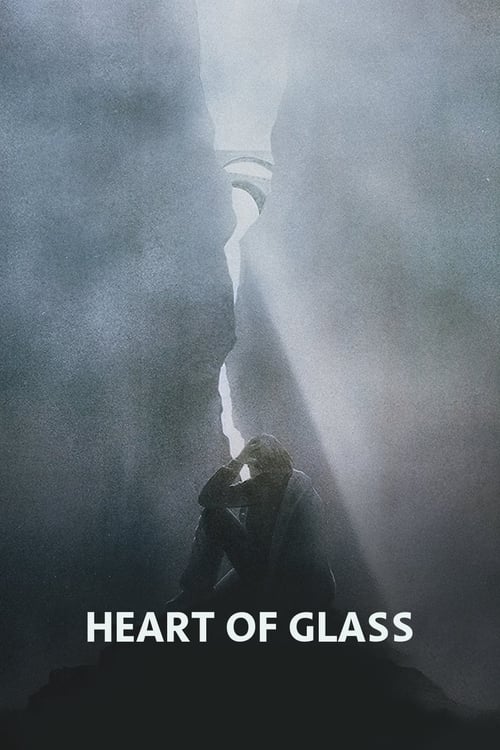
Heart of Glass
1976 · Werner Herzog
For when you want cinema as a strange dream rather than a plot — a challenging, meditative watch for late nights and adventurous moods. Not comfort viewing; more like a vision you submit to.
What it's about
A Bavarian village lives off its famous ruby-red glass — until the one man who knew the secret of the glaze dies without passing it on. The glassworks owner spirals into obsession over the lost formula while the town sinks into a collective stupor, and a peasant seer who stands apart from it all begins prophesying catastrophe. It's a village portrait told as fable: a community losing the thing that held it together.
The experience
Slow, hypnotic and genuinely eerie — less a story unfolding than a trance you sink into. The famously strange performances give every scene a sleepwalking wrongness that gets under your skin and stays there.
Performances
Werner Herzog filmed nearly the entire cast under actual hypnosis, so the acting is unlike anything else on film — glassy, involuntary, dreamlike deliveries that no directing note could produce.
The craft
The hypnosis experiment is the headline, but the film is also ravishing to look at: misty mountain landscapes and candlelit interiors composed like old paintings, paired with an unearthly score. It rewards patience, a dark room, and surrendering to its rhythm.
Why it matters
It stands as one of the most radical experiments in the history of screen acting and a keystone of Herzog's legend as cinema's great risk-taker — a film people still argue about as either visionary or mad, and usually both.
Snapshot
A Bavarian village famous for its "ruby glass" slides toward collective madness when the foreman who alone knew the secret formula for the crimson glaze dies without passing on his knowledge. The glassworks owner, Huttenbesitzer, descends into murderous obsession; the peasant seer Hias, who was not part of the works, stands apart and prophesies the village's annihilation and visions of the world's end. Herzog filmed almost the entire cast under clinical hypnosis — one of the most radical decisions in the history of acted cinema — rendering every performance dreamlike, involuntary, and slightly wrong in ways no waking actor could manufacture. The result is less a dramatic film than an incantation: a work that refuses psychological realism in favor of something closer to trance, myth, and apocalyptic vision.
Industry & production
Herz aus Glas was produced by Werner Herzog Filmproduktion and co-financed through the mechanisms that sustained the New German Cinema throughout the 1970s, primarily public television funding (the role of broadcasters such as WDR in subsidizing ambitious German art films in this period is well documented). Herzog wrote the screenplay drawing on prose texts by the Bavarian writer and filmmaker Herbert Achternbusch, whose idiosyncratic, darkly comic engagement with Bavarian folk culture and landscape provided the thematic raw material; the final script and its apocalyptic vision belong entirely to Herzog. The production was modest in scale but demanding in logistical terms: hypnotizing performers daily before each take required the consistent presence of a hypnotherapist on set, an unusual line item in any film's budget. The film was shot on location in rural Bavaria and, for the film's ecstatic landscape passages — the fog-shrouded sea cliffs and sublime Atlantic vistas that frame and close the narrative — on the western coast of Ireland, whose geological drama provided an otherworldly counterpoint to the village's enclosed, suffocating community.
Technology
The film was shot on 35 mm color in the standard ratio of its period. Herzog and his cinematographer Jörg Schmidt-Reitwein worked with available and natural light wherever possible, consistent with the production philosophy Herzog had developed through the earlier New German Cinema films. The glass-blowing sequences presented particular technical challenges: capturing the incandescence of molten glass and the deep arterial crimson of the finished ruby product required exposure discipline and color timing that the film exploits for visual meaning — the glass is almost the only vivid color in a world of gray, brown, and mist. No elaborate optical effects or post-production manipulation is documented; the film's uncanny quality derives from performance, composition, and editing rather than from technical artifice.
Technique
Cinematography
Jörg Schmidt-Reitwein, Herzog's most sustained cinematographic collaborator of this period, shoots Heart of Glass in a manner that keeps landscape and interior on roughly equal dramatic footing, both equally inimical to human comfort. The Bavarian sequences use a muted, wintry palette — overcast skies, snow, the dark timber and stone of rural buildings — that drains the frame of warmth. Compositions favour figures dwarfed by their surroundings or framed against empty sky; the effect is explicitly Romantic in the tradition of Caspar David Friedrich, whose painting of solitary figures contemplating fog and abyss Herzog has acknowledged as a formative visual reference. The Irish cliff sequences are shot in a different register — wider, more open, the sea filling the bottom third of the frame — and function as a visual rupture, signaling that we have left the village's claustrophobic historical time and entered prophetic time. Camera movement is slow and deliberate; there is no restless searching energy. The hypnotized performers move through shots as if the camera has always been waiting for them.
Editing
The editing (Beate Mainka-Jellinghaus, who cut several of Herzog's films in this period, is associated with the post-production of this era of his work, though specific archival confirmation of her precise credit here is worth verifying against primary sources) constructs rhythm through duration rather than pace. Cuts are infrequent; shots are held past the point of conventional dramatic utility. This elongation is not purely aesthetic: because hypnotized actors cannot respond in real time to cues or to each other with the micro-adjustments of normal performance, Herzog builds meaning through accumulation and atmosphere rather than through the classical editing grammar of action and reaction. The intercutting between Hias's visions and the village's unraveling follows an associative rather than causal logic.
Mise-en-scène / staging
The staging is the film's most radical formal gesture. Because the cast — with the single significant exception of Josef Bierbichler as Hias — performed under hypnosis, conventional blocking, motivation, and ensemble interaction were impossible. Herzog instead placed performers in spaces and trusted that the camera would find the strangeness in their movements. Hypnotized actors do not cheat toward the lens, do not modulate expression for an audience, do not land on marks with the reliable precision of trained performers. Their bodies occupy space in slightly alien ways. This produces a mise-en-scène that is simultaneously more physically authentic (no one is performing naturalistically) and utterly surreal. The glassblowing sequences, filmed with actual craftsmen demonstrating real technique, provide an anchor of genuine skilled labor that throws the dreamlike performances of the dramatic scenes into higher relief.
Sound
The sound design favours an austere, near-ambient texture. Village sounds — the creak of timber, the breath of wind, the working of the glassblowers' furnaces — are present but not emphasized in the manner of psychological realism. The music, composed by Popol Vuh (the German ensemble led by Florian Fricke, who scored many of Herzog's films throughout the 1970s and 1980s), is spare, meditative, and oriented toward drone and sustained tones rather than melodic development. Fricke's approach at this period drew on minimalism and an interest in sacred and devotional music from various traditions; the score for Heart of Glass supports the film's trance quality without underlining it with conventional emotional cues. Dialogue is minimal and often delivered in a manner that, again because of the hypnotic state, lacks normal prosodic color — words arrive with a flatness that reads as ancient, oracular, or simply not-quite-human.
Performance
The decision to hypnotize the cast is the film's performance philosophy made literal. Herzog has been explicit in interviews that he sought a register unavailable to conscious acting: a quality of interior distance, of people who are present but not entirely there, which no training system produces. The hypnotized performers — villagers, workers, the increasingly frantic Huttenbesitzer — move and speak with a somnambulistic precision that is visually cohesive precisely because it is uniformly strange. Josef Bierbichler, unhypnotised, plays Hias as someone permanently in an interior elsewhere that the rest of the village cannot access; paradoxically, his un-hypnotised performance most closely resembles what the hypnotized performers are doing, which is part of Herzog's conceptual point. The glassblowers, whose sequences involve actual dangerous craft, worked as themselves; their expertise grounds the film's most viscerally real passages.
Narrative & dramatic mode
The film operates more as prose poem or folk legend than as conventional dramatic narrative. Causality is present — the death of the foreman causes the loss of the formula, which causes the owner's breakdown, which causes murder — but it is subordinated to atmosphere, prophecy, and symbolic repetition. Hias functions as a chorus of one, his visions periodically rupturing the village storyline with images of apocalypse: burning landscapes, collapsing orders, the end of a world. The narrative's dramatic mode is closest to what critics have described as "mythic realism" — a mode in which the surface of historical or regional life carries the weight of archetype and eschatology. The film is not interested in psychological explanation; no one's motivation is built in the conventional sense. Characters represent positions in a cosmic drama: the keeper of the secret (dead before the film begins), the man destroyed by the loss, the man who sees destruction coming and cannot prevent it.
Genre & cycle
Heart of Glass belongs to no clean genre, which is consistent with its maker's consistent avoidance of genre expectation. It draws on the tradition of the German historical or folk drama — films set in identifiable regional pasts — but strips that mode of its usual narrative comfort. It has affinities with folk horror in its portrait of a community's collective psychological collapse, with art cinema in its formal severity, and with the visionary film in its prophetic passages. Within German cinema it participates in what critics have identified as the "mountain film" (Bergfilm) tradition's dark inverse: where Riefenstahl and Fanck's Alpine films celebrated the sublime as a site of Aryan triumph, Herzog's sublime landscapes are sites of abyss and disorientation. The film is also part of a small and largely German-language cycle of films about artisanal or craft knowledge as an existential absolute — the idea that a community's identity can be destroyed by the loss of technical mastery.
Authorship & method
Werner Herzog's authorial signature is present throughout: the obsessive protagonist (here doubled, as both the owner and the prophet are consumed by their respective fixations), the landscape as psychological externalization, the interest in extreme or altered states of consciousness, and the willingness to subordinate narrative efficiency to experiential intensity. Herzog has theorized his approach in terms of what he calls "ecstatic truth" — the idea that literal accuracy to surface reality is a lesser form of truth than the deeper truth accessible through heightened, even fabricated, intensity. The hypnosis of the cast is the most literalized version of this principle in his body of work. Jörg Schmidt-Reitwein's cinematographic collaboration was essential to translating this aesthetic into images. Florian Fricke and Popol Vuh provided the sonic equivalent of the visual trance. Herbert Achternbusch's foundational prose material contributed a specifically Bavarian texture — the particular weight of that regional culture's relationship to doom, folklore, and religious intensity — that an outsider's script would have been unlikely to produce.
Movement / national cinema
Heart of Glass is a product of the New German Cinema (Neues Deutsches Kino), the movement that emerged from the Oberhausen Manifesto of 1962 and reached its international peak in the 1970s. The movement's institutional infrastructure — the Film Subsidy Board, television co-production agreements, the film academies — made possible a generation of auteur films that would have been commercially unmakeable. Within the movement, Herzog occupied a distinct position: less overtly political than Rainer Werner Fassbinder, less cosmopolitan in his cultural references than Wim Wenders, and more consistently drawn to the mythic, the visionary, and the geographically extreme. Heart of Glass is in some sense the purest expression of his branch of the movement: a film that has no interest in contemporary social reality and whose German-ness is archaic and regional rather than metropolitan and self-critical.
Era / period
The mid-1970s was the moment at which the New German Cinema achieved its widest international recognition, following the success of Aguirre, the Wrath of God (1972) and, for Fassbinder and Wenders, through festival circuits and critical support in France, Britain, and the United States. Heart of Glass arrived in this context and was received as a characteristically Herzogian provocation. The film also belongs to a broader 1970s international art cinema that was prepared to be demanding about temporality, to refuse psychological realism, and to use landscape and altered states as primary dramatic material — a context that included Andrei Tarkovsky, Theo Angelopoulos, and Chantal Akerman working in related directions from different national traditions.
Themes
Loss of knowledge as existential catastrophe — not merely economic but ontological — is the film's central preoccupation. The ruby glass formula is not merely a trade secret; it is the meaning-making center of the village's collective identity, and its disappearance reveals that identity to have been more fragile than anyone suspected. The film meditates on apocalypse not as external event but as internal collapse: the village destroys itself because the thing that organized its life is gone. Hias's visions extend this to a cosmic register, suggesting that the village is a figure for civilization itself, and that civilization is always closer to dissolution than it appears. Madness in Herzog's films is rarely simple pathology; here it is the rational response of a man who cannot tolerate meaninglessness. The glass itself — beautiful, fragile, red as blood — carries the themes of beauty and destruction, craft and death, in visual form throughout.
Reception, canon & influence
Backward influences. The film's most obvious visual debt is to Caspar David Friedrich, the great painter of German Romantic landscape, whose compositional vocabulary — the solitary figure before the fog-shrouded abyss, the world seen from an inhuman distance — is directly quoted in Heart of Glass. The literary tradition of German Romanticism, particularly the prose of Novalis (with his mysticism of nature and night) and Heinrich von Kleist (with his catastrophic, fate-driven narratives), provides a broader cultural framework. Within cinema, the influence of F.W. Murnau's expressionist staging and Carl Theodor Dreyer's long-take intensity can be felt, though Herzog's relationship to film history is always indirect and mediated by his own polemical anti-aestheticism.
Critical reception. The film divided critics on release and has never become entirely comfortable for audiences expecting conventional dramatic engagement. Admirers have celebrated its formal audacity and the genuinely strange quality of the hypnotized performances; detractors have found it inert, self-regarding, and resistant to emotional contact. It is now firmly placed within the recognized Herzog canon, though it remains one of the less frequently discussed of his major works, perhaps because its radicalism is so total that it resists partial incorporation into other traditions. Herzog's own discussion of the film — and he has discussed it extensively over decades — has made it a locus classicus in arguments about the ethics and aesthetics of directing, particularly around the question of what a director is owed from performers and what extremity is permissible in pursuit of a vision.
Forward influence. Heart of Glass has not generated direct imitations — the hypnosis technique is too singular to be borrowed without becoming parody — but its influence operates at the level of permission and of atmosphere. It demonstrated that a film could sustain an entirely non-naturalistic performance register for feature length without comic or alienating effect, provided the formal framework was consistent enough. The slow cinema movement of the 1990s and 2000s — Béla Tarr, Lav Diaz, Carlos Reygadas — shares with Heart of Glass a commitment to duration and to landscape as dramatic agent, though the genealogy is diffuse and multi-sourced. Within Herzog's own work, the film's themes of obsession, of communities undone by the loss of a structuring principle, and of the seer who cannot be heard, recur throughout his subsequent career. It stands as the most formally uncompromising entry in a body of work that has never prioritized accessibility.
A Deleuzian reading
Start with the one warm thing in the whole film: the ruby glass, glowing arterial red in a world otherwise drained to gray, brown, and mist.
The full Deleuzian reading of Heart of Glass →
Reception
Baffled and divided critics on release in 1976 — even Herzog devotees didn't know what to make of its glassy-eyed trance pacing — but it has since settled into cult status as one of the strangest, most singular entries in his 1970s run.
How Heart of Glass was received, from release to now →
Influences: the films it descends from and the films it influenced
- The Cabinet of Dr. Caligari (1920) — Wiene's somnambulist Cesare—a body in directed trance, moving with absent precision—is the direct cinematic figure Herzog literalizes through actual hypnosis, transferring the performance conceit from character-content to directorial method.
- Nosferatu (1922) — Murnau's staging of figures as extensions of elemental landscape rather than social agents, and his fog-saturated location shooting as psychological externalization, directly feeds Schmidt-Reitwein's compositional approach to the Bavarian highland sequences.
- Faust (1926) — Murnau translates Caspar David Friedrich's compositional grammar into cinema—miniaturized figures before sublime fog-bound vistas, aerial overviews that dissolve human scale—providing the specific visual vocabulary Schmidt-Reitwein adopts for Heart of Glass's landscape sequences.
- The Passion of Joan of Arc (1928) — Dreyer's practice of withholding contextual information from Falconetti during filming to generate authentic anguish prefigures Herzog's hypnosis method: both directors bypass conscious acting technique to extract performance states unavailable to trained craft.
- Ordet (1955) — Dreyer's long-take domestic scenes—held until the miraculous emerges from quotidian duration rather than visual heightening—establish the formal principle that sustained fixed observation generates spiritual credibility, which Heart of Glass inherits and radicalizes.
- Au Hasard Balthazar (1966) — Bresson's training of non-professional models through mechanical repetition to suppress psychological acting achieves a secular somnambulism—gesture without interiority—that is the closest formal precedent for Herzog's hypnosis-induced somnambulistic precision.
- Andrei Rublev (1966) — Tarkovsky's sustained treatment of a craftsman whose technique constitutes a spiritual necessity for his community, structured around long takes in which winter landscape performs as spiritual duration, provides the thematic-formal framework Heart of Glass adopts for the glassblower's secret.
- The Enigma of Kaspar Hauser (1974) — Both films use Popol Vuh's drone minimalism as the sonic correlate of a consciousness isolated from social legibility, and share the structural device of a visionary-innocent figure whose inner world cannot be decoded by the community encountering them.
- Nosferatu the Vampyre (1979) — Herzog applies Heart of Glass's Friedrich-derived landscape grammar through Schmidt-Reitwein's camera and uses Kinski's naturally somnambulistic physicality to achieve the trance-performance register without literal hypnosis, translating Heart of Glass's formal apparatus directly into genre.
- Sátántangó (1994) — Tarr extends Heart of Glass's core formal propositions to their structural limit: a seven-and-a-half-hour commitment to duration as the primary dramatic agent, and a rural community's self-destruction staged as internal spiritual collapse rather than external catastrophe.
- Werckmeister Harmonies (2000) — Tarr operationalizes Heart of Glass's hypnotic blocking through elaborate choreographed single takes—camera and non-professional performers moving in geometric coordination—achieving trance-performance through sheer formal rigor rather than literal hypnosis.
- Silent Light (2007) — Reygadas casts non-professional Mennonite community members in a Dreyer-structured long-take framework, achieving Heart of Glass's somnambulistic performance register through community embeddedness and formal constraint, with the landscape functioning as a Friedrich-esque psychological agent.
- Dry Leaf (2026) — Herzog stages a folk fable in a real village with non-professional locals organized around a single mysterious prophecy/miracle, joined to the storyteller's incantatory voice — the village-plus-one-wonder structure Koberidze reuses.
- Fata Morgana (1971) — Both films build entirely from associative visual logic—landscape sequences edited for rhythmic and atmospheric accumulation rather than narrative causality—with Popol Vuh's drone minimalism performing the same organizing function as the images themselves.
- Aguirre, the Wrath of God (1972) — Both films extract non-naturalistic performance states through extreme physical conditions and share the structural grammar of a community dissolving into a single obsessive figure's delusion, with identical authorial method overriding naturalistic performance conventions entirely.
- The Wicker Man (1973) — Both films stage folk horror through the performance of collective ritual belief rather than individual menace, and both deploy ceremonial sound (traditional folk song / Popol Vuh drone) as a formal organizing layer that makes the community's catastrophic worldview audible before it becomes visible.
Similar films
- Nosferatu the Vampyre (1979) — influence & lineage
- Aguirre, the Wrath of God (1972) — influence & lineage
- The Enigma of Kaspar Hauser (1974) — influence & lineage
- Satantango (1994) — influence & lineage
- The Cabinet of Dr. Caligari (1920) — influence & lineage
- Nosferatu (1922) — influence & lineage
- Fata Morgana (1972) — shared sensibility
- Hour of the Wolf (1968) — shared sensibility
All the films related to Heart of Glass →