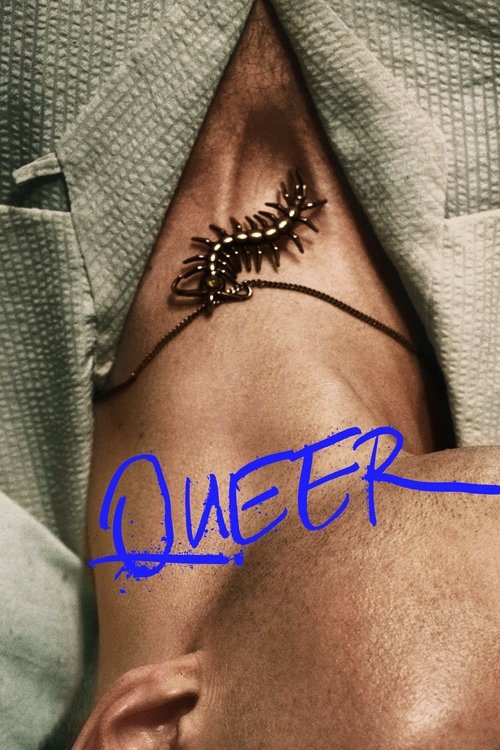
Queer
2024 · Luca Guadagnino
The horniest working prestige director, in the culture's affectionate phrasing: Challengers and Queer in a single year made him the center of every conversation about desire on screen, and his prolific pace (Bones and All, After the Hunt) is itself a talking point. Also permanently attached to the Call Me by Your Name/Armie Hammer asterisk.
When you want something adult, sensual, and sad to sit with — a film about loneliness and desire to chew on rather than a tidy love story. Definitely the challenging end of romance.
What it's about
Mexico City, early 1950s. William Lee, a middle-aged American expat, drifts between bars in a fog of drink, heroin, and practiced charm, keeping loneliness at arm's length — until Eugene Allerton, a beautiful, unreadable young ex-serviceman, arrives. Lee's pursuit of him becomes an obsession that carries the pair to South America in search of a jungle drug rumored to grant telepathy: a way, Lee hopes, to finally reach another person. Adapted from William S. Burroughs' long-unpublished autobiographical novel.
The experience
Woozy, romantic, and increasingly strange — it starts as a barroom courtship and slides into fever dream, with stretches of frank eroticism and aching, unrequited need. It's less about what happens than about how badly one person wants to be truly seen, and it leaves a bruise.
Performances
Daniel Craig gives one of his most exposed performances — needy, funny, humiliated, physically fearless — a full dismantling of his usual armor. Drew Starkey matches him by staying opaque, making Allerton a screen Lee can project everything onto.
The craft
Luca Guadagnino shot the film almost entirely on constructed sets at Rome's Cinecittà, giving 1950s Mexico City a heightened, dreamlike artificiality that suits the story's slide into hallucination. Trent Reznor and Atticus Ross supply the score, and the deliberately unreal look rewards a big screen.
Why it matters
A Venice competition premiere and one of the boldest swings of Guadagnino's career — a long-thought-unfilmable Burroughs book brought to the screen, and a reinvention moment for Daniel Craig after Bond.
Snapshot
Queer is Luca Guadagnino's adaptation of William S. Burroughs' short novel of the same name — written around 1951–53, abandoned, and not published until 1985. It follows William Lee (Daniel Craig), a middle-aged American expatriate adrift in the bars of 1950s Mexico City, whose obsessive pursuit of a younger, sexually noncommittal ex-serviceman, Eugene Allerton (Drew Starkey), carries the two of them to South America in search of yagé (ayahuasca), a drug Lee believes confers telepathy. Scripted by Justin Kuritzkes, shot almost entirely on constructed sets at Cinecittà in Rome, and scored by Trent Reznor and Atticus Ross, the film premiered in competition at the Venice Film Festival in September 2024 and was released by A24 in the United States that autumn. It is the second of two Guadagnino–Kuritzkes features to reach audiences in 2024, after Challengers, and the most formally unguarded film of Guadagnino's career: a study of unreciprocated desire that abandons realism by degrees until it dissolves into hallucination.
Industry & production
The picture sits at the intersection of three financing cultures. It was produced through Frenesy Film Company, Guadagnino's own Italian outfit, in concert with Fremantle, with A24 handling North American distribution and MUBI taking the United Kingdom — a structure that lets a European auteur production reach American arthouse screens under a brand with strong specialty-market identity. That configuration is the practical reason a film about a heroin-sick gay American in Mexico could be built on Italian soundstages with a former James Bond in the lead.
Guadagnino has spoken repeatedly of encountering the Burroughs novella as a teenager and carrying the ambition to film it for decades; the project's long gestation is one of the better-documented facts about it. Adaptations were attempted before — Steve Buscemi is reported to have developed a version years earlier — but none reached production, and the specifics of those efforts are thinly recorded.
The immediate production context matters. Guadagnino shot Challengers and Queer in close succession, and the SAG-AFTRA strike of 2023 pushed Challengers from a September 1023 berth into spring 2024, so both films landed within months of each other. The effect was to present Queer as the second half of a diptych with a shared crew and a shared interest in triangulated, non-consummated desire.
Casting Craig was the film's central commercial gamble and its central critical hook. Coming directly off fifteen years of Bond, he took a role requiring extended nudity, explicit gay sex, and a portrait of physical degradation — the sort of deliberate persona demolition that recurs in star careers but rarely at this scale of visibility. Awards attention proved narrower than the film's profile suggested; Craig drew the bulk of it, and the film was largely bypassed in the major Academy categories. Box-office figures for the release are not something I can state with confidence, and I won't invent them; the film performed as a specialty title rather than a crossover.
Technology
The defining technological choice is negative: Queer refuses location. Mexico City in 1950 was reconstructed as a set — streets, bars, apartment interiors — at Cinecittà, and the Ecuadorian jungle of the final act is likewise a built and painted environment rather than a photographed one. The film has been reported to have been shot photochemically on 35mm; I flag that as reported rather than certain, but the image is unambiguously grain-bearing and halation-prone in a way that reads as film emulsion, and the choice is consistent with cinematographer Sayombhu Mukdeeprom's practice on earlier Guadagnino collaborations.
Digital tools appear where the film goes furthest from the observable world. The recurring image of a spectral Lee — a translucent double who reaches toward Allerton while the "real" Lee sits inert — is achieved as a compositing effect, and the yagé sequence's climactic image of two bodies interpenetrating and merging combines physical performance, contortion, and digital work. Detailed accounts of vendors and specific methods are not well documented in the public record.
The score is the other technological signature. Reznor and Ross work in the register they have made their own — processed guitar, sustained synthetic drone, tuned percussion that sits closer to sound design than to melody — and it is used to bind sequences that the cutting has deliberately loosened.
Technique
Cinematography
Sayombhu Mukdeeprom is the crucial technical collaborator. Best known outside Guadagnino's orbit for his work with Apichatpong Weerasethakul (Uncle Boonmee Who Can Recall His Past Lives, Cemetery of Splendor), he brings to Queer precisely the sensibility that Apichatpong requires: an ability to photograph an environment so that its ontological status stays uncertain. The early Mexico City passages are lit warm and dense — amber bar interiors, hard tropical daylight raking through shutters — but the artifice is never concealed. Painted skies read as painted. Streets have the shallow depth of a backlot. The camera favors sustained handheld following shots that track Lee's drift from bar to bar, then pivots toward stiller, more frontal compositions once the film enters its hallucinatory register. The photographic grammar of the jungle sequences openly invokes the studio-bound exoticism of Powell and Pressburger's Black Narcissus — a reference several critics made on release and one the film does nothing to disown.
Editing
Marco Costa, who cut Bones and All and Challengers, edits. His work here is the opposite of what he did on Challengers, where the cutting was propulsive and rhythmically aggressive. Queer is built on duration and on gaps: long stretches of Lee talking into indifference, held past comfort; abrupt elisions that skip over the mechanics of travel; and, in the final movement, a collapse of continuity altogether, where the cut stops guaranteeing that one shot follows another in time. The film is formally partitioned — chapters, then an epilogue set long after — and the partition is itself an editorial argument that the story cannot be told continuously.
Mise-en-scène / staging
Everything follows from the decision to build rather than find. The studio Mexico City is not a failure of verisimilitude but a claim about memory: this is the past as a man reconstructs it, with the seams showing. Stefano Baisi's production design gives the expat bars a specific sociology — small rooms, few people, the same faces nightly — that makes the closed circuit of Lee's world legible before any dialogue does. Jonathan Anderson's costumes (he had dressed Challengers) do heavy characterological work: Lee in linen suits and a Panama hat, an aging man's insistence on presentability worn over a body that is failing; Allerton in a cooler, blanker register that keeps him unreadable.
Staging is organized around proximity that never resolves. Guadagnino repeatedly places Lee beside Allerton with a small, unbridgeable interval between them, and the spectral-double effect literalizes exactly that: the desire reaches across, the body does not. Lesley Manville's Dr. Cotter, the reclusive botanist encountered in the jungle, arrives under heavy prosthetic transformation — an actorly gargoyle who tips the film's last act toward the grotesque.
Sound
The soundtrack runs on calculated anachronism. Period-plausible source music coexists with pop recordings decades out of the film's time — Nirvana's music figures prominently, including Sinéad O'Connor's cover of "All Apologies," and other post-1980s tracks are dropped over 1950s images without apology. The device is not ironic; it functions as it does in Sofia Coppola's Marie Antoinette or Baz Luhrmann's period films, insisting that the emotional present of the film is now. Ambient design is dense in the Mexico City passages — traffic, radios, the hum of rooms — and thins toward abstraction as the drug takes hold.
Performance
Craig gives the performance the film is built to hold. Its subject is not seduction but need: the pitch of a man performing charm at length to someone who is not responding, with the effort visible. He plays intoxication and withdrawal as a set of specific physical facts — sweat, tremor, a body that keeps announcing its condition — and, crucially, plays Lee's self-awareness. Lee knows he is humiliating himself and continues. Starkey's Allerton is deliberately opaque, an object built to reflect projection rather than a character with an interior we are given access to; the performance's flatness is the point, and it divided viewers. Jason Schwartzman, as the expat Joe Guidry, supplies comic slackness and a portrait of the alternative life Lee has refused.
Narrative & dramatic mode
Structurally the film is a pursuit that fails to become a romance, then a quest that fails to deliver revelation, then an epilogue that refuses closure. Burroughs' novella is a fragment — it breaks off, its ending was never resolved, and its central absence is the death of Burroughs' wife Joan Vollmer, whom he killed in Mexico City in 1951 in a drunken "William Tell" act. Burroughs addressed that absence only in his 1985 introduction, where he described being driven to the conclusion that he would never have become a writer but for her death.
Kuritzkes' screenplay makes the film's most consequential intervention here: it supplies a final movement the novella does not have, carrying Lee past the jungle into age, and restages the William Tell shooting as an oneiric event within Lee's consciousness. This is an interpretation, not a restoration — a decision to read Queer through the biographical wound that Burroughs kept outside the text. It is also where critical opinion divided most sharply.
The dramatic mode throughout is confession without absolution. There is no arc of self-knowledge, no scene where Lee understands himself. The telepathy he seeks from yagé is a wish for connection that would bypass the risk of asking, and the film treats it as such.
Genre & cycle
Queer is a literary adaptation, a period drama, and a psychedelic film, in roughly that order of surface and reverse order of emphasis. Within the Burroughs adaptation tradition it sits beside David Cronenberg's Naked Lunch (1991) and Gus Van Sant's Drugstore Cowboy (1989, in which Burroughs appears), and it deliberately declines Cronenberg's route: where Naked Lunch metabolized Burroughs' prose into body horror and metafiction, Guadagnino keeps the surface novelistic and lets the disintegration arrive late.
It also belongs to a live 2020s cycle of adult, non-apologetic queer cinema made by name directors with theatrical ambition — Ira Sachs' Passages (2023), Andrew Haigh's All of Us Strangers (2023) — in which explicit sex is treated as ordinary dramatic material rather than as transgression.
Authorship & method
Guadagnino's late-period method is now clearly legible: a repertory of collaborators, rapid production, and a willingness to shift register violently between projects. The core team on Queer — Kuritzkes writing, Costa cutting, Reznor and Ross scoring, Anderson costuming, Mukdeeprom shooting — is largely the Challengers team, and the two films function as a paired experiment in filming desire that cannot be discharged.
Kuritzkes, a playwright and novelist before Challengers, writes dialogue that is talky, patterned, and performative — characters who speak to construct a self rather than to communicate — which suits Burroughs' Lee, a man whose routines are a defense. Mukdeeprom supplies the film's capacity to hold the unreal without signaling it. Costa supplies the rupture. Reznor and Ross supply continuity of mood across a film whose narrative logic breaks down.
Guadagnino's own signature here is his long-standing subject: desire as an asymmetry, filmed with tactile attention to skin, heat, food, and clothing, and structured around a person who wants more than they are given. Call Me by Your Name (2017) treated that asymmetry as elegiac; Queer treats it as pathology.
Movement / national cinema
The film is a product of Italian production culture applied to American material — Frenesy, Cinecittà, a European crew — which places it in a long lineage of Italian studios reconstructing foreign worlds for international release. Its most direct formal ancestor is Rainer Werner Fassbinder's Querelle (1982), which likewise built an entirely artificial port on a soundstage to film a queer literary text (Genet's) as pure stylized environment. Guadagnino's studio Mexico City is a considered echo of that strategy. Against these, its distribution identity is American independent: A24's brand of star-driven auteur specialty film.
Era / period
The setting is exact and consequential. Post-war Mexico City hosted an American expatriate community subsidized in part by GI Bill money and sustained by cheap living and lax policing — a refuge for men whose sexuality and drug use were criminalized at home. The period is the height of the McCarthy era and the Lavender Scare, when homosexuality in American public life was a security matter; the film's expats are exiles as much as tourists. Lee's yagé quest also belongs to its moment: mid-century Western interest in Amazonian psychoactives ran alongside Cold War experimentation with drugs and mind control, and Burroughs' own search issued in The Yage Letters (1963), his correspondence with Allen Ginsberg.
Themes
The governing theme is unreciprocated desire and its distortion of perception. Lee's want is so total that it generates a second body reaching across the room; the film's supernatural device is a symptom.
Second is telepathy as a fantasy of contact without vulnerability — the wish to be known without having to disclose. The drug promises it and does not deliver.
Third is addiction, treated without moralism as an organizing structure of a life: the geography of scoring, the rhythm of withdrawal, the way appetite for a person and appetite for a substance rhyme.
Fourth is the closet as an atmosphere rather than a plot device — the specific social physics of a small expat scene where everyone knows and no one says.
Fifth, and framing all of it, is guilt: the film's coda insists that the story cannot end without the killing Burroughs excluded from the book.
Reception, canon & influence
The Venice premiere generated strong notices, concentrated on Craig, and the film's reception settled into a durable split: broad admiration for the first two-thirds and for the performance, sharper disagreement about the psychedelic final movement and the invented coda, which detractors read as an imposed thesis and defenders as the film's necessary reckoning. Starkey's deliberate blankness was similarly contested. Awards recognition was modest relative to the film's visibility.
Its backward influences are legible and mostly acknowledged: Burroughs first, then Fassbinder's Querelle for the strategy of the built world, Powell and Pressburger for the painted jungle, Cronenberg's Naked Lunch as the adaptation it declines to be, and the mid-century Hollywood soundstage picture as a general grammar of beautiful falseness.
Forward influence cannot honestly be assessed this soon; the film is barely two years old. What can be said is narrower and more concrete. It consolidated Craig's post-Bond repositioning as a character actor. It confirmed the Guadagnino–Kuritzkes–Costa–Reznor/Ross–Anderson unit as one of the more distinctive standing production teams in current arthouse cinema. And it added a substantial entry to the small shelf of films that treat drug experience as a formal problem rather than a visual effect. Whether it enters the canon will depend largely on whether its last act comes to look like a flaw or like the reason the film exists.
A Deleuzian reading
Lee sits a foot away from Allerton, doing nothing.
The full Deleuzian reading of Queer →
Reception
Premiered at Venice 2024 to real awards buzz for Daniel Craig, then split critics and got completely shut out at the Oscars — a snub that's already fueling its 'they'll come around on this one' narrative among fans.
How Queer was received, from release to now →
How to watch Queer: what to notice on a first viewing
- Watch a second, translucent Lee reach toward Allerton. While the seated Lee stays still, a second, see-through version of him steps out and reaches across the gap toward Allerton, with no explanation offered for what you are seeing. The wanting in him becomes visible as a second body, since the real one will not risk actually crossing the room.
- Watch the small gap Guadagnino always leaves between the two men. Lee is repeatedly staged right beside Allerton, close enough to touch, but with a small interval between them that the blocking never quite closes. The distance between them is built into the staging itself, not just implied by how the two men talk to each other.
- Watch Craig's body announce its own condition constantly. Craig plays intoxication and withdrawal as specific physical facts, sweat, tremor, unsteady hands, and lets you see that Lee knows exactly how he looks while he keeps going. He is not performing seduction. He is performing the effort of trying anyway, in full view of his own humiliation.
- Listen for music that clearly does not belong to the 1950s. Nirvana and other decades-later songs play over the period images without apology, mixed in with music that actually sounds like the era the story is set in. The soundtrack is telling you the emotional present of this story is now, not the decade the costumes claim it is.
- Watch how little Allerton's face actually gives away. Starkey plays Allerton cool and blank, a surface that reflects Lee's wanting back at him rather than a character letting you inside his own head. You are watching desire aimed at someone built to reflect it, not to answer it, and the flatness is doing exactly that job.
The whole guide to watching Queer, with the keys for a rewatch →
Influences: the films it descends from and the films it influenced
- Querelle (1982) — The acknowledged model for Queer's Cinecittà build: an entire port city rendered as a lit, painted, obviously fabricated arena so that desire has nowhere to hide behind location realism, with sodium-orange keys and a horizon you can see the edge of.
- Black Narcissus (1947) — Supplies the technique of building the tropics indoors — painted glass mattes and forced-perspective foliage — which Queer reuses for its Ecuadorian jungle, the artifice left legible rather than blended away.
- Death in Venice (1971) — Establishes the grammar Mukdeeprom's handheld follows adopt: the camera trailing an older man trailing a beautiful, near-mute object of desire through streets, so pursuit itself becomes the shot's subject and the desired body is never granted interiority.
- Naked Lunch (1991) — The prior solution to unfilmable Burroughs — invent a framing conceit the book doesn't contain — which licenses Guadagnino's invented coda, even as Queer refuses Cronenberg's route of externalizing hallucination into prosthetic creature effects.
- Performance (1970) — The template for both of Queer's riskiest moves at once: dismantling a hard-man star's public persona on camera, and treating the drug state as a cutting problem — superimposition, mismatched eyelines, dissolved continuity — rather than a visual effect.
- Last Tango in Paris (1972) — Model for Craig's long confessional arias: the leading man improvising autobiography at a partner who cannot absorb it, shot in unbroken duration so the monologue reads as self-exposure without the film granting absolution.
- Chappaqua (1966) — The first film to put Burroughs onscreen and to render withdrawal as editorial derangement — jump-cut repetition, sound divorced from image — the direct precedent for Costa's continuity collapse in Queer's later reels.
- Altered States (1980) — Source of the ritual-hallucinogen set piece in which two bodies optically merge and separate; Queer's yagé sequence restages that effect with photochemical superimposition instead of digital morphing.
- Beau Travail (1999) — Supplies the elision method — scenes entered late and abandoned early, plot carried by skin, heat and gesture in tactile 35mm close-up — that lets Queer hold two men at unbridgeable proximity without dramatizing the gap in dialogue.
- Marie Antoinette (2006) — Legitimizes the anachronistic needle drop as period-film syntax: pop recordings decades out of the diegesis used as the protagonist's interior weather, which Queer extends with Nirvana-by-way-of-O'Connor and New Order over 1950 Mexico City.
- The Social Network (2010) — Where Reznor and Ross fixed the scoring method Queer depends on — continuous pulse-and-drone beds rather than discrete cues — which is what holds the film's mood intact after its narrative logic stops functioning.
- Call Me by Your Name (2017) — The Mukdeeprom protocol Queer inherits verbatim: one 35mm camera, almost no coverage, handheld reframing inside the take, so asymmetrical desire is registered by where the lens chooses to linger — treated as elegy there, as pathology here.
- Bones and All (2022) — Same Reznor/Ross scoring unit and the same appetite-as-camera logic — flesh, mouths and hunger shot in tactile close-up on the road — with narrative gaps bridged by score rather than by exposition.
- Poor Things (2023) — Contemporaneous case for the same wager: chaptered picaresque staged entirely on built sets with painted skies and matte cities, the falseness declared as a moral position on the protagonist rather than concealed as production limitation.
- All of Us Strangers (2023) — Runs the parallel technique of letting the needle drop carry the emotional argument while continuity quietly slips — a room, a train, a body persisting where the timeline says it shouldn't — so the unreality arrives without a marked transition.
Similar films
- Call Me by Your Name (2017) — influence & lineage
- Naked Lunch (1991) — influence & lineage
- Last Tango in Paris (1972) — influence & lineage
- Challengers (2024) — influence & lineage
- Marie Antoinette (2006) — influence & lineage · often watched together
- Bones and All (2022) — influence & lineage · often watched together
- All of Us Strangers (2023) — influence & lineage · often watched together
- Fallen Angels (1995) — often watched together
All the films related to Queer →
Watch it with: curated runs of related films
- Desire on Uneven Ground — A run of tender, lopsided intimacies — an outsider fixed on someone just out of reach — that keep slipping from realism into dream, myth, or memory.