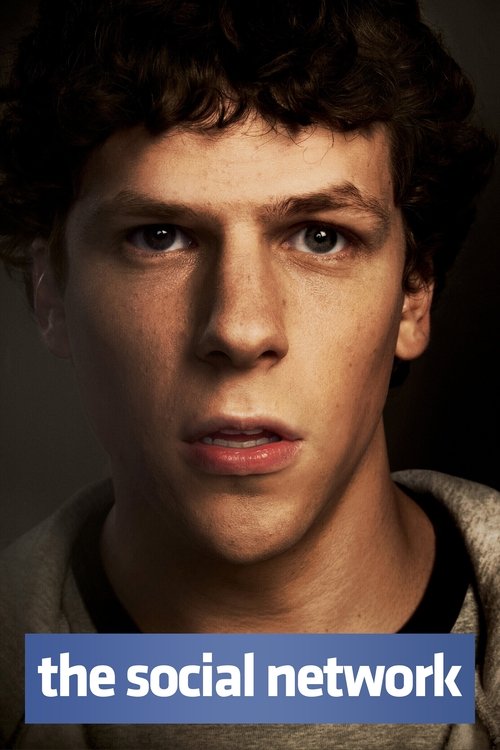
The Social Network
2010 · David Fincher
The Killer and his Netflix marriage keep the "master craftsman in a streaming cage" discourse alive; every rumored project (the Chinatown prequel series, a Squid Game English remake rumor cycle) trends instantly.
For when you want to feel smart and slightly wired — a film that moves at the speed of ambition and gives you plenty to argue about at dinner afterward. Sharp company, not comfort food.
What it's about
A Harvard sophomore with a gift for code and a grudge to feed builds a website in his dorm room, and it swallows the world. The story of Facebook's founding is told from inside two lawsuits — one brought by the best friend who bankrolled it, one by the twins who claim the idea was theirs — so the empire rises and the friendships rot in parallel. It's a business origin story that plays like a betrayal drama.
The experience
Fast, cold, and relentlessly talky in the best way — the dialogue comes at you like a fencing match, and the whole thing hums with late-night urgency. It leaves a bruise: exhilarating while it runs, quietly sad when it stops.
Performances
Jesse Eisenberg makes Mark Zuckerberg mesmerizing without ever asking you to like him — all clipped speech and buried hurt — while Andrew Garfield gives the film its heart as the friend left behind, and Justin Timberlake is pure seductive trouble as the Napster founder who whispers in Mark's ear.
The craft
Aaron Sorkin's screenplay is a machine of overlapping, quotable dialogue, and David Fincher directs it with surgical control — every frame dark, precise, and deliberate. Trent Reznor and Atticus Ross's electronic score turns dorm-room coding into something ominous and grand; it sounds fantastic on good speakers.
Why it matters
Widely called the defining Hollywood film of its decade, it set the template for how movies dramatize the tech world and turned a website's founding into modern myth.
Snapshot
A film about the founding of Facebook that functions less as corporate biography than as American tragedy: a Citizen Kane-inflected portrait of genius curdling into solitude, told backwards through the adversarial grammar of civil litigation. David Fincher directs Aaron Sorkin's adaptation of Ben Mezrich's disputed account with the precision of a forensic examiner, producing what many critics immediately identified as the defining Hollywood film of its decade — a work whose formal severity and thematic density sit in permanent, productive tension with its tabloid subject matter.
Industry & production
The Social Network was produced by Columbia Pictures through Scott Rudin's production company, with additional producers Dana Brunetti, Michael De Luca, and Fincher's producing partner Ceán Chaffin. The project originated with Rudin, who acquired the rights to Ben Mezrich's The Accidental Billionaires (2009) — itself a work of narrative nonfiction blending reconstructed scenes with reported fact — and engaged Aaron Sorkin to write the screenplay before the book had even been published. Sorkin, whose research reportedly relied on legal depositions and public records rather than the book itself, delivered a script that Facebook and Zuckerberg's representatives disputed on numerous factual grounds, a controversy Fincher and Sorkin largely declined to engage with publicly.
The budget has been reported at approximately $40 million, modest for a prestige studio drama of this scope. Principal photography took place in late 2009, primarily in the Boston area, with Harvard facilities unavailable — the university declined to cooperate — meaning that Fincher's Cambridge was largely assembled from Johns Hopkins University, the University of Southern California, and carefully controlled location work. The Henley Royal Regatta rowing sequences required separate international production. The film opened in North America on October 1, 2010, and went on to earn approximately $224 million worldwide, a substantial commercial success for a dialogue-driven drama with no action sequences.
It was nominated for eight Academy Awards, winning three: Best Adapted Screenplay (Sorkin), Best Original Score (Trent Reznor and Atticus Ross), and Best Film Editing (Kirk Baxter and Angus Wall). Its loss in the Best Picture category to The King's Speech became, in subsequent critical retrospect, one of the more frequently revisited Oscar decisions of the era.
Technology
Fincher had been an early and committed advocate for digital acquisition since Zodiac (2007), which he shot on the Viper FilmStream camera. For The Social Network he used the Red One MX, at the time among the highest-resolution digital cinema cameras commercially available, shooting at 4K and exploiting the sensor's latitude for the film's characteristic dark, shadow-rich interiors. The Red One allowed Fincher's characteristically high take counts without the cost pressures of celluloid stock, a practical consideration that reinforced his directorial method.
The film's most technically ambitious sequence is the depiction of both Winklevoss twins, who are played by Armie Hammer in their entirety: Hammer's face was digitally mapped onto the body of actor Josh Pence using methods derived from performance capture and compositing, allowing the same actor to appear opposite himself without resort to the twin-actor casting conventions of earlier productions. The result is seamless to a degree that made the technique widely discussed at the time of release, representing an intermediate step in the digital face-replacement work that would become industry-standard practice in subsequent years.
Technique
Cinematography
Jeff Cronenweth, who had shot Fight Club (1999) with Fincher and would go on to collaborate with him on The Girl with the Dragon Tattoo (2011) and Gone Girl (2014), established a palette that is among the most carefully controlled in Fincher's filmography. The color grading suppresses warmth almost entirely: interiors are blue-gray and underlit, faces emerging from deep shadow in a manner that owes something to Vilmos Zsigmond and Gordon Willis while remaining distinctly contemporary. The ambient light sources — laptop screens, cellphone displays, the fluorescent haze of institutional corridors — are integrated into the photographic logic rather than supplemented by conventional fill, giving the film a functional coldness that mirrors its thematic preoccupations. Exterior sequences, particularly the Henley rowing footage, shift toward a burnished naturalism that makes them feel like intrusions from a different, more traditionally cinematic world.
Editing
Kirk Baxter and Angus Wall's editing, the work for which the film received its most technically specific Academy recognition, operates across three temporal registers simultaneously: the present-tense depositions, conducted in two separate legal proceedings with partially overlapping testimony, and the dramatized past that those depositions describe. The transitions between registers are often achieved by purely sonic means — a word, a name, a sound — before the image follows, creating an associative grammar that the viewer internalizes within the film's first twenty minutes. The opening sequence, a nine-minute unbroken exchange between Zuckerberg (Jesse Eisenberg) and his girlfriend Erica Albright (Rooney Mara), establishes a cutting rhythm calibrated to dialogue rather than to conventional scene structure, a rhythm the rest of the film will systematically vary and return to.
Mise-en-scène / staging
Fincher's staging consistently works against the expectations generated by social subject matter. Crowd scenes — the Phoenix Club party, the Facemash crash sequence, the nightclub sequences in Los Angeles — are not staged for chaos or energy but for geometrical precision, every body placed and every camera position planned so that the social world reads as a kind of code to be deciphered rather than a milieu to be inhabited. The deposition rooms, which might easily have become theatrical bottlenecks, are given depth and dimension through blocking that keeps all parties in frame and in play simultaneously. The contrast between the fluorescent geometry of institutional legal proceedings and the organic disorder of the past that those proceedings examine is never labored but is always present.
Sound
Trent Reznor and Atticus Ross, the Nine Inch Nails collaborators who had no prior feature film scoring credit of comparable scale, produced a score that became immediately influential: largely electronic, built on synthesizer textures and processed piano, it functions less as underscore in the conventional sense than as an atmospheric substrate that the film breathes through. The score does not swell to signal emotion but intensifies and withdraws in ways that subtly pressurize scenes without directing the viewer's sympathy. The sound design maintains a similarly controlled relationship to the dialogue, which is delivered at the elevated speed Sorkin's scripts require without any softening of consonants or reduction in overlap. The overall sonic experience is unusually dense for a prestige drama, the music and dialogue and ambient sound occupying distinct but proximate frequencies.
Performance
Jesse Eisenberg's Zuckerberg is the film's argumentative center: delivered at speed, relentlessly analytical, tonally flat in ways that register as either neurodivergent bluntness or performed cruelty depending on the scene. Eisenberg resists making the character sympathetic or its opposite, sustaining an opacity that the film's competing testimonies never fully dissolve. Andrew Garfield as Eduardo Saverin grounds the film's emotional register, providing the warmth and legibility that Eisenberg withholds and making the relationship between the two characters feel like genuine loss rather than narrative function. Justin Timberlake's Sean Parker is deployed as a figure from a different film entirely — charismatic, unstable, slightly cartoonish — a choice that reflects Sorkin's structural instinct for contrast. Rooney Mara appears only in the opening sequence and in Zuckerberg's remembered projection of Erica, but the performance establishes the film's moral stakes more efficiently than many more extended roles.
Narrative & dramatic mode
The film's structural model is Rashomon refracted through the procedural forms of the American legal drama: competing accounts of the same events, delivered under oath in adversarial circumstances, with the film granting neither account definitive authority. The deposition frame does not function merely as a framing device but as an epistemological claim — that the story of Facebook's founding is, precisely, a story that cannot be told from a single perspective because the participants do not agree on what happened and may not be capable of knowing. Sorkin's script is notably candid about its own fictionalizing: the Erica Albright character is an acknowledged composite, the dialogue in reconstructed scenes is invented, and the film takes no position on the legal merits of the Winklevoss and Saverin suits. Within that admitted fiction, however, the dramatic architecture is conventionally Aristotelian — a protagonist defined by a central lack (social belonging, emotional reciprocity) pursuing a goal that achieves everything except what he most wanted.
Genre & cycle
The Social Network belongs formally to the prestige biographical drama, but its generic affiliations are more complicated than that category suggests. It participates in the tradition of the American ambition narrative — the self-made man whose success constitutes or produces his isolation — associated with Citizen Kane (1941), All the President's Men (1976), and the corporate procedural dramas of Sydney Lumet. It is also a legal procedural, a campus film, and a tech thriller in the precise sense that it uses the creation of a technology as the mechanism for exploring social and moral questions the technology only incidentally raises.
The film arrived during the early consolidation of Silicon Valley as a site of cultural mythology, and it helped define what would become a genre cycle: the tech-founder biopic or dramatized account, subsequently including Jobs (2013), Steve Jobs (2015, also written by Sorkin), and extended to the documentary and prestige television spaces. Its template — the driven founder, the betrayed partner, the legal aftermath — proved remarkably durable.
Authorship & method
The film represents an unusual convergence of strong authorial personalities, and the critical question of which sensibility dominates remains productively unresolved. David Fincher is among the most formally rigorous directors working in American commercial cinema: his films are characterized by high take counts (reportedly common in the dozens on this production), obsessive control of frame and color, and a consistent preference for the cold and the systematic over the emotional and the spontaneous. These tendencies are in principle antithetical to Sorkin's method, which is essentially theatrical — rhetorical, performance-driven, built around the display of verbal intelligence — and yet the two sensibilities produce a complementary friction rather than a collision, Fincher's visual severity preventing Sorkin's language from becoming self-regarding while Sorkin's density of dialogue provides a subject for Fincher's analytical rigor.
Jeff Cronenweth had been part of Fincher's extended collaborative circle since the mid-1990s and was the first-choice cinematographer without significant deliberation, their working relationship by this point a shared visual grammar rather than a negotiation. Trent Reznor and Atticus Ross were an unconventional choice whose outsider status relative to Hollywood scoring conventions proved an advantage: they brought an electronic sensibility and a willingness to treat the score as sound design that the score could not have had from a more institutionally trained composer. Kirk Baxter and Angus Wall had edited Zodiac (2007) and The Curious Case of Benjamin Button (2008) with Fincher, and the three-timeline structure of The Social Network was executed with a confidence that reflects genuine collaboration rather than direction.
Movement / national cinema
The film is fully within the Hollywood studio system — Columbia Pictures, A-list producer, major distributor, wide release — but its tone and ambition place it in the tradition of American prestige cinema that emerged in the 1970s, when directors with aesthetic and intellectual ambitions operated within commercial frameworks. Fincher's career is one of the more coherent examples of the auteur-within-the-studio-system model that has defined American prestige drama from the late New Hollywood period through the streaming era: his films are consistently profitable enough to sustain his formal ambitions while those ambitions keep his work distinct from more purely commercial entertainment. The Social Network operates at the intersection of the adult drama — a form whose commercial viability Hollywood had been questioning since the early 2000s — and the contemporary cultural event film, a position that accounts for both its substantial box office and its critical reception.
Era / period
The film is doubly situated in time: it dramatizes events from 2003 to 2005 and was released in 2010, the year Facebook reached 500 million users. This temporal gap is not incidental. The film arrives when the phenomenon it depicts has already been fully assimilated into daily life, which means its audience brings to the screen a knowledge of consequences that the characters cannot have. The period detail — the specifics of early 2000s campus culture, the particular affordances and limitations of 2003-era web technology, the visual language of early social networking — is rendered with precision rather than nostalgia, and Fincher consistently refuses to editorialize about the gap between the scrappy dormitory enterprise and the global corporation it became.
In the broader periodization of American cinema, the film belongs to the moment just before streaming disruption fundamentally altered the economics of the adult drama: a $40 million dialogue picture with no franchise implications that opened in wide release and earned significant theatrical revenue is a production model that became substantially harder to sustain in the years following.
Themes
The film's nominal subject — the founding of Facebook — is the vehicle for several overlapping preoccupations. The most immediate is the relationship between intelligence and social competence, and the particular American myth that conflates the two: Zuckerberg's facility with code and his inability to maintain friendship are presented as related expressions of the same cognitive architecture rather than as paradox. The film is also, in Sorkin's characteristic mode, a meditation on the nature of ideas and their ownership — what it means to "have" an idea, what obligations that having creates, what the law can and cannot adjudicate about human creativity and collaboration.
The betrayal theme is more nuanced than the film's advertising suggested: it is not clear that Zuckerberg consciously betrayed Saverin, any more than it is clear that he did not, and the film's formal structure — competing depositions, irreconcilable accounts — is the argument that certainty on this point is unavailable. Underneath these themes runs a strand of American class anxiety that is rarely discussed: the Winklevoss twins' sense of entitlement, Saverin's bourgeois social ambitions, Parker's hustler mythology, and Zuckerberg's outsider hunger are all manifestations of a specifically American confusion between meritocracy and hierarchy that the film neither endorses nor satirizes but simply presents.
Reception, canon & influence
The Social Network was received upon release with near-universal critical acclaim, achieving a degree of consensus unusual even for well-regarded films. Roger Ebert gave it four stars; the film held an exceptionally high aggregate critical score throughout its run and appears consistently on critics' decade-end lists for the 2010s. The American Film Institute and the National Board of Review named it among the best films of the year. Its loss of the Best Picture Academy Award to The King's Speech generated critical commentary about the Academy's preferences that persisted for years and entered the standard narrative about the limits of Oscar recognition.
The films that most demonstrably shaped The Social Network include Citizen Kane (1941), whose rise-and-fall structure and structural use of testimony as an interrogative frame Sorkin has acknowledged; All the President's Men (1976), whose procedural seriousness and institutional subject matter provided a generic model for politically and socially significant drama conducted through documentation; and Fincher's own prior work, particularly Zodiac (2007), which established his method for dramatizing documented events through a combination of procedural specificity and atmospheric unease.
In the decade and a half since its release, the film's forward influence has been substantial. As a model for the tech-founder narrative it defined what the genre would look like — Sorkin's Steve Jobs (2015) is explicitly in conversation with it, and numerous subsequent dramatizations of Silicon Valley figures (including television work) have adopted its structural conventions. As a specimen of Fincher's method it consolidated his reputation and the visual language associated with him sufficiently that subsequent filmmakers working in prestige drama register his influence in cinematography, color grading, and editorial rhythm.
More diffusely, the film's treatment of social media as a subject for serious dramatic art rather than satire or cautionary fable helped legitimate the technology sector as a domain of cultural interest equivalent to political and business subjects that had previously occupied the prestige drama. The irony that a film about the creation of digital social connection should be photographed with such deliberate coldness, and should end with its protagonist alone, repeatedly refreshing a browser page for a response that does not come, has not diminished in resonance as the subsequent decades of social media history have accumulated.
A Deleuzian reading
Start with the laptops.
The full Deleuzian reading of The Social Network →
Reception
A critical darling on release that famously lost Best Picture to The King's Speech — a loss now routinely cited as one of the Academy's great mistakes. Its stock has only risen since, regularly topping best-of-the-2010s polls as the decade's defining film.
How The Social Network was received, from release to now →
Influences: the films it descends from and the films it influenced
- Citizen Kane (1941) — Reconstructs an unknowable mogul through the contradictory depositions of interviewed witnesses, the interrogative-testimony armature Sorkin transposed directly onto the two lawsuit framings.
- Rashomon (1950) — Establishes the formal device of mutually incompatible eyewitness accounts of one event, the structural model for cutting the film's action against competing deposition testimony.
- All the President's Men (1976) — Proves that documentation, paper trails and procedural verification can carry a serious drama, supplying the genre template of socially significant subject matter conducted through records.
- His Girl Friday (1940) — Pioneers overlapping, faster-than-real rapid-fire dialogue as a rhythmic engine, the verbal velocity Sorkin's overlapping exchanges and the cold-open breakup scene inherit.
- Sweet Smell of Success (1957) — Weaponizes acerbic, epigrammatic dialogue into instruments of social cruelty among ambitious men, the rhetorical aggression Sorkin's put-downs descend from.
- A Few Good Men (1992) — Sorkin's own deposition-and-cross-examination setpiece structure, where testimony under interrogation becomes the dramatic climax, prefigures the film's twin legal framings.
- Network (1976) — Models the sustained, intellectually dense rhetorical monologue delivered by hyper-articulate professionals, the speech-as-aria mode Sorkin's writing extends.
- Fight Club (1999) — Jeff Cronenweth's first Fincher collaboration established the desaturated, shadow-rich, near-bleach palette and obsessive frame control reused here as a shared visual grammar.
- Zodiac (2007) — Fincher's method of dramatizing documented real events via digital acquisition, procedural specificity and ambient dread is the direct precedent for this film's atmospheric coldness.
- Frost/Nixon (2008) — Fincher uses deposition proceedings as mockumentary scaffolding for reconstructing past events through parallel intercutting between present-tense legal proceedings and dramatic recreation, and Baxter and Wall's editing constructs a procedural thriller rhythm from dialogue-driven confrontation in closed rooms — techniques that Frost/Nixon's editing blueprint makes available.
- Charlie Wilson's War (2007) — Sorkin's signature dense, overlapping walk-and-talk and intelligence-as-virtue dialogue, refined on this film, becomes the defining engine of his next screenplay's deposition-driven structure.
- Amadeus (1984) — Narrates a prodigy through the depositions of resentful near-equals, transposing Salieri's mediocrity-recognizing-genius confessional structure into legal testimony (Sorkin has cited the debt).
- The Girl with the Dragon Tattoo (2011) — Immediate continuation of the same Cronenweth digital cinematography and Reznor/Ross electronic underscore, deploying the cold-palette tech-thriller grammar developed here.
- Gone Girl (2014) — Carries forward the Reznor/Ross non-swelling synthetic score and the unreliable-testimony structure, narrating events through competing, distrusted accounts.
- Steve Jobs (2015) — Sorkin's explicit follow-up, restructuring the tech-founder biopic into three real-time backstage movements driven by the same rhetorical-confrontation method.
- Molly's Game (2017) — Sorkin directing his own script foregrounds the rapid voiceover-as-testimony narration and legal-framing scaffolding refined in the deposition structure here.
- Mank (2020) — Fincher's reflexive return to the Citizen Kane origin, applying his digital monochrome and exacting frame control to the same testimony-and-authorship preoccupations.
- After the Hunt (2025) — Originates the Reznor-Ross anxious-synth scoring of cold institutional ambition, pairing surveillance-flat framing with verbally dense status combat that After the Hunt's sound design extends.
- The Imitation Game (2014) — Fincher's deposition framing device — past events reconstructed through adversarial testimony to institutional authority — directly models Tyldum's interrogation frame, while Reznor and Ross's mechanized digital pulse beneath flashbacks anticipates Desplat's Bombe-tick ostinato.
- Brexit: The Uncivil War (2019) — The explicit template: a deposition/framing-device structure and rapid, overlapping Sorkin dialogue that renders a socially abrasive outsider as an ambivalent disruptor-genius — Graham's Cummings is built on this lens.
- The Trial of the Chicago 7 (2020) — Sorkin's screenplay pioneered the deposition-frame structure he reuses here: present-tense legal testimony intercut with dramatized flashbacks of the contested events, the courtroom adjudicating a past we keep cutting back to.
- Bones and All (2022) — The origin point of Trent Reznor and Atticus Ross's film-scoring method—brooding, textured synth-and-piano dread—that underscores Maren and Lee's romance.
- Moneyball (2011) — Sorkin's immediate template — overlapping legalistic dialogue and deposition-framed flashback interweaving that stages non-physical intellectual work as combat; its success is what made Moneyball's greenlight and Sorkin's involvement plausible.
- Waves (2019) — Reznor and Ross's breakthrough as film composers, whose atmospheric synth-and-drone scoring as emotional undertow becomes the same duo's spine for Waves.
- The Insider (1999) — A corporate-whistleblower procedural that renders institutional power through cool surveillance-tinged unease and verbal duels, a parallel prestige-procedural register.
- Michael Clayton (2007) — Extends the Pakula corporate-legal procedural into a desaturated, emotionally withheld prestige drama built on affective opacity rather than catharsis.
- Spotlight (2015) — Revives the All the President's Men documentation-procedural in a restrained prestige register, dramatizing institutional reporting through records rather than spectacle.
- Twinless (2025) — Face-replacement compositing makes one actor read as the Winklevoss twins seamlessly, advancing the invisible dual-role craft Twinless relies on for its twin staging.
- A Complete Unknown (2024) — Fincher's retrospective-ironic framing — flashback dramatizations in permanent tension with competing testimonial accounts — formalizes the biographical gap between action and explanation that ACU's title-card structure performs, and Eisenberg's withholding characterization of Zuckerberg as constitutively evasive American genius is the performance model Chalamet's Dylan inhabits.
- Capote (2005) — A narrow-episode, morally skeptical biopic of a creator who mines his relationships for the work — the predatory-authorship study transposed to a single founding.
- Soul (2020) — Origin of the Trent Reznor & Atticus Ross ambient-electronic scoring method that Soul splits off as the ethereal Seminar music, counterpointed against Batiste's acoustic jazz.
- TRON: Legacy (2010) — Contemporary demonstration of the Fincher-Trent Reznor model — precise digital editing married to a foregrounded electronic score as narrative engine — the same schooling Haygood and Daft Punk bring to Legacy.
- Quiz Show (1994) — The literate adult studio drama of epigrammatic verbal duels and ambition-as-Faustian-bargain inside an institutional milieu, the form Quiz Show exemplified.
Similar films
- Fight Club (1999) — influence & lineage · same viewing thread
- The Girl with the Dragon Tattoo (2011) — influence & lineage · often watched together
- Steve Jobs (2015) — influence & lineage
- Gone Girl (2014) — influence & lineage
- Molly's Game (2017) — influence & lineage
- Zodiac (2007) — influence & lineage
- Michael Clayton (2007) — influence & lineage · same viewing thread
- The Game (1997) — same viewing thread
All the films related to The Social Network →
Watch it with: curated runs of related films
- The American Male Comes Apart — A run of self-made men — brokers, founders, dealers, drifters — hollowed out by the very thing they chase, each film pressing the same nerve where ambition curdles into alienation and violence.