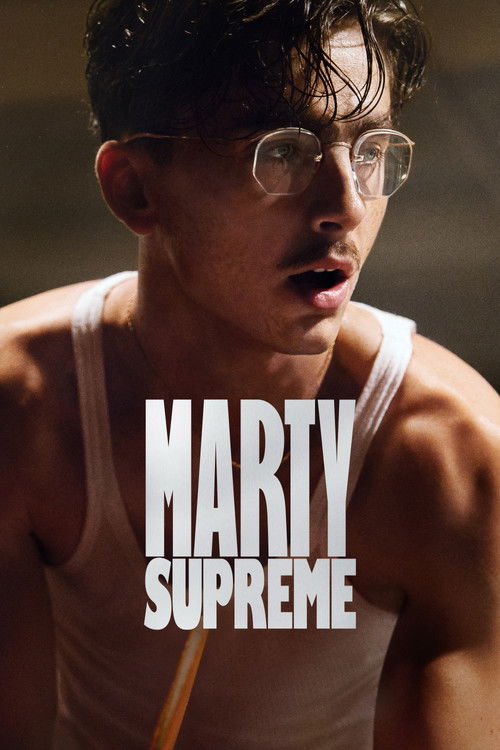
Marty Supreme
2025 · Josh Safdie
When you want energy — a film that grabs you by the collar and doesn't let go — and you enjoy rooting for someone you'd never lend money to. More adrenaline than comfort.
What it's about
In 1950s New York, Marty Mauser is a young man burning to be great at the one thing nobody respects: table tennis. Treated as a joke by the sport-loving world around him, he schemes, hustles, and bluffs his way toward legitimacy, dragging everyone in his orbit along on the ride. It's a sports story wired like a con-artist picture, loosely inspired by the real ping-pong champion and lifelong hustler Marty Reisman.
The experience
Propulsive and jangly — the comedy of a fast talker who won't take no, laced with the dread of watching him gamble everything, again, on himself. It's funny and stressful in roughly equal measure.
Performances
Timothée Chalamet goes full motor-mouth obsessive as Marty, channeling his charm into something needier and more relentless than his usual leading-man mode.
The craft
This is Josh Safdie's first feature directed without his brother, written with his regular collaborator Ronald Bronstein, shot by the great Darius Khondji, and scored by Daniel Lopatin — a pedigree built for texture and momentum. The period New York is rendered with grain and noise rather than nostalgia, and it's the kind of film that rewards a loud room and a big screen.
Why it matters
A watched-closely test of what the Safdie style becomes when split solo, and a swing at making an American epic out of the least glamorous sport imaginable.
Snapshot
Marty Supreme is the first solo feature directed by Josh Safdie, made apart from his brother and longtime co-director Benny Safdie, with whom he built one of the most distinctive American filmographies of the 2010s (Heaven Knows What, Good Time, Uncut Gems). It stars Timothée Chalamet as Marty Mauser, a young table-tennis obsessive in 1950s New York who chases greatness in a sport the world treats as a parlor novelty. The character is loosely inspired by the real American table-tennis champion and lifelong hustler Marty Reisman (1930–2012), though the film fictionalizes him under a changed surname and should be read as an invention "after" Reisman rather than a biopic. Written by Safdie with his regular collaborator Ronald Bronstein, shot by Darius Khondji, and scored by Daniel Lopatin, it was produced and released by A24 and arrived in U.S. theaters in late December 2025. It extends the Safdie template — the propulsive, anxiety-saturated portrait of a striver who cannot stop pushing his luck — into a period register and onto an unusually large canvas for the filmmakers and their studio.
Industry & production
The production's defining industrial fact is the dissolution of the Safdie directing partnership. After Uncut Gems (2019), Josh and Benny Safdie pursued separate paths; Marty Supreme is Josh's solo directorial debut, released in the same general window as Benny's own solo feature, The Smashing Machine (2025). The split reframed the "Safdie brand" — forged through their company Elara Pictures and a tight repertory of collaborators — as two distinct authorial projects, and Marty Supreme is the test case for how much of that sensibility belongs specifically to Josh and to the writing partnership with Bronstein.
The film was produced and distributed by A24, the studio that released Uncut Gems and with which the Safdies are closely identified. Trade coverage positioned Marty Supreme as one of A24's largest and most ambitious productions to date — a period film with extensive costuming, era reconstruction, and a marquee lead. I should flag that precise budget and box-office figures are not something I can verify with confidence, and given the film's very recent release the financial record remains thin; I will not assign numbers I cannot stand behind. What is clear is a strategic shift: a studio known for lean, mid-budget auteur cinema mounting a star-driven prestige picture timed to the year-end awards corridor, with Chalamet — among the most bankable young actors of his generation, here also serving as a producer — as the commercial anchor.
The casting reflects the Safdies' signature method of surrounding a star with an eclectic ensemble drawn from outside the conventional acting pool. Reported cast members include Gwyneth Paltrow, the musician Tyler, the Creator, Odessa A'zion, Fran Drescher, and a range of figures recruited for texture and surprise rather than résumé. This is consistent with the directors' long practice — most visibly Adam Sandler's career-redefining turn in Uncut Gems and the use of non-professionals in Heaven Knows What — of building authenticity from unexpected faces.
Technology
The Safdies' cinema is bound up with a particular analog-leaning toolkit, and Marty Supreme, with Khondji behind the camera, continues that orientation toward photochemical capture and the grain, halation, and tonal density of film stock. The earlier work moved across 16mm (Heaven Knows What), the textured 35mm of Good Time, and the lush 35mm of Uncut Gems; a 1950s subject invites that same celluloid materiality both as period idiom and as the directors' native visual language. I should note that I cannot confirm the exact gauge and stock used on this production, so I will describe the tradition rather than assert specifications.
The more demanding technological problem is sport itself. Table tennis is among the fastest ball sports to photograph — rallies move quicker than the eye comfortably tracks — and rendering it with clarity and kinetic force requires deliberate solutions in camera placement, frame rate, and choreography. The film's burden is to make a "small" sport feel enormous, which puts the technical apparatus in service of scale and legibility rather than spectacle for its own sake.
Technique
Cinematography
Darius Khondji is the decisive craft signature. A cinematographer with one of the deepest pedigrees in contemporary cinema — from Jeunet's Delicatessen and Fincher's Se7en through long associations with Michael Haneke and James Gray — he shot Uncut Gems, where he married the Safdies' restless, telephoto-compressed, neon-and-fluorescent New York to a painterly control of color and light. The Safdie visual grammar favors long lenses that flatten and crowd the frame, handheld immediacy, and a camera that stays uncomfortably close to faces, generating claustrophobia and momentum. For a period film, Khondji's challenge is to fuse that nervous proximity with the warmer, more composed palette of 1950s reconstruction — to keep the anxious energy while honoring the era's surfaces.
Editing
Editing is central to the Safdie effect and to this film's authorship, because Ronald Bronstein is both co-writer and a principal architect of the cutting room. The house style — developed with Bronstein and Benny Safdie across Good Time and Uncut Gems — layers overlapping dialogue, hard cuts that refuse breathing room, and an accelerating rhythm that mirrors a protagonist's compulsion. The films are famous for sustaining tension to the point of physical discomfort. In a sports narrative the editing carries additional weight: match sequences must be intelligible as games (geography, score, momentum) while delivering the propulsive drive that is the Safdies' trademark.
Mise-en-scène / staging
The Safdies stage life as congestion. Their frames teem with bodies, hustles, transactions, and overlapping crises; the protagonist is forever threading through a hostile, overstuffed world. Translated to the 1950s, this means table-tennis halls, back rooms, and the period's demimonde rendered as lived, crowded, slightly seedy spaces rather than nostalgic dioramas. The staging tends to keep the hero in perpetual motion, the environment pressing in, so that ambition reads as a kind of entrapment.
Sound
Sound design has always been a Safdie weapon — dense, abrasive, and immersive, with diegetic chaos pushed forward in the mix and the score interwoven aggressively with environmental noise. Daniel Lopatin's electronic scores (discussed below) are mixed not as accompaniment but as pressure. In a film about table tennis, the percussive report of ball on paddle and table offers a ready-made rhythmic motif, and the sport's distinctive acoustic signature is an obvious resource for building tempo and tension.
Performance
The Safdie performance idiom prizes raw, overlapping, almost documentary naturalism, with stars pushed past polish into something feral and exposed — Robert Pattinson in Good Time and Adam Sandler in Uncut Gems are the templates. Chalamet, an actor of conspicuous technique and charisma, is here asked to inhabit that mode: a striver whose hunger curdles into recklessness. The surrounding ensemble's mix of professionals and non-traditional performers is designed to keep the lead honest, abrading star wattage against unpredictable textures.
Narrative & dramatic mode
The film operates in the Safdies' characteristic dramatic mode: present-tense, forward-driving, and built around a protagonist whose appetite outruns his judgment. Their stories are engines of escalation — a single obsession (a score, a gem, a sister, a brother's freedom) sets off a cascade of complications that the hero meets by doubling down. The TMDB logline — a young man with "a dream no one respects" who goes "to hell and back in pursuit of greatness" — signals exactly this structure: aspiration as compulsion, ambition that is also self-endangerment. The dramatic question is less "will he win?" than "what will winning cost, and is the wanting itself the disease?" This aligns the film with the Safdies' recurring tragicomic fatalism, in which the chase is exhilarating and ruinous at once.
Genre & cycle
Marty Supreme sits at the intersection of the sports film and the Safdie anxiety-thriller. As a sports picture it belongs to the durable American subgenre of the obsessive striver — Raging Bull's self-destructive pugilist and The Hustler's pool-hall gamesman are its clearest forebears, the latter especially apt given the hustling, low-rent milieu and the gap between a "minor" game and the existential stakes its players assign it. As a Safdie film it extends a cycle of hustler narratives about marginal figures gambling everything for a breakthrough. The novelty is the period setting: the brothers' previous features were emphatically contemporary, and moving the formula into the 1950s tests whether their nervous realism survives translation into a reconstructed past. It also participates in a broader recent appetite for stylish, auteur-driven period dramas mounted at prestige scale.
Authorship & method
The authorship story is the film's most consequential context. The Safdie brothers' method — grueling, immersive, research-driven, built on long gestation and a stock company of collaborators — produced a body of work so unified that disentangling individual contributions is genuinely difficult, and the record on precisely who did what is thin enough that I will not pretend otherwise. Marty Supreme is the experiment that begins to clarify it.
- Josh Safdie (director, co-writer) is, in interviews across the partnership's history, the brother most associated with story origination and obsessive subject research; the Reisman-inspired premise fits his documented fascination with real New York characters and subcultures.
- Ronald Bronstein (co-writer) is the Safdies' essential third voice — a filmmaker in his own right (Frownland) who co-wrote and co-edited Good Time and Uncut Gems. His presence is the strongest line of continuity from the joint features into Josh's solo work, suggesting that much of the "Safdie" sensibility lives in the Safdie–Bronstein writing-and-editing partnership.
- Darius Khondji (cinematographer) brings world-class craft and the specific visual memory of Uncut Gems.
- Daniel Lopatin / Oneohtrix Point Never (composer) is the directors' signature musical voice. His synthesizer scores for Good Time (acclaimed at Cannes) and Uncut Gems are inseparable from those films' pulse; his electronic idiom set against a 1950s subject promises a productive anachronism rather than period pastiche.
The collective method — total immersion in a milieu, naturalistic performance wrung from stars and amateurs alike, and a relentless edit — is the through-line; the open question Marty Supreme answers is how much of it is Josh's and how much was Benny's.
Movement / national cinema
The film is a product of a specific strain of twenty-first-century American independent cinema: the New York–rooted, A24-aligned auteurism that prizes texture, immersion, and outsider milieus. The Safdies are central figures in a lineage of gritty New York filmmaking that runs from the loose, observational realism of John Cassavetes through the street cinema of early Martin Scorsese, Abel Ferrara, and the city-symphony tradition of urban congestion and moral pressure. Their work also bears the imprint of cinéma-vérité documentary and of 1970s New Hollywood character study. Marty Supreme's period setting deepens the explicit dialogue with that 1950s–70s New York mythology rather than departing from it.
Era / period
Two eras are in play. The film's setting is 1950s America — the postwar moment of the table-tennis halls, the hustlers' economy, and a striver's notion of fame in a culture not yet organized around it. Its production belongs to the mid-2020s, a period in which streaming pressure, the contraction of mid-budget filmmaking, and the scarcity of theatrical events made a star-driven, theatrically-released auteur period drama a deliberate bet on cinema-as-event. The film thus reads its 1950s through a contemporary lens preoccupied with ambition, celebrity, and the cost of greatness.
Themes
The governing theme is the pathology of ambition — the dream "no one respects," pursued past the point of reason. Around it cluster the Safdies' recurring concerns: hustling and self-invention, the American faith that sheer will can convert a marginal talent into legend; legitimacy and respect, the ache to be taken seriously in a field the world deems trivial, which gives the "minor" sport its outsized emotional weight; and self-destruction as the shadow of aspiration, the way the engine that drives the striver forward also drives him toward ruin. The choice of table tennis — fast, unglamorous, faintly comic — sharpens the irony: the film insists that greatness is a posture of the soul, not a property of the arena, and that the wanting may matter more, and wound more, than the winning.
Reception, canon & influence
Because Marty Supreme premiered only at the very end of 2025, its critical and commercial record is still forming, and I will be candid that the data available to me is thin; I will not invent reviews, awards, or numbers. What can be stated responsibly is the horizon of expectation it entered. The film carried unusual anticipation as Josh Safdie's solo debut, as a reunion of the Uncut Gems creative core (Safdie, Bronstein, Khondji, Lopatin, A24) minus Benny, and as a Chalamet vehicle positioned in the year-end prestige window. Its reception will inevitably be read comparatively — against Uncut Gems as a benchmark, and against Benny Safdie's parallel solo feature — as critics adjudicate which brother carried which part of the shared genius.
Influences on the film (backward): the obsessive-athlete tragedy of Raging Bull; the hustler-in-a-minor-game drama of The Hustler; the New York realism of Cassavetes, early Scorsese, and Ferrara; the documentary impulse of cinéma vérité; and, at the subject's root, the real career and showmanship of Marty Reisman, refracted into fiction.
What it may shape (forward): its most immediate significance is as a hinge in its makers' careers — the moment the Safdie partnership becomes two authorships, with Marty Supreme the primary evidence for what Josh Safdie's cinema is on its own terms. Should it succeed, it also models a path for A24 and similar studios: the auteur period film at scale, betting that a singular sensibility plus a major star can still make theatrical cinema feel essential. Its longer legacy — canonical standing, imitators, influence on how the unglamorous sport film is made — cannot yet be assessed and should be revisited as the record matures.
A Deleuzian reading
The ball is barely there.
The full Deleuzian reading of Marty Supreme →
Reception
Dropped on Christmas Day 2025 to record-breaking arthouse numbers and instant Oscar buzz for Chalamet, it just as instantly became the movie everyone was fighting about — six months on, the acclaim and the walkouts have both hardened into legend.
How Marty Supreme was received, from release to now →
How to watch Marty Supreme: what to notice on a first viewing
- Listen for the ball on the table under the score. The dry report of paddle on ball is the film's metronome, and Daniel Lopatin's synthesizers keep swallowing it and handing it back as pulse. The mix pushes room noise forward instead of clearing space for dialogue. The picture runs on that beat. Tempo reaches you through your ears before the plot gives you a reason for it.
- Notice how close the lens gets to Chalamet's face. Darius Khondji shoots long lenses that flatten and crowd the frame, handheld and jammed uncomfortably near. The hunger keeps crossing Marty's face before anything in the scene has actually happened. The face is the plot running ahead of the story. Intensity builds there and never fully spends itself.
- Watch how many people are crowded into every room. Halls, back rooms and the period demimonde are staged as congestion: bodies, hustles and transactions pressing in from all sides. Marty threads through them and is never given open space. His ambition reads as entrapment. The world he intends to conquer is standing on his feet.
- Track what each hustle uncovers about the next one. He wins a match and a debt walks in. He works a con and a bigger room opens behind it. None of his acts transforms the situation. Each one exposes more of it. The film is built the way a hustle is built, one move at a time, with the next trap already waiting.
- Look at how grubby the 1950s rooms are allowed to be. Khondji works on film, with grain and halation, and keeps the period warm without turning it into a display case. These are lived, slightly seedy spaces rather than nostalgic dioramas. The past here is a working environment rather than a costume. It has sweat on it.
The whole guide to watching Marty Supreme, with the keys for a rewatch →
Influences: the films it descends from and the films it influenced
- Uncut Gems (2019) — The direct progenitor, reassembling the same engine room — Khondji's lenses, Lopatin's synths, Bronstein's pen and razor — to drive a protagonist through escalating compulsion on a wall of overlapping, abrasive dialogue and sound.
- Good Time (2017) — Establishes the Lopatin electronic score as relentless propulsive pulse and the Bronstein co-write/co-edit as the structural through-line Josh carries into his solo work.
- Heaven Knows What (2014) — Sets the Safdie casting method — embedding non-actors in their own real milieu and shooting them on long lenses from across the street — that underwrites the film's feral naturalism.
- Frownland (2007) — Bronstein's own film, whose anxiety-pitched, abrasive close-quarters naturalism and convulsive cutting are the editorial sensibility he supplies as co-writer/editor of the Safdie features.
- Raging Bull (1980) — The template for the obsessive-athlete tragedy built around self-destruction, with sound design that makes the arena subjective and the body's punishment visceral.
- Mean Streets (1973) — Model for restless handheld immersion inside a specific New York subculture, riding diegetic needle-drops and amateur-grade faces for documentary friction.
- The Hustler (1961) — Founding move of building a tragic ambition drama around a 'minor' game — the pool hall as pressurized social arena — exactly the unglamorous-sport architecture Marty Supreme inherits for table tennis.
- Faces (1968) — Source of the feral-naturalism aesthetic: performance wrung from improvisation and held in relentless, grainy, tight handheld close-up rather than composed coverage.
- Bad Lieutenant (1992) — The Ferrara strain of New York realism — a protagonist's escalating compulsion and self-destruction rendered in abrasive, immersive, near-vérité texture.
- The French Connection (1971) — Pioneers the long-lens vérité capture of real New York crowds and streets with handheld immediacy, the compression-and-congestion grammar Khondji extends here.
- The Panic in Needle Park (1971) — Scoreless, documentary-grade immersion that drops a star (Pacino) into a fully observed subculture — the realist mode the Safdies revive with stars and amateurs intermixed.
- The Smashing Machine (2025) — The parallel solo debut applying the shared immersive-athlete method to a real sportsman, the controlled experiment that lets critics isolate which brother carried which part of the craft.
- Whiplash (2014) — Drives the same pathology of ambition through abrasive percussive sound and an accelerating cross-cut edit that fuses cutting rhythm to the protagonist's rising panic.
- Challengers (2024) — Scores athletic compulsion with a pulsing electronic Reznor/Ross track set against the sport — the same productive friction of synth idiom against a body-driven game.
- The Iron Claw (2023) — The contemporary A24 sport-as-tragedy, staging ambition and bodily self-destruction within a milieu rendered through tactile period naturalism rather than triumph-arc convention.
- Sound of Metal (2019) — Builds drama out of an abrasive, subjective immersive sound mix as its primary engine — the same conviction that the mix, not the score alone, carries the protagonist's interior state (with Benny Safdie on story/cast).
Similar films
- Whiplash (2014) — influence & lineage · same viewing thread
- Challengers (2024) — influence & lineage · same viewing thread
- The Smashing Machine (2025) — influence & lineage
- Uncut Gems (2019) — influence & lineage
- Good Time (2017) — influence & lineage
- The Hustler (1961) — influence & lineage
- Babylon (2022) — same viewing thread
- tick, tick... BOOM! (2021) — same viewing thread
All the films related to Marty Supreme →
Watch it with: curated runs of related films
- Burning to Be the Best — Watch these together for the shared fever of ambition — musicians, dancers and one table-tennis obsessive driving themselves past exhaustion toward a greatness that keeps costing more.