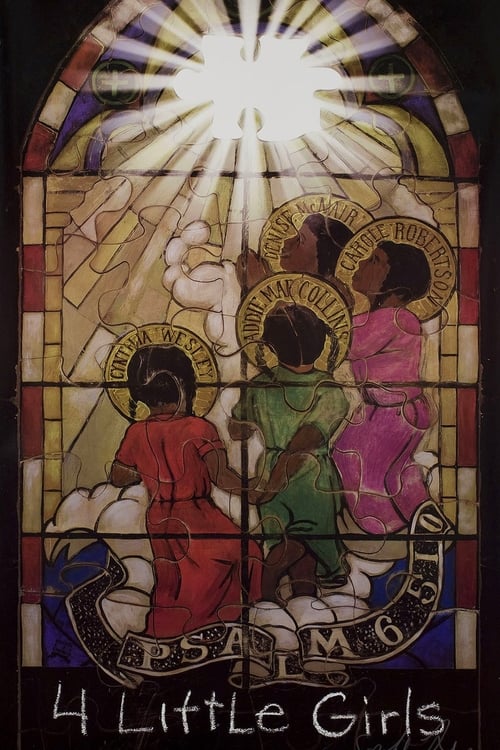
4 Little Girls
1997 · Spike Lee
For when you're ready to sit with something serious and true — a film to watch when you want history made personal, not abstract. Demanding, essential viewing rather than an easy night.
What it's about
On a Sunday morning in September 1963, a bomb planted by white supremacists destroyed the Sixteenth Street Baptist Church in Birmingham, Alabama, killing four girls preparing for Sunday school. Spike Lee's documentary restores the girls as individual children — through their families, friends, and home photographs — before widening out to the city's machinery of segregationist terror and the reckoning that followed, including an interview with former Alabama Governor George Wallace.
The experience
Quiet, measured, and devastating — the power comes not from archival horror but from parents describing their daughters decades later, grief still fresh in their voices. It's heavy, but it earns every minute of your attention.
The craft
Lee sets aside his stylized fiction instincts for patient oral history, letting intimate interviews with the families carry the film while weaving in archival footage that situates the girls' deaths within the larger civil rights struggle. The restraint is the craft — the camera simply stays with faces and lets them speak.
Why it matters
Spike Lee's first feature documentary earned an Academy Award nomination conversation-wide respect and helped return the Birmingham bombing to national memory as a story of real children, not just an icon of the movement.
Snapshot
4 Little Girls is Spike Lee's first feature-length documentary: a measured, grief-saturated account of the September 15, 1963 bombing of the Sixteenth Street Baptist Church in Birmingham, Alabama, which killed Addie Mae Collins, Carole Robertson, Cynthia Wesley (all fourteen) and Carol Denise McNair (eleven) as they prepared for Sunday school. Made for HBO and released to a brief qualifying theatrical run in 1997, the film approaches an atrocity long absorbed into civil-rights iconography by patiently restoring the four girls to particularity — as daughters, friends, and children with hobbies and futures — before situating their deaths within Birmingham's machinery of segregationist terror. It is best understood as a deliberate turn by a filmmaker known for stylized, confrontational fiction toward the disciplines of oral history and archival testimony. The film was nominated for the Academy Award for Best Documentary Feature and is widely regarded as one of Lee's most restrained and durable works.
Industry & production
The project originated as a producer-driven passion of Lee's rather than a studio commission. By his own account, Lee's interest dates to 1983, when he read Howell Raines's New York Times Magazine piece on the bombing and subsequently wrote to Chris McNair, Denise McNair's father, seeking permission and cooperation. The film thus carried a long gestation, contingent on earning the trust of surviving families — a relationship the finished work foregrounds and depends upon entirely.
Production was housed under Lee's 40 Acres and a Mule Filmworks and financed and broadcast by HBO, which by the late 1990s had become a significant patron of feature documentary. Sam Pollard, a longstanding Lee collaborator, served as producer and editor; the two functioned as the project's creative core. The film premiered on the festival circuit in 1997 and received a limited October Films theatrical release that year — the customary mechanism for qualifying a television documentary for Academy Awards consideration — before its HBO broadcast. Beyond the confirmed Oscar nomination for Best Documentary Feature (which it lost), the film gathered additional industry and critics-group recognition; specific award tallies vary in the record, and I will not assign honors I cannot verify precisely. What is not in doubt is that the film substantially raised the profile of Lee as a nonfiction filmmaker and demonstrated HBO's capacity to underwrite serious historical documentary.
Technology
4 Little Girls is a late-1990s documentary and reflects the tools of that moment: newly shot interview material captured on film and/or professional video, married to an enormous body of pre-existing archival media. The film's technological substance is largely the substance of the historical record it curates — black-and-white news film and photographs from 1963, television broadcast footage, still photographs from family albums, and, most disturbingly, forensic and morgue photographs of the victims. Lee and Pollard's method depends on the rephotography and manipulation of these stills — slow pushes, holds, and reframings that predate but anticipate the software-driven still-animation now ubiquitous in the form. There is no technological novelty being showcased here; rather, the film's craft lies in the disciplined orchestration of heterogeneous source materials into a single tonal register. The decision to include graphic post-mortem images was an ethical and editorial choice as much as a technical one, and it remains the film's most debated formal gesture.
Technique
Cinematography
The interview photography is credited to Ellen Kuras, a cinematographer who worked repeatedly with Lee in this period. The dominant visual strategy is the intimate, static talking-head shot, frequently framed tight on the face and held long past the point of comfortable exposition, so that pauses, hesitations, and the physical labor of remembering become part of the testimony. This patience is central to the film's meaning: rather than cutting away on the beat, the camera stays, and grief accrues in real time. Against this restraint, the archival photography supplies a harsher, grainier visual texture — the high-contrast black-and-white of period news images — creating a rhythm between the composed present and the ruptured past.
Editing
Editing, by Sam Pollard, is the film's structural signature. The movement is broadly chronological and biographical — establishing the girls and their community, building toward the bombing, then following the long, delayed arc of investigation and prosecution — but the achievement is tonal control. Pollard modulates between tenderness (family recollection) and horror (the aftermath), and the film's most discussed cut is the juxtaposition of testimony with the forensic images of the dead, a montage decision designed to refuse the anesthetizing distance of historical retrospect. The pacing is deliberate throughout, trusting silence and duration rather than momentum.
Mise-en-scène / staging
As a documentary built largely from interviews and archival material, the film's staging is chiefly a matter of how subjects are placed and lit within their own environments, and how photographs are presented to the frame. Interviewees are generally shot in settings that read as personal and lived-in rather than neutral studio space. The most charged staging is not Lee's invention but something he captures: the George Wallace interview, in which the ailing former governor summons his Black attendant on camera and presents him as a rebuttal to charges of racism — a self-staged gesture the film simply allows to play, letting its awkwardness indict itself.
Sound
The soundscape combines interview audio, archival sound, and an original score by Terence Blanchard, Lee's regular composer, whose writing here favors elegy over emphasis. The film also draws on period-associated music of the movement; Joan Baez's recording of "Birmingham Sunday" (Richard Fariña's song memorializing the four girls) is among the musical touchstones associated with the film's mourning register. Sound is used sparingly and functionally — the film does not score its horrors so much as frame its testimonies — and the restraint is consistent with its overall refusal of melodrama.
Performance
"Performance" in a documentary of this kind means the presence and self-presentation of real people. The film's power rests on the testimony of the girls' families — parents, siblings, and childhood friends whose recollections carry the biographical weight — alongside civil-rights figures and Birmingham contemporaries who supply historical and political context. The interviews are notable for their lack of coaching: subjects are permitted to falter and fall silent. The Wallace segment functions almost as a study in bad-faith self-performance, and its inclusion is one of the film's boldest editorial judgments.
Narrative & dramatic mode
The film operates in the mode of oral-historical documentary: first-person testimony, arranged to reconstruct both an event and its long moral aftermath. Its dramatic structure is double. The first movement is essentially a work of resurrection — an insistence on the four girls as individuals, with names, personalities, and interrupted lives, countering the way "the four little girls" had hardened into an abstraction. The second movement is a chronicle of deferred justice: the bombing, the failure to prosecute for years, and the eventual conviction of Robert Chambliss in 1977. (The film was made before the later convictions of Thomas Blanton and Bobby Frank Cherry in the early 2000s, which fall outside its frame.) The emotional logic runs from intimacy to atrocity to the incomplete arithmetic of accountability, and the film declines any tidy redemptive resolution.
Genre & cycle
4 Little Girls belongs to the historical/testimonial documentary tradition and, more specifically, to the cycle of civil-rights nonfiction filmmaking that carried the memory of the movement into a new generation — the terrain most influentially mapped by the Eyes on the Prize series in the late 1980s. Its method — survivor and family testimony braided with archival footage to reanimate a foundational event — is squarely within that documentary lineage. Within Lee's own filmography it inaugurates a nonfiction strand that he would extend in later HBO projects on New Orleans after Hurricane Katrina, making 4 Little Girls the origin point of Lee-the-documentarian as distinct from Lee-the-dramatist.
Authorship & method
The film is a Spike Lee work in authorship and conviction but a genuinely collaborative one in execution. Lee's method here is markedly different from his fiction: he suppresses the stylistic flourishes — the direct address, the dolly-borne "double" shot, the saturated palette — that mark his features, subordinating auteurist signature to the testimony. His authorial role is that of an interviewer and a moral organizer of material, and his long personal investment (the years spent securing the families' trust) is itself part of the film's ethics.
The key collaborators are essential to the result. Sam Pollard (editor and producer) is arguably co-architect of the film's shape and tone; his editorial control gives the picture its gravity. Ellen Kuras (cinematographer) supplies the intimate, patient interview photography. Terence Blanchard (composer) provides the elegiac score, continuing his long musical partnership with Lee. The film has no conventional screenwriter in the fiction sense; its "writing" is the work of research, interview, and assembly. Together these collaborators produce a work whose authorship is best described as Lee's vision realized through a tightly knit creative team he had cultivated across his career.
Movement / national cinema
The film is a work of American cinema and, within it, of Black American filmmaking as advanced by Lee and his 40 Acres and a Mule enterprise. It is not aligned with a formal documentary "movement" so much as with an ongoing project of African American historical memory on screen — the effort to keep the archive of the civil-rights era, and its unfinished business, in active cultural circulation. In that sense the film's national-cinema identity is inseparable from its politics: it is an American film insisting on a fuller American reckoning.
Era / period
Two eras press against each other in the film. Its subject is the segregationist South of 1963 — Birmingham as "Bombingham," the church as a movement organizing site, and the bombing as a catalytic outrage that helped shift national opinion toward the Civil Rights Act. Its moment of making is the late 1990s, when the case's cold embers were being stirred and when premium cable was funding ambitious documentary. The film sits self-consciously at that hinge, using late-century retrospection to measure how much — and how little — had been resolved in the intervening decades.
Themes
The governing themes are memory and its refusal to close; the individuation of victims against the anesthesia of the "historical event"; and justice deferred, incomplete, and unequally distributed. The film is centrally concerned with the ethics of looking — hence the contested inclusion of the forensic images, which force the viewer to confront the physical fact of the murders rather than a sanitized memorial version. It examines the ordinary infrastructure of white supremacist violence and the complicity, active and passive, that sustained it; the Wallace interview crystallizes the theme of unrepented power performing its own absolution. Above all it is a film about grief as a permanent condition for the families, not a stage to be worked through — a meditation on how a community carries an unhealed wound across a lifetime.
Reception, canon & influence
4 Little Girls was strongly received critically and is frequently cited as among Lee's finest works and a landmark of civil-rights documentary. Its most concrete institutional marker is the Academy Award nomination for Best Documentary Feature at the 70th Academy Awards; it did not win, and I will not attribute additional specific prizes I cannot verify. Critical praise centered on the film's restraint, the depth of its testimony, and its ethical seriousness, though its use of graphic post-mortem photography drew principled debate about the limits of documentary looking.
Looking backward, the film's influences lie in the testimonial-archival tradition consolidated by Eyes on the Prize and in the broader practice of movement oral history; Howell Raines's journalism was the literal spark. Looking forward, the film matters in at least three registers. Within Lee's career it opened a sustained documentary practice that culminated in his later long-form nonfiction on American catastrophe. Within documentary culture it stands as a model for the individuation-of-victims approach — restoring names and biographies against the flattening of a mass-casualty event — that subsequent memorial documentaries have echoed. And within the broader public reckoning with the case, the film is widely credited with helping return the Birmingham bombing to national attention in the years immediately preceding the reopened prosecutions of the early 2000s; the precise causal weight of the film in those legal developments is not something the historical record settles cleanly, and it should be described as contributory rather than determinative. What is clear is that 4 Little Girls re-established the bombing as a living moral question rather than a closed chapter — which was, by every indication, exactly Lee's intent.
A Deleuzian reading
A woman on screen finishes a sentence about a girl she knew in 1963, and then she stops.
The full Deleuzian reading of 4 Little Girls →
Reception
Acclaimed from the moment it hit HBO in 1997, and its stature has only hardened — its Best Documentary Oscar loss is now widely remembered as one of the category's great injustices, and the Library of Congress added it to the National Film Registry in 2017.
How 4 Little Girls was received, from release to now →
How to watch 4 Little Girls: what to notice on a first viewing
- Watch the camera stay on a face after the words run out. Lee lets each interview hold well past the point where the sentence has finished, so hesitation and silence become part of what's said. The pause isn't dead air to be trimmed. It's a person visibly leaving the present for 1963.
- Listen for how sparingly the score is actually used. Terence Blanchard's music favors elegy over emphasis, staying out of the way so testimony carries the film instead of music cueing your feelings. The restraint keeps grief from ever being manufactured for you.
- Notice the film naming each girl before anything else. The first movement is built entirely around restoring the girls as individuals, through family and friends recalling who they actually were. Before you're shown what happened to them, the film makes sure you know who they were.
- Notice there's no narrator at any point in the film. Lee builds the account entirely from testimony, without a voice-of-God narration explaining or interpreting what people say. The history reaches you through people remembering it, not through an outside authority telling you what it means.
- Watch family members falter and go quiet on camera. The interviews are visibly uncoached, letting people stop mid-thought rather than being edited into tidy, composed statements. The lack of polish is what makes the grief register as real instead of performed.
The whole guide to watching 4 Little Girls, with the keys for a rewatch →
Influences: the films it descends from and the films it influenced
- Eyes on the Prize (1987) — Consolidated the testimonial-archival civil-rights template — first-person movement witnesses intercut with period news footage and let to narrate in their own unhurried words — which Lee adopts wholesale as the film's structuring grammar.
- Shoah (1985) — Model of uncoached, patient testimony as the film's entire substance, refusing reenactment and trusting the witness's face and silences to carry atrocity — the ethic behind Lee's stripped-down interview restraint.
- Night and Fog (1955) — Rephotography of atrocity stills and the explicit moral problem of showing corpse imagery, which Lee extends in his controversial slow pans across the girls' post-mortem photographs.
- The Sorrow and the Pity (1969) — Long-form talking-head oral history that builds historical judgment out of accumulated individual memory rather than an authoritative voice-over narrator.
- The Civil War (1990) — Codified the archival-rephotography grammar — slow camera moves across still photographs married to an elegiac score and read testimony — that Kuras applies to Birmingham's family snapshots.
- Harlan County USA (1976) — Embedded movement documentary that earns its testimony through the filmmaker's long-cultivated trust with a community, the same access ethic Lee spent years building with the victims' families.
- The Times of Harvey Milk (1984) — Memorial documentary that individuates loss through intimate talking-head remembrance and a mournful score, restoring a person from a headline — the individuation-of-victims approach Lee applies to the four girls.
- When We Were Kings (1996) — Lee immediately adopts Gast's retrospective choral interview structure — multiple witnesses speaking across decades to the same historical event, their testimony braided into archival documents — to construct Black political history, with Lee's own on-screen role as commentator in WWWK functioning as a rehearsal for his authorial position here.
- When the Levees Broke (2006) — Lee's long-form catastrophe nonfiction with the identical team — Sam Pollard editing, Terence Blanchard scoring — extending the individuation-of-victims method to a mass American disaster.
- Jim Brown: All-American (2002) — Continues Lee's suppressed-signature documentary mode as patient interviewer and moral organizer of testimony rather than stylist, the posture he first assumed in 4 Little Girls.
- The Central Park Five (2012) — Individuates the wrongly accused through patient talking-head testimony braided with archival footage, framing racialized justice-deferred in Lee's exact register (Lee later dramatized the same case).
- O.J.: Made in America (2016) — Testimonial-archival epic on American race and justice that uses named individual witnesses and period footage to reopen a supposedly closed verdict as ongoing moral inquiry.
- I Am Not Your Negro (2016) — Archival-rephotography essay on civil-rights martyrdom set to an elegiac score, extending Lee's practice of interrogating the ethics of the historical image.
- 13th (2016) — Black-American nonfiction that marries talking-head testimony to aggressive juxtaposition-montage of archival footage, carrying forward the movement-history editing lineage.
- Summer of Soul (2021) — Movement-music archival documentary that restores an erased Black event through rediscovered footage and participants' testimony, echoing Lee's fusion of movement-music and the individuation of the overlooked.
- MLK/FBI (2020) — Lee's own 4 Little Girls editor turned director, applying the archival-testimonial method he helped architect there to civil-rights history — a direct collaborator-to-author lineage.
- David Byrne's American Utopia (2020) — Established, with Kuras, Lee's operating conviction that holding on a still photograph of a murdered person constitutes an argument rather than illustration — the exact device detonated during 'Hell You Talmbout.'
- The Thin Blue Line (1988) — Documentary engineered to reopen a closed case and re-establish it as a live moral and legal question, prefiguring how 4 Little Girls is credited with returning the bombing to national attention before the reopened prosecutions.
Similar films
- Malcolm X (1992) — same viewing thread
- Do the Right Thing (1989) — same viewing thread
- Boyz n the Hood (1991) — same viewing thread
- The Birth of a Nation (1915) — same viewing thread
- BlacKkKlansman (2018) — same viewing thread
- Selma (2014) — shared sensibility
- Nickel Boys (2024) — shared sensibility
- Bless Their Little Hearts (1984) — shared sensibility
All the films related to 4 Little Girls →
Watch it with: curated runs of related films
- Reckoning with the Color Line — A run through a century of American film on race — from the movie that industrialized screen racism to the ones that talk back to it — best watched in rough chronological conversation.