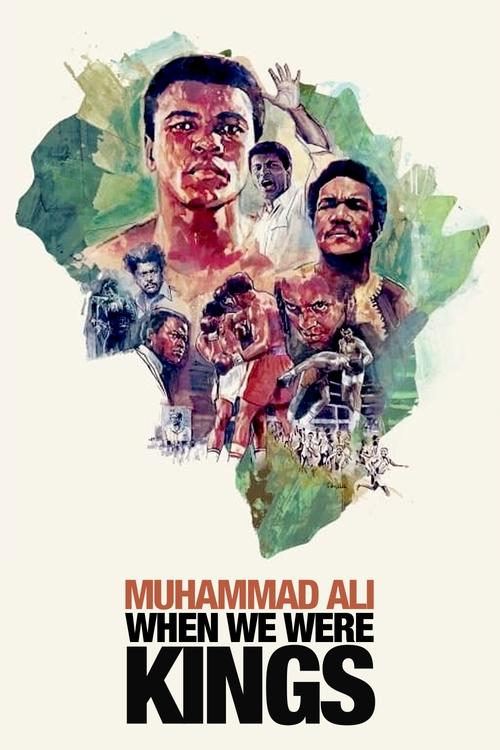
When We Were Kings
1996 · Leon Gast
When you want to be swept up — a crowd-pleaser with real stakes, perfect for a night when you want to feel inspired without being lectured. Comfort viewing with a spine.
What it's about
Kinshasa, 1974. Muhammad Ali, thirty-two and widely written off, arrives in Zaire to fight George Foreman — younger, terrifying, and the reigning heavyweight champion — in a bout promoter Don King dubbed the Rumble in the Jungle, bankrolled by the dictator Mobutu. Around the fight swirls a massive music festival and a continent's worth of expectation, with Ali talking, charming, and needling his way toward the ring.
The experience
Electric and funny, then genuinely suspenseful — Ali is such magnetic company that ninety minutes fly by, and the fight itself plays like a thriller even if you know boxing. There's a current of melancholy underneath: you're watching a vanished moment, preserved by accident.
Performances
Ali himself is the show: one of the great screen presences ever captured, hilarious and needling in press conferences, suddenly quiet and serious when the cameras catch him alone.
The craft
The footage was shot in 1974 — fight camp, streets of Kinshasa, and festival sets from giants like James Brown and B.B. King — then sat in limbo for over twenty years before being cut into a film. The result has a raw, time-capsule vividness no reenactment could fake, and the music alone rewards good speakers.
Why it matters
It won the Academy Award for Best Documentary and arrived just as America re-embraced Ali, helping fix the Rumble in the Jungle as one of the defining cultural events of the twentieth century.
Snapshot
A documentary more than two decades in the making, When We Were Kings records the October 1974 heavyweight championship fight between Muhammad Ali and George Foreman — staged in Kinshasa, Zaire, and billed by promoter Don King as the "Rumble in the Jungle" — and the concurrent Zaire '74 music festival that surrounded it. Shot in 1974 by a crew assembled primarily to document the concerts, the footage languished for over twenty years in legal and financial limbo before producer Taylor Hackford helped broker its completion. Released in 1996, it won the Academy Award for Best Documentary Feature at the 1997 ceremony, arriving at the precise cultural moment when Ali's torch-lighting at the Atlanta Olympics had cemented his transformation from controversial figure to beloved icon. The film holds a rare position in nonfiction cinema: a time-capsule archive of enormous historical richness that was fashioned, retrospectively, into a dramatic narrative about cultural identity, athletic genius, and the political valences of the African diaspora.
Industry & production
Leon Gast traveled to Kinshasa in 1974 with a mandate to shoot concert footage for a separate music film built around the Zaire '74 festival — an event featuring James Brown, B.B. King, Miriam Makeba, the Spinners, and others. The fight itself was not his original primary subject. When Foreman suffered a training cut that postponed the bout by approximately five weeks (from its originally scheduled September date to October 30), Gast and his crew found themselves with unexpected time and access, filming Ali's interactions with Kinshasa crowds, the fighters' preparations, and the political theater orchestrated by Mobutu Sese Seko's government.
The post-production collapse was severe. Ownership disputes over the concert footage became entangled in litigation; the original negative sat unedited for years, reportedly held in a warehouse under difficult storage conditions. By the early 1990s, David Sonenberg — connected to Ali's management circle — helped open a path toward completion. Taylor Hackford came on as executive producer, providing both financing leverage and distribution access. The film was finally assembled in 1995–96, with Hackford's involvement proving decisive in converting an inert archive into a releasable theatrical work. It was distributed in the United States by Gramercy Pictures and achieved both critical approval and modest commercial success before its awards recognition expanded its audience.
Technology
The 1974 footage was shot on 16mm film — the standard gauge of observational documentary practice in that era, lightweight enough for handheld work and adequate in low-light conditions, if prone to grain and dynamic-range compression compared to 35mm. Multiple cameras covered both the concerts and the fight, producing a heterogeneous visual record with varying exposure quality depending on the conditions in Stade du 20 Mai. The limitations are visible: some fight footage is murky, some concert material grainy and underlit. These imperfections were not disguised in the final cut; they function as authenticating markers of the footage's age and provenance.
The contemporary interview segments — with Norman Mailer, George Plimpton, and Spike Lee, recorded in the mid-1990s — were shot on higher-resolution stock and in controlled conditions, producing a deliberate visual contrast that signals the retrospective, mediating layer of interpretation the film imposes on the archive. The editing was completed on nonlinear systems available in the mid-1990s, enabling the editors to weave archival material across a decades-long span with the kind of fluid structural control that would have been cumbersome on flatbed. The sound design involved re-syncing and restoring original audio from multiple sources — concert recordings, press conference audio, ambient sound from the fight venue — and integrating it with the interview narration and music tracks.
Technique
Cinematography
The 1974 footage carries the visual grammar of direct cinema: handheld cameras tracking Ali through Kinshasa neighborhoods, close-range coverage at press conferences, static wide shots of the outdoor concert stage, and ringside angles on the fight itself that prioritize proximity over elegance. Specific director-of-photography credits for the original 1974 production unit are not prominently documented in the film's standard accounts, reflecting the collective, improvisational nature of the shoot — multiple camera operators covered different elements of a sprawling multi-day event with no unified cinematographic strategy. What emerges is a mosaic of contingent images, some of striking compositional power (Ali among jubilant Kinshasa crowds, Foreman shadow-boxing against the river light) and some visibly compromised by conditions. The film's visual authority comes less from any sustained aesthetic program than from the sheer proximity of the cameras to unrepeatable history.
Editing
Keith Robinson edited the film alongside Gast, and the editorial structure is the film's most significant formal achievement. The challenge was constructing a legible dramatic arc — Ali as underdog, the psychological campaign against Foreman, the improbable eighth-round knockout — from footage originally gathered without narrative intent. The editors solve this by subordinating the concert material to the fight story, using the music festival footage as rhythmic counterpoint and cultural context rather than equal subject matter. The intercut contemporary interviews function as choral commentary: Mailer's characteristically baroque appraisals of Ali's genius, Plimpton's journalist's eye for the fight's staging, Lee's articulation of what Ali signified for Black Americans. These retrospective voices transform raw documentation into interpretive cinema without entirely displacing the archival energy of the original footage. The fight sequence is edited with enough restraint to preserve its duration and weight; the rope-a-dope strategy registers as something genuinely surprising within the film's own unfolding, even for viewers who know the historical outcome.
Mise-en-scène / staging
The film makes no formal claims on mise-en-scène in the directorial sense — its images were gathered observationally rather than composed. But the staging it records carries its own visual argument. Ali's informal press conferences and walkabouts in Kinshasa reveal a performer with an acute instinct for self-presentation; he understood the camera's appetite and fed it deliberately, constructing a public persona in real time. Foreman, by contrast, reads as closed and wary, accompanied by his German Shepherd dogs in a gesture that Kinshasa crowds reportedly found threatening and culturally alienating — an association the film exploits editorially. The contrast between Ali's apparent ease among Zairian onlookers and Foreman's isolation becomes a visual argument for the outcome before a punch is thrown.
Sound
The original concert recordings give the film a sonic richness rare in historical documentary. James Brown's performance, in particular, arrives with the force of primary evidence — not background texture but the authentic sound of a cultural moment. The crowd chanting "Ali, bomaye!" (in Lingala: "Ali, kill him!") is the film's most indelible aural image, repeated and built upon across the running time until its eruption during the fight itself feels like collective prophecy fulfilled. The sound design in the fight sequence integrates crowd noise, ring ambience, and corner corner-talk to reconstruct something approaching the aural experience of presence at the event. Original music by the musicians themselves, rather than a commissioned score, grounds the film in the historical moment rather than translating it into retrospective sentiment.
Performance
The film is in substantial measure a performance study of Ali, who emerges as perhaps the most charismatic documentary subject in American nonfiction film. His verbal improvisations before the assembled press — his poetry, his psychological provocations of Foreman, his articulations of African identity — are not merely colorful but analytically precise. He correctly identified the cultural politics of the event (a Black champion fighting in Africa, supported by African crowds) as a weapon against Foreman's psyche, and he wielded it with complete deliberateness. Whether this constitutes "performance" in any conventional sense is a genuine interpretive question the film raises without fully answering: Ali is never not performing, yet his engagement with Kinshasa crowds reads as genuine rather than theatrical.
Narrative & dramatic mode
When We Were Kings operates as a retrospective narrative documentary — it uses knowledge of the outcome to construct suspense about process rather than result. The film is structured as a classical underdog narrative (Ali as aging, fading champion facing a seemingly invincible younger opponent) whose outcome the viewer likely already knows but whose how remains dramatically charged. The insertion of contemporary commentators accelerates this retrospective framing: Mailer and Plimpton speak from a position of confirmed historical knowledge, their voices already tinged with the valedictory register appropriate to myth-making. The film is not merely recording events but consciously participating in the construction of Ali's legend — a participatory act the retrospective structure makes transparent rather than concealing.
Genre & cycle
The film sits at the intersection of three documentary traditions: the sports documentary, the music documentary, and the political/historical documentary. Its primary generic identity is the sports documentary, and it remains one of the defining examples of that form, alongside Hoop Dreams (1994) and Senna (2010). As a music documentary, it is secondary but not incidental — the Zaire '74 concert footage connects it to the tradition of concert films running from Monterey Pop (1968) and Woodstock (1970) through to later music documentaries, and the film's implicit argument about music as a vehicle for political and cultural identity resonates with that tradition. As a historical documentary, it belongs to the cycle of retrospective political films that use archival footage to revisit the long 1970s — a cycle energized in the 1990s by renewed scholarly and popular attention to that decade's cultural upheavals.
Authorship & method
Leon Gast came to the project as a music and event documentarian rather than a political filmmaker; his formation was in concert coverage rather than advocacy journalism. This background shaped the project's initial scope (a concert film) and may account for some of its distinctive texture: the music festival is treated with a musician's attention to performance detail rather than merely as backdrop. Gast's primary creative contribution, however, was archival in nature — the choice to keep shooting beyond the concert mandate, to document Ali's public presence exhaustively, and to preserve footage that might easily have been discarded as peripheral to the fight. The film's completion required the second creative partnership with Taylor Hackford, whose narrative instincts and industry access shaped the theatrical version viewers know.
Keith Robinson's editorial work and the retrospective decision to involve Mailer, Plimpton, and Lee as commentators transformed the footage from archive into argument. Norman Mailer had covered the fight as a journalist, publishing The Fight in 1975 — one of the definitive literary accounts of the event — and his presence in the film creates an intertextual loop with his own prior documentation. George Plimpton similarly brought firsthand journalistic knowledge. Spike Lee's contemporary commentary situates Ali within a specifically Black American political and cultural framework that Mailer and Plimpton, however perceptive, could not fully inhabit. The three voices together constitute a kind of chorus across generations and subject positions, mediating between 1974 and 1996.
Movement / national cinema
The film belongs to the tradition of American observational documentary that traces from the direct cinema of the early 1960s — Robert Drew, D.A. Pennebaker, the Maysles brothers — while diverging from that tradition's purist prohibition on retrospective mediation. It also participates in the concurrent Black independent documentary movement of the 1980s and 1990s, which increasingly claimed African American history and cultural identity as documentary subjects. The Zairian setting and its political implications connect the film, if loosely, to questions of African cinema and pan-African cultural representation — though the film remains principally an American work in its production culture and interpretive framework.
Era / period
Produced and released during the mid-1990s American documentary renaissance — a period energized by Hoop Dreams, Brother's Keeper (1992), and the mainstreaming of feature-length nonfiction at Sundance and beyond — When We Were Kings benefited from an infrastructure for serious documentary exhibition and criticism that had not existed when its footage was shot. It arrived, additionally, at a precise moment in Ali's public rehabilitation: 1996 was the year of his Atlanta Olympic torch-lighting, a ceremonial reclamation of an athlete long treated as a disruptive political figure. The film's emotional register was calibrated to that moment of retrospective valorization.
Themes
The film's central thematic concern is the relationship between athletic achievement and political identity — specifically, the question of what it meant, in 1974, for a Black American Muslim named Muhammad Ali to fight for the heavyweight championship of the world in Africa, before a crowd chanting in Lingala. Ali's own articulations of this meaning are the film's primary intellectual content; he was one of the most verbally sophisticated athletes ever recorded on film, and his press conference monologues constitute a sustained argument about race, religion, and sovereignty that the film treats as equivalent in importance to the fight itself.
Counterpointing Ali's cultural politics is the film's more ambivalent treatment of Mobutu Sese Seko, whose authoritarian government funded and organized the event. The film does not ignore the contradiction implicit in a celebration of Black liberation staged by a brutal dictator for propaganda purposes, though it does not dwell on it at the length a more politically focused documentary might. The music festival, the crowd's reception of Ali, and the fight itself are treated as genuine cultural events whose meaning exceeds and escapes the political uses to which Mobutu sought to put them.
Reception, canon & influence
When We Were Kings received rapturous critical notices on its 1996 release and won the Academy Award for Best Documentary Feature — the most visible recognition in American nonfiction film. Critics praised it both for the intrinsic historical value of its footage and for the formal intelligence with which that footage had been assembled. Roger Ebert's enthusiastic review was representative of the consensus that the film achieved something beyond mere historical record: it had made Ali's greatness viscerally legible to viewers who had not lived through the 1970s.
Looking backward, the film's primary debt is to direct cinema practice — to the belief that extended observation of extraordinary subjects yields extraordinary documents. More specifically, it draws on the tradition of music-as-politics documentary initiated by Monterey Pop and consolidated by Woodstock, extending that tradition's interest in mass cultural events as sites of political meaning. The literary journalism of Mailer and Plimpton — especially Mailer's The Fight — provided the interpretive framework the contemporary interviews invoke and expand.
The film's forward influence on documentary practice has been substantial. It demonstrated that archival footage of sufficient historical depth, combined with lucid retrospective commentary, could achieve theatrical release and mainstream critical recognition — a model for subsequent historical documentaries. Its treatment of Ali specifically established a template for subsequent boxing documentaries: the 2001 Michael Mann biopic Ali drew on its iconography, and several subsequent nonfiction films about the sport explicitly positioned themselves in relation to Gast's film. The Zaire '74 concert footage, used in the film as cultural context, eventually became the subject of separate scholarly and archival interest in its own right. The film remains a canonical text in both documentary studies and the cultural history of the 1970s, regularly assigned in courses on nonfiction cinema, African American studies, and sports history.
A Deleuzian reading
Round eight.
The full Deleuzian reading of When We Were Kings →
Reception
Acclaimed on arrival — Sundance buzz in 1996 and the Best Documentary Oscar in 1997 — and it has only climbed since, now routinely ranked among the greatest sports documentaries ever made.
How When We Were Kings was received, from release to now →
Influences: the films it descends from and the films it influenced
- Primary (1960) — Drew Associates' synchronous-sound handheld 16mm grammar — camera pressed into a crowd, following rather than directing — establishes the direct cinema vocabulary that Gast's 1974 crew inherits wholesale for Ali's Kinshasa neighborhood walkabouts and press-conference footage.
- Don't Look Back (1967) — Pennebaker's method of letting the charismatic subject perform for the handheld camera — press conferences as theater, corridors as stage — directly anticipates Gast's capture of Ali's rhetorical self-staging in Kinshasa, where the documentary apparatus and Ali's political performance are mutually constitutive.
- Le Chagrin et la Pitié (1969) — Ophüls's four-hour template of weaving archival wartime footage with retrospective interview testimony — where witnesses and analysts become a choral interpretive layer on historical documents they didn't originally author — is the structural model for Gast's use of Mailer, Plimpton, and Lee as retrospective commentators reframing the 1974 archive.
- a.k.a. Cassius Clay (1970) — Klein's handheld portrait of Ali during his conscientious-objector years — capturing Ali's political oratory and press-conference theater in direct cinema proximity — is the immediate formal predecessor for Gast's approach to Ali's Kinshasa self-staging as simultaneously athletic preparation and Black political performance.
- Gimme Shelter (1970) — The Maysles-Zwerin structure of intercutting concert footage with retrospective framing testimony — the editing-suite replay of the Altamont murder imposing legal and moral hindsight onto celebratory material — is the template Gast adopts when he uses 1990s interview commentary to impose dramatic narrative retrospectively onto 1974 concert and fight footage shot without that narrative intent.
- Wattstax (1973) — Stuart's hybrid structure — diegetic concert performance intercut with man-on-the-street community testimony as explicit political commentary — directly models Gast's use of the Zaire '74 music festival as an index of pan-African political identity rather than mere entertainment backdrop to the fight.
- Harlan County, USA (1976) — Kopple's integration of diegetic protest songs into the documentary's political argument — music functioning as ideological statement and structural spine rather than illustration — models Gast's use of James Brown's and Miriam Makeba's Zaire '74 performances as affirmations of pan-African solidarity structurally equivalent to Ali's fight.
- The Last Waltz (1978) — Scorsese's hybrid of high-quality multi-camera concert footage with retrospective interview commentary — musicians reflecting on history in the wake of a performance — establishes the concert-documentary-plus-analytical-overlay structure that Gast uses to elevate the Zaire '74 festival material beyond a music film into cultural history.
- 4 Little Girls (1997) — Lee immediately adopts Gast's retrospective choral interview structure — multiple witnesses speaking across decades to the same historical event, their testimony braided into archival documents — to construct Black political history, with Lee's own on-screen role as commentator in WWWK functioning as a rehearsal for his authorial position here.
- Thrilla in Manila (2008) — Dower uses the same retrospective multivoice interview structure — critics, insiders, and former adversaries speaking to camera decades after the event — to reexamine Ali's myth from contested angles, directly extending Gast's method of constructing a heavyweight fight as the node of a larger cultural and political argument.
- When the Levees Broke (2006) — Lee scales Gast's retrospective choral interview architecture — dozens of firsthand witnesses speaking to camera in aftermath, their accounts braided with news footage and ambient documentation — to construct Black political crisis narrative from the fragmented audiovisual record of Katrina across a four-part structure.
- O.J.: Made in America (2016) — Edelman extends Gast's archival-construction method — retrospective choral interviews framing a Black sports figure's career as a prism for American racial politics — across a seven-and-a-half-hour structure, applying the same documentary grammar at a scale that allows the surrounding social history to absorb and contextualize the sporting event rather than merely accompany it.
- Paris Is Burning (1990) — Livingston's direct cinema observational method — handheld camera given insider access to a Black and queer community's competitive self-staging and identity performance — is a sibling documentary in the Black independent tradition that applies the same American direct cinema grammar to subjects constructing public identity under political pressure.
- Hoop Dreams (1994) — James's sustained direct cinema tracking of Black athletic aspiration through a political-economic frame — extended observational footage accumulated over years, the underdog arc emerging from contingency rather than scripted drama — is the 1990s documentary renaissance sibling that shares WWWK's grammar of witnessing sports as social text.
- Soul Power (2008) — Levy-Hinte assembled this film from the identical 1974 Zaire '74 concert footage Gast shot, focusing on the music festival rather than the fight; the two films constitute a controlled experiment in archival construction, demonstrating how editorial selection and retrospective framing — not raw material — determine what a documentary is about.
Similar films
- Hoop Dreams (1994) — influence & lineage
- Primary (1960) — influence & lineage
- Soundtrack to a Coup d'Etat (2024) — shared sensibility
- The Lion King (1994) — shared sensibility
- One Night in Miami... (2020) — shared sensibility
- The Battle of Algiers (1966) — shared sensibility
- GoodFellas (1990) — shared sensibility
- Judas and the Black Messiah (2021) — shared sensibility