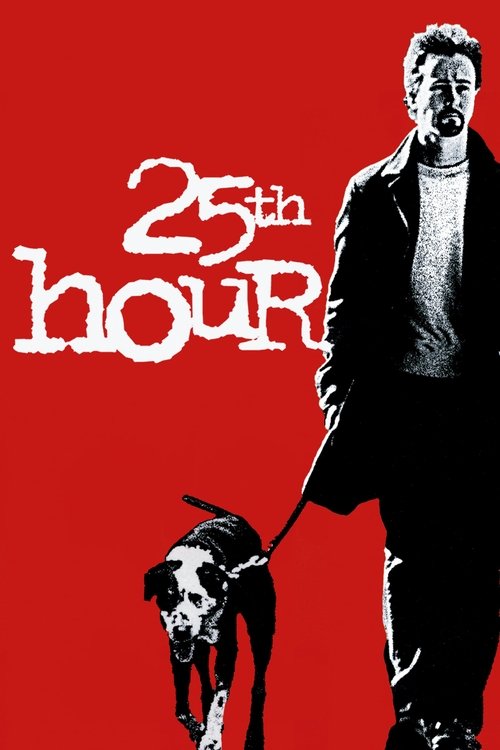
25th Hour
2002 · Spike Lee
For when you want a serious, soulful drama to sit with — regret, friendship, and second chances, best on a night you're ready to feel the weight. Definitely challenge over comfort, and worth every minute.
What it's about
Monty Brogan, a New York drug dealer, has twenty-four hours of freedom left before a seven-year prison sentence begins. In one final day and night he walks his dog, faces his Russian suppliers, gathers his two oldest friends for a farewell, wonders whether his girlfriend was the one who informed on him, and reckons with his father — all in a city still raw from 9/11. Not a thriller: a countdown, and an accounting.
The experience
Heavy, mournful, and simmering with anger — the tension comes not from what will happen but from watching a man measure everything he's about to lose. It builds to an ending that leaves you wrung out.
Performances
Edward Norton carries the film with coiled, wounded intensity, including one furious solo monologue that's become legendary. Around him, Philip Seymour Hoffman and Barry Pepper are superb as friends failing Monty in different ways, and Brian Cox breaks your heart as his father.
The craft
Spike Lee folds the wound of post-9/11 New York directly into the film — Ground Zero, the tribute lights, the city's grief — making the backdrop inseparable from Monty's own reckoning. Terence Blanchard's mournful score and the elegiac photography give it the feel of a requiem; the final movement is one of the boldest closing stretches in American film of its decade.
Why it matters
One of the first major American films to face 9/11 head-on rather than edit it out, and now widely regarded as one of Spike Lee's finest works — a reputation that has only grown since 2002.
Snapshot
25th Hour follows Monty Brogan (Edward Norton), a mid-level New York drug dealer, through the final day and night before he begins a seven-year federal prison sentence. Over roughly twenty-four hours he walks his rescued pit bull, settles accounts with his Russian suppliers, gathers his oldest friends — bond trader Frank Slaughter (Barry Pepper) and high-school teacher Jacob Elinsky (Philip Seymour Hoffman) — for a farewell night out, circles the open question of whether his girlfriend Naturelle (Rosario Dawson) informed on him, and reckons with his ex-firefighter-turned-bar-owner father (Brian Cox). The plot's engine is not suspense but countdown: a man measuring what he is about to lose. Adapted by David Benioff from his own 2001 debut novel, the film became, almost by accident of timing, one of the first major American features to absorb the aftermath of September 11, 2001 into its texture rather than its subject. Lee shot in a wounded city and let that wound become the film's emotional weather, turning an intimate crime-drama character study into an elegy for a moment, a man, and a metropolis.
Industry & production
The film was produced by Lee's 40 Acres and a Mule Filmworks with Industry Entertainment and Gamut Films, and released through Touchstone Pictures, the Disney-owned adult-oriented label — a comparatively mainstream studio berth for Lee, who had spent the late 1990s and early 2000s moving between studio assignments and independently financed work. Edward Norton, then near the height of his post-American History X / Fight Club standing, served as a producer and was instrumental in developing the adaptation; his involvement helped attach a recognizable lead to material that was structurally uncommercial. David Benioff adapted his own novel, his first screen credit and the launch of a screenwriting career that would later run through Troy and, eventually, Game of Thrones. The supporting ensemble — Pepper, Hoffman, Dawson, Cox, plus Anna Paquin as a flirtatious student and former NFL lineman Tony Siragusa as a Russian heavy — was assembled at modest cost. By Lee's standards this was a mid-budget studio drama rather than a personal passion project financed against the odds; the exact production budget and grosses are not something I will assign specific figures to here, but the consistent record is that the film performed modestly at the box office and found its larger life through critical reassessment and home video. Crucially, the project predated the attacks: Benioff's novel was published in early 2001, and the decision to fold post-9/11 New York into the film was made in production, a choice that reshaped the adaptation's meaning.
Technology
25th Hour was photographed on 35mm film, the standard for prestige studio drama in 2002, before digital capture had displaced celluloid for this kind of work. Its technological interest lies less in novel equipment than in cinematographer Rodrigo Prieto's manipulation of the film image — controlled color temperature, desaturation, and lighting design that lend the city a chilled, convalescent palette. The film's most genuinely documentary-technological gesture is its use of the real post-attack landscape: the opening title sequence is built around the "Tribute in Light," the twin vertical beams installed at the World Trade Center site, and a central scene is staged in a high-rise apartment overlooking the actual Ground Zero excavation, with cleanup floodlights still burning in the pit below. The film thereby incorporated an unrepeatable real-world location at a specific historical instant. Beyond that, claims of any special technical innovation would be overstated; this is a film whose technology serves mood and place rather than spectacle.
Technique
Cinematography
Rodrigo Prieto — the Mexican cinematographer who had broken through internationally with Amores Perros and would shortly shoot 21 Grams, Brokeback Mountain, and decades later Scorsese's The Irishman and Killers of the Flower Moon — gives the film a cold, bruised-blue New York, drained of warmth and saturation to match the city's grief and Monty's foreclosing horizon. Interiors of the nightclub finale shift toward more lurid, hallucinatory color, isolating the principals in pools of red and amber. Prieto and Lee deploy the director's signature visual figures: the famous "double dolly" shot, in which actor and camera glide together so the figure floats while the world slides past, recurs at key moments, most memorably carrying Monty in the film's closing passages with a dreamlike, unmoored quality. Framing repeatedly traps Monty against the geometry of the city — bridges, windows, the void of the WTC site — visual reminders of confinement closing in.
Editing
Barry Alexander Brown, Lee's longtime editor, structures the film as a slow tightening rather than a propulsive crime narrative. The cutting is patient through the long dialogue scenes — the riverside walk, the apartment overlooking Ground Zero, the nightclub conversations — and accelerates into montage at two crucial set-pieces: the mirror "fuck you" tirade and the extended coda. Brown's most celebrated work here is that final sequence, a sustained imagined-future montage cross-cut against the literal drive to prison, holding two timelines — the life Monty might have and the one he is entering — in simultaneous suspension until the fantasy collapses.
Mise-en-scène / staging
Lee stages the film as a series of valedictory encounters, each location carrying thematic weight: the bar his father keeps, a memorial to the dead firefighter brotherhood; Frank's sterile glass apartment hanging directly over the smoking pit of the Trade Center; the neon underworld of the farewell nightclub. The recurring motif of Doyle, the beaten pit bull Monty rescues from the roadside, functions as a staged mirror — a maimed, dangerous, abandoned creature given one more chance — placed deliberately within the frame at the film's beginning and threaded through to its end.
Sound
Composer Terence Blanchard, the jazz trumpeter and Lee's most enduring musical collaborator, supplies a mournful, large-scale orchestral score whose elegiac main theme accompanies the Tribute in Light credits and recurs as the film's emotional signature — closer to requiem than crime-thriller scoring. The sound design holds the ambient hum of a subdued city; dialogue is foregrounded, the film trusting long verbal exchanges. Source music in the club scenes contrasts the score's solemnity with the night's frantic, anaesthetizing energy.
Performance
Norton's Monty is the film's center — a charismatic man curdling into dread, by turns tender, self-pitying, defiant, and terrified, the bravado audibly thinning as the hours run out. Around him the ensemble is exceptionally calibrated: Hoffman's Jacob is a knot of repressed longing and cowardice; Pepper's Frank is brittle, aggressive loyalty masking judgment; Dawson holds Naturelle's wounded ambiguity; and Cox, as the father, carries the film's devastating final voiceover with weary, hoping grief. The performances are pitched for duration — long takes, sustained two-handers — rather than fireworks.
Narrative & dramatic mode
The film operates in the "last day of freedom" mode — a compressed, near-unity-of-time structure in which an ordinary span of hours is charged with finality. It is essentially a tragedy of consequence: the crisis has already occurred (Monty is caught, sentenced, doomed) before the film begins, so the drama is retrospective and confessional rather than goal-driven. Flashbacks open up the backstory — how Monty rose through dealing, his relationship with Naturelle, the bust — but the present tense is elegiac, a man saying goodbye. Two great rhetorical set-pieces punctuate the realist surface: the mirror monologue, an interior aria of rage, and the closing imagined-life sequence, a counterfactual reverie. Both rupture naturalism to externalize Monty's psyche, marking the film as a character study willing to break form for emotional truth.
Genre & cycle
Nominally a crime drama, 25th Hour belongs less to the gangster or heist tradition than to the introspective post-noir of doomed protagonists and to the small cycle of films built around a single reckoning day. It sits, too, at the head of the emergent cycle of post-9/11 American cinema — arguably the first significant fiction feature to register the attacks not as plot but as atmosphere, predating the more literal accounts (United 93, World Trade Center) by several years. Its crime-genre machinery (Russian mob, drug money, the informer question) is real but subordinate; the film withholds the genre's usual catharsis of violence or escape.
Authorship & method
This is a Spike Lee film in its DNA despite originating in another author's novel. Lee's recurring concerns and devices saturate it: New York as protagonist; the direct-address ethnic catalog (Monty's bathroom-mirror "fuck you" to every group in the city, then to himself, is a deliberate descendant of the racial-slur montage in Do the Right Thing); the double-dolly shot; and a moral seriousness about brotherhood, betrayal, and the city's character. His core collaborators carry that authorship: editor Barry Alexander Brown and composer Terence Blanchard, both fixtures of Lee's filmography, shape the film's rhythm and mournful tone. Cinematographer Rodrigo Prieto, newer to Lee's world, brought a contemporary, color-controlled sensibility that updated the director's visual language. Writer David Benioff supplied the architecture — the countdown, the characters, the informer mystery — and Lee supplied the historical consciousness, grafting Ground Zero onto a story conceived before it. The collaboration between Norton (as developing producer-star) and Lee gave the film both its commercial anchor and its restrained, performance-led realism.
Movement / national cinema
The film is firmly within American independent-minded studio cinema, the tradition of New York personal filmmaking that runs from the post-Cassavetes, post-Scorsese sensibility through Lee's own body of work. It is a quintessentially New York film, the city's neighborhoods, accents, and self-image central rather than incidental. It does not belong to a formal "movement" so much as to the durable strain of socially conscious American auteur cinema, here turned toward collective trauma.
Era / period
Made and set in 2002, the film is inseparable from its moment: the first full year after September 11, with the Trade Center site still an active excavation and the national mood raw. It captures a specific historical New York — anxious, grieving, defiantly continuing — and the textures of pre-financial-crisis Manhattan, Frank's bond-trader prosperity included. As a period document it is unusually precise, fixing on screen a city in a condition that would not last and could not be reconstructed.
Themes
Foremost is consequence and the irreversibility of choice — Monty's last day is an extended confrontation with a future he has forfeited. Adjacent is freedom and its loss, literalized by the prison clock and figured by the caged dog. The film meditates on the city itself: Monty's mirror tirade is a love-hate inventory of New York's peoples that turns, finally, inward — the city's faults are his own. 9/11 grief and endurance pervade everything; the Ground Zero apartment scene makes the link explicit, framing private downfall against public catastrophe and asking how a wounded place keeps going. Loyalty, friendship, and betrayal structure the human drama — who informed, what the three friends owe each other, how love survives suspicion. And the closing reverie raises the theme of the road not taken: an imagined life of escape, family, and old age, offered and then withdrawn, an elegy for every life that "came so close to never happening."
Reception, canon & influence
Critical reception in 2002–03 was strong if not unanimous, with particular praise for Norton's performance, the ensemble, Prieto's photography, and the audacity of the Ground Zero material; some reviewers found the crime-drama and 9/11 strands imperfectly fused. The film was not a major commercial success on release. Its reputation, however, has risen substantially over time: it is now widely regarded as among Lee's finest works of the 2000s and as the foundational post-9/11 American narrative film, routinely cited for confronting the attacks' aftermath earlier and more obliquely than its successors. The mirror monologue and the closing imagined-escape sequence are frequently anthologized as standout passages of 2000s American cinema.
Looking backward, the film's influences are legible: Lee's own Do the Right Thing supplies the direct-address ethnic catalog; the broader tradition of single-day, doomed-protagonist dramas and confessional New York realism informs its structure; and Benioff's novel furnishes the narrative scaffolding. Looking forward, 25th Hour helped establish the template for how mainstream cinema could metabolize collective trauma through intimate story and atmosphere rather than literal reenactment, and it stands as a touchstone for the "last night of freedom" countdown drama. It also marked an early step in Prieto's ascent to the front rank of American cinematographers and reaffirmed Lee's stature as the essential chronicler of New York. The detailed quantitative record of its commercial performance and awards profile is thinner and more modest than its eventual critical canonization would suggest — a film that earned its place less at the box office than in the long reckoning of what it captured.
A Deleuzian reading
Watch the way Monty Brogan moves through the city in his last free hours.
The full Deleuzian reading of 25th Hour →
Reception
Landed quietly in December 2002 — respectful reviews, modest box office — but two decades of reappraisal have turned it into the consensus 'great post-9/11 film,' with critics like A.O. Scott ranking it among the very best American films of the 2000s.
How 25th Hour was received, from release to now →
Influences: the films it descends from and the films it influenced
- Do the Right Thing (1989) — Monty's bathroom-mirror 'Fuck You' tirade is a direct formal descendant of this film's racial-slur direct-address montage — characters spitting epithets straight to camera in rapid cuts before the lens turns the venom back on the speaker.
- Malcolm X (1992) — Establishes the floating double-dolly shot (actor and camera gliding on the same rig so the figure drifts uncannily through space) that Lee reprises for Monty, paired again with Terence Blanchard's mournful orchestral-jazz scoring.
- Mean Streets (1973) — Template for the location-shot New York Catholic-guilt crime drama built on small-time neighborhood loyalty, debt, and betrayal among a tight circle of men, narrated as a moral reckoning rather than a heist.
- High Noon (1952) — Pioneers the real-time ticking-clock countdown to an inescapable reckoning as the spine of the drama, the structural device behind 25th Hour's last-day-before-prison countdown.
- On the Waterfront (1954) — Supplies the informer-mystery moral architecture — a working-class man undone by the question of who ratted, and a fraternal bond strained by that betrayal — that drives Monty's hunt for who tipped the DEA.
- Carlito's Way (1993) — The doomed ex-con-going-straight in New York, narrated under a fate the audience knows is already sealed and framed by flashback, prefigures Monty's countdown told as elegy for a freedom already lost.
- Amores Perros (2000) — Rodrigo Prieto's breakthrough — grainy, desaturated, handheld urban realism with crushed color — is the photographic sensibility he carried directly into his first collaboration with Lee.
- Taxi Driver (1976) — Codifies shooting New York itself as a decaying moral protagonist, the city's textures photographed as an indictment, which Lee extends into the Ground Zero–haunted cityscape.
- The Last Temptation of Christ (1988) — Deploys an extended imagined alternate-life sequence as a film's climactic emotional device — the protagonist living out a future he will never have — the structural ancestor of the drive-west coda.
- Blow (2001) — Lee hired Ellen Kuras the year after Blow to shoot this drug-dealer-facing-imprisonment narrative, directly extending her Blow visual methodology — natural-light interior cinematography, low-angle compositions weighted toward the protagonist — into a compressed single-day retrospective that strips the rise-and-fall arc to its final hours.
- American History X (1998) — Reunites Norton with the day-compression structure — a man's last free hours before incarceration, rendered through confessional reckoning and a specific city's geography — the same countdown-to-consequence architecture in a major-key register.
- Clockers (1995) — Lee crime narrative that again subordinates plot mechanics to a doomed protagonist's interiority and the city itself as a moral environment.
- Inside Man (2006) — Continues the Lee/Blanchard post-9/11 New York mode — the wounded, surveilled city as living protagonist scored with elegiac brass — building on 25th Hour's reading of the altered metropolis.
- Brokeback Mountain (2005) — Marks Prieto's ascent into the front rank, his controlled, muted, emotionally restrained palette — pioneered on 25th Hour — refined into a signature for prestige American drama.
- The Irishman (2019) — Prieto's elegiac, desaturated photography of aging men reckoning with irreversible consequence extends the mournful, color-controlled visual grammar he first brought to Lee's countdown drama.
- Reign Over Me (2007) — Follows 25th Hour's template for metabolizing 9/11 collective trauma through one intimate New York story and atmosphere rather than literal reenactment of the event.
- Margaret (2011) — Diffuses post-9/11 New York moral unease into a sprawling personal drama of irreversible consequence and guilt, inheriting 25th Hour's strategy of letting the city's collective wound bleed into private reckoning.
- Blindspotting (2018) — Lee's final-hours countdown around a man about to lose his freedom, plus the stylized mirror-monologue that breaks realism for a torrent of direct address, prefigures both Blindspotting's probation ticking-clock and its verse-address climax.
- United 93 (2006) — The opposite pole of post-9/11 craft: literal, real-time, documentary-handheld reenactment of the attack, against which 25th Hour's oblique metabolization through atmosphere and intimate story defines itself.
- He Got Game (1998) — Same essayistic montage-and-music thesis-by-juxtaposition method, Barry Alexander Brown's editing, and a recurrence of the double-dolly gliding walk.
Similar films
- Taxi Driver (1976) — influence & lineage · same viewing thread
- Carlito's Way (1993) — influence & lineage
- The Irishman (2019) — influence & lineage
- Inside Man (2006) — influence & lineage
- United 93 (2006) — influence & lineage
- Do the Right Thing (1989) — influence & lineage
- Fight Club (1999) — same viewing thread
- Michael Clayton (2007) — same viewing thread
All the films related to 25th Hour →
Watch it with: curated runs of related films
- The American Male Comes Apart — A run of self-made men — brokers, founders, dealers, drifters — hollowed out by the very thing they chase, each film pressing the same nerve where ambition curdles into alienation and violence.