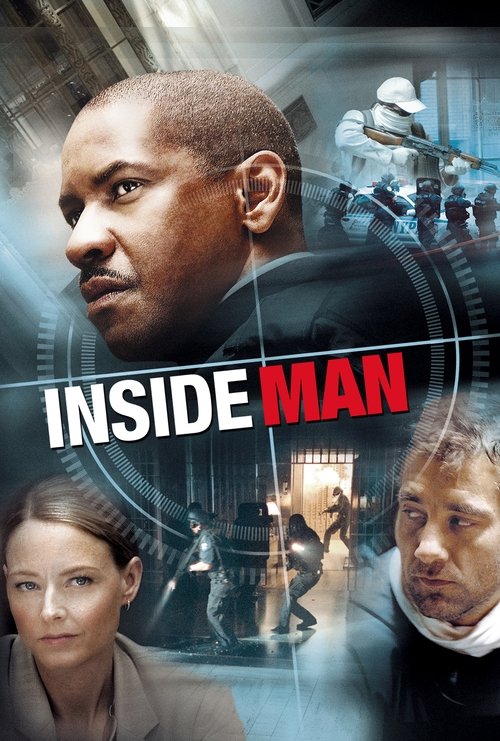
Inside Man
2006 · Spike Lee
For a Friday night when you want something smart but effortless — a crowd-pleasing puzzle you can watch with anyone, that still leaves you something to think about after.
What it's about
A masked crew seizes a Manhattan bank, locks the doors, and takes everyone inside hostage — then behaves like no bank robbers anyone has seen. The detective sent to negotiate is fighting corruption allegations of his own, and a mysterious fixer hired by the bank's founder keeps steering events from the outside. The question stops being how they'll get out and becomes what they actually came for.
The experience
A cool, confident chess match — witty, twisty, and propulsive without ever breaking a sweat. You spend the runtime happily trying to stay one move ahead, and the film stays two ahead of you.
Performances
Denzel Washington is pure charisma as the needling, quick-witted negotiator, sparring beautifully with Clive Owen's ice-calm mastermind, while Jodie Foster glides through as a power broker so smooth she's almost frightening.
The craft
Spike Lee runs a precision genre machine while sneaking a whole second movie underneath — about money built on old atrocities and the institutions that launder it. New York itself is a character, from the audacious Bollywood-scored opening to the interrogation vignettes threaded through the heist.
Why it matters
Spike Lee's biggest commercial hit at the time, and lasting proof that a director's social conscience can live inside a mainstream thriller without dulling either.
Snapshot
A precision-engineered bank-robbery thriller whose surface pleasures — the locked-room puzzle, the procedural chess match, the star-studded cast at peak form — conceal a second film underneath: a moral parable about wealth accumulated on atrocity and the institutional arrangements that protect it across generations. Spike Lee's most commercially successful picture at the time of its release, Inside Man demonstrated that the director's confrontational intelligence could function inside a genre machine without being diminished by it. The film holds two incompatible tones in suspension — cool, witty puzzle-box entertainment and a cold indictment of post-war financial impunity — and never fully resolves the tension, which is precisely the point.
Industry & production
Universal Pictures and Brian Grazer's Imagine Entertainment produced the film from a spec script by first-time feature writer Russell Gewirtz. The project reached Lee at a commercially vulnerable moment in his career following a run of ambitious but divisive pictures, and it was understood by all parties as an opportunity to prove his range within a studio genre framework. The budget was in the mid-range for a commercial thriller of the period — substantial enough to secure a cast of Denzel Washington, Clive Owen, Jodie Foster, Christopher Plummer, and Willem Dafoe, all near the height of their marquee value, but not a runaway production. Lee completed the film on schedule and under the studio's commercial expectations for its release category. Inside Man became his highest-grossing picture to that date, performing strongly both domestically and internationally, validating the calculation that a filmmaker of Lee's stature could move product when channeling his signature instincts into accessible genre. Gewirtz's script was reportedly acquired in competitive circumstances and went through revisions before production; the essential architecture of the puzzle — the robbery as retrieval cover — survived intact from his draft.
Technology
Principal photography took place on location across Manhattan, with the bank interior built as a practical set to allow Lee and his collaborators full spatial control of the hostage environment. The film was shot anamorphic, consistent with Lee's preference for the wide-screen frame during this period, lending even ordinary interiors an expansive, slightly distorted grandeur. Matthew Libatique served as director of photography, continuing a working relationship with Lee that gave the film a warm but not nostalgic color temperature — amber and ochre tones inside the bank contrasted with the cooler, more exposed gray-blue of the New York streets. Post-production editing made use of digital intermediate grading workflows then becoming standard in studio production, which permitted the precise color separation between the two temporal registers the film employs: the "then" of the hostage crisis and the "now" of the post-event interviews, differentiated in part through subtle grade shifts. The film does not pursue formal digital experimentation; its technology is in service of classical clarity.
Technique
Cinematography
Libatique's work here is disciplined and occasionally spectacular without drawing attention to itself as spectacle. The bank interior is lit to feel enclosed and artificially controlled — fluorescent overheads bleached to near-white, shadow pooling at the edges of frame — which amplifies the claustrophobia of the scenario. On the streets, natural light floods the frame, restoring a sense of the city's indifference to the drama playing out inside. Lee and Libatique deploy the director's signature dolly-against-dolly move — a character placed on a camera-dolly track while the camera itself moves on a counter-track, producing the optical effect of the character floating while the world scrolls past — most prominently in a sequence involving Washington's Detective Frazier that visually externalizes his mounting isolation from the institutional machinery he serves. Close-ups during the interrogation sequences are held longer than genre convention usually permits, forcing the viewer to read micro-expressions rather than cut away to safety.
Editing
Barry Alexander Brown, Lee's editor on projects stretching back to Do the Right Thing (1989), cuts the film with a structural confidence that matches Gewirtz's script design. The dual time-frame — hostage crisis intercut with post-event witness interviews — requires an editing logic that is simultaneously propulsive and deliberately withholding. Brown's cuts are crisp within individual sequences but the transitions between the two temporal registers are slowed, allowing the audience to feel the epistemological gap: we know the crisis ended safely but are denied the how and why until the film chooses to release that information. The pacing in the third act, where several pieces of the puzzle settle into place nearly simultaneously, is Brown's most technically demanding contribution — the film never feels breathless, only inevitably convergent.
Mise-en-scène / staging
Lee's spatial sense is at its most assured in the confined geography of the bank. The robbers' boiler-suit and mask uniforms — deliberately identical to the civilian hostage clothing they force on their captives — create a staging problem that functions as a thematic statement: the differentiation of perpetrator from victim becomes impossible by design, which is both a practical escape strategy and an argument about moral legibility under capitalism. The direct-address sequences, in which Owen's Dalton Russell speaks to the camera from an indeterminate space, invoke Brechtian distance — the audience is not permitted the immersive safety of pure spectacle. Lee has used direct address since his first features as a Brechtian interrupt, and its placement here at the film's opening and closing frames the entire middle as something already known, already past, already survived.
Sound
The most audacious decision in the film's sound design is the choice to open on "Chaiyya Chaiyya," A.R. Rahman's kinetic 1997 composition from Mani Ratnam's Dil Se, performed by Sukhwinder Singh and Sapna Awasthi — a thunderclap of Bollywood energy poured over establishing shots of Manhattan. The choice is neither arbitrary nor merely cosmetic. Lee has spoken publicly about his interest in global cinema and in the hybrid cultural lives of New York residents; the Rahman cue signals immediately that this New York film will not restrict itself to the sonic geography that the genre usually occupies. Terence Blanchard, Lee's composer since Jungle Fever (1991), scores the remainder of the film in a register that is tense and brass-forward without tipping into conventional thriller bombast — there are jazz inflections in the negotiation sequences that keep the tone slightly off-center. The sound mix during the bank interior gives particular weight to silence and to the ambient hum of the space, making the moments of sudden noise — gunfire, the crack of a barked command — feel genuinely startling.
Performance
Washington plays Frazier as a man whose intelligence is his primary resource in an institutional environment that has otherwise passed him over. The corruption charge hanging over him is never resolved with full clarity, which keeps the performance in productive moral ambiguity — Frazier is neither corrupt nor demonstrably clean, and Washington holds that uncertainty without tipping it. Owen's Dalton Russell is one of the more controlled star performances of the decade: almost entirely concealed behind a mask for much of the film, his physical presence must communicate through posture and voice alone, which Owen manages with a stillness that reads as absolute command. Foster's Madeleine White is a cameo that dominates every scene she enters — the character is a fixer whose power derives not from any visible authority but from the depth of her social capital, and Foster plays this as a sustained exercise in threat delivered without inflection. Plummer, as Arthur Case, has less screen time but shoulders the film's moral weight in a single sustained close-up during a confrontation with Washington near the film's resolution.
Narrative & dramatic mode
The film operates as a locked-room puzzle inverted. Where the classic puzzle withholds the identity of a crime's perpetrator, Inside Man presents the perpetrator immediately and withholds instead the purpose and method — we know who, we are made to ask why and how. Gewirtz's structural innovation is to make the heist itself a misdirection: the bank is not being robbed of money but of a document box whose contents would expose Arthur Case's wartime collaboration with the Nazi regime and his theft of assets from Jewish deportees. The robbery is not robbery; it is archive retrieval and extortion. The film's second structural conceit — Dalton Russell hiding inside the bank for days after the apparent resolution, in a concealed room he constructed himself — is flagged in the opening monologue but withheld as explanation until the end. The dual temporal register of the interviews permits Lee to have it both ways: the narrative's tension is preserved because we know the outcome only in the broadest strokes.
Genre & cycle
Inside Man sits at the intersection of the New York street procedural — a tradition running from The French Connection (1971) through Sidney Lumet's bank-crime pictures, particularly Dog Day Afternoon (1975), whose hostage-negotiation dynamic and street-theater energy are clear antecedents — and the architecturally complex heist film whose modern template is Michael Mann's Heat (1995). The film also participates in a mid-2000s cycle of puzzle-box studio thrillers (alongside pictures like Confidence, 2003, and later Lucky Number Slevin, 2006) that self-consciously foregrounded structural cleverness as a form of pleasure. What distinguishes Inside Man from most of that cycle is its willingness to subordinate the puzzle to a political argument: the cleverness is finally in service of exposing what Case's money protects and how power insulates itself across time.
Authorship & method
Spike Lee brought to the project a set of preoccupations — racial dynamics within institutions, the entanglement of American prosperity with historical atrocity, the texture of New York City as a social ecosystem — that inflect what might otherwise have been a neutral studio genre exercise. The subplot involving a Sikh hostage strip-searched by police officers connects the scenario to post-9/11 profiling practices; the Albanian-American character played by Kim Director is subject to ethnically coded suspicion that Lee ensures the camera registers. These insertions are not digressions: they are the material making the case that the moral failures exposed by the Nazi-gold plot are not aberrations but continuities. Terence Blanchard and Barry Alexander Brown functioned as long-standing creative partners in the production, giving the film a coherence between departments that a less experienced collaboration might not have sustained under the studio's commercial pressure. Gewirtz's contribution is substantial and under-discussed: the architecture of the script gave Lee the container he needed.
Movement / national cinema
Inside Man belongs to the American commercial cinema of the early 2000s but is animated by Lee's position within it as a filmmaker whose relationship to Hollywood has always been negotiated rather than assimilated. The film is not properly a "New Black Cinema" work in the sense that Lee's earlier films established that category, but it is recognizably his — the Brechtian devices, the explicit racial commentary, the New York geography — in ways that distinguish it from a work of genre entertainment without political parentage. The Rahman opening cue places it additionally in a global cultural circulation that the genre usually ignores.
Era / period
The film was shot in 2005 and released in March 2006, at a moment when the public memory of September 11 was still active enough to make a Manhattan hostage scenario automatically charged, and when the post-war financial impunity plot connected to a broader public conversation about corporate accountability and the uses of power. The NYPD's relationship with communities of color — already extensively examined in Lee's earlier 25th Hour (2002) — was a live political subject. The mid-2000s were also a moment of peak confidence in puzzle-box narrative structure as a consumer product, which gave the film a generic context that made its deeper material easier to smuggle.
Themes
The film's deepest concern is the relationship between wealth and atrocity — specifically, the degree to which fortunes built on historical crime are protected by their antiquity and by the social institutions (banks, law firms, political connections) that surround them. Arthur Case's wartime collaboration produced the capital that underwrote a reputable financial institution; the crime is so old, and so well-laundered, that exposing it requires not law enforcement but a private criminal actor with both the intelligence to reconstruct it and the leverage to extract what he wants. Lee is clear about the implication: the legal system as represented by Frazier is not equipped, and is not intended, to reach crimes committed at this level of power. Madeleine White exists to make this argument concrete — she is the mechanism by which power speaks to power without leaving a record.
Reception, canon & influence
Inside Man received strong reviews on release, with critics noting the quality of the performances and the intelligence of Gewirtz's construction while debating whether Lee had subordinated too much of his signature to genre convention or had achieved a productive synthesis. The consensus settled toward the latter — the film was widely cited as proof of Lee's flexibility and was embraced by audiences in a way that his more confrontational work rarely achieved commercially. It did not generate the awards-season conversation that might have consolidated its prestige standing, sitting slightly below the threshold at which genre films of that era received sustained critical institutionalization.
Influences on the film: The hostage-negotiation procedural tradition is the most direct antecedent — Dog Day Afternoon in particular provides both the New York street theatrics and the moral ambiguity of the central detective figure. The heist films of Jules Dassin, particularly Rififi (1955), shadow the precision-planning ethos. Lumet's New York procedurals — Serpico (1973), Prince of the City (1981) — provide the template for depicting institutional corruption as atmospheric rather than episodic. The Nazi-gold inheritance plot has precedents in thrillers of the 1970s concerned with the unresolved legacies of the Second World War.
Legacy and influence forward: The film's most durable contribution to genre practice is its demonstration that the puzzle-box thriller can carry political cargo without becoming didactic — that structural cleverness and ideological argument are not incompatible. Its influence on subsequent heist and procedural pictures is difficult to trace in specific titles but legible as a kind of permission: the genre could aspire to more than mechanism. A direct-to-video spinoff, Inside Man: Most Wanted (2019), was produced without Lee's involvement and is not considered a continuation of the original's project. Lee has spoken periodically about a proper sequel, though as of this writing no such project has been produced. The film remains the most accessible entry point to Lee's filmography for viewers arriving from mainstream genre cinema, and the one most likely to send them backward through his work.
A Deleuzian reading
A man speaks to you from a small, undefined room.
The full Deleuzian reading of Inside Man →
Reception
Landed in 2006 as a well-reviewed hit and Spike Lee's biggest box-office success, but at the time it was filed under 'Spike does a studio genre job.' Now it's constantly reappraised upward — a poster child for the smart mid-budget thriller Hollywood supposedly stopped making.
How Inside Man was received, from release to now →
Influences: the films it descends from and the films it influenced
- Dog Day Afternoon (1975) — Lumet establishes the Manhattan bank-hostage procedural as a moral form — real-time police negotiation apparatus running in structural parallel to criminal interiority, with institutional racial hierarchy (the Black detective subordinated to the FBI) as subtext beneath the genre surface — the exact architecture Inside Man inherits and inverts by placing a Black detective as the procedural's controlling intelligence.
- The Taking of Pelham One Two Three (1974) — Provides the code-named criminal identity system Inside Man inherits: masked perpetrators who surrender individual selfhood inside the crime, assigned designations rather than names, with the police radio procedural running in tonal parallel to the hijacking; Sargent's uniform-anonymization of the crew is the direct model for Russell's boiler-suit strategy.
- Rififi (1955) — Dassin invents the heist whose true purpose is concealed beneath the stated crime — the robbery as cover for retrieving something more significant than the nominal target — which is the structural core of Inside Man's archive-retrieval plot: a bank robbery constructed to provide documentary rescue of Nazi-era evidence hidden inside the vault.
- Diabolique (1955) — Clouzot's inverted-locked-room puzzle — the audience discovers the criminals were operating from inside the victim's position all along, inverting the apparent power geometry — supplies Inside Man's epistemological trap: Russell's presence inside the vault from the opening is withheld until the film permits the false architecture to collapse.
- The Odessa File (1974) — The narrative architecture Inside Man most directly inherits: documentary evidence of Nazi-era atrocity hidden inside a contemporary institutional cover, the dossier as MacGuffin that endangers financial elites in the present, and the discovery that the legal and banking apparatus has been protecting war criminals across decades — Plummer's safe-deposit box is a direct descendant of this structure.
- The Usual Suspects (1995) — Singer's dual-timeframe architecture — post-event interrogation intercut with dramatized flashback, the detective as audience surrogate whose access to information is structurally withheld through a puzzle-box design that recontextualizes prior footage at the final reveal — is the direct formal model for Inside Man's interview/crisis intercutting and Barry Alexander Brown's third-act convergence editing.
- Do the Right Thing (1989) — The formal engine Inside Man runs on: Barry Alexander Brown's editing rhythms established here as Lee's collaborative baseline, Terence Blanchard's scoring relationship with Lee initiated here, and the Brechtian direct-address interrupt — a character speaking to camera from an indeterminate space — first deployed here as Lee's signature genre frame-break.
- Heat (1995) — Mann establishes the procedural chess-match between morally equivalent cop and criminal in anamorphic widescreen as the prestige crime-genre register; Washington's Frazier and Owen's Russell are structurally Mann's Pacino and De Niro, and Inside Man's formal decision to hold both figures at the same moral altitude — neither hero nor villain — directly inherits Mann's refusal to differentiate.
- Traffic (2000) — Soderbergh's use of differentiated color-grade registers to separate simultaneous narrative strands — bleach-bypass for Mexico, saturated blue for Ohio — establishes the digital intermediate workflow Inside Man compresses into two temporal registers: the warm amber 'then' of the hostage crisis vs. the cooler, overexposed 'now' of the post-event witness interviews.
- 25th Hour (2002) — Lee's immediately prior NYC feature refines the formal toolkit Inside Man inherits: the dolly-against-dolly externalizing Norton's moral isolation in the same way it will externalize Washington's institutional isolation, Barry Alexander Brown's editing, Terence Blanchard's score, and anamorphic widescreen Manhattan portraiture — the complete craft package rehearsed here before Inside Man channels it into genre.
- The Thomas Crown Affair (1999) — Recasts the heist as an intellectual chess match between thief and investigator, the contest-of-equals structure where outwitting matters more than the loot.
- The Negotiator (1998) — A bank-siege hostage negotiation in which the negotiator protagonist must outthink a captor while a buried institutional conspiracy turns the standoff into a cover-up game.
- Michael Clayton (2007) — Extends Inside Man's fixer-as-moral-interlocutor figure to his logical conclusion — Clayton is Frazier taken inside the machine entirely — with Robert Elswit's anamorphic New York photography at the same widescreen spatial register and elite financial criminality protected by institutional apparatus as the structural engine; the film inherits Lee's argument that the legal and banking systems are designed to protect historical crime.
- The Town (2010) — Extends Inside Man's uniformed/masked heist crew as procedural genre grammar: Affleck's hockey-mask robbers make identification structurally impossible for the same narrative reasons Lee's boiler-suit crew does, and his procedural cross-cutting between the FBI apparatus and the criminal operation inherits Lee's dual-track editing structure directly.
- Hell or High Water (2016) — Applies Inside Man's heist-as-archive-retrieval architecture to West Texas: the bank robberies are cover for reclaiming ancestral land documentation from the foreclosing institution itself — the theft as archival justice — and the moral equivalence between criminal and law enforcement that Inside Man sustains through its dual-track procedural is here formalized as the film's explicit thesis.
- Widows (2018) — Transplants Inside Man's heist-as-archive-retrieval into explicitly racial-political Chicago: the robbery conceals a struggle over documented political complicity, masked performers and uniform-as-moral-ambiguity are deployed in a context where institutional racial violence is the hidden archive being accessed, and McQueen's procedural structure sustains the same irresolution between genre entertainment and systemic indictment.
- Munich (2005) — Deploys the same uniformed/anonymized operative crew whose individual identities dissolve into collective function — the moral-ambiguity-via-costume logic Inside Man uses for the boiler-suit robbers — and sustains the same formal tension between procedural genre efficiency and an indictment of institutional violence that the genre surface cannot cleanly resolve.
- Syriana (2005) — Applies Traffic's multi-strand color-differentiation grammar to an institutional thriller about elite financial criminality, producing the same formal result Inside Man achieves simultaneously: procedural density and genre momentum as delivery mechanism for a systemic indictment that the puzzle-box surface defers rather than resolves.
- Ocean's Twelve (2004) — Descendant/sibling whose heist conceals and reorders its own method for misdirection, withholding mechanics from the audience in Twelve's elided fashion.
Similar films
- Heat (1995) — influence & lineage
- The Usual Suspects (1995) — influence & lineage
- Michael Clayton (2007) — influence & lineage
- 25th Hour (2002) — influence & lineage
- Clockers (1995) — shared sensibility
- The Rip (2026) — shared sensibility
- Thief (1981) — shared sensibility
- American Gangster (2007) — shared sensibility
All the films related to Inside Man →