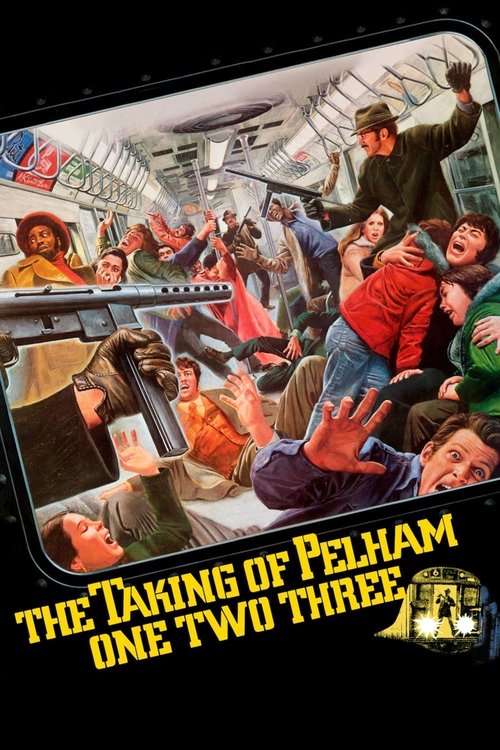
The Taking of Pelham One Two Three
1974 · Joseph Sargent
For when you want a lean, no-fat 70s thriller with personality — pure procedural pleasure, banter included, done in under two hours. An easy crowd-pleaser that still feels sharp.
What it's about
Four armed men in matching disguises hijack a New York subway car, uncouple it from the train, and demand a million dollars within the hour — one hostage shot for every minute the city is late. On the other end of the radio is Garber, a rumpled Transit Authority cop who has to stall, negotiate, and out-think them while a broke, cynical city bureaucracy lurches into motion. The nagging question hanging over everything: how do you escape from a tunnel?
The experience
Tense and fast, but with a wiseacre grin — the ticking clock keeps squeezing while the New York attitude keeps cracking jokes. It's a thriller that's genuinely funny without ever losing its menace.
Performances
Walter Matthau's weary, sardonic Garber and Robert Shaw's ice-cold, clipped Mr. Blue make a perfect duel of temperaments — most of it conducted over a radio, and riveting anyway.
The craft
Shot in real grimy subway spaces with a script that runs like a stopwatch, it's a model of economical thriller construction. David Shire's snarling funk score is one of the great crime-movie themes, worth good speakers on its own. The whole city — dispatchers, cops, a flu-ridden mayor — becomes part of the machine.
Why it matters
A cornerstone of the gritty 1970s New York thriller, its color-coded criminal aliases and hostage-clock structure echo through decades of heist and siege films, and it's been remade more than once.
Snapshot
The Taking of Pelham One Two Three is a New York hijacking thriller that turns the most mundane fixture of urban life — the subway — into the stage for a hostage siege. Four armed men, operating under the color-coded aliases Mr. Blue, Mr. Green, Mr. Grey, and Mr. Brown, seize a Lexington Avenue local, uncouple the lead car, and demand one million dollars in cash within the hour, threatening to shoot a passenger for every minute the city runs late. On the other end of the transit radio is Lieutenant Zachary Garber of the Transit Authority Police, a rumpled, wisecracking bureaucrat who must talk, stall, and reason his way toward a solution while the machinery of a cynical, near-bankrupt city grinds around him. Directed by television veteran Joseph Sargent from Peter Stone's screenplay (adapting John Godey's 1973 novel), the film is a model of procedural tension welded to sardonic comedy — a genre hybrid that reads as pure crime-thriller in its clockwork mechanics and as satire in its portrait of municipal dysfunction. It has become one of the defining artifacts of 1970s New York cinema and a touchstone for later filmmakers, most famously through its influence on the naming convention of Tarantino's Reservoir Dogs.
Industry & production
The film was produced by Palomar Pictures (Edgar J. Scherick and Gabriel Katzka's operation) and released by United Artists in 1974. It belongs to a moment when Hollywood's major distributors were financing tough, morally ambivalent urban dramas aimed at adult audiences — a cycle that had been commercially validated by The French Connection (1971) and would run through the decade. The production's signal achievement was practical: securing cooperation from the New York City Transit Authority to shoot in and around the subway system, a notoriously difficult logistical and bureaucratic proposition. The result is a film saturated with the authentic texture of the mid-1970s IRT — the tiled stations, the graffiti-scarred cars, the control-room hardware of the Transit command center. I should note that the finer contractual details of the Transit Authority arrangement are not something I can document precisely here, and I won't invent them; the on-screen evidence of genuine location access, however, is unambiguous. The casting drew on a deep bench of New York and character-actor talent — Walter Matthau, Robert Shaw (fresh from and soon to be identified with Jaws, released the following year), Martin Balsam, Hector Elizondo, Jerry Stiller, and Earl Hindman — which gave the ensemble a lived-in density rather than star gloss.
Technology
Technologically, the film is conventional for its era in capture but distinctive in its exploitation of a real, complex environment. It was shot on 35mm color film stock, the industry standard. The production's demands were less about novel equipment than about the discipline of shooting in cramped, low-light, fixed-geometry spaces — the interior of a single subway car, tunnels, and the Transit command center with its illuminated track-display board. Working in actual subway tunnels imposes hard constraints: limited room for lighting rigs and camera movement, the noise and vibration of the system, and the need to stage a moving-train climax safely. The film's technical interest lies precisely in how it makes those constraints legible and dramatic rather than hiding them. Where the record of specific rigs, lenses, or on-set engineering solutions is thin, I'll leave it unstated rather than fabricate detail.
Technique
Cinematography
The photography is by Owen Roizman, one of the defining American cinematographers of the 1970s, whose credits already included The French Connection (1971) and The Exorcist (1973). Roizman brings a documentary-inflected realism to the material: available-feeling light, grit and grime rendered without prettification, and a palette that leans into the drab institutional greens, browns, and fluorescent whites of the transit system. The visual scheme exploits contrast between confined and open space — the claustrophobic tube of the hostage car against the busier, wider frames of the command center and the street-level chase of the ransom delivery. The camera treats the subway as a real, unglamorous place, which is central to the film's tension: the threat is credible because the environment is.
Editing
The editing — credited to Jerry Greenberg (Gerald B. Greenberg) and Robert Q. Lovett — is the film's engine. Greenberg had cut The French Connection, and the same command of accelerating, cross-cut suspense is on display here. The structure is essentially a race against a clock, and the picture intercuts among the hijacked car, Garber's command post, and the frantic effort to move a million dollars across a gridlocked Manhattan. The film's precise sense of elapsed time — the countdown to the first threatened execution — is an editorial achievement as much as a scripted one: the cutting rhythm tightens as the deadline nears, and the parallel action keeps three or four spatial fronts alive simultaneously without confusion.
Mise-en-scène / staging
Staging is built around a fundamental spatial opposition: the hijackers and hostages sealed inside one uncoupled car, versus the sprawling apparatus of the city trying to reach them. The single-car interior is a pressure chamber — a fixed set of seats, a fixed cast of passengers, a fixed set of masked men — and Sargent wrings variety from a nearly static space through blocking and the shifting alliances among the four criminals. Against this, the command center offers a wall of information (the track board, phones, radios) that visualizes the bureaucratic scramble. The staging consistently dramatizes the gap between the villains' cold precision and the city's improvised chaos.
Sound
Sound is crucial and largely diegetic in feel: the crackle and protocol of transit radio, the rumble of trains, the ambient clatter of the system. The transit-radio dialogue between Garber and Mr. Blue is effectively a duel conducted over an audio channel, and much of the film's suspense is carried through voice alone. Layered over this is David Shire's score (discussed below), which functions as a near-continuous rhythmic pulse rather than conventional underscoring.
Performance
Performance is where the genre-hybrid identity lives. Walter Matthau plays Garber as a deadpan, put-upon civil servant, deploying his comic timing to leaven the tension — his Garber is competent but unheroic, an ordinary man doing a hard job. Robert Shaw is his opposite: Mr. Blue is clipped, disciplined, and chilling, a mercenary professional whose British reserve reads as menace. Martin Balsam's Mr. Green (a former motorman) supplies anxious human texture, and Hector Elizondo's Mr. Grey is volatile and dangerous. The ensemble of passengers and functionaries — the mayor's office, the beleaguered Transit brass — rounds out a portrait of the city as a collection of exasperated, self-interested people.
Narrative & dramatic mode
The narrative mode is procedural thriller braided with black comedy. Its dramatic spine is the classic ticking-clock hostage negotiation: a fixed deadline, an escalating body-count threat, and a protagonist who must solve a problem — here, the seemingly impossible question of how four men can escape from a sealed tunnel with no exit. That "locked-room" puzzle (how do the hijackers plan to get away?) gives the film a mystery-story structure layered atop the siege. The comedic register — Matthau's dry asides, the venal and incompetent city officials, the famous final beat built on a single physical gesture — never undercuts the suspense; instead it sharpens the film's cynicism about institutions. The tone is characteristic of 1970s American film: distrustful of authority, unsentimental, and willing to let its "hero" be a tired functionary rather than an action figure.
Genre & cycle
The film sits at the intersection of the heist/caper film, the hostage-negotiation thriller, and the urban-decay drama. It belongs to the broader 1970s cycle of gritty New York crime pictures — a lineage that includes The French Connection (1971), Serpico (1973), Dog Day Afternoon (1975), and The Warriors (1979) — in which the city itself, financially strained and socially frayed, is effectively a character. Within the heist tradition, its innovation is to invert the usual "how do they pull it off" structure into "how do they get out," and to treat the police-side procedure with equal weight to the criminal plan. Its use of anonymous color aliases is a small structural device that has outlived the film's own fame.
Authorship & method
Joseph Sargent came to the film primarily from television, where he was a prolific and respected director; Pelham is generally regarded as the high point of his feature work. His method here is unshowy and efficient — a craftsman's command of coverage, pace, and ensemble rather than a signature visual flourish, well suited to material that depends on clarity of information and momentum. His key collaborators are central to the achievement:
- Screenwriter Peter Stone, an accomplished writer of witty, tightly plotted entertainments (he wrote Charade and won an Academy Award for the story of Father Goose), supplies the film's crisp dialogue and its comic-cynical voice, adapting John Godey's novel.
- Cinematographer Owen Roizman brings the documentary realism described above.
- Editor Jerry Greenberg (with Robert Q. Lovett) provides the cross-cut suspense architecture.
- Composer David Shire contributes what may be the film's most celebrated single element.
Shire's score is a landmark of 1970s film music: a driving, funk-inflected jazz composition that reportedly employs a twelve-tone row within a groove idiom — a fusion of avant-garde serial technique with propulsive rhythm that gives the film its distinctive nervous energy. (I'm characterizing the score's widely noted twelve-tone construction; I'll avoid asserting bar-by-bar technical specifics I can't verify.)
Movement / national cinema
The film is a product of the "New Hollywood" of the late 1960s and 1970s — the period in which American studios financed director- and writer-driven films with darker, more ambiguous sensibilities. More specifically, it is an exemplar of 1970s New York filmmaking, a body of work rooted in real-location shooting and a fascination with the metropolis at a low ebb. It is not avant-garde or part of an international art-cinema movement; its realism is a commercial, genre-based realism rather than a programmatic one.
Era / period
1974 places the film squarely in New York's era of fiscal crisis, rising crime, and civic anxiety — the years leading to the city's near-bankruptcy in 1975. That context is not incidental: the film's premise turns on a city that can barely function, whose officials are venal or overwhelmed and whose institutions are the butt of the joke even as they scramble to save lives. The subway — dirty, graffiti-covered, chronically troubled — is a precise emblem of the period. The film's cynicism about government competence reflects a broader post-Watergate mood of institutional distrust.
Themes
Several themes recur. First, institutional dysfunction and civic decay: the film is as interested in the bureaucratic and political failure surrounding the crisis as in the crime itself. Second, the ordinary man as reluctant competent: Garber embodies unglamorous professionalism, and the film locates heroism in dogged, tired capability rather than bravado. Third, money and value: the ransom is a flat transaction, and the film's mordant view treats human life as something the city literally puts a price on and haggles over. Fourth, order versus chaos: the hijackers' military precision against the city's improvisational mess. And finally, a persistent dark comedy about American cynicism — the sense that everyone, criminal and official alike, is working an angle.
Reception, canon & influence
The Taking of Pelham One Two Three was well received on release as a superior, intelligent thriller and has grown in critical stature over time; it is now widely regarded as one of the best New York films of its decade and a benchmark of the hostage-thriller form. I don't have verified box-office figures to cite and won't invent them, but its reputational trajectory — from strong contemporary notice to enduring cult and canonical status — is well established.
Influences on the film (backward): It draws on John Godey's source novel for its plot and characters; on the New Hollywood taste for morally gray, realistic crime drama; and on the location-shooting realism pioneered in New York pictures like The French Connection, with which it shares both a cinematographer and an editor. Its comic-cynical tone descends from a tradition of witty American caper writing (Peter Stone's own Charade among them).
Legacy (forward): The film's most cited direct influence is on Quentin Tarantino's Reservoir Dogs (1992), whose color-coded criminal aliases (Mr. White, Mr. Orange, etc.) echo Pelham's Mr. Blue/Green/Grey/Brown convention — an homage Tarantino has acknowledged. More broadly, the film became a template for the modern hostage-negotiation thriller and the "contained siege plus outside procedure" structure. It was remade for television in 1998 and again as a theatrical feature in 2009 (directed by Tony Scott, starring Denzel Washington and John Travolta), a testament to the durability of its premise. David Shire's score has been separately celebrated and is frequently cited in discussions of 1970s film music. Its combination of clockwork suspense, deadpan comedy, and unromanticized urban texture continues to be invoked as a model of how to make a thriller that is simultaneously exciting, funny, and grounded in a real place and time.
Reception
A solid hit in 1974 but treated as a genre programmer, it's since been canonized as one of the great gritty New York thrillers of the 70s — now routinely mentioned in the same breath as The French Connection and Dog Day Afternoon.
How The Taking of Pelham One Two Three was received, from release to now →
How to watch The Taking of Pelham One Two Three: what to notice on a first viewing
- Notice the drab greens and browns lit by fluorescent light. Roizman shoots the subway system in grimy institutional colors, denying the film any glamour so the threat feels like it's happening in a real place. The unglamorous look makes the danger credible, because the environment itself feels unstaged.
- Listen to Garber and Mr. Blue talk only by radio. Much of the standoff is carried entirely through transit-radio dialogue, a verbal duel between two men who never share a room. The tension lives in voice alone, proving a threat doesn't need a shared space to feel dangerous.
- Listen for the score's nervous, off-kilter groove. David Shire's music mixes a jittery, atonal-feeling melody into a driving funk rhythm that runs almost continuously under the action. The music itself feels a little wrong, keeping you keyed up even in the quieter scenes.
- Watch how little the hijackers' car actually moves. Sargent stages the hostage car as a fixed, cramped set of seats, wringing variety from blocking and shifting alliances rather than new locations. The stillness of the car makes the frantic effort to reach it, happening elsewhere, feel even bigger by contrast.
- Watch Garber's face stay flat under mounting pressure. Matthau plays him as tired, wisecracking, and competent rather than heroic, never raising his voice to match the crisis around him. His flatness argues that ordinary tired competence, not heroics, is what actually gets a crisis handled.
The whole guide to watching The Taking of Pelham One Two Three, with the keys for a rewatch →
Influences: the films it descends from and the films it influenced
- The Naked City (1948) — Pioneered the semi-documentary crime picture shot entirely on real New York streets with a newsreel eye — the location-realism grammar Pelham inherits for its subway and command-center world.
- The Asphalt Jungle (1950) — Codified the heist-as-procedure structure — an ensemble of specialists, a meticulously diagrammed plan, and its step-by-step execution — that Pelham adopts for the gang's rehearsed takeover of the train.
- Rififi (1955) — Its long, near-wordless clockwork heist set the template for suspense built purely from watching a plan run on schedule, the ticking mechanical precision Pelham times against a literal clock.
- Charade (1963) — Written by Pelham's own screenwriter Peter Stone, it established his signature of tight caper plotting laced with comic-cynical banter — the deadpan wit Stone carries directly into the negotiation scenes.
- Bullitt (1968) — Lalo Schifrin's jazz-funk crime score legitimized propulsive groove-driven scoring for urban thrillers, the idiom David Shire pushes further into twelve-tone funk for Pelham.
- The French Connection (1971) — Shares Pelham's cinematographer Owen Roizman and editor Jerry Greenberg, transferring the same handheld, available-light NYC documentary realism and staccato cross-cut editing.
- The Anderson Tapes (1971) — A Manhattan heist staged as a collision between criminal execution and layers of institutional surveillance/procedure — the 'contained crime plus outside apparatus' architecture Pelham formalizes.
- Serpico (1973) — Its grimy on-location portrait of a dysfunctional, bureaucratic NYPD supplies the institutional-dysfunction texture Pelham mines for cynical comedy in the Transit Authority command center.
- Reservoir Dogs (1992) — Directly homages Pelham's Mr. Blue/Green/Grey/Brown convention with its color-coded criminal aliases (Mr. White, Mr. Orange), a debt Tarantino has acknowledged.
- Die Hard (1988) — Extends the contained-siege-plus-outside-procedure template with a radio/CB duel of wits between the trapped criminal ringleader and the authorities coordinating from outside.
- Speed (1994) — Transposes Pelham's premise — a ransom demand on a hijacked mass-transit vehicle, negotiated by radio and cut against a command post racing the clock — onto a city bus.
- The Negotiator (1998) — Makes the negotiator-versus-hostage-taker verbal duel the entire engine of the film, the diegetic-radio contest of wits Pelham centered its suspense on.
- Inside Man (2006) — A New York contained-siege heist that runs the locked-room puzzle inside against methodical police negotiation and procedure outside, updating Pelham's dual structure for the surveillance age.
- The Taking of Pelham 123 (2009) — A direct feature remake preserving the subway-hijack premise and the negotiator-versus-hijacker radio duel, restyled with Scott's saturated, kinetic contemporary aesthetic.
- The Silent Partner (1978) — Sets the crime inside a functioning public institution and lets bureaucratic, transactional dialogue carry the suspense, with David Shire's jazz-funk cues running in deadpan counterpoint to civic banality — the structural model for the bank-branch procedural.
- The Man Who Stole the Sun (1979) — Models the extortion plot as radio-diegesis procedural — the whole drama carried on a hijacked audio channel while municipal agencies stall in cross-cut, played in a dry comic register that treats civic paralysis as bureaucratic farce.
- The Conversation (1974) — Scored the same year by David Shire with sparse, dissonant piano-and-jazz cues, it is Pelham's twin in using a composer's austere modern idiom to key procedural paranoia.
- Dog Day Afternoon (1975) — Builds the identical hostage-siege-plus-outside-negotiation structure with deadpan NYC comedy and cross-cut suspense between the contained interior and the swelling police apparatus.
Similar films
- Serpico (1973) — influence & lineage · same viewing thread
- The French Connection (1971) — influence & lineage · same viewing thread
- Dog Day Afternoon (1975) — influence & lineage
- Reservoir Dogs (1992) — influence & lineage
- The Conversation (1974) — influence & lineage
- The Negotiator (1998) — influence & lineage
- Die Hard (1988) — influence & lineage
- The Asphalt Jungle (1950) — influence & lineage
All the films related to The Taking of Pelham One Two Three →
Watch it with: curated runs of related films
- Undercover and Underworld — A run of cops, criminals, and the moles planted between them — watch these back-to-back for how loyalty curdles into betrayal across one corrupt city after another, from the Boston docks to Hong Kong to Marseille-by-way-of-New-York.