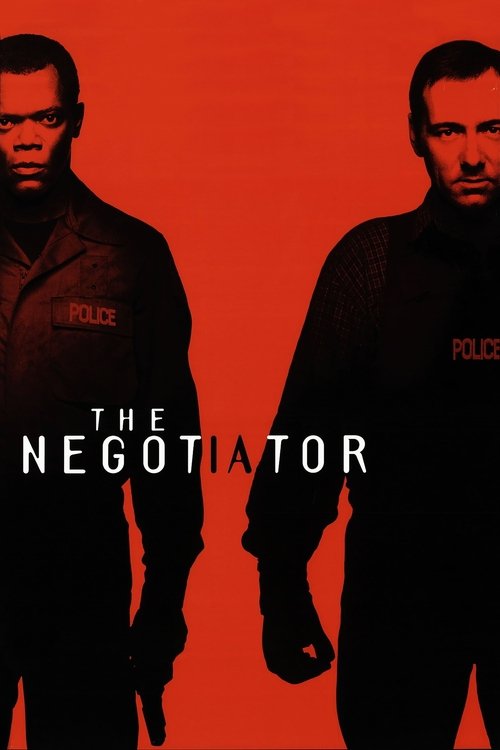
The Negotiator
1998 · F. Gary Gray
For a Friday night when you want a smart, meaty thriller that keeps you leaning forward — popcorn with a working brain. Pure engaged comfort for fans of the genre.
What it's about
Danny Roman is Chicago's best hostage negotiator — until he's framed for his partner's murder and the theft of the police pension fund. With the department closing in and the evidence buried in Internal Affairs, he does the one thing no one can counter: he takes the IA office hostage himself and demands a negotiator from across town, a stranger who can't be part of the conspiracy. What follows is a chess match between two men who know every move in each other's playbook.
The experience
Tense, talky in the best way, and propulsive — the thrill comes from watching two experts read, bluff, and outmaneuver each other, with the walls closing in on both. It grips early and doesn't let go.
Performances
Samuel L. Jackson runs the full range from command to desperation, and Kevin Spacey plays the cool outside negotiator against him; their verbal duels are the movie, and both actors clearly relish them.
The craft
F. Gary Gray directs the siege with clean, muscular efficiency, and the script's smartest trick is making dialogue the weapon — negotiation tactics explained and then deployed against the people teaching them. The standoff geography stays crisp even as the conspiracy tightens.
Why it matters
A benchmark of the 1990s star-driven studio thriller, remembered for pairing two of the decade's most magnetic actors in a battle of pure talk, and a step in Gray's rise as a top-tier action director.
Snapshot
The Negotiator is a studio hostage thriller built on an inversion: the man holding the gun is the police department's own best hostage negotiator, and the siege is his only available instrument of self-defense. Chicago Police Lieutenant Danny Roman (Samuel L. Jackson), framed for the murder of his partner and for embezzlement from a disability fund, walks into the Internal Affairs offices, takes hostages, and refuses to deal with anyone but Chris Sabian (Kevin Spacey), a negotiator from another precinct whom he has never met and therefore believes cannot be part of the conspiracy closing around him. The film's engine is thus a duel between two professionals who share a vocabulary — both know every move in the negotiator's playbook — and the suspense derives less from whether Roman will shoot than from whether Sabian will come to believe him. Released by Warner Bros. and Regency in the summer of 1998, it sits at the confident center of the late-1990s adult action thriller: glossy, talk-driven, anchored by movie stars at the height of their authority. It is also a film of valedictions, containing the final screen performance of the character actor J.T. Walsh, who died before its release.
Industry & production
The Negotiator was produced by New Regency Productions and Mandalay/associated entities and distributed by Warner Bros., a typical major-studio configuration for a mid-budget, star-led genre picture of the period. The screenplay is credited to James DeMonaco and Kevin Fox. DeMonaco would later become best known as the creator and director of The Purge franchise (2013 onward); The Negotiator belongs to his earlier career as a writer of mainstream thrillers. Reporting at the time linked the story's premise to a real-life hostage-negotiation incident, but the specifics of that grounding are not something I can confirm with precision, and the finished film is plainly a constructed star vehicle rather than a docudrama.
The project's defining industrial fact is its casting. Samuel L. Jackson was, by 1998, one of the most bankable and prolific actors in American film, fresh from Pulp Fiction (1994) and Jackie Brown (1997); Kevin Spacey arrived off The Usual Suspects (1995), Se7en (1995), and L.A. Confidential (1997), a run that made him synonymous with intelligent menace, and immediately before the role that would win him a second Oscar, American Beauty (1999). The film's design — two acclaimed actors of roughly equal stature, kept physically apart for much of the running time and communicating by phone and across a cordon — is essentially a production strategy as much as a dramatic one: it sells two stars without requiring them to share most of their scenes.
The deep bench is unusually strong for the genre: David Morse as the SWAT commander, Ron Rifkin and John Spencer as departmental authorities, Paul Giamatti in an early, conspicuous role as a small-time hostage, Regina Taylor as Roman's wife, and J.T. Walsh, whose death in February 1998 made this his last released film. The casting of so many recognizable character actors as the office hostages is itself a production decision that pays dividends: it populates a single confined location with faces the audience will track.
Technology
The Negotiator is a photochemical 35mm production of the late analog era, before digital intermediates became standard studio practice, and its look is built from traditional anamorphic-scale Hollywood craft rather than any novel capture technology. Its more interesting technological dimension is diegetic. The film is saturated with the apparatus of late-1990s tactical and surveillance technology — telephones and headsets, fiber-optic and pinhole cameras snaked into the building, listening devices, computer records, and the bureaucratic data trails (electronic fund transfers, internal files) that constitute both the frame-up against Roman and his hope of clearing it. The plot literally turns on digital evidence: the conspiracy is one of falsified records, and exoneration depends on physical or electronic proof hidden in the Internal Affairs offices. In this sense the film is an artifact of the moment when the thriller began to locate its MacGuffins in databases and audio recordings rather than in safes and briefcases.
Technique
Cinematography
The film was photographed by Russell Carpenter, who had just won the Academy Award for Titanic (1997). His work here is the polished, controlled studio idiom of the period: clean, legible coverage of a fundamentally static situation, with the camera doing significant work to keep a single-location siege visually alive. The challenge of the material is that most of the action is people talking in rooms and across a perimeter, and the photography compensates with scale — establishing the towering downtown high-rise, the massed police vehicles, the sodium-and-blue palette of an urban night standoff — and with a mobile, prowling interior camera that maps the geography of the occupied offices so the audience always understands sightlines, exits, and the position of the hostages. The lighting tends toward the burnished, high-contrast gloss characteristic of late-'90s Warner Bros. thrillers.
Editing
Cut by Christian Wagner, the film runs long for its premise (well over two hours) and is structured as a slow tightening rather than a series of set pieces. The editing's principal task is sustaining cross-cut tension between the inside (Roman and his hostages) and the outside (the command post, SWAT, the conspirators), and between the two negotiators as they probe each other. The rhythm accelerates around the few bursts of physical action — the initial takeover, a SWAT incursion, the climax — but the dominant mode is the dialogue duel, where cutting is governed by reaction and the management of information: who knows what, who is lying, what each man reads in the other's voice.
Mise-en-scène / staging
The film is essentially a chamber piece inflated to blockbuster dimensions. Its controlling spatial idea is the siege geometry: a single occupied floor of a skyscraper, ringed by an ever-thickening cordon of police, media, and tactical units, with Roman commanding a shrinking interior and Sabian working from the command post outside. The staging exploits the asymmetry — one man with a few hostages against an entire apparatus of state force — and the recurring motif of the telephone as the only channel between two people who must read each other without seeing each other. The hostages function as a chorus and as stakes, and the production design keeps the Internal Affairs office both mundane (cubicles, files, fluorescent banality) and charged, since that banality conceals the evidence the whole plot pivots on.
Sound
Graeme Revell composed the score, working in the propulsive orchestral-with-electronic-texture mode he had established across 1990s genre cinema. Sound design is central to a film whose drama is conducted largely through voices on phone lines: the texture of speech, the click and hiss of communications equipment, the difference between a private word and a monitored one. The film repeatedly stages the act of listening — surveillance audio, recorded conversations, the negotiator's trained attention to tone and hesitation — so that sound is not merely accompaniment but the medium of the plot.
Performance
Performance is the film's true subject and its main attraction. Jackson plays Roman as a man performing competence under existential pressure — a negotiator who must negotiate for his own life while suppressing the terror and rage that would get him killed — and the role lets Jackson modulate between charisma, fury, and exhaustion. Spacey's Sabian is the cooler instrument: watchful, dryly intelligent, withholding, a study in the negotiator's discipline of giving nothing away. The two-hander is built so their first real meeting is delayed and weighted, and the pleasure is procedural — two experts recognizing each other's technique. Around them, the ensemble of character actors (Morse, Rifkin, Spencer, Giamatti, and the late Walsh) supplies the texture of an institution under strain.
Narrative & dramatic mode
The film's mode is the conspiracy thriller crossed with the contained, real-time pressure-cooker drama. Its structure is classical: a brief prologue establishes Roman's mastery of negotiation (so that we understand the skills he will later turn against the system), the frame-up is sprung, and the bulk of the film unfolds as a near-continuous siege. The dramatic irony is doubled — the audience knows Roman is innocent while the institution treats him as a criminal, and within the siege both negotiators are simultaneously performing the standard script of crisis negotiation and improvising a covert investigation beneath it. The screenplay foregrounds the metafictional pleasure of watching characters who know the rules of their own genre: they name tactics, anticipate moves, and call out manipulation, so the negotiation becomes a kind of transparent chess.
Genre & cycle
The Negotiator belongs to the late-1990s cycle of the prestige adult action-thriller — films built around star actors, urban settings, institutional corruption, and dialogue as much as spectacle. Its clearest ancestor is the hostage-siege drama, and any serious account must name Sidney Lumet's Dog Day Afternoon (1975) as the genre's touchstone: the contained standoff, the media circus, the negotiator-as-interlocutor. It also sits beside the 1990s wave of dirty-cop and internal-corruption pictures and the negotiator/profiler procedural. Within F. Gary Gray's career it represents his pivot from the Black-cinema and crime films of his early work (Friday, Set It Off) toward large-scale studio action, a trajectory that would continue through The Italian Job (2003) and beyond.
Authorship & method
F. Gary Gray came to features from music video, a background that informs his sense of pace, surface, and star presentation; Set It Off (1996) had already shown his facility with ensemble tension and action staged for emotional stakes. The Negotiator is, for him, an exercise in scale and restraint — sustaining a long, talk-driven studio thriller without losing momentum. His key collaborators give the film its finish: cinematographer Russell Carpenter brings the high-gloss craft of an Oscar-winning DP; composer Graeme Revell supplies the genre's muscular orchestral-electronic score; editor Christian Wagner manages the cross-cut architecture; and writers James DeMonaco and Kevin Fox engineer the procedural mechanics and the negotiator-versus-negotiator conceit. The casting itself functions as authorial method: the decision to pair Jackson and Spacey as evenly matched antagonists is the film's central creative choice.
Movement / national cinema
This is mainstream American studio cinema of the Hollywood late-1990s — not a product of any avant-garde or national-cinema movement, but of the industrial machinery of the major studios and their producing partners. It can be read within the specific history of African American directors moving into big-budget studio filmmaking: Gray's ascent from independent-leaning Black ensemble films to a Warner Bros. tentpole is part of a broader 1990s opening of the studio system, even as the film itself is generically "colorblind" in its surface (Roman's race is not the plot's subject, though Jackson's stardom and presence are inseparable from it).
Era / period
The Negotiator is firmly of its moment: the pre-9/11, post-Cold War American thriller, where the enemy is internal — corrupt institutions, bad cops, embezzled funds — rather than a foreign adversary, and where surveillance and financial records have begun to drive plots. It is a film of the late analog age, made just before digital production and exhibition reshaped the form, and it reflects the late-1990s studio confidence in the star-driven, two-hour-plus adult thriller as a viable summer product, a category that would contract sharply in the following decades.
Themes
The film's governing theme is trust under institutional betrayal: a man whose entire professional identity is built on earning the trust of strangers in crisis discovers that the institution he served has turned against him, and must extend trust to a single stranger to survive. Allied themes include the performance of professional competence as both shield and trap; the corruption of the systems meant to police themselves (the irony that the frame-up originates in Internal Affairs, the very office charged with integrity); surveillance and the politics of who controls information; and the thin line between negotiation and manipulation, persuasion and coercion. The doubling of the two negotiators dramatizes a question about expertise itself — whether shared mastery of a craft can become a basis for solidarity across the line that institution and circumstance have drawn between two men.
Reception, canon & influence
The Negotiator was received as a well-made, well-acted commercial thriller — praised in particular for the Jackson–Spacey pairing and the craft of its execution, while some critics found its length and its conspiracy mechanics conventional. It performed respectably as a summer release, though I won't cite specific box-office figures I can't verify. Its lasting cultural footnote is poignant: it carries J.T. Walsh's final screen performance, the picture being dedicated to his memory, and it features Paul Giamatti in one of the early roles that would establish him.
Looking backward, the film's influences are legible: the DNA of Dog Day Afternoon and the broader siege-negotiation tradition; the 1990s conspiracy and dirty-cop thriller; and the actorly two-hander as a structuring principle. Looking forward, its most direct legacy lies in the continued vitality of the negotiator/standoff thriller as a form and in the career trajectories it advanced — Gray's move into the upper tier of studio action directing (eventually Straight Outta Compton and The Fate of the Furious), and the further ascent of its writer DeMonaco toward the Purge films. The film endures less as a canonical landmark than as a durable, frequently revisited example of the form: a showcase for two major actors operating at full power within the disciplined architecture of the classical Hollywood thriller.
A Deleuzian reading
Two men on a phone, and neither can see the other's face.
The full Deleuzian reading of The Negotiator →
Reception
A solid-but-unspectacular performer in summer 1998, it's since been adopted as a poster child for the extinct mid-budget, star-driven adult thriller — the 'they literally don't make these anymore' movie that reruns turned into a favorite.
How The Negotiator was received, from release to now →
Influences: the films it descends from and the films it influenced
- Dog Day Afternoon (1975) — The template for the telephone-mediated urban siege where the negotiator becomes the captor's audience and confessor — real-time contained standoff, media/crowd pressure, the phone as the only conduit between inside and outside.
- The Taking of Pelham One Two Three (1974) — Builds its suspense entirely on a negotiator-versus-criminal duel conducted over a comms channel, cross-cutting between a control room and the besieged site — the exact spatial grammar Wagner's editing reprises.
- The Conversation (1974) — Establishes listening-as-medium: surveillance audio and the act of hearing as the thriller's instrument, the professional-listener protagonist whose expertise is also his vulnerability.
- 12 Angry Men (1957) — The single-room chamber-piece that sustains feature-length tension purely through talk and shifting blocking geometry, proving a contained location can carry a whole picture.
- Serpico (1973) — The honest cop isolated and endangered by systemic police corruption — the institutional-betrayal engine that frames Danny Roman and drives the conspiracy mechanics.
- Three Days of the Condor (1975) — The 1970s conspiracy paradigm in which the protagonist is framed and hunted by his own institution, forced to weaponize his insider knowledge to survive.
- Die Hard (1988) — Codifies single-location siege geometry and the antagonistic radio dialogue between hero and adversary — the besieged building as a fully mapped tactical chessboard.
- In the Line of Fire (1993) — Makes the protagonist/antagonist telephone two-hander the plot's actual engine, two stars dueling through a handset across most of the film.
- Heat (1995) — Architects the whole film around two equally weighted stars as mirror-image adversaries who meet in charged shared scenes — the casting-as-structure logic behind pairing Jackson and Spacey.
- A Few Good Men (1992) — Exposes an institutional cover-up through an evenly-matched verbal-duel two-hander, the antagonists battling on talk and wit rather than gunfire.
- Inside Man (2006) — A bank-siege hostage negotiation in which the negotiator protagonist must outthink a captor while a buried institutional conspiracy turns the standoff into a cover-up game.
- Phone Booth (2002) — Distills the form to a single location and a real-time clock, built entirely on the telephone-as-channel between a trapped man and an unseen controlling antagonist.
- John Q (2002) — A hospital hostage standoff with a sympathetic captor and a police negotiator, channeling populist institutional grievance through chamber-piece siege staging.
- Hostage (2005) — Centers a police-negotiator protagonist whose siege is complicated by an outside conspiracy — the negotiator's own expertise turned against him, directly in The Negotiator's lineage.
- Training Day (2001) — A two-hander star duel built around police corruption and institutional rot, two leads circling each other across a compressed timeline of escalating mistrust.
- The Departed (2006) — Extends the dirty-cop conspiracy of institutional betrayal — moles embedded inside the department — into a cross-cut architecture of dueling identities and surveillance.
- Law Abiding Citizen (2009) — Gray's own two-hander architecture — a man who deliberately seals himself inside an institutional trap to run it from within, staged as alternating professional-vs-professional dialogue scenes held on long lenses across a fixed threshold — is reused here with the sympathy stripped out and the barricade replaced by a cell.
- Set It Off (1996) — Gray's own prior demonstration of ensemble standoff tension with action staged for emotional stakes — the music-video-honed pace and star presentation he carries into the siege.
Similar films
- Heat (1995) — influence & lineage
- In the Line of Fire (1993) — influence & lineage
- The Taking of Pelham One Two Three (1974) — influence & lineage
- Serpico (1973) — influence & lineage
- 12 Angry Men (1957) — influence & lineage
- Die Hard (1988) — influence & lineage
- Dog Day Afternoon (1975) — influence & lineage
- Out of Sight (1998) — shared sensibility