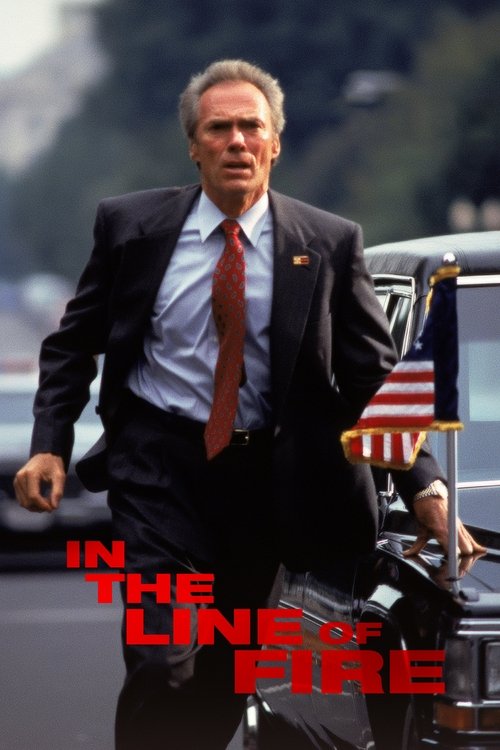
In the Line of Fire
1993 · Wolfgang Petersen
For when you want a classy, grown-up thriller — cat-and-mouse done with brains instead of explosions. A comfort watch for anyone who loves the '90s studio thriller at its sleekest.
What it's about
Frank Horrigan is an aging Secret Service agent who was on the Dallas detail the day Kennedy was shot — a failure he's carried for thirty years. When a meticulous, taunting stranger calling himself 'Booth' phones to announce he intends to kill the current president, Horrigan claws his way back onto protection duty to stop him. What follows is a long, personal duel of phone calls, near-misses, and mind games between two men who understand each other far too well.
The experience
A slow-tightening screw of a thriller — smart, patient, and genuinely suspenseful, with a streak of dry humor about growing old in a young man's job. The phone conversations between hunter and killer are the best scenes: intimate, creepy, and electric.
Performances
Clint Eastwood does some of his most vulnerable late-career work, letting age, regret, and gallows humor show through the icon. John Malkovich is unforgettable as the assassin — soft-spoken, brilliant, and skin-crawlingly reasonable.
The craft
Wolfgang Petersen directs with old-school precision: telephoto stakeouts, motorcades, crowds scanned face by face, every set piece built on geography you can actually follow. The script gives its villain real intelligence, which makes the suspense honest — you believe he could win.
Why it matters
It stands as one of the high-water marks of the 1990s adult thriller and proved Eastwood the star could deepen with age, paving the way for his great late period.
Snapshot
In the Line of Fire is a sleek, intelligent presidential-protection thriller that doubles as a late-career meditation on aging, guilt, and the persistence of duty. Clint Eastwood plays Frank Horrigan, a Secret Service agent who, three decades earlier, was on the Dallas detail the day John F. Kennedy was killed — a failure he has carried, half-buried, ever since. When a meticulous, taunting would-be assassin who calls himself "Booth" (John Malkovich) phones to announce that he intends to kill the current president, Horrigan forces his way back onto protection detail to stop him, drawn into an extended cat-and-mouse duel that is as much psychological as procedural. The film pairs the conventions of the 1990s glossy thriller — surveillance, telephoto stakeouts, motorcades, ticking-clock set pieces — with an unusually rueful character study of a man confronting his own obsolescence and the ghost of the one moment he could not change. Directed by Wolfgang Petersen in the picture that cemented his Hollywood standing, written by Jeff Maguire, photographed by John Bailey, scored by Ennio Morricone, and edited by the legendary Anne V. Coates, it was both a major commercial success and a critical favorite, earning Academy Award nominations for Malkovich's supporting performance, Maguire's original screenplay, and Coates's editing. More than thirty years on, it endures as a model of the adult, star-driven studio thriller — a genre that has since largely vanished — and as one of Eastwood's most self-aware performances.
Industry & production
In the Line of Fire was a Castle Rock Entertainment production released through Columbia Pictures in July 1993. It arrived at a moment when the mid-budget, star-anchored thriller for adult audiences was still a reliable studio staple, before the franchise and tentpole logic of the following decades crowded it out. The package combined several kinds of prestige: Eastwood, then in his early sixties and at a career high after the previous year's Unforgiven; Wolfgang Petersen, the German director of Das Boot who had had an uneven Hollywood run and badly needed a hit; and a roster of seasoned craftspeople. Castle Rock, founded by Rob Reiner and partners and known for filmmaker-friendly, quality-oriented production, was a natural home for material that prized character and dialogue alongside spectacle.
The production made notable use of real Washington, D.C. locations and of access to the look and rhythm of presidential protection — motorcades, rope lines, hotel ballrooms, and fundraising dinners — to lend procedural texture. The screenplay by Jeff Maguire reportedly circulated as a sought-after script before reaching the screen; its strength as a piece of construction is part of the film's reputation, and it earned an Academy Award nomination for Best Original Screenplay. Commercially the picture was a substantial hit, one of the more successful releases of its summer and a film that restored Petersen's standing as a maker of efficient, high-tension entertainments; I will refrain from citing precise grosses, but its success was decisive enough to shape his subsequent American career (Outbreak, Air Force One, The Perfect Storm).
Technology
The film is a product of conventional early-1990s analog filmmaking — 35mm photography, optical-era craft — but it is notable for one conspicuous early embrace of digital image manipulation. To establish Horrigan's presence in Dallas in 1963, the production created images that place a younger Eastwood within the historical Kennedy milieu, using digital compositing to insert his likeness into period-style photographs and footage. This is an early, narratively motivated use of the kind of digital seamless-insertion technique that Forrest Gump would popularize the following year; here it serves the plot's central conceit, fabricating the photographic "evidence" of Horrigan's proximity to history's most scrutinized failure. Beyond that flourish, the technological character of the film is grounded in practical methods: real motorcade staging, long-lens surveillance photography, and stunt work, including the much-discussed rooftop sequence. The film's depiction of its villain's craft — a hand-fabricated, largely non-metallic pistol designed to defeat security screening — is itself a kind of technological fantasy, dramatizing the era's anxieties about detection and the improvised weapon, though the specifics should be read as thriller invention rather than a verified design.
Technique
Cinematography
John Bailey's cinematography gives the film a clean, controlled, distinctly 1990s studio gloss while reserving expressive shadow for its more interior passages. The protection sequences favor a bright, legible, telephoto-inflected style — long lenses that compress crowds and isolate faces, surveillance framings that put the audience in the agent's scanning point of view, always searching the throng for the one wrong element. Against this public brightness, the scenes of Horrigan alone — at home, at the piano, on the phone with Leary — are lit more intimately and somberly, the photography registering fatigue and age in Eastwood's face rather than smoothing it. Bailey's camera is restless during set pieces and patient during the duologues, and the contrast between the exposed, over-lit public spaces (where an assassin can hide in plain sight) and the shadowed private ones organizes the film's visual logic.
Editing
The editing, by Anne V. Coates — whose career reaches back to her Oscar-winning work on Lawrence of Arabia — earned an Academy Award nomination and is central to the film's effectiveness. Coates manages two distinct registers: the sustained, dialogue-driven phone exchanges between Horrigan and Leary, which she lets breathe so the verbal duel can develop, and the accelerating crosscut suspense of the action set pieces, where parallel cutting between the assassin, the agents, and the protectee tightens the clock. The film's signature suspense mechanism — the audience knowing more than the characters, the cut that withholds and then delivers — is an editorial achievement as much as a directorial one. The control of rhythm, holding tension long past the point a lesser cut would release it, is the kind of craft that distinguishes the picture from routine genre product.
Mise-en-scène / staging
Petersen stages the film around the geometry of protection: the choreography of a motorcade, the sightlines of a ballroom, the vulnerable seconds of a rope line, the architecture of a hotel as a problem to be secured. The mise-en-scène repeatedly thematizes looking and exposure — who can see whom, from where, and through what. The most celebrated staging is the rooftop chase and the moment Horrigan dangles from a height while clinging to Leary's hand, an image that literalizes the film's moral entanglement of pursuer and pursued. Equally important are the quieter two-handers: the telephone conversations, which are essentially staged as a duet between two faces in separate spaces, and the tender, sparring scenes between Horrigan and fellow agent Lilly Raines (Rene Russo), in which the staging negotiates a workplace romance across lines of rank and gender.
Sound
Ennio Morricone's score is one of the film's distinctive features — restrained, melancholy, and built around a recurring, jazz-tinged piano theme that ties directly to Horrigan's own off-duty piano playing, blurring the line between diegetic and underscore. Rather than the brassy, percussive bombast common to the era's action thrillers, Morricone supplies something more wistful, scoring the character's regret as much as the suspense. The sound design exploits the telephone as a dramatic instrument: Leary's disembodied voice, intimate and insinuating in Horrigan's ear, is among the film's most effective sonic ideas, making the antagonist a presence long before he is fully seen. Public ambience — crowd roar, motorcade noise, the clamor of a fundraiser — is used to heighten the sense of threat hidden within mass sound.
Performance
The film is, finally, an actors' duel. Eastwood gives one of his most openly vulnerable performances, playing against his own iconography: Horrigan is physically diminished, winded by a rooftop run, stung by jokes about his age, and haunted in a way Eastwood rarely allowed his heroes to be. The performance trades the impassive stoicism of his Westerns and Dirty Harry films for something more weathered and self-questioning. Opposite him, John Malkovich's Mitch Leary is a landmark thriller villain — cerebral, mercurial, wounded, and genuinely frightening — and his Academy Award–nominated turn supplies the film's charge; the role's blend of intellectual superiority and emotional damage (a former government assassin who feels betrayed by the state he served) makes him a worthy and disturbing antagonist. Rene Russo brings intelligence and adult sexuality to a partner role written with more agency than the genre usually allowed, and the supporting bench — Dylan McDermott, Gary Cole, John Mahoney, Fred Dalton Thompson — lends procedural credibility.
Narrative & dramatic mode
The dramatic mode is the cat-and-mouse thriller built on a duel of equals, structured around the recurring telephone confrontations that escalate the personal stakes between hunter and hunted. The screenplay is admired for the elegance of this construction: Leary chooses Horrigan as his audience and antagonist precisely because of Dallas, making the contest intimate and turning the assassination plot into a referendum on Horrigan's competence, courage, and capacity for redemption. The narrative runs on dramatic irony and the suspense of foreknowledge — the audience watches the assassin assemble his means and select his moment while the protectors scramble to anticipate him — and it interleaves the public plot with a private one (the romance, the buried trauma). The mode is fundamentally redemptive: it offers Horrigan the chance to do, this time, the thing he failed to do in 1963, and structures its climax around whether he will take the bullet he once did not.
Genre & cycle
The film belongs to the early-1990s cycle of polished, adult thrillers that flourished between the action-movie excess of the 1980s and the franchise era — pictures driven by a high-concept premise, a charismatic villain, and procedural detail rather than by superheroics. It sits specifically within the presidential/political-assassination thriller tradition that runs from The Manchurian Candidate and The Day of the Jackal through later entries, and it shares DNA with the "brilliant criminal versus haunted lawman" subgenre that The Silence of the Lambs had recently elevated, where the antagonist's intellect and the protagonist's psychological wound are the real subject. It is also a late entry in the Eastwood lone-protector cycle, recasting his familiar figure of the aging professional reckoning with the limits of his code. The Secret Service procedural texture — the mechanics of protection — gives it a distinct flavor within the broader thriller field.
Authorship & method
The dossier's authorship sits at the intersection of a strong director, a prized screenplay, and a remarkable set of collaborators. Wolfgang Petersen brought the suspense engineering and tonal control he had honed since Das Boot, with a method oriented toward propulsive momentum, clear spatial geography, and the wringing of tension from confined, high-stakes situations; In the Line of Fire is the film that re-established him as a top-tier studio craftsman of the thriller. Jeff Maguire's original screenplay supplies the film's architecture — the villain-as-caller device, the Dallas backstory, the redemptive arc — and is widely credited as the bedrock of the film's quality. John Bailey, a cinematographer with a strong authorial reputation, gives the picture its disciplined visual style. Ennio Morricone, one of cinema's greatest composers, contributes a score that deepens the film's melancholy and ties its suspense to its emotion. And Anne V. Coates, an editor of historic stature, shapes its rhythm and suspense. Eastwood, though here functioning as star rather than director, inevitably inflects the film with the self-reflexive concerns — aging, guilt, the cost of violence — that run through his own directorial work of the period.
Movement / national cinema
The film is mainstream American studio cinema, not the product of any movement, but it is shaped by an émigré director: Wolfgang Petersen, who carried into Hollywood the technical rigor and claustrophobic suspense-craft of Das Boot, an instance of a German filmmaker successfully assimilating to, and elevating, the American genre picture. Its other notable transnational element is Morricone, the Italian master whose involvement links this glossy American thriller to a much larger European tradition of film scoring. The picture is best understood as a high point of the Hollywood studio system's mid-budget adult entertainment, executed by an internationally sourced team of craftspeople working within American genre conventions.
Era / period
In the Line of Fire is a quintessential artifact of early-1990s Hollywood — the brief window in which the prestige adult thriller, anchored by a movie star and a memorable villain, was a dependable commercial form. It reflects post–Cold War anxieties refracted through a domestic lens: its villain is a disillusioned former government operative, an insider turned against the state, rather than a foreign agent, registering a shift toward enemies produced by the system itself. The film's preoccupation with the Kennedy assassination also speaks to its moment — Oliver Stone's JFK had reignited public fascination with Dallas just two years earlier — and the picture trades on that renewed cultural obsession with the 1963 trauma. Technologically it stands on the cusp between analog and digital, deploying early digital compositing in the service of an old-fashioned, character-driven story.
Themes
At its center the film is about guilt and the possibility of redemption: Horrigan is defined by a single unrecoverable failure, and the entire plot is engineered to give him a second chance to make the sacrifice he could not make in 1963. Aging and obsolescence run throughout — the film is unusually frank about its hero's diminished body, his sense of being a relic, and the question of whether an old man still has the speed and nerve the job demands. Duty and sacrifice are examined as both burden and identity: the agent's defining willingness to "take the bullet" is literalized as the film's moral test. The doubling of protagonist and antagonist is a major theme — Leary and Horrigan are presented as dark mirrors, both former servants of the state, both shaped by its uses of them, locked in a relationship of mutual fascination. And beneath it all sits the wound of Kennedy's death as a national and personal trauma, the originating failure that the film seeks, symbolically, to redress.
Reception, canon & influence
On release the film was both a commercial success and a strong critical favorite, widely praised for the intelligence of its screenplay, the quality of its performances, and Petersen's command of suspense. It earned three Academy Award nominations — John Malkovich for Best Supporting Actor, Jeff Maguire for Best Original Screenplay, and Anne V. Coates for Best Film Editing — an unusual level of recognition for a summer thriller and a marker of how seriously the picture was taken. Malkovich's Leary in particular was singled out as one of the era's great screen villains.
Looking backward, the film draws on a deep lineage: the assassination thriller of The Day of the Jackal and The Manchurian Candidate; the recently ascendant model of the brilliant-criminal/haunted-investigator duel exemplified by The Silence of the Lambs; the cultural reactivation of the Kennedy assassination by Stone's JFK; and Eastwood's own long-running persona of the aging lawman, which Unforgiven had just interrogated. Petersen carried forward the suspense methods of Das Boot.
Looking forward, its legacy is substantial within its genre. It confirmed Wolfgang Petersen as a leading Hollywood maker of thrillers and led more or less directly to Air Force One, another Petersen film about threats to the presidency. It is frequently cited as a high-water mark of the adult, star-driven thriller — a form whose subsequent decline makes the film look, in retrospect, like the end of an era as much as a model. Its central device, the assassin who phones his pursuer and makes the contest personal, and its psychologically wounded, sympathetic-yet-monstrous antagonist, fed the genre's later villains. And its early, narratively motivated digital insertion of an actor into historical imagery anticipates a technique that would become ubiquitous after Forrest Gump. It endures as a touchstone for what the mainstream thriller could achieve when built on character and craft rather than spectacle alone — and as one of the films in which Clint Eastwood most candidly examined his own aging myth.
A Deleuzian reading
Remember the rooftop.
The full Deleuzian reading of In the Line of Fire →
Reception
A critical and commercial hit in the summer of 1993, earning three Oscar nominations including Malkovich for Best Supporting Actor; today it's remembered fondly as a peak example of the smart, adult star-vehicle thriller Hollywood supposedly stopped making.
How In the Line of Fire was received, from release to now →
Influences: the films it descends from and the films it influenced
- The Day of the Jackal (1973) — Establishes the assassination-procedural's parallel cutting between a methodical lone gunman's preparations and the investigators slowly closing the geometry around him — the structural engine Maguire's screenplay reuses.
- The Manchurian Candidate (1962) — Defines the paranoid political-assassination thriller around the rifle-scope POV and the single shooter in a crowd, the iconography ITLOF reactivates at its climactic rally.
- The Silence of the Lambs (1991) — Pioneers the intimate predator/pursuer duel built on direct, almost seductive address from the brilliant antagonist — the exact register Malkovich's Leary adopts in his phone calls to Eastwood.
- Dirty Harry (1971) — Supplies both Eastwood's weary-lawman persona and the template of the taunting killer (Scorpio) who phones the cop to personalize the hunt — the seed of ITLOF's telephone-as-instrument.
- Das Boot (1981) — Petersen's own school of confined-space suspense engineering — clear spatial geography and tension wrung from pressure — carried directly into the thriller's set pieces.
- Unforgiven (1992) — Immediately precedes and licenses Eastwood's self-reflexive performance about aging, guilt, and obsolescence — the persona ITLOF's Frank Horrigan is built to interrogate.
- JFK (1991) — Reactivates Kennedy-assassination iconography and the manipulation of Dealey Plaza archival imagery, the cultural ground ITLOF's Dallas backstory and digital inserts stand on.
- Lawrence of Arabia (1962) — Showcase of Anne V. Coates's editing method — rhythmic withholding and the famous match cut — the craft sensibility she brings to shaping ITLOF's suspense beats.
- The Conversation (1974) — Codifies surveillance craft as a visual language — long-lens, telephoto eavesdropping framed as voyeuristic distance — echoed in Bailey's telephoto-surveillance compositions.
- The Parallax View (1974) — Models the lone-operative-versus-conspiracy thriller's cold, architectural framing of public spaces as kill zones, anticipating ITLOF's rally and rooftop geometry.
- Air Force One (1997) — Petersen reapplies the same presidential-threat suspense engineering and confined high-stakes geography, the direct studio sequel-in-spirit to ITLOF.
- Phone Booth (2002) — Takes telephone-as-instrument to its limit — an unseen caller who controls and morally probes the trapped protagonist entirely by voice, ITLOF's device made the whole film.
- Forrest Gump (1994) — Popularizes the narratively motivated digital insertion of an actor into historical footage that ITLOF used quietly for its Dallas flashbacks a year earlier.
- Se7en (1995) — Advances the sympathetic-yet-monstrous antagonist who orchestrates the duel from psychological intimacy and surrenders on his own terms — Leary's lineage of the controlling villain.
- The Negotiator (1998) — Makes the protagonist/antagonist telephone two-hander the plot's actual engine, two stars dueling through a handset across most of the film.
- Absolute Power (1997) — Eastwood extends the Secret Service / corrupted-presidency milieu, again pairing his aging-craftsman screen presence with a political-power thriller.
- Speed (1994) — Builds its plot on the villain who phones the hero to make the contest personal and intimate (Hopper to Reeves), the same telephone-duel device a year later.
- Heat (1995) — Stages the pursuer and pursued as mirror images who meet face-to-face in mutual respect, the cat-and-mouse duel elevated to existential equivalence.
- The Fugitive (1993) — Contemporary high-water mark of the adult, star-driven pursuit thriller built on parallel cutting between hunter and hunted and character over spectacle.
- Outbreak (1995) — Petersen sibling that perfects his star-driven procedural-to-thriller pivot — institutional protocol and duty giving way to one heroic protagonist's personal stand, the exact arc Outbreak follows.
Similar films
- Absolute Power (1997) — influence & lineage
- Dirty Harry (1971) — influence & lineage
- JFK (1991) — influence & lineage
- Unforgiven (1992) — influence & lineage
- The Fugitive (1993) — influence & lineage
- Spy Game (2001) — shared sensibility
- Clear and Present Danger (1994) — shared sensibility
- The Negotiator (1998) — shared sensibility