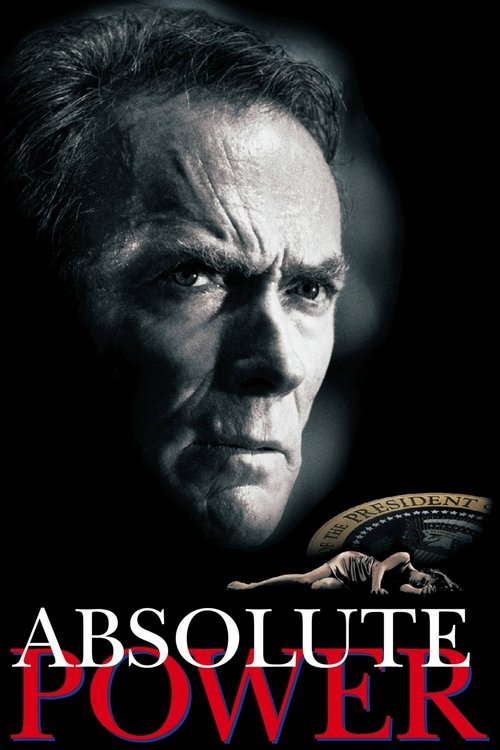
Absolute Power
1997 · Clint Eastwood
For a low-key thriller night when you want intrigue you can sink into — grown-up suspense that trusts you to keep up, comfort-food for fans of the paranoid political thriller.
What it's about
An aging master thief is mid-burglary in a Washington mansion when, hidden behind a one-way mirror, he witnesses a killing that implicates the President of the United States. Now the only witness to a crime the White House is burying, he must outrun government fixers and the police while deciding what he owes his estranged daughter — a prosecutor who's ashamed of him.
The experience
A slow-burn cat-and-mouse thriller that runs on craft and character rather than explosions — patient, procedural, and quietly gripping, with a dry streak of gallows humor. The pleasure is watching an old professional stay two moves ahead of very powerful people.
Performances
Eastwood is at his flinty, minimal best as the thief, Gene Hackman radiates entitled menace as the President, and Ed Harris brings warmth and intelligence to the detective circling them both.
The craft
Eastwood directs with his signature economy — unhurried, precise, and confident enough to let long wordless stretches of the burglary play out in near silence. The screenplay (adapted by William Goldman from David Baldacci's novel) lets you piece the procedure together yourself.
Why it matters
A solid entry in Eastwood's late-career run of morally weighted dramas, and one of the 1990s' cleaner marriages of the heist picture with post-Watergate political paranoia.
Snapshot
A political thriller that uses the architecture of the cat-and-mouse heist picture to examine corruption at the summit of institutional power, Absolute Power follows Luther Whitney, an aging master thief who witnesses—through a one-way mirror—the President of the United States complicit in a woman's killing. The film is formally conservative and character-driven, more interested in the moral geometry between a father and estranged daughter than in action spectacle. It arrives in Eastwood's late-career phase as a meditation on guilt, legacy, and what an old man owes to those he failed. Its pleasures are low-temperature: precise craft, a casually extraordinary ensemble, and a screenplay that trusts the audience to follow procedural detail without hand-holding.
Industry & production
Absolute Power originated in David Baldacci's debut novel, published in 1996, which became a major commercial success and effectively launched Baldacci as one of the dominant practitioners of the Washington-set legal and political thriller. The novel's premise—a solitary witness to presidential criminality—attracted immediate Hollywood attention. Eastwood secured it for Malpaso Productions, his long-running company housed at Warner Bros., and brought in William Goldman to write the adaptation. Goldman, whose credits included All the President's Men (1976) and The Princess Bride (1987), was one of the most commercially bankable and intellectually serious screenwriters working in Hollywood. The pairing of Goldman's structuralist sensibility with Eastwood's laconic directorial voice produced a script that trimmed Baldacci's apparatus considerably, centering the father-daughter relationship that functions as the film's emotional spine.
The casting of Eastwood in the lead was an act of star-driven auteurism: at 66 during production, he was playing a thief who is explicitly described as slowing down, whose body is a register of time passing. Gene Hackman, a recurring figure in films that probe masculine authority and its corruption—from The Conversation (1974) to Unforgiven (1992)—took the role of President Alan Richmond. Ed Harris, Judy Davis, Scott Glenn, Laura Linney, Richard Jenkins, and E.G. Marshall rounded out a cast of unusual depth for a mid-budget thriller. The production shot on location in Washington, D.C. and Virginia, grounding its political paranoia in physical authenticity. Specific production budget figures circulated in trade reporting at the time, but the film carried the costs appropriate to an Eastwood star vehicle of the period—a mid-range studio production rather than a tentpole.
Technology
The film's most technically demanding sequence—Luther watching the killing unfold through a one-way mirror while the killers search the room on the other side, unaware of his presence—required careful practical staging. The mirror apparatus was constructed to allow simultaneous action on both sides of the glass, with lighting calibrated to maintain the reflective property from one angle while permitting clear sight lines from the other. The sequence is shot and edited with Hitchcockian precision, exploiting the fundamental voyeuristic grammar of the one-way mirror without calling attention to its own cleverness. No significant digital visual effects appear in the film; this is entirely a work of practical production design and in-camera technique.
Technique
Cinematography
Jack N. Green, who served as Eastwood's director of photography from Heartbreak Ridge (1986) through this period, brought his characteristic approach: naturalistic sources, restrained movement, and a preference for allowing drama to inhabit space rather than engineering it through aggressive coverage. The mansion robbery sequence is lit to suggest the cold, impersonal wealth of a house that is a trophy rather than a home. Green uses the large frame of the robbery location as a kind of trap—Luther moves through rooms that dwarf him, an intruder in a world where he doesn't belong and where the stakes are far beyond what he anticipated. Exterior Washington locations are photographed without glamour or visual rhetoric; the capital appears as a place of surfaces rather than symbols.
Editing
Joel Cox, Eastwood's editor since Pale Rider (1985) and an Academy Award winner for Unforgiven, cut Absolute Power in the rhythmically unhurried style that characterizes Eastwood productions. Cox does not use editing as a tool of artificial excitement; cuts occur when the scene's logic demands them rather than to impose kinetic energy. The mirror sequence is the film's editing set piece, crosscutting between Luther's concealed vantage and the action in the room with an almost clinical patience that makes the sequence more, not less, frightening. The film runs approximately two hours without feeling padded, an economy that owes much to Cox's willingness to hold on actors' faces rather than rush through reaction shots.
Mise-en-scène / staging
Eastwood's directing style by the mid-1990s was fully consolidated: he gave actors room, preferred longer takes, shot with minimal rehearsal to preserve spontaneity, and avoided visual ornamentation. The opening robbery is staged as a professional's routine—methodical, quiet, efficient—which establishes Luther's competence and control before the film strips both from him. The mirror sequence inverts this: Luther is suddenly frozen, the methodology that has sustained his career made useless. The staging across the glass creates a spatial irony, the hunter immobilized by visibility itself.
The father-daughter scenes between Eastwood and Laura Linney are staged with deliberate understatement, dialogue carrying years of unspoken failure. Eastwood resists the temptation to sentimentalize; the reconciliation, when it comes, is tentative and earned rather than cathartic.
Sound
Lennie Niehaus, who had served as Eastwood's composer for most of his directorial career since the early 1980s, provided a score rooted in jazz-inflected orchestral writing—modest, functional, period-appropriate for Eastwood's filmmaking aesthetic. Niehaus's scores for Eastwood pictures tend toward restraint, complementing the visual and dramatic understatement rather than amplifying it. The sound design in the mirror sequence relies on ambient texture—the sounds Luther can hear from the room beyond the glass—as a source of sustained tension, making the audience's ear as implicated as Luther's eye.
Performance
Eastwood's performance is built on concealment and economy: Luther is a man who has spent decades making himself invisible, and Eastwood gives him a physicality that suggests compressed energy rather than brute strength. The self-casting as an aging professional whose body is beginning to betray him carries an autobiographical undertow that Eastwood exploits without milking. Hackman brings to President Richmond the quality he had perfected elsewhere—authority that masks volatility, charm that coexists with menace. It is not among his most demanding performances, but it is characteristic in its precision.
Laura Linney, in an early major film role, plays Kate Whitney with a controlled anger that doesn't tip into sympathy-seeking; her estrangement from her father is rendered as something she has made her peace with, not an open wound waiting to be salved. Ed Harris's detective, Seth Frank, is the film's most purely genre figure, but Harris brings intelligence and wry self-awareness to the procedural role. Judy Davis, as the President's chief of staff, does considerable work in limited screen time.
Narrative & dramatic mode
The film operates primarily as a procedural-thriller hybrid, though Goldman's script continuously repositions the genre machinery as a delivery mechanism for character drama. The thriller architecture—the witness who must be found, the evidence that changes hands, the institutional conspiracy that expands to contain the threat—functions reliably, but the emotional weight falls on the father-daughter axis. Luther's return into Kate's life is enabled by his jeopardy and complicated by the crimes he has committed to survive. The film's moral position is interesting: it does not ask the audience to admire Luther but invites identification with his predicament, a distinction Eastwood managed throughout his career with unusual consistency. The ending is essentially Jacobean in structure—the corrupt are destroyed, but the cost is high.
Genre & cycle
Absolute Power belongs to the strain of American political thriller that has the Constitution as its implicit background text—the idea that the office of the presidency, in corrupted hands, becomes the most dangerous institution in the republic. This cycle extends from All the President's Men (1976) through The Parallax View (1974), Three Days of the Condor (1975), and into the 1990s with films like The Pelican Brief (1993) and Murder at 1600 (1997), which appeared the same year. Goldman's presence connects it directly to the Watergate-era tradition; he wrote All the President's Men and understood how to dramatize institutional conspiracy without making it incoherent. It is simultaneously a heist picture in its opening registers, a chase film in its middle section, and a revenge tragedy in its resolution.
Authorship & method
Eastwood's method as a director by 1997 was well established and widely documented: minimal takes, fast schedules, genuine respect for actors' instincts, an aversion to the costly machinery of the contemporary blockbuster. He had built Malpaso into one of the most efficient production operations in Hollywood precisely because this aesthetic preference aligned with fiscal discipline. He rarely shot more coverage than he intended to use, a habit that constrained editorial options but maintained his authority over the film's final shape.
Goldman's contribution deserves emphasis. He was one of the few screenwriters in the New Hollywood era whose authorial signature was recognizable across genres; his structural clarity, his ear for workplace vernacular, and his skepticism toward heroic mythology are all legible in the Absolute Power script. The Goldman-Eastwood collaboration was a meeting of two career-long commitments to craft over showmanship—a sensibility that produced a film more interested in being well-made than in announcing itself.
Jack N. Green, Joel Cox, and Lennie Niehaus complete the Eastwood production ensemble that gave his films of this period their tonal consistency. Their long collaboration amounted to a house style: underdressed, unhurried, emotionally direct.
Movement / national cinema
Absolute Power is firmly within the Hollywood studio system of the 1990s, a major-star vehicle produced under the terms of Eastwood's longstanding Warner Bros. relationship. It has no significant connection to a national cinema movement or an international art-cinema context. Its Hollywood classicism is the point: Eastwood's aesthetic investment in this period was explicitly in the continuity of the studio tradition rather than its disruption.
Era / period
The film arrived in early 1997 in a specific political atmosphere. The Clinton presidency had been marked by persistent questions about the personal conduct of the office-holder, and while the Lewinsky scandal did not break publicly until 1998, the cultural anxieties it would later crystallize were already latent. A film premised on the President's moral bankruptcy and the institutional apparatus deployed to protect it had obvious, if implicit, resonances with the contemporary moment. The film does not exploit these resonances; it does not need to. The premise carries its own charge.
Themes
The film's title names its central preoccupation: the corruption that accompanies unchecked authority, and the impossibility of accountability when institutional power is turned toward self-protection. Against this, Eastwood places a thief—someone who has operated outside the law his entire life—as the figure of moral clarity. The irony is structural: the man most guilty of private crime becomes the agent of public justice, not because he is virtuous but because he was present. The father-daughter relationship complicates this: Luther's crimes have cost him Kate, and the film suggests that his decision to pursue justice is partly an attempt to become, belatedly, someone worth knowing. Whether this rehabilitation is earned or merely hoped for is something the film leaves productively unresolved.
Reception, canon & influence
Critical reception at the time of release was respectful but unenthusiastic. Reviewers tended to acknowledge the film's professionalism—the cast, the craft, the screenplay's structural intelligence—while noting that it didn't rise to the level of Eastwood's major works. The comparison to Unforgiven (1992) was both inevitable and limiting; Absolute Power is not an attempt at that kind of statement. Box office performance was modest, appropriate for a character-driven thriller without significant action spectacle.
In terms of what the film absorbed: Goldman's Watergate-era political thriller framework is the most direct antecedent, and the Hitchcockian voyeur-in-danger scenario—the witness positioned behind glass, knowledge becoming a death sentence—has clear precedent in Rear Window (1954). Eastwood's own filmography provided the deepest context: the aging professional whose competence is tested by circumstances outside his usual parameters connects Absolute Power to themes he had explored throughout his career.
Its forward legacy is genuinely limited, as the record suggests. The film has not become a reference point for subsequent political thrillers, nor has it generated significant critical reassessment. It holds a place in Eastwood's filmography as a well-executed journeyman work by a master craftsman between more celebrated projects. Baldacci's subsequent prominence as a thriller novelist, and the eventual adaptation of other Baldacci novels for screen and television, gives the film a minor historical footnote as the first screen translation of what became a substantial franchise brand. But Absolute Power itself is best understood as an honorable, technically accomplished entertainment that does precisely what it intends without reaching for more—a quality that, in the context of late-1990s Hollywood, is less common than it sounds.
A Deleuzian reading
A thief lets himself into a rich man's house at night.
The full Deleuzian reading of Absolute Power →
Reception
Greeted in 1997 with a shrug — mixed reviews, modest box office, filed under 'minor Eastwood' between Unforgiven and Mystic River. Now it gets warm 'they don't make mid-budget adult thrillers like this anymore' reappraisals as a prime specimen of the 90s star-driven potboiler.
How Absolute Power was received, from release to now →
Influences: the films it descends from and the films it influenced
- Rear Window (1954) — The one-way-mirror robbery sequence directly imports Hitchcock's voyeur-trapped-by-architecture grammar, staging the witness as a body paralyzed by the act of seeing, with crosscutting calibrated so the observer's immobility—not action—generates suspense.
- Point Blank (1967) — Lee Marvin's minimalist physical performance—doing maximum work through stillness and controlled movement rather than expression—establishes the model for Eastwood's own performance economy as Luther Whitney, the aging professional whose body communicates competence and encroaching limitation.
- Klute (1971) — Gordon Willis's low-key naturalistic lighting—figures emerging from and receding into shadow without atmospheric embellishment—provides the direct visual grammar Jack N. Green extends throughout the mansion robbery and Washington location sequences.
- Charley Varrick (1973) — Siegel stages a professional thief who accidentally takes money from people far more dangerous than anticipated and must redirect criminal competence against institutional lethality—the precise structural template for Luther's predicament once the one-way mirror transforms a robbery into a witness-to-power scenario.
- The Conversation (1974) — Hackman as a surveillance professional destroyed by witnessing a crime through his own craft; Walter Murch's ambient sound design as the formal register of complicity and dread directly anticipates Niehaus's approach to the score's ambient tension around the mirror sequence.
- Night Moves (1975) — Hackman's physically restrained performance in a jazz-textured procedural—the investigator's methodical movement through institutional concealment shot with naturalistic intimacy and unhurried crosscutting—anticipates both the score's inflection and Cox's editing logic in the film's procedural accumulation passages.
- All the President's Men (1976) — Goldman's own screenplay for Pakula establishes the procedural architecture he transplants into the Baldacci adaptation: information revealed through methodical accumulation, Washington locations photographed without symbolic glamour, and institutional paranoia rendered as bureaucratic texture rather than melodrama.
- Marathon Man (1976) — Goldman's script architecture—a lone figure trapped between institutional power and personal survival, procedural betrayal revealed through competent professionals navigating systems that have turned against them—is the thriller template he carries wholesale into the Baldacci adaptation.
- Unforgiven (1992) — Joel Cox's editing rhythm of deliberate patience—cuts deferred until the scene's internal logic demands them, reaction shots held rather than rushed—and the structural device of Jacobean moral accounting as resolution rather than climax are both carried directly into this film by the same editor and director.
- The Good Shepherd (2006) — De Niro's procedural thriller of CIA institutional corruption adopts the Goldman-Pakula architecture—unhurried crosscutting between operational tradecraft and personal cost, naturalistic cinematography (Robert Richardson) without atmospheric embellishment, and a performance-economy ensemble whose behavioral restraint carries the moral accounting.
- Michael Clayton (2007) — Gilroy's script withholds exposition in the Goldman manner—competent professionals navigating institutional betrayal without hand-holding—while Robert Elswit's naturalistic lighting and Gilroy's unhurried crosscutting between corporate procedure and moral reckoning constitute the Goldman-Eastwood institutional thriller carried into a new decade.
- Breach (2007) — Laura Linney—Luther's estranged daughter in Absolute Power—is recast as an institutional insider navigating highest-level betrayal; Ray's naturalistic staging, performance economy, and ambient procedural dread extend the Eastwood approach, with Linney's physical restraint again carrying the weight of complicity in a closed institutional world.
- The Ides of March (2011) — Clooney's presidential corruption thriller adopts Eastwood's long-take ensemble staging—characters revealing moral compromise through occupational gesture rather than exposition—with a procedural-hybrid structure and Jacobean resolution in which the cost of knowing institutional corruption is the protagonist's own corruption.
- True Crime (1999) — Jack N. Green's cinematography, Joel Cox's unhurried crosscutting, and Lennie Niehaus's jazz-inflected score are deployed by the same production unit in a procedural thriller about institutional injustice, confirming that Absolute Power's formal system is a repeatable directorial method rather than a one-film solution.
- Mystic River (2003) — Joel Cox's editing rhythm persists under a new cinematographer (Tom Stern replacing Green), and the Jacobean resolution—the guilty escape, the innocent destroyed by the same institutional logic—combined with ensemble depth and the paternal guilt/legacy theme constitutes a structural recapitulation of Absolute Power's architecture in a different generic register.
- In the Line of Fire (1993) — Eastwood extends the Secret Service / corrupted-presidency milieu, again pairing his aging-craftsman screen presence with a political-power thriller.
Similar films
- The Conversation (1974) — influence & lineage
- All the President's Men (1976) — influence & lineage
- Unforgiven (1992) — influence & lineage
- Night Moves (1975) — influence & lineage
- In the Line of Fire (1993) — shared sensibility
- J. Edgar (2011) — shared sensibility
- Heat (1995) — shared sensibility
- Dirty Harry (1971) — shared sensibility
All the films related to Absolute Power →