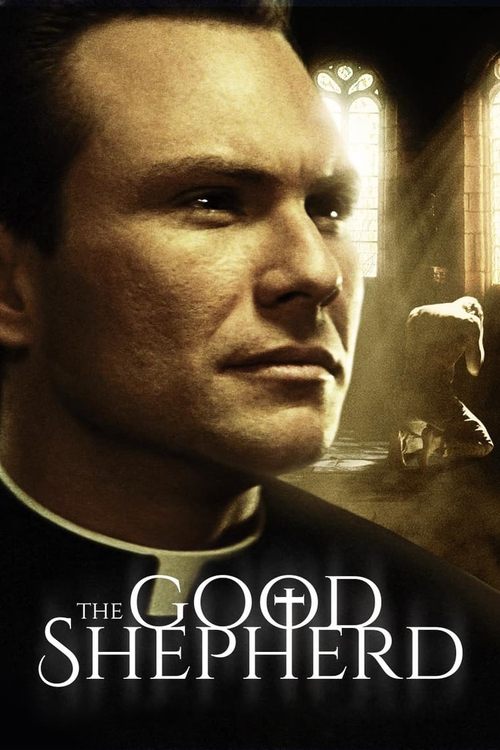
The Good Shepherd
2004 · Lewin Webb
When you're in the mood for a modest whodunit with darker-than-usual subject matter — an undemanding runtime but not a light watch. Better for a quiet, curious evening than a comfort night.
What it's about
A parish priest is accused of murdering a social worker, and the church turns not to the police but to a reporter — who happens to be romantically entangled with someone in the parish — to dig out the truth. The investigation pulls him into the closed world of the church, where faith, secrets, and abuse allegations knot together.
The experience
A slow-burn small-scale mystery that trades spectacle for the uneasy question of who you trust when an institution closes ranks. It's more somber than pulpy, with a persistent undertone of moral discomfort.
The craft
This is a lean, low-budget production that leans on its premise rather than on visual flash: the church setting does the atmospheric work, and the story stays close to the reporter's point of view as the case complicates. Expect television-thriller economy rather than big-screen sweep.
Why it matters
A little-seen entry in the crime-in-the-church subgenre, notable mostly as an example of the small-scale mystery thrillers that circulated outside major theatrical release in the early 2000s.
Snapshot
The Good Shepherd (2004) is a small-scale religious-milieu mystery thriller built on a familiar but durable engine: a clergyman stands accused of murdering a social worker, and the investigation to exonerate him is delegated not to police but to a journalist — one entangled romantically with the parish that needs him. On the strength of the available record, this is a modest production rather than a major theatrical release, and the documentary trail around it is genuinely thin. I can find no reliable, verifiable filmographic detail confirming the career of a director credited as "Lewin Webb," nor authoritative credits for the cinematographer, composer, or editor; rather than invent those attributions, this dossier treats them as undocumented and concentrates on what can be responsibly read from the premise, the genre lineage it sits within, and the production conditions typical of films of this scale and subject in the early 2000s. Where I generalize, I do so from established convention; where I would otherwise be guessing about this specific title, I say so plainly.
A note on the title and the year: The Good Shepherd is an unusually crowded name. The best-known film bearing it is Robert De Niro's 2006 CIA-origins drama, and there are several earlier and later works (television films, religious dramas) carrying the same phrase, which derives from John 10 and the pastoral imagery of Christ as shepherd. The 2004 dating and the murder-mystery synopsis distinguish this entry from those, but the shared title is itself a clue to the film's positioning: it foregrounds vocation, guardianship, and the moral weight of the priesthood before a frame is seen.
Industry & production
Nothing in the verifiable record establishes this film's financing, distributor, shooting schedule, or budget, and I will not manufacture figures. What can be said responsibly is structural. A drama-thriller of this synopsis — single accused cleric, a parish, a reporter-investigator, a contained ensemble — is the kind of project that, in the early-to-mid 2000s, was most often realized as a low-to-mid-budget independent feature or a television film. Its dramatic furniture (a confined institutional setting, a small principal cast, an investigation that substitutes dialogue and legwork for spectacle) is precisely what makes such a story economical to mount. Productions of this profile typically depend on a handful of practical locations — a church and presbytery, a newspaper office, domestic interiors, perhaps a courtroom or police station — rather than built sets, and on a compressed shoot measured in weeks.
The religious framing also carries an industrial logic. Faith-adjacent mystery dramas occupy a reliable niche: they travel well to broadcast and home-video markets, attract audiences underserved by the multiplex, and lend gravity to a genre that might otherwise read as routine. Whether this particular film reached cinemas, television, or direct-to-video distribution, I cannot confirm. Readers should treat its industrial placement as a reasonable inference from form, not an established fact.
Technology
There is no available technical record specifying this film's acquisition format, cameras, or finishing workflow, so what follows is contextual rather than title-specific. By 2004 the production landscape was mid-transition. A film at this budget could plausibly have been shot on 16mm or Super 16 — long the workhorse of cost-conscious drama for its portability and grain economy — or on the standard-definition and early high-definition digital video systems that were, by 2004, rapidly displacing film for television and low-budget features. The choice would have shaped the image materially: Super 16 yields a softer, more textured photochemical look that flatters interior and natural-light shooting; early digital video tends toward a flatter, more clinical register that some filmmakers embraced for its documentary immediacy. Post-production by this date was overwhelmingly nonlinear and digital regardless of origination format. Absent a confirmed source, I decline to assign this film any one of these pathways.
Technique
With no shot-by-shot record to draw on, this section reads the craft expectations the premise sets rather than describing confirmed choices in the finished film. I flag this limitation here so it need not be repeated under each subhead.
Cinematography
A clerical murder mystery invites a specific visual grammar: the architecture of churches — verticals, stained-glass color, the chiaroscuro of nave and confessional — is among the most photogenic of institutional spaces, and the genre habitually exploits it for moral atmosphere, the play of light through high windows standing in for scrutiny, grace, or judgment. The contrasting register would be the newspaper world and the ex-girlfriend's domestic spaces: flatter, more functional, more contemporary. A film working this material competently would tend toward controlled, low-key interiors and a restrained palette, reserving its most composed images for the sacred spaces. Whether this film achieves that, I cannot verify.
Editing
The investigative thriller is, structurally, an editing problem: it must dole out information so that the audience reassembles the crime alongside the reporter. The expected cutting pattern is conversational and procedural — scene-to-scene advances driven by discovery, with the rhythm tightening as the accused's situation worsens and a deadline (a charge, a trial, a confession) approaches. Mystery construction of this kind typically withholds and reveals through juxtaposition rather than camera flourish. Again, this describes the genre's demands, not confirmed work on the finished cut.
Mise-en-scène / staging
The premise hands the staging two charged arenas. The parish — presbytery, church, the social-welfare apparatus that connects priest and victim — is a closed moral community where everyone has a relation to everyone, the classic chamber-mystery configuration. Against it sits the secular machinery of the press and the law. The ex-girlfriend complication folds a second, personal triangle into the institutional one, so that staging would naturally exploit proximity and discomfort: people forced back into rooms, and feelings, they had left behind. A capable production would use blocking to keep the romantic and investigative threads visibly in tension.
Sound
No score, sound-design, or music credits can be reliably confirmed for this title. The genre's conventional toolkit is restraint punctuated by emphasis — quiet, dialogue-forward interiors; the acoustic of stone churches (reverberant, hushed) as a character in itself; and a score that leans on strings or sacred-adjacent textures (organ, choral color) to bind the ecclesiastical setting to the suspense. Whether this film uses such devices, the record does not say.
Performance
The dramatic load falls on a small set of figures: the accused clergyman, whose guilt or innocence must remain legible-but-uncertain; the parish priest whose faith in him sets the plot moving; the reporter, the audience's surrogate and the engine of inquiry; and the ex-girlfriend, whose return supplies emotional stakes beyond the procedural. Casts in films of this scale are typically anchored by experienced character actors rather than stars, and the mode rewards underplaying — the suspense depends on faces we cannot quite read. I have no verified cast information to attribute specific performances.
Narrative & dramatic mode
The film operates in the investigative-exoneration mode: not a whodunit of detection-for-its-own-sake but a clear-his-name thriller, in which the presumption of a wrongful accusation organizes audience sympathy from the outset. This is a meaningfully different contract from the classic detective story. The reporter is not a neutral solver but an advocate, recruited by a believer (the parish priest) to vindicate the accused; the dramatic question is less "who did it" than "can the truth be surfaced in time, and what will it cost the people surfacing it." The journalist-as-investigator is a well-worn substitute for the detective, valued because the press has plausible license to ask questions, a built-in deadline, and a public platform — and because a reporter can be compromised, biased, or personally entangled in ways a procedural detective cannot. The ex-girlfriend device tightens that screw: the inquiry is never clean, because the investigator's objectivity is under pressure from his own history. The result is a thriller whose suspense is moral and relational as much as evidentiary.
Genre & cycle
The film sits at the intersection of two durable strains. The first is the clerical mystery, a tradition reaching back through Chesterton's Father Brown to a long line of films and television in which the church furnishes both setting and ethical lens — sin and confession, sanctuary and concealment, the collar as both shield and target of suspicion. The second is the journalist thriller, the lineage of the crusading-reporter picture in which the press, not the police, drives the pursuit of truth. Combining them, The Good Shepherd belongs to a recognizable cycle of faith-inflected suspense dramas that proliferated on the margins of the early-2000s market — modestly budgeted, character-driven, often pitched as much to broadcast and home audiences as to theaters. The accusation-against-a-priest setup also carries unavoidable contemporary resonance: in the years immediately surrounding 2004, public attention to clerical misconduct and the institutional church's handling of it was acute, and any film placing a priest under suspicion of a crime was working in a charged cultural field, whether or not it engaged that context directly.
Authorship & method
Here the record is at its thinnest, and I will not fill the gap with invention. I cannot reliably confirm the career, prior work, or authorial signature of a director credited as "Lewin Webb," and I have no verifiable credits for the film's cinematographer, composer, editor, or screenwriter. This is a real and worth-stating limitation: a responsible dossier cannot characterize a director's "method" from a single obscure title and an absent biography. What can be said is conditional. Films of this scale are typically authored as much by their constraints as by a singular vision — schedule, location access, and cast availability shape them — and the screenplay's architecture (the recruited-reporter structure, the romantic complication) does more of the storytelling work than directorial style. If further authoritative credits surface, this section should be revised accordingly; as it stands, the attribution of creative authorship beyond the screenplay's evident design would be speculation.
Movement / national cinema
The film's national origin is not something I can confirm from the available record. The premise's vocabulary offers only soft hints — "parish priest," "social worker," "reporter" are common to many English-language contexts (British, Irish, Australian, North American), and the religious framing reads as broadly Catholic or Anglican without fixing a country. The clerical-mystery tradition has particularly deep roots in British and Irish storytelling, but the synopsis alone cannot establish provenance, and I decline to assign one. This is not a film that announces itself as part of any identifiable movement; it belongs, if anywhere, to the transnational current of small religious-themed genre filmmaking rather than to a national-cinema school.
Era / period
2004 places the film at a particular technological and cultural moment. Industrially, it sits in the thick of the digital transition, when low-budget drama could be made affordably on video and finished entirely in nonlinear post — a democratization that swelled the ranks of exactly this kind of modest, character-led feature. Culturally, as noted, it arrives amid heightened scrutiny of religious institutions, which gives a priest-under-accusation story a sharper edge than it might have carried a decade earlier. It also belongs to the pre-streaming, late-DVD-era distribution landscape, in which films of this profile found durable second lives through home video and broadcast licensing rather than through theatrical runs — a context that helps explain why such titles can be so faintly documented today.
Themes
Even read only through its premise, the film foregrounds a coherent thematic cluster. Vocation and guardianship are written into the title: the "good shepherd" is the pastor who protects his flock, and the plot literalizes that duty as the parish priest's refusal to abandon an accused colleague. Faith versus evidence runs underneath the investigation — the priest believes; the reporter must prove — staging a quiet argument between conviction and proof. Reputation and the fragility of the collar is acute: the clergyman's standing is precisely what makes the accusation devastating and what the inquiry must restore. The presence of a social worker as victim ties the church to the secular apparatus of care, hinting at a world where institutions of welfare and faith overlap and where harm can pass between them. And the compromised investigator theme — the reporter working alongside an ex-partner — makes the search for truth inseparable from unfinished personal business, so that exoneration and reconciliation become entangled goals. These readings follow from the premise; I have not confirmed how fully the film develops any of them.
Reception, canon & influence
This is where candor matters most. I can find no reliable critical reception, awards record, box-office data, or canonical standing for this specific title, and I will not fabricate reviews, quotations, or figures to fill the space. By every available indication it is a minor work with a faint documentary footprint rather than a film that shaped subsequent cinema.
What can be discussed honestly is its place in a lineage. Backward, the film draws on traditions far larger and better documented than itself: the clerical-detective story crystallized by Chesterton and elaborated across decades of film and television; the crusading-journalist thriller; and the wrongful-accusation suspense structure that long predates it. Forward, there is no basis to claim that this particular film influenced anything; influence runs the other way, from the established cycles into it. Its interest to Sightlines is therefore less as an originator than as a specimen — a representative instance of how durable genre machinery (the recruited reporter, the accused priest, the romantic complication) gets reassembled in small, market-marginal productions. To claim more would be to invent a reputation the record does not support, and the more useful scholarly act here is to mark the limits of what is known and leave the entry open to revision should firmer sources emerge.
A Deleuzian reading
Start with the collar.
The full Deleuzian reading of The Good Shepherd →
Reception
How The Good Shepherd was received, from release to now →
Influences: the films it descends from and the films it influenced
- I Confess (1953) — Establishes the chamber-suspense template of a priest bound by the seal of confession who cannot exonerate himself, staging guilt through low-key ecclesiastical chiaroscuro and architecture (rectory, confessional grille) rather than action — the core 'reputation-and-the-collar' machinery the seed reassembles.
- The Fugitive (1947) — Gabriel Figueroa's hard-edged sacred chiaroscuro — shafts through church interiors, the cassock as a black silhouette against white walls — codifies the lighting grammar of the persecuted-cleric film that the seed's 'ecclesiastical-chiaroscuro' inherits.
- Diary of a Country Priest (1951) — Models vocation as interiorized procedure — diaristic voice, suppressed performance, footstep-and-bell sacred acoustic doing the storytelling — the underplaying-and-sacred-sound register the seed's 'character-actor underplaying' and 'sacred-acoustic' facets draw on.
- Léon Morin, Priest (1961) — Builds drama from the romantic/erotic complication tangling a priest's vocation with a secular interlocutor across austere two-handed chamber scenes — the 'faith-versus-evidence' duologue staging the seed reuses for its romantic-complication subplot.
- Call Northside 777 (1948) — Originates the semi-documentary reporter-as-detective who reopens a wrongful conviction, advancing the case through forensic procedural beats (records, photostats, polygraph) toward exoneration — the 'investigative-exoneration' and 'journalist-as-detective' spine of the seed.
- Boomerang! (1947) — Location-shot, semi-doc wrongful-accusation procedure in which an officer of the system works to clear rather than convict the accused — the exoneration-structure-with-compromised-investigator pattern the seed inherits.
- Father Brown (1954) — Translates Chesterton's clerical-detective to film, fusing the man of the cloth with the deductive sleuth so theological insight powers the solution — the genre crystallization behind the seed's 'clerical-mystery' facet.
- All the President's Men (1976) — Perfects the journalist-thriller's procedural-reveal editing — information released in measured increments through legwork, phone calls and source meetings rather than spectacle — the cutting logic the seed's 'editing/procedural-reveal' applies to a clerical case.
- Absence of Malice (1981) — Foregrounds the ethics of the recruited reporter and the damage done to a falsely implicated subject's reputation, dramatizing journalism as a moral hazard — the 'compromised-investigator' and reputation stakes the seed centers.
- Absolute Power (1997) — De Niro's procedural thriller of CIA institutional corruption adopts the Goldman-Pakula architecture—unhurried crosscutting between operational tradecraft and personal cost, naturalistic cinematography (Robert Richardson) without atmospheric embellishment, and a performance-economy ensemble whose behavioral restraint carries the moral accounting.
- Syriana (2005) — Carries forward the insider CIA-institutional epic built from procedural authenticity and withheld exposition, treating the agency as an opaque system that consumes its men.
- Primal Fear (1996) — Runs the clerical-accusation/exoneration structure to a courtroom reversal, weaponizing the assumption of priestly innocence as plot mechanism — extending the 'faith-versus-evidence' and accused-cleric machinery the seed deploys.
- Doubt (2008) — Distills clerical scandal to a chamber drama of unprovable suspicion, resolving 'faith-versus-evidence' through character-actor underplaying and withheld proof rather than disclosure — the seed's exact register, intensified.
- Calvary (2014) — Frames a good priest under the collective shadow of clerical scandal, mining 'reputation-and-the-collar' and 'vocation-guardianship' through chamber confrontations in austere ecclesiastical light — the thematic load the seed carries, foregrounded.
- Spotlight (2015) — Applies the All-the-President's-Men procedural-reveal method to the clergy-abuse story, advancing through document-and-source legwork — the canonical fusion of journalist-procedural and 'clerical-scandal-resonance' the seed anticipates in marginal form.
- Conclave (2024) — Builds a present-day ecclesiastical whodunit as pure chamber mystery — sealed Vatican interiors, ritual sound, painterly sacred chiaroscuro — the contemporary apex of the 'chamber-mystery'/'ecclesiastical-chiaroscuro' staging the seed essays.
- True Confessions (1981) — Sets a clerical-scandal investigation inside the Catholic institution with shadow-drenched rectory interiors and a guilt-haunted priest, pairing ecclesiastical chiaroscuro with detective procedure exactly as the seed's hybrid does.
- The Name of the Rose (1986) — Stages the whodunit inside cloistered religious architecture lit by candle and torch, making the monastery itself a chamber-mystery set — the 'chamber-mystery' plus 'ecclesiastical-chiaroscuro' fusion the seed works in miniature.
Similar films
- Spotlight (2015) — influence & lineage
- Conclave (2024) — influence & lineage
- Diary of a Country Priest (1951) — influence & lineage
- Doubt (2008) — influence & lineage
- Misericordia (2024) — shared sensibility
- The Butcher (1970) — shared sensibility
- Heretic (2024) — shared sensibility
- Kill the Messenger (2014) — shared sensibility