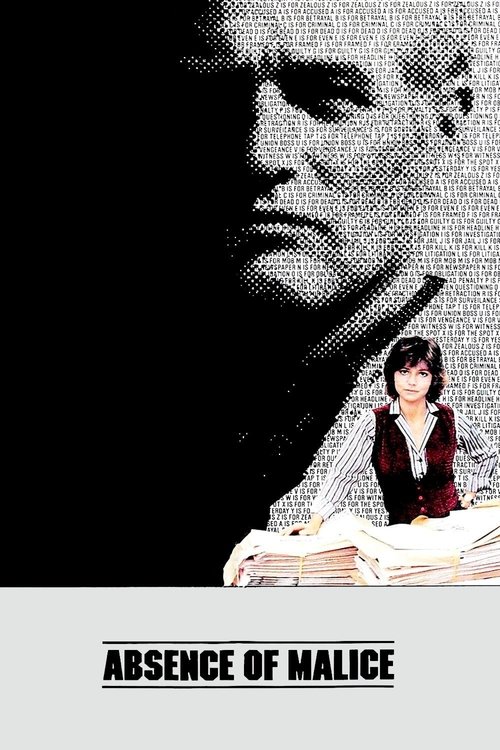
Absence of Malice
1981 · Sydney Pollack
When you want something serious and talky that respects your intelligence — a film to debate over dinner about ethics, journalism, and collateral damage. Challenge more than comfort, but a smooth, classical kind of challenge.
What it's about
A Miami newspaper reporter, Megan Carter, is fed a leaked story implicating liquor wholesaler Michael Gallagher in the disappearance of a union official. The story is untrue — and Gallagher's alibi would clear him, but proving it means exposing an innocent person. As the fallout spreads, reporter and subject are pulled into an uneasy, charged relationship while the machinery of press and prosecution grinds on around them.
The experience
A grown-up, deliberately paced drama that works like a moral vise — quietly tightening until you realize how much damage 'accurate' reporting can do. It's absorbing rather than flashy, and it leaves you chewing on questions with no clean answers.
Performances
Paul Newman brings a coiled, wounded dignity to Gallagher — a man fighting a smear with patience and cunning — while Sally Field makes Megan's ambition and dawning guilt uncomfortably human rather than villainous.
The craft
Written by a former newspaper editor, so the newsroom detail rings true — how leaks work, how stories get lawyered, how 'legally safe' and 'fair' can be different things. Sydney Pollack directs in his polished, adult-drama mode: unshowy, actor-centered, letting the moral argument build scene by scene.
Why it matters
A key entry in Hollywood's post-Watergate reckoning with the press — the skeptical counterweight to the era's heroic-journalist stories — and it's still cited in journalism classrooms as a case study in what reporting can break.
Snapshot
Absence of Malice is a journalism procedural turned moral inquest: a Miami crime reporter, Megan Carter (Sally Field), is fed a leaked, unfounded story implicating liquor wholesaler Michael Gallagher (Paul Newman) in the disappearance of a union official, and the publication of that story sets off a chain of private and public ruin. Directed by Sydney Pollack at the height of his standing as Hollywood's preeminent maker of intelligent adult dramas, and written by former Detroit newspaper editor Kurt Luedtke from inside the trade, the film is less a thriller than an argument about the gap between what is legally permissible and what is ethically defensible. Its title is a legal term of art from American defamation law — the standard under which a public figure cannot recover damages absent proof of "actual malice" — and the picture's central irony is that everything done to destroy Gallagher and a vulnerable bystander is, technically, lawful. Released by Columbia Pictures, it earned three Academy Award nominations (Newman for Best Actor, Melinda Dillon for Best Supporting Actress, and Luedtke for Best Original Screenplay) and remains a touchstone for any discussion of how movies depict the press.
Industry & production
The film is a product of the early-1980s studio prestige system at a transitional moment, when the auteur energies of the 1970s were consolidating into a more controlled, star-driven mode of serious filmmaking. Pollack produced as well as directed, a degree of control he had earned through a decade of reliable, awards-courting hits, and the project carried the imprimatur of two of the era's most bankable leads. Casting Paul Newman as a man wrongly smeared was itself a piece of meaning: Newman's accumulated screen decency made the audience's certainty of Gallagher's innocence almost a given, freeing the film to concentrate on consequences rather than mystery. Sally Field, fresh from her Oscar for Norma Rae (1979), brought a comparable everywoman credibility to a character the script refuses to let off the hook.
The screenplay's origin is central to the film's authority. Kurt Luedtke had been executive editor of the Detroit Free Press before turning to screenwriting; Absence of Malice was his first produced script, and its newsroom detail — the lawyering of a story, the rationalizations of editors, the seductions and self-deceptions of access — carries the texture of lived experience rather than research. That insider knowledge is the film's strongest production asset and the reason it has been assigned and debated in journalism schools.
A note on timing the record supports only loosely: the film arrived in cinemas in late 1981, the same year the Washington Post returned a Pulitzer after Janet Cooke's "Jimmy's World" was exposed as fabricated. The coincidence sharpened the film's contemporary reception, but the screenplay long predated that scandal, and it would overstate the record to claim any direct influence between the two. The resonance was atmospheric, not causal.
Technology
Technologically the film is unremarkable by design, and that restraint is appropriate to its aims; it is a dialogue-and-performance picture, not a showcase for process. It was shot on 35mm color stock and finished for conventional theatrical release in the standard practices of its moment. The most period-specific "technology" on screen is the newspaper apparatus itself — the typewriters and early-1980s pressroom, the physical mechanics of getting a story into print — which the film treats as a working environment rather than as spectacle. Beyond that, the picture predates the digital tools that would later transform both newsrooms and cinematography, and there is little in the verifiable record to suggest it pursued any technical innovation; its ambitions lay elsewhere.
Technique
Cinematography
The cinematographer was Owen Roizman, among the most distinguished American directors of photography of the period, whose credits include The French Connection (1971), The Exorcist (1973), and Network (1976), and who would shoot Pollack's Tootsie the following year. Roizman's signature was a controlled naturalism — available-light realism disciplined by a classical sense of composition — and that sensibility suits a film built around faces reading documents, weighing words, and registering the dawning cost of their choices. The Miami settings give the photography warmth and a sense of place without tipping into travelogue; the visual emphasis stays on the human transactions in offices, newsrooms, and homes. Specific technical particulars of the shoot (lenses, stocks, lighting setups) are not well documented in the public record, and it would be invention to detail them; what is established is Roizman's reputation for restraint in service of story, which the film bears out.
Editing
The picture was cut by Sheldon Kahn, an editor closely associated with Pollack's work in this era. The editorial rhythm is patient and conversational, prioritizing the legibility of arguments and the build of consequence over momentum for its own sake. The film's most discussed structural feature — its climactic stretch — depends on editing that withholds and then reveals the shape of Gallagher's scheme, allowing the audience to reconstruct his counter-maneuver alongside the characters. The cutting serves comprehension, which is the correct instinct for a story whose suspense is procedural and ethical rather than physical.
Mise-en-scène / staging
Pollack stages the film as a series of rooms in which power is unevenly distributed: the prosecutor's office, the editor's glass-walled domain, the reporter's desk, Gallagher's modest home and warehouse. Much of the drama is two people at a table negotiating what each will reveal or conceal, and Pollack — an actor's director trained in the Actors Studio tradition — frames these encounters to keep the moral pressure visible in posture and proximity. The decisive emotional sequence, in which Gallagher's friend Teresa scrambles at dawn to retrieve newspapers from neighbors' lawns before they learn her secret, is a model of staging that lets physical action carry unbearable interior states.
Sound
The score is by Dave Grusin, a frequent Pollack collaborator (Three Days of the Condor, and later Tootsie and The Firm), working in his characteristic jazz-inflected idiom. The music is spare and cool, leaning on piano and small-ensemble textures rather than orchestral underlining, which keeps the film's temperature low and lets the dialogue dominate. This is consistent with the picture's overall sonic restraint: it trusts conversation and silence over emphasis.
Performance
Performance is the film's true medium. Newman plays Gallagher with banked anger and watchful intelligence, an innocent man who refuses victimhood and instead engineers his own redress — a performance that earned an Academy Award nomination. Field gives Megan Carter the brittle confidence of a professional who mistakes her job's permissions for license, and the role's refusal to redeem her cheaply is part of the film's integrity. The supporting work is exceptional: Melinda Dillon, as the devout, fragile Teresa Perrone, delivers the film's emotional catastrophe and was Oscar-nominated for it; Bob Balaban is chillingly bland as the federal prosecutor who treats people as instruments; and Wilford Brimley, in a single late scene as a no-nonsense assistant attorney general convening the guilty parties, walks off with the picture in one of the most celebrated supporting turns of the decade.
Narrative & dramatic mode
The film operates as a moral thriller in a realist register. Its engine is not "did he do it" — the audience knows early that Gallagher is innocent — but "what does the truth cost, and who pays." The dramatic mode is investigative and dialectical: scenes are structured as confrontations in which competing justifications are argued aloud, and the plot advances through disclosures, leaks, and the legal and ethical reasoning around them. The third act shifts into something like a revenge structure, but a cerebral one: Gallagher's retaliation is an elaborate informational trap rather than violence, and the film's satisfaction lies in watching a wronged man use his adversaries' own appetites against them. The closing scene functions as a judgment, an authority figure arriving to ask each character, in effect, by what right they did what they did.
Genre & cycle
Absence of Malice belongs to the post-Watergate cycle of American journalism films, but it occupies a critical, even adversarial position within it. Where All the President's Men (1976) had celebrated reporting as a heroic public good, and The China Syndrome (1979) made the journalist a truth-teller against corporate power, Pollack and Luedtke turn the lens back on the press to interrogate its power to wound. The film thus sits alongside Network (1976) — another Roizman-shot picture skeptical of media — in the strain of the cycle that distrusts the institution. It is also a hybrid: a crime drama (the racketeering pretext, the mob inheritance), a romance (the compromised attraction between reporter and subject), and a courtroom-adjacent procedural about defamation law. The marketing-era genre tags of Drama, Romance, and Crime are accurate but undersell the film's primary identity as an ethics film.
Authorship & method
Sydney Pollack's authorship is one of tasteful command rather than visible signature. Across They Shoot Horses, Don't They? (1969), Jeremiah Johnson (1972), The Way We Were (1973), Three Days of the Condor (1975), and soon after Tootsie (1982) and Out of Africa (1985), Pollack specialized in the well-made, star-anchored adult drama that took ideas seriously without abandoning emotional accessibility. His Actors Studio background made him a director of performances first, and Absence of Malice is characteristic: it subordinates style to talk and behavior, and it organizes a genuine argument inside a satisfying mainstream shape.
The key collaborators reinforce that profile. Kurt Luedtke supplies the script's authority and its central legal-ethical conceit; he would reunite with Pollack to write Out of Africa. Owen Roizman provides disciplined, naturalistic images; Dave Grusin a cool jazz score; Sheldon Kahn an editorial rhythm tuned to comprehension. The method, in sum, is collaborative classicism — a director marshaling top craftspeople toward clarity and feeling rather than toward formal experiment.
Movement / national cinema
The film is a work of mainstream American studio cinema, not of any avant-garde or national movement. Its lineage is the socially engaged Hollywood problem picture, updated by the 1970s' new candor and disillusion. If it has a "movement" affiliation, it is to the strain of post-Vietnam, post-Watergate American filmmaking that turned to institutions — government, media, corporations — as subjects of moral scrutiny, made by directors who had absorbed European realism but worked within Hollywood's storytelling grammar.
Era / period
Absence of Malice is very much a film of the turn from the 1970s to the 1980s. It carries forward the prior decade's institutional skepticism while exhibiting the early 1980s' more polished, star-centered surface. The period's anxieties are legible throughout: the reach of federal prosecutorial power, the unaccountability of leaks, the ethics of a press emboldened by its own Watergate-era mythology and protected by a defamation regime that, after New York Times v. Sullivan, set a high bar for public-figure plaintiffs. The film essentially dramatizes the downside of that hard-won press freedom, asking what happens when the right to publish outruns the responsibility to be just.
Themes
The governing theme is the divergence of the legal from the moral — the way "absence of malice" can launder real harm. Around it cluster several others: the ethics of the leak and the danger of the reporter who becomes an instrument of a source's agenda; the violation of privacy, embodied unforgettably in Teresa, whose private decision is exposed for institutional convenience with fatal results; the corrosive intimacy between reporter and subject, in which professional access shades into personal compromise; and the inheritance of reputation, since Gallagher is presumed guilty largely because of his late father's mob ties. Finally, the film is about accountability — its absence among the powerful and the institutional, and the difficulty of imposing it, which is why the ending must import an outside authority to demand that everyone answer for what they did.
Reception, canon & influence
The film was received as a serious, well-acted adult drama and was recognized by the Academy with three nominations, for Newman, Dillon, and Luedtke's screenplay; Wilford Brimley's single scene became its most quoted moment. Critical response engaged the film primarily as an argument, and the debate it provoked was substantive: many in the journalism world objected that it stacked the deck against the press, presenting an implausibly reckless reporter and editor, while others praised its insistence that the power to publish carries real moral weight. That very contention is a measure of its seriousness; few films about the press have been argued over so much on the merits of their portrait.
Looking backward, the film draws on the post-Watergate journalism cycle it means to complicate — All the President's Men and Network are its essential interlocutors — and on Luedtke's firsthand newsroom experience as its documentary ballast. Pollack's own body of intelligent studio dramas is the other clear antecedent. Looking forward, Absence of Malice became a durable teaching text in journalism and media-ethics curricula, valued precisely because it dramatizes the difference between what a reporter may legally do and what she ought to do; the phrase and the case study have outlived the film's box-office moment. Its broader cinematic legacy is as a key counter-text within the media-movie tradition — the film most often cited when later pictures want to question, rather than celebrate, the press's power to define the truth. The precise figures of its commercial performance are not something I will assert here without a reliable source; what is securely established is its critical standing, its Oscar recognition, and its lasting pedagogical afterlife.
A Deleuzian reading
Dawn in a Miami suburb.
The full Deleuzian reading of Absence of Malice →
Reception
In 1981 it landed as a pointed counter-punch to the post-Watergate glow of All the President's Men, and working journalists bristled at its portrait of a reckless press; today it's settled in as the journalism-ethics teaching text — the film j-schools screen when they want students to squirm.
How Absence of Malice was received, from release to now →
Influences: the films it descends from and the films it influenced
- The Good Shepherd (2004) — Foregrounds the ethics of the recruited reporter and the damage done to a falsely implicated subject's reputation, dramatizing journalism as a moral hazard — the 'compromised-investigator' and reputation stakes the seed centers.
- Tootsie (1982) — Grusin's small-combo scoring — solo piano and electric keys used sparingly under professional-ethics dialogue rather than cueing the emotion — is the scoring discipline carried straight into Tootsie, with the Bergmans supplying the single lyric placement.
- All the President's Men (1976) — The template Pollack inverts: it builds suspense from the methodical procedure of reporting itself, and Absence of Malice borrows its comprehension-paced editing of fact-gathering while reversing the moral polarity to indict rather than valorize the reporter.
- Network (1976) — Chayefsky's model of building a media-ethics film as a sustained dialectical argument carried by talk, which Luedtke's screenplay adopts in its set-piece confrontations about what the press may legally versus morally do.
- Three Days of the Condor (1975) — Pollack and cinematographer Owen Roizman's own prior collaboration establishing the naturalistic, available-light paranoia thriller built on two-character verbal duels that Absence of Malice refines into newsroom and prosecutor confrontations.
- The French Connection (1971) — Roizman's grainy, documentary available-light cinematography pioneered here becomes his disciplined house style, supplying Absence of Malice its unglamorous, observational urban naturalism.
- Sweet Smell of Success (1957) — The original counter-text on press power as moral menace, staged through restaurant-and-table dialectical sparring, whose cynical anatomy of how a columnist manufactures truth Pollack's film updates for the post-Watergate era.
- Ace in the Hole (1951) — Wilder's portrait of the recklessly destructive reporter who weaponizes publication establishes the ethical indictment Absence of Malice revives — journalism as harm rather than heroism.
- They Shoot Horses, Don't They? (1969) — Pollack's early demonstration of Actors Studio direction in which physical behavior carries interior states rather than dialogue, the performance method he applies to Newman's contained fury.
- On the Waterfront (1954) — The foundational Actors Studio text for performance as banked, behaviorally-channeled emotion, the lineage of Method direction Pollack inherited and deploys with Newman and Brimley.
- The Hustler (1961) — Establishes Newman's signature register of charismatic, simmering anger held just beneath the surface — the precise 'banked anger' Pollack mines for the wronged businessman.
- 12 Angry Men (1957) — The model of dramatizing a legal-moral argument almost entirely through confined two- and three-person confrontations at a table, the staging grammar Absence of Malice uses for its ethical reckonings.
- The Verdict (1982) — A direct sibling released months later: Newman again channeling banked anger into a legal-versus-moral drama built on hushed two-handers and naturalistic available-light realism.
- Out of Africa (1985) — The Pollack–Luedtke reunion, extending the same authorial method of subordinating style to literate screenplay and star performance within a well-made studio shape.
Similar films
- The Verdict (1982) — influence & lineage
- All the President's Men (1976) — influence & lineage
- The Insider (1999) — influence & lineage
- Spotlight (2015) — influence & lineage
- On the Waterfront (1954) — influence & lineage
- 12 Angry Men (1957) — influence & lineage
- The Hustler (1961) — influence & lineage
- Crimes and Misdemeanors (1989) — shared sensibility