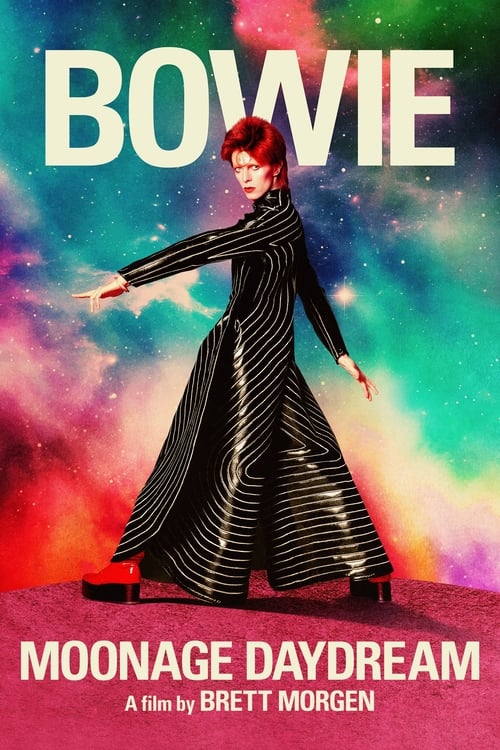
Moonage Daydream
2022 · Brett Morgen
For when you want to turn the lights off, turn the volume up, and be transported — a sensory trip rather than an information session. Perfect for fans, but really for anyone craving a film that feels like a concert crossed with a fever dream.
What it's about
David Bowie's life and art, told entirely in Bowie's own voice and image: no narrator, no talking heads, no dates on screen. Built from the estate's archive — unseen concert footage, decades of interviews, his paintings, his film roles, and borrowed fragments of science fiction and silent cinema — it follows his creative and spiritual restlessness rather than the beats of a biography, with his music remixed to fill a theater.
The experience
An immersive, sometimes overwhelming rush — closer to a planetarium show or a two-hour piece of music than a documentary. It washes over you in waves of sound and color, and Bowie's voice, musing on change, death, and making things, gives it a surprisingly meditative undertow.
Performances
Bowie himself is the show: decades of stage footage capture a performer of almost alien magnetism, and the interview reel reveals how funny, searching, and self-aware he was off stage.
The craft
Brett Morgen spent years alone in the archive cutting this like a piece of music, and the sound design is the star — the songs are remixed for big rooms and genuinely demand the loudest speakers or best headphones you have. The collage editing, folding Bowie's influences and images into his own, is virtuosic.
Why it matters
The first film made with the Bowie estate's blessing, it pushed the music documentary decisively away from the talking-head formula and toward pure sensory portraiture — a template the genre has been chasing since.
Snapshot
Moonage Daydream is a feature-length collage assembled almost entirely from the David Bowie archive, and it is the first film about Bowie made with the cooperation of his estate. It has no narrator, no talking heads, no on-screen dates or captions, and no biographical spine. The only voice that explains anything is Bowie's own, harvested from four decades of television interviews and edited into something closer to an essayistic monologue than an oral history. Around that voice, director Brett Morgen builds a two-hour-and-fifteen-minute sensory rush: concert footage, film clips, Bowie's paintings, animation, appropriated science fiction and silent cinema, and a soundtrack of Bowie recordings remixed for a large-format theatrical space.
The film's ambition is explicitly not documentary in the informational sense. Morgen has described the project as an experiential or immersive work — an attempt to reproduce the feeling of encountering Bowie rather than the facts of his career. What results is a film that will frustrate anyone looking for a life of the artist and reward anyone willing to accept a portrait organized by theme, texture, and philosophy instead of chronology.
Industry & production
The film exists because of a rights position that had never previously been granted. Bowie died in January 2016; the estate, administered with the involvement of his longtime business manager Bill Zysblat, subsequently opened the archive to Morgen — reportedly a collection numbering in the millions of individual assets, including unreleased concert masters, home movies, studio material, artwork, journals, and television appearances. Morgen has said in interviews that he spent roughly two years simply cataloging and digitizing before he began cutting, and that the edit and sound work consumed several years after that. The project was announced years before delivery and was repeatedly delayed.
Production was interrupted by a severe medical event: Morgen suffered a heart attack during the making of the film and has spoken publicly about the recovery period and its effect on the film's preoccupation with mortality and the use of one's time. That biographical fact is unusually load-bearing here — Morgen has framed the finished film's argument about how to live as partly his own.
Financing and production partners included Morgen's own production entity, Live Nation Productions, and BMG, with HBO Documentary Films attached for the eventual streaming window. NEON distributed in the United States; Universal handled international territories. The film premiered at the Cannes Film Festival in May 2022 outside the main competition and opened theatrically in September 2022 with a deliberately front-loaded IMAX engagement before rolling into conventional theatrical release and then to HBO Max.
The commercial logic is worth naming: this is an event-cinema play in a period when documentaries are otherwise streaming products. The IMAX exclusive, the Atmos mix, and the marketing emphasis on scale were all arguments that a music documentary could justify a ticket. That strategy arrived alongside a broader repositioning of the Bowie catalog as an asset — the estate sold Bowie's songwriting catalog to Warner Chappell Music in January 2022, and the film's theatrical run functioned, whatever its artistic intentions, within that same period of catalog activation.
Technology
The technical problem the film sets itself is heterogeneity. The source material spans 16mm and 35mm film, 2-inch quad and later analog videotape, broadcast masters of varying provenance, consumer formats, and digital video — much of it degraded, some of it never intended for projection at any size. Restoration and grading work had to bring these into a single perceptual register without flattening their differences into a uniform gloss; the film often preserves video artifacts, scan lines, and generational softness as expressive texture rather than concealing them.
The IMAX presentation compounds the problem: material shot for a 4:3 television broadcast in 1974 is being blown up to a screen where every flaw is enormous. Morgen's solution is largely aesthetic rather than corrective — degraded footage is framed, composited, multiplied, and abstracted so that its coarseness reads as intentional. Aspect ratios shift openly throughout, and the film moves between full-frame archival windows, letterboxed film clips, and edge-to-edge large-format imagery.
On the audio side, the film was built for Dolby Atmos, and the music was substantially reworked from source multitracks rather than licensed as flat stereo masters. Tony Visconti — Bowie's most important record producer across the Berlin albums and again on Blackstar — contributed to the music preparation, and the film's concert sequences are frequently new mixes rather than archival audio. This is the single technological decision that most defines the film's reception: the difference between hearing a 1973 Ziggy performance as a bootleg-grade document and hearing it as a spatialized, full-range concert event.
Technique
Cinematography
There is no cinematographer in the conventional sense; the film's images were photographed by dozens of people across fifty years, most of them uncredited television crews. The cinematographic authorship is therefore curatorial and post-photographic. Morgen treats found frames as raw material to be re-photographed digitally — reframing, slowing, mirroring, tinting, layering, and running images through kaleidoscopic and prismatic effects. Bowie's face is repeatedly multiplied and split, an obvious but effective visual argument about a self that refuses to be single.
Some of the most striking passages come from the film's citation of other films: D.A. Pennebaker's document of the 1973 Hammersmith "retirement" show, Alan Yentob's 1975 BBC portrait Cracked Actor, Nicolas Roeg's The Man Who Fell to Earth, Nagisa Ōshima's Merry Christmas, Mr. Lawrence, Tony Scott's The Hunger, Jim Henson's Labyrinth. Alongside these, Morgen splices in classic science fiction and German Expressionist cinema — the imagery of Metropolis and Weimar-era horror recurs — positioning Bowie inside a visual lineage rather than merely illustrating him.
Editing
Morgen cut the film himself, which is the central authorship fact. The editing is the film's argument. It is organized not by year but by concept, and it moves at a rate that makes conventional documentary comprehension impossible — dozens of images can pass under a single sentence of Bowie's voice. Cuts are frequently on musical accent rather than sense, and Morgen will hold a single long take of Bowie speaking for a minute and then dissolve into a two-minute barrage with no verbal anchor at all.
The macro-structure is roughly a movement from fragmentation toward integration: the early sections are the most chaotic, tracking the Ziggy and Diamond Dogs personae and the Los Angeles crisis; the middle finds Berlin and a partial recovery of self; the later sections move through the Let's Dance mass-audience period, its creative disillusion, and finally a settled late adulthood organized around work, marriage to Iman, and an accommodation with mortality. Chronology exists, but only as an undertow. Notably, the film mostly declines biography's obligations: family, business disputes, and the specific circumstances of Bowie's death are largely absent.
Mise-en-scène / staging
The staged elements are archival — Bowie's own stagings. The film is unusually attentive to them as design: the Kansai Yamamoto costumes and the kabuki-derived quick changes of the Ziggy tours, the totalitarian-modernist proscenium of the Diamond Dogs tour, the stark white-light austerity of the Station to Station period, the Serious Moonlight arena spectacle. Morgen also gives significant screen time to Bowie's paintings and drawings, treating them not as trivia but as evidence of a single sensibility working across media, alongside his stage work in The Elephant Man.
Sound
Sound is arguably the film's primary medium. Music is not scored under images; images are frequently cut to a soundtrack already constructed. Beyond the remixed songs, Morgen builds dense sound-design beds — layered voices, room tone, tape hiss, reversed and pitched material — so that Bowie's speaking voice sometimes floats in an ambiguous acoustic space rather than in the room where the interview occurred. Interview audio from figures including Dick Cavett, Russell Harty, and British television interviewers of the 1970s and 1980s is often retained while the questioner is cut away, leaving Bowie apparently addressing the audience directly.
Performance
The performance under examination is Bowie's, in two registers. There is the stage performer — the film is at its most conventionally thrilling in extended concert passages — and there is the interview performer, which is where the film's real interest lies. Morgen selects moments where Bowie is visibly constructing a self in real time: the composed provocateur of the early seventies, the visibly unwell figure of the mid-seventies American interviews, the guarded charm of the eighties, the relaxed and funny man of the nineties and after. The cumulative effect is a portrait of someone for whom performance was not a mask over an authentic self but the method by which a self was made.
Narrative & dramatic mode
The film is an essay film wearing the clothes of a rock documentary. It has no plot and refuses the standard music-documentary arc of rise, fall, and redemption — or rather, it gestures at that arc and then declines to dramatize its incidents. Instead the organizing structure is philosophical: Bowie's recorded thinking about identity, transience, fear, work, chaos, and meaning is arranged into something like a sustained argument, and the images function as illustration, contradiction, or overwhelm.
The dramatic mode is closest to the lyric — accumulation rather than causation. Its risk, which critics identified immediately, is that a film with no exposition and no counter-voice can only advance the subject's self-understanding. There is no one in Moonage Daydream to disagree with Bowie about Bowie.
Genre & cycle
Formally the film sits inside the archive-only documentary cycle that Asif Kapadia's Senna (2010) and Amy (2015) made commercially viable — no talking-head interviews, subject's own voice as narration, contemporaneous footage only. It belongs equally to the wave of estate-authorized music films that followed the streaming boom and the catalog-acquisition boom: Peter Jackson's The Beatles: Get Back (2021), Questlove's Summer of Soul (2021), and the parallel wave of musical biopics led by Bohemian Rhapsody (2018) and Rocketman (2019).
Against that biopic wave, Moonage Daydream is pointedly the opposite gesture. Where the biopic converts a life into three acts and a hit-parade soundtrack, Morgen refuses actors, refuses reenactment, and refuses narrative closure. It also stands in implicit relation to the two prior Bowie-adjacent fictions: Todd Haynes's Velvet Goldmine (1998), which had to fictionalize because it could not obtain rights, and Stardust (2020), made without the estate's music. Moonage Daydream is what access buys.
Authorship & method
Brett Morgen has spent his career on the archive-as-medium. The Kid Stays in the Picture (2002, co-directed with Nanette Burstein) built a film almost entirely from still photographs and a producer's voice. Chicago 10 (2007) animated trial transcripts. Crossfire Hurricane (2012) applied the archive-plus-voices method to the Rolling Stones. Cobain: Montage of Heck (2015), made with the cooperation of Kurt Cobain's family, drew on journals, tapes, and drawings and used animation to render private material. Jane (2017) reassembled unseen National Geographic footage of Jane Goodall into a new film, with a Philip Glass score.
Moonage Daydream is the extreme case of the method. Morgen is credited as director, writer, producer, and editor, and the concentration of those roles in one person is the reason the film has the coherence — and the singularity of viewpoint — that it does. He worked with a small core team over several years rather than a large post-production apparatus, and the editorial and sound-design decisions are effectively continuous with one another.
The most significant collaborator is Tony Visconti, whose involvement with the music gives the film a legitimacy that no restoration house could supply: the person who shaped the sound of Low, "Heroes", and Blackstar also shaped how those recordings arrive in a theater. The film has no composer in the usual sense — Bowie's own catalog, recombined, does the scoring — and no screenwriter beyond Morgen's construction of the voice track. Detailed public documentation of the wider technical crew is thinner than for a comparable fiction feature, and I would rather flag that than assign credits I cannot verify.
Movement / national cinema
The film is a US–UK production about a British artist whose career was structurally transnational: London art-school culture and British music hall, American soul and Philadelphia R&B, Weimar Berlin, Japanese theatrical design, and the international art market. Morgen's citation practice mirrors this — the film's visual quotations reach into German Expressionism, mid-century science fiction, and Ōshima's cinema, positioning Bowie less as a British pop figure than as a node in a European and Japanese modernist inheritance. It belongs to no national documentary movement; if anything it is closest in spirit to the essay-film tradition running from Chris Marker through contemporary found-footage practice, transposed into a commercial music-film frame.
Era / period
Moonage Daydream is a 2020s film in several specific ways. It is a post-pandemic theatrical event, betting that spectacle and scale could pull audiences back into cinemas for non-fiction. It is a product of the catalog economy, arriving as legacy music rights changed hands at unprecedented valuations and as estates learned that authorized documentaries are both revenue and brand maintenance. And it is a product of the mature streaming era, in which HBO Max is the film's real long-term home and the IMAX run is a promotional prologue.
It is also a film made in the shadow of Bowie's death, six years after the fact, at a moment when Blackstar had already reframed his entire career as an artwork with a designed ending. The film's refusal to dramatize that death reads as a deliberate resistance to the memorial mode.
Themes
The central theme is change as a discipline rather than a symptom — Bowie's recurring insistence that stability is a trap and that reinvention is the only honest response to time. Adjacent to it runs the theme of the constructed self: personae not as concealment but as the mechanism of becoming.
Underneath both sits mortality. The film returns constantly to time running out, to work as the only durable meaning, to the question of what one is doing with a finite life — a preoccupation shaped by Bowie's own late statements and, plausibly, by Morgen's illness. The film also tracks isolation and its resolution: the fragmented, chemically damaged figure of the mid-seventies gradually gives way to an artist who describes finding stability in love and in sustained labor, and the marriage to Iman is treated as a genuine turning point rather than a footnote.
Secondary strands include spirituality as restless search rather than arrival (Buddhism, Nietzsche, Gnostic imagery all pass through), the artist's relationship to a mass audience and the creative cost of the Let's Dance period's success, and the city — London, Los Angeles, Berlin, New York — as a determinant of what an artist can make.
Reception, canon & influence
Critical reception was strong and broadly enthusiastic, particularly regarding the film's sensory construction and the quality of the concert material; reviewers repeatedly reached for words like immersive, kaleidoscopic, and overwhelming. The dissenting line was consistent and substantive: that the film's refusal of context, chronology, and any voice but Bowie's produces a hagiography, and that two-plus hours of maximalist montage becomes exhausting and occasionally shapeless. Both readings are defensible, and they identify the same formal choice from opposite sides. The film's awards profile was respectable rather than dominant — it circulated through the documentary awards season without becoming its front-runner, and it competed strongly in music-film categories.
The backward influences are traceable and layered. Structurally, the film descends from Kapadia's archive-only method and from Morgen's own earlier work, particularly Jane. Its music-film ancestors are Pennebaker's Ziggy document and Yentob's Cracked Actor, both of which it quotes. Its aesthetic ancestors are further afield: the found-footage and collage traditions, the psychedelic light-show and expanded-cinema practices of the sixties, and the specific visual repertoire of Expressionist and early science-fiction cinema that Bowie himself drew from. There is a nice circularity in this — the film borrows Bowie's own sources to explain him.
Forward influence is genuinely unsettled at this distance, and it would be premature to claim a lineage. What can be said is that Moonage Daydream demonstrated two things to the industry: that an estate-authorized archive film can be positioned as large-format event cinema rather than as a streaming release, and that a music documentary can jettison biography entirely and still find an audience. Subsequent estate-backed and concert-scale music films have leaned on the same theatrical-event logic. Whether the film's more radical proposition — the non-narrative, voice-of-the-subject essay film as a commercial form — becomes a template or remains a one-off tied to a uniquely articulate subject and a uniquely obsessive director is not yet answerable.
A Deleuzian reading
A man is talking in the back of a car.
The full Deleuzian reading of Moonage Daydream →
Reception
Landed at Cannes 2022 as an instant event — the first film sanctioned by Bowie's estate — and was praised as a sensory overload best experienced in IMAX, though a vocal minority found it exhausting. Just a few years on it's already settled in as the 'right' Bowie film, the anti-biopic people point to whenever a lazy jukebox biopic drops.
How Moonage Daydream was received, from release to now →
How to watch Moonage Daydream: what to notice on a first viewing
- Notice you never hear anyone ask Bowie a question. Morgen keeps decades of interview audio but cuts away every interviewer, so each answer plays like a thought Bowie is sharing with you directly. The film turns journalism into a monologue, and you are the one being addressed.
- Watch Bowie's face get mirrored, split, and multiplied on screen. Morgen repeatedly reframes and layers archival footage through kaleidoscopic and prismatic effects, so a single face becomes several at once. The technique argues visually that there was never one fixed Bowie to capture, only versions.
- Notice there are no captions, dates, or on screen titles. The film gives you no chronology markers at all; you have to place each section by costume, hairstyle, or the texture of the footage instead. Understanding here comes from watching closely, not from being told what year it is.
- Watch how often the costume changes mid performance. The Yamamoto designs and kabuki-style quick changes let Bowie swap an entire body of stage identity in seconds, sometimes within a single song. Changing costume this fast turns reinvention itself into the show, not just a wardrobe choice.
- Listen for how thick and layered the sound design gets. Beneath the music, Morgen builds beds of overlapping voices, tape hiss, and reversed sound, so Bowie's speaking voice sometimes floats outside any real room. Sound stops just recording a moment and starts building the feeling of one instead.
The whole guide to watching Moonage Daydream, with the keys for a rewatch →
Influences: the films it descends from and the films it influenced
- Ziggy Stardust and the Spiders from Mars (1979) — Pennebaker's handheld multi-camera 16mm coverage of the 1973 Hammersmith retirement show is the literal source stock of Moonage Daydream's central concert passages, and Morgen re-cuts that direct-cinema footage against Visconti's new multitrack remix rather than its original sync track, breaking the one-camera-one-take contract Pennebaker built it on.
- Cracked Actor (1975) — Supplies the limousine and Los Angeles interview material that Morgen strips of Yentob's questions entirely, converting a BBC Omnibus Q&A into unprompted first-person monologue — the film's interviewer-erased voice track is built by surgically excising this film's off-camera author.
- The Man Who Fell to Earth (1976) — Roeg's associative cutting — matching on gesture, color and sound across nonadjacent time rather than on story causality — is the editorial grammar Morgen scales to feature length, and he splices Roeg's fiction footage into the archive stream so Newton reads as documentary evidence of Bowie.
- The Kid Stays in the Picture (2002) — Morgen's own prototype for the single-voice construction: no interviewer, no counter-testimony, the subject narrating his self-mythology while still photographs are separated into planes and pushed through in 2.5D — the same refusal to let anyone contradict the subject.
- Cobain: Montage of Heck (2015) — Establishes Morgen's method of building narration from a subject's private audio cassettes and animating his notebooks and drawings, so the interiority is rendered in the subject's own materials rather than described by witnesses.
- Jane (2017) — The direct structural parent: unseen mute 16mm rolls reassembled with no sync sound and hung on a continuous Philip Glass score, proving out the architecture where music is the spine and image is cut to the composition's accents — Bowie's catalog simply replaces the commissioned score.
- Senna (2010) — Kapadia's archive-only rule — every frame from period material, every interview relegated to disembodied audio, no present-day talking head ever seen — is the formal permission Moonage Daydream takes to its extreme, and it likewise sustains present tense by never cutting to retrospective commentary.
- Amy (2015) — Demonstrates the music-doc application of the archive-only method: the artist's recordings carry the emotional argument, and lyrics are surfaced as graphic text so songwriting functions as testimony rather than soundtrack.
- Koyaanisqatsi (1982) — Non-narrative image-music montage in which cut points are dictated by musical phrase and accent rather than by narrative beat, with rephotography and speed manipulation used as the primary rhetorical device — the same accent-cutting logic drives Morgen's set pieces.
- Scorpio Rising (1963) — Originates the pop-record-as-cutting-grammar: found and staged footage edited to commercial singles so the song's structure, not a scene's, governs duration and juxtaposition — the underground root of both Bowie's promo-video vocabulary and Morgen's montage.
- A Movie (1958) — The founding argument that authorship can consist purely of selection and juxtaposition of other people's footage, with meaning generated at the splice — the collage tradition Morgen is working in when he cuts a Bowie interview against unrelated stock and expects the collision to read as thought.
- Metropolis (1927) — Quoted directly on screen; its Expressionist machine-city and Maschinenmensch iconography were Bowie's own borrowed source for Ziggy's design, so Morgen recycles the star's raw material as visual exposition instead of explaining the influence verbally.
- One to One: John & Yoko (2024) — Takes the Moonage template wholesale — no narrator, no interviewees, a thematic rather than biographical spine, and concert masters newly remixed by the estate (Sean Lennon) for an immersive large-format release.
- Becoming Led Zeppelin (2025) — Estate-authorized archive-only band film with no outside commentators, built on restored and re-synced performance elements and released as an IMAX event — the commercial proof of the exhibition logic Moonage Daydream established for archive music docs.
- The Beatles: Get Back (2021) — The technical counterpart: Jackson's machine-learning de-mixing of mono tapes into isolated stems is the same premise as Visconti's stem-level rebuild of Bowie's masters — restoration treated as a creative remix that lets archive sound arrive in a modern theatrical mix.
- Meet Me in the Bathroom (2022) — Contemporaneous archive-only music film that keeps every interview off camera and cuts period video and DV to the songs, adopting the no-talking-heads rule for a scene rather than a single artist.
- Nothing Compares (2022) — Builds its present-day narration entirely from newly recorded audio of the subject laid over period footage, so the artist is heard but never seen aging — the same device of keeping the archive image in eternal present tense while the voice comments from now.
Similar films
- The Man Who Fell to Earth (1976) — influence & lineage
- 2001: A Space Odyssey (1968) — influence & lineage
- Resurrection (2025) — shared sensibility
- Blue (1993) — shared sensibility
- Birdman or (The Unexpected Virtue of Ignorance) (2014) — shared sensibility
- Pink Floyd: The Wall (1982) — shared sensibility
- Thirty Two Short Films About Glenn Gould (1993) — shared sensibility
- Interstella 5555: The 5tory of the 5ecret 5tar 5ystem (2003) — shared sensibility