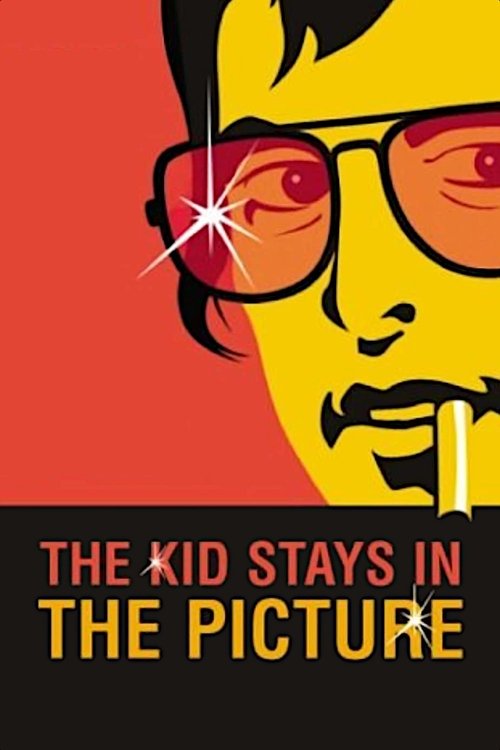
The Kid Stays in the Picture
2002 · Brett Morgen
For a night when you want pure charisma and great Hollywood gossip — an easy, delicious watch that doubles as a crash course in how movies actually get made. Comfort viewing for anyone who loves the movies about the movies.
What it's about
A documentary portrait of Robert Evans, the impossibly handsome actor who talked his way into running Paramount Pictures during its early-1970s golden age, then rode fame all the way down. It's his rise, fall, and comeback told in his own inimitable rasp, adapted from his notorious memoir.
The experience
Fast, funny, and outrageously entertaining — like being cornered at a party by the best storyteller alive, who may or may not be telling the truth. Part of the pleasure is knowing the legend is polishing his own statue while you watch.
The craft
Brett Morgen animates still photographs into layered, drifting tableaux, giving a talking-head-free film real visual swagger, all stitched to Evans's gravel-and-velvet narration. The voice is the score; it's worth hearing on decent speakers just for the delivery.
Why it matters
Its photo-animation style was widely imitated across documentaries afterward, and the film revived Evans as a pop-culture figure — the self-mythologizing mogul as showbiz folk hero.
Snapshot
The Kid Stays in the Picture is a documentary portrait of Robert Evans — the actor-turned-mogul who ran production at Paramount Pictures during its early-1970s renaissance — told almost entirely in Evans's own gravel-and-velvet voice, adapted from his 1994 memoir of the same name. The film takes its title from the moment that, in Evans's telling, saved his acting career: shooting The Sun Also Rises (1957), the cast and Ernest Hemingway lobbied to have the inexperienced Evans replaced, and studio chief Darryl F. Zanuck overruled them with the verdict "The kid stays in the picture." That anecdote sets the template for the whole film — self-mythology delivered with such relish that the question of its accuracy becomes part of the entertainment. The opening narration lays the cards on the table: "There are three sides to every story: my side, your side, and the truth. And no one is lying." Directed by Brett Morgen with Nanette Burstein as co-director, the film is a landmark of first-person archival documentary, and it is remembered above all for a visual technique — animating still photographs into shallow, breathing dioramas — that became widely imitated.
(Note: the dossier prompt credits Morgen alone, but the historical record is clear that Burstein co-directed; this account treats it as their joint film while recognizing Morgen as the dominant authorial voice in its style.)
Industry & production
The film sits at an interesting industrial intersection: a documentary about the studio system made well outside it, by independent documentarians, yet steeped in Hollywood glamour and produced with Hollywood patronage. Its source is Evans's memoir The Kid Stays in the Picture (1994) and, crucially, the audiobook Evans recorded of it — a performance so distinctive that it effectively pre-wrote the film's soundtrack. Morgen and Burstein had come to attention with On the Ropes (1999), a vérité boxing documentary that earned an Academy Award nomination; The Kid was a radical departure from that observational mode toward something stylized and constructed.
Among the producers was Graydon Carter, then editor of Vanity Fair, whose involvement reflects the magazine-world fascination with old Hollywood that the film both serves and gratifies. The production premiered at the Sundance Film Festival in 2002 and was released theatrically in the United States by USA Films / Focus Features (the distributor was in transition during this period as USA Films folded into Focus). It became a notable specialty-box-office and critical success; I won't cite specific grosses, as I can't verify them precisely. What matters industrially is that the film demonstrated a low-budget documentary could be built largely from licensed photographs, film clips, and a single narrating voice — and still feel cinematic. That economic proposition, as much as the aesthetic one, is part of its legacy.
Technology
The defining technological gambit is the photo-animation system the filmmakers used to bring still images to life — often described as a "2.5-D" or multiplane approach. Photographs were cut into separate planes (foreground figure, midground, background), and the camera moved through and across them so that a static image acquired parallax, depth, and a sense of inhabited space. The technique descends conceptually from the Disney multiplane camera and from the rostrum-camera "Ken Burns effect" of pan-and-scan over stills, but pushes much further: figures appear to stand out from their settings, smoke and light seem to drift, and the viewer glides past Evans's life as if walking through a series of dimensional tableaux. This was achieved through digital compositing tools then maturing in the early 2000s, which made frame-by-frame layering and motion-tracking of scanned photographs economically feasible for an independent production. I'm not able to verify the specific software or the name of the animation house with confidence, so I'll describe the method rather than attribute it. The other relevant technology is simply archival sourcing — the marshaling of personal snapshots, studio publicity stills, home movies, news footage, and film clips, cleared and conformed into a single timeline.
Technique
Cinematography
There is, in the conventional sense, very little original photography in the film; its visual grammar is curatorial and compositing-driven rather than lensed. The "cinematography" lives in how the camera (real or virtual) moves over and into found images: slow pushes that isolate Evans's face from a crowd, lateral drifts that reveal a photograph's deep space, rack-focus effects simulated across flat planes. The few present-tract images — notably of Evans's Beverly Hills estate, Woodland — are shot with a burnished, nostalgic warmth that matches the gloss of the archival material. The overall look is high-contrast, saturated, and lush, deliberately echoing the glamour photography of mid-century Hollywood rather than the cooler palette of conventional documentary.
Editing
Editing is where the film truly lives, because it is fundamentally an act of construction: a memoir's prose, an audio performance, and a vast image bank welded into a propulsive narrative. The cutting is musical and rhythmic, timed to the cadences of Evans's voice and to the period needle-drops and score. It compresses decades into brisk movements and knows exactly when to slow down for a set piece — the discovery at the Beverly Hills Hotel pool, the making of The Godfather, the unraveling of the Cotton Club years. The edit also performs the film's central rhetorical trick: it makes Evans's subjective account feel like documented history by binding his voice so tightly to images that the images seem to corroborate him. I'm not able to confirm the editor's name with certainty, so I won't attribute the cut to an individual.
Mise-en-scène / staging
Because the raw material is found, "staging" here means the orchestration of the image-planes and the design of transitions — the choreography of how one dimensional tableau dissolves into the next. The filmmakers stage Evans's memories almost theatrically, framing him as the lone protagonist isolated against backdrops of power: studio boardrooms, premieres, the bungalows of the powerful. The recurring motif of Evans's voice played over images of his empty house gives the film a melancholy framing device — the great showman alone in the ruins of his stage.
Sound
Sound is arguably the film's true authorial center, because the entire picture is keyed to Robert Evans's narration. His delivery — confidential, theatrical, bruised, self-amused — supplies the through-line, the humor, and the pathos. The soundtrack layers this voice over a mix of period popular music and an original score that leans into lush, cinematic emotionality appropriate to the Hollywood subject. (The score is generally credited to Jeff Danna; I flag this as my best recollection rather than a verified certainty.) Sound design also does subtle dimensional work — ambient textures that lend the animated photographs the suggestion of a living environment.
Performance
The film's only "performance" in the dramatic sense is Evans's, and it is total. He is sole narrator, protagonist, and unreliable witness, and the film's effect depends entirely on the charisma of his voice and the persona it projects. It is a self-performance — Evans playing "Robert Evans," the role he spent a lifetime perfecting — and the documentary is wise enough to foreground that theatricality rather than pretend to neutral biography.
Narrative & dramatic mode
Structurally the film is a classical rise-and-fall, told in the confessional first person: the lucky discovery, the improbable ascent to studio chief, the golden run of hits, the great romance with Ali MacGraw and her loss to Steve McQueen, the cocaine bust, the catastrophe of The Cotton Club and its entanglement with the Roy Radin murder case, the years in the wilderness, and a coda of survival. The dramatic mode is autobiographical legend — closer to a raconteur's after-dinner monologue than to investigative documentary. The film is candid about its own subjectivity, which is both its ethical hedge and its artistic premise: it does not claim to adjudicate the truth of Evans's claims, only to render his version with maximum vividness.
Genre & cycle
It belongs to the biographical documentary, and more specifically to a cycle of stylized, archive-driven, first-person nonfiction films that flourished in the early 2000s as digital post-production made elaborate manipulation of found material affordable. Within Hollywood-on-Hollywood storytelling, it joins a long tradition of the industry mythologizing its own golden ages, but it inverts the usual third-person documentary authority by surrendering the microphone entirely to its subject. It is also, unmistakably, a comeback narrative — a genre Evans himself authored in print before the film extended it to the screen.
Authorship & method
The film is the product of two directors with a documentary background — Brett Morgen and Nanette Burstein, fresh from On the Ropes — but it reads most strongly as the origin point of Morgen's distinctive method: build a nonfiction film as an immersive, subjective experience driven by the subject's own voice and archive, with aggressive stylization rather than talking-head sobriety. Morgen would refine this approach across Chicago 10 (2007), Cobain: Montage of Heck (2015), Jane (2017), and Moonage Daydream (2022), each pushing further into animation, collage, and first-person immersion. Burstein went on to direct American Teen (2008) and other documentaries with her own observational sensibility. The decisive creative collaborator beyond the directors is Robert Evans himself, whose memoir and audiobook performance are the film's script and lead performance in one. The producers — Graydon Carter among them — supplied the cultural patronage and access. As noted, I cannot reliably name the editor or confirm the composer, and I won't invent those credits.
Movement / national cinema
This is an American film about the most American of subjects — Hollywood itself — and it participates in no formal movement. Its closest affiliations are aesthetic rather than national: the early-2000s American independent documentary scene centered on festivals like Sundance, and the broader turn within nonfiction cinema away from pure observation toward designed, expressive, archive-based filmmaking. If it has a lineage, it is the tradition of the essayistic, constructed documentary rather than the vérité school from which its own directors had emerged.
Era / period
The film is doubly period-bound. As an artifact, it is an early-2000s documentary made possible by maturing digital compositing. As a subject, it is steeped in the New Hollywood of roughly 1966–1980 — the era when Paramount, under Evans's production leadership, released Rosemary's Baby (1968), Love Story (1970), The Godfather (1972), and Chinatown (1974), among others. The film is thus a primary cultural document of how that period chose to remember itself, filtered through one of its central and most self-dramatizing participants. It treats the studio's revival as inseparable from Evans's personal saga — a framing that flatters its subject and that historians of the period have rightly approached with caution.
Themes
Its abiding themes are self-invention and the manufacture of legend; the inseparability of image from identity in Hollywood; the seductions and costs of power; love as both triumph and wound (the MacGraw chapter); and survival as the ultimate Hollywood virtue. Running beneath all of these is the theme of truth and its unreliability — the film's opening epigraph about three sides to every story is a thesis statement, not a throwaway. The picture is finally about storytelling itself: about a man who understood that controlling the narrative was the only durable form of power, and a film that demonstrates the same lesson by letting him tell it.
Reception, canon & influence
Critically, the film was warmly received on its 2002 release, widely praised for Evans's irresistible narration and for the inventiveness of its photo-animation; it became one of the more talked-about documentaries of its year and a specialty-market success. (I'm avoiding specific scores or grosses I can't verify.) The film's backward influences are legible: the Hollywood self-portrait tradition; the rostrum-camera animation of stills associated with Ken Burns; the conceptual depth of the multiplane camera; and, most directly, Evans's own memoir and audiobook, without which the film could not exist in this form. Its forward influence has been substantial and specific. The "2.5-D" animated-photograph technique it popularized became a documentary and advertising staple in the years that followed — so ubiquitous that it now reads as a period signature of mid-2000s nonfiction. More broadly, the film helped legitimize the stylized, subjective, archive-driven documentary as a serious mode, and it launched Brett Morgen's career-long project of immersive first-person nonfiction, traceable straight through to Moonage Daydream. Within the canon it endures both as a uniquely entertaining portrait of New Hollywood from the inside and as a sly meditation on the documentary's own relationship to truth — a film that lets its subject spin his myth so completely that the spinning becomes the subject.
A Deleuzian reading
Start with a photograph that won't hold still.
The full Deleuzian reading of The Kid Stays in the Picture →
Reception
A critical hit out of Sundance 2002, praised for turning still photographs into swaggering cinema; it's since settled in as a foundational text of the stylized modern documentary and the definitive artifact of Robert Evans worship.
How The Kid Stays in the Picture was received, from release to now →
Influences: the films it descends from and the films it influenced
- The Civil War (1990) — Establishes the rostrum-camera pan-and-zoom across still photographs (the 'Ken Burns effect') that Morgen inherits and then thickens into layered 2.5-D parallax.
- Snow White and the Seven Dwarfs (1937) — Disney's multiplane camera, stacking separated artwork planes to manufacture parallax depth, is the conceptual blueprint for cutting Evans's photos into foreground/background layers a virtual camera can dolly through.
- Sunset Boulevard (1950) — Pioneers the Hollywood-insider first-person voiceover narrating his own downfall as glamorous self-mythology — the dead man telling his story that prefigures Evans spinning his rise and fall.
- Citizen Kane (1941) — The rise-and-fall portrait of a self-inventing mogul assembled from contradictory testimony, where the myth resists the documentary's attempt to fix the truth.
- F for Fake (1973) — The essay-documentary that foregrounds its narrator as a charming fabricator, deliberately collapsing the line between record and con so that unreliability itself becomes the subject.
- A Personal Journey with Martin Scorsese Through American Movies (1995) — Models the subjective, insider-authored film history in which an industry voice narrates the canon from within rather than via neutral exposition.
- Tarnation (2003) — Extends the stylized, archive-driven first-person documentary into a fully subjective collage of personal media scored to needle-drops, treating the self as the only narrating authority.
- Chicago 10 (2007) — Morgen pushes his own collage method further by animating archival trial transcripts via motion-capture, reanimating documentary record as performance.
- American Teen (2008) — The co-director carries the stylization forward, embedding animated fantasy sequences inside observational documentary to externalize subjective interior states.
- Senna (2010) — Builds a feature biography purely from archival montage with no present-day talking heads, immersing the viewer in a first-person mythic arc Morgen helped legitimize.
- Stories We Tell (2012) — Stages its own unreliable narration, letting competing tellers spin a family myth so that the act of mythologizing — not the facts — becomes the film's true subject.
- Crossfire Hurricane (2012) — Morgen reapplies the subject's-own-voice archive immersion to the Rolling Stones, narration-led with no on-camera interviews and aggressive period stylization.
- Amy (2015) — Assembled almost entirely from archive with the subject's own recorded voice as narration, rejecting talking-head sobriety for inside-the-myth immersion.
- Listen to Me Marlon (2015) — Constructed wholly on Brando's own audiotapes as posthumous first-person narration and self-performance — the subject scripting and starring in his own portrait, exactly as Evans's audiobook does here.
- Cobain: Montage of Heck (2015) — Morgen refines the method into animated journals and home-recording collage, a fully immersive subjective archive built around the subject's voice.
- Moonage Daydream (2022) — The culmination of Morgen's career-long project begun here: first-person, archive-driven nonfiction as overwhelming sensory immersion narrated by the subject himself.
- Won't You Be My Neighbor? (2018) — Pioneers the archive-only first-person portrait, animating a subject's own photographs and materials into a self-mythologizing narrative — the assembly-as-authorship approach Neville's editors adopt.
- My Mom Jayne (2025) — Star-authored Hollywood memoir that animates still photographs and studio ephemera into moving evidence carried by a single first-person voice — the archival-restoration, voice-driven form.
- Goodfellas (1990) — Propulsive first-person voiceover laid over wall-to-wall period needle-drops to drive a seductive rise-and-fall arc that lets the teller glamorize his own corruption.
- Waltz with Bashir (2008) — Animated documentary that visualizes the unreliability of first-person recollection, dramatizing memory as a reconstructed, possibly false image rather than recorded fact.
- The Devil and Daniel Johnston (2006) — First-person, subject-narrated life story constructed from personal archive and photographs, foregrounding the subject-as-author of his own mythologized account.
Similar films
- Moonage Daydream (2022) — influence & lineage
- Citizen Kane (1941) — influence & lineage
- F for Fake (1973) — influence & lineage
- Edvard Munch (1974) — shared sensibility
- Thirty Two Short Films About Glenn Gould (1993) — shared sensibility
- The Player (1992) — shared sensibility
- Elvis (2022) — shared sensibility
- Catch Me If You Can (2002) — shared sensibility