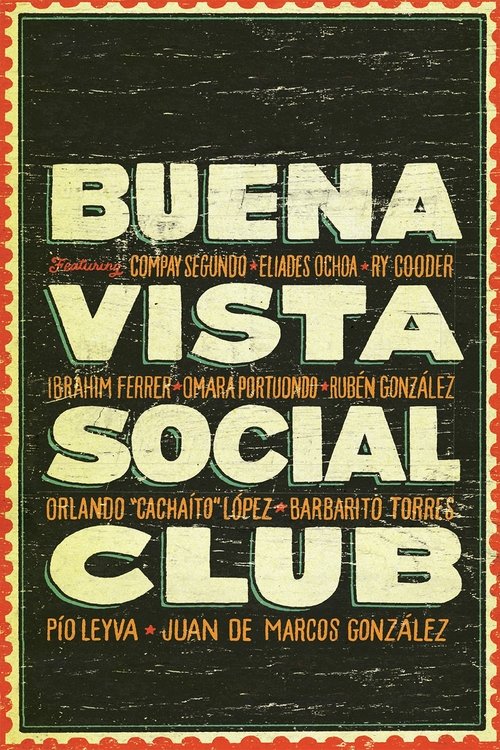
Buena Vista Social Club
1999 · Wim Wenders
For an evening when you want to feel good without turning your brain off — music, sunlight, and people who earned their late-life triumph. Pure comfort, best with the volume up.
What it's about
American guitarist Ry Cooder travels to Havana to record with a circle of legendary Cuban musicians, some of them in their nineties, whose careers had faded decades earlier. Wim Wenders follows them from crumbling studios and sun-bleached streets to sold-out stages in Amsterdam and, finally, Carnegie Hall. It's the story of an album becoming a phenomenon, and of old masters getting one more turn in the light.
The experience
Warm, unhurried, and quietly euphoric — the music does most of the talking, and the faces do the rest. You drift between weathered Havana streets and rapturous concert halls, and by the end the joy is contagious.
The craft
Wenders keeps his method simple — portrait, place, performance — letting interviews in kitchens and doorways flow into full songs rather than snippets. The roving camera soaks up Havana's decayed color, and the concert footage rewards good speakers; this is a film you listen to as much as watch.
Why it matters
One of the most commercially successful documentaries ever made, it carried a Grammy-winning album and a whole genre of Cuban son into global circulation and earned an Oscar nomination along the way.
Snapshot
A German director follows an American guitarist to Havana, and the result is one of the most commercially successful documentaries ever made — a film that carried an album, a genre, and a group of elderly Cuban musicians into global circulation almost simultaneously. Buena Vista Social Club documents the aftermath of Ry Cooder's 1996 recording sessions at Havana's EGREM studios, sessions that produced the World Circuit album of the same name, and follows Cooder's 1998 return to the city to record Ibrahim Ferrer's solo album while Wenders' small crew filmed the musicians in their homes, on their streets, and in performance at Amsterdam's Carré theater and New York's Carnegie Hall.
The film's method is deceptively simple: portrait, place, performance. Wenders alternates informal interviews — Compay Segundo revisiting his birthplace in Siboney, Ibrahim Ferrer in his Havana apartment, Rubén González at a rehearsal piano surrounded by young ballet students — with concert footage shot on the two European and American dates. There is no narration, no historical explainer, no argument about Cuban politics beyond what the musicians themselves offer, and almost no on-camera presence from Wenders. Cooder appears frequently, driving through Havana on a motorbike with his son Joachim, functioning less as a subject than as the film's connective tissue.
What makes the film significant is not formal innovation — its techniques are largely those of observational music documentary going back decades — but the way it converted an existing commercial phenomenon into a self-amplifying cultural event. The album had already sold strongly before the film's release; the film then multiplied that reach enormously and made the phrase "Buena Vista Social Club" shorthand for a mode of world-music discovery that the next two decades would alternately imitate and interrogate. It received an Academy Award nomination for Best Documentary Feature in 2000 (it did not win) and became, for a generation of viewers, the default image of Cuban music.
Industry & production
The production sits at an unusual intersection of German public television funding, British independent record-label money, and American musical celebrity. Wenders' own company Road Movies Filmproduktion (Berlin) produced in association with Kintop Pictures and with backing from German broadcasters — the film's financing profile is typical of the European auteur-documentary infrastructure of the 1990s, where television pre-sales made small-crew international shooting feasible. Nick Gold's World Circuit label, which had commissioned and released the 1997 album, supplied the underlying access; Cooder's involvement was the door through which Wenders entered.
The chronology matters. Cooder had traveled to Havana in March 1996 for a World Circuit project originally conceived as a collaboration between Cuban and West African musicians. When the Malian participants failed to obtain travel documents, Gold and Cooder improvised, working with Cuban bandleader Juan de Marcos González — who had already been assembling veteran players for the Afro-Cuban All Stars — to gather a cast of largely retired soneros, trovadores, and pianists. The album was recorded in roughly six days. It won a Grammy in 1998 and became one of the best-selling records in the history of the world-music category; precise cumulative sales figures reported over the years vary widely and should be treated with caution.
Wenders, a longtime friend of Cooder's — Cooder had scored Paris, Texas (1984) and contributed to The End of Violence (1997) — was invited to film the follow-up sessions. Shooting took place in 1998 across Havana, Amsterdam, and New York. The Amsterdam concerts at the Carré preceded the Carnegie Hall date, which the film treats as its climax and terminus.
The distribution story is central to the film's meaning. Artisan Entertainment handled the U.S. release; the film performed exceptionally for a documentary in a period when non-fiction features rarely reached wide arthouse circulation, and it played for extended runs in many markets. Its box-office success is routinely cited as a milestone in the late-1990s documentary revival that also included Hoop Dreams (1994) and would soon include Bowling for Columbine (2002) and March of the Penguins (2005). The film also functioned as marketing infrastructure for an ongoing recording and touring enterprise — a circularity that later critics would scrutinize.
The Cuban political context conditioned everything. The U.S. embargo made the Carnegie Hall appearance a logistical and symbolic event; visas for Cuban artists were, and remained, contingent. The film registers this only glancingly — the musicians' wonder at New York is filmed as wonder, not as commentary — but the absence is itself a production fact worth naming.
Technology
Buena Vista Social Club is one of the more consequential early demonstrations of digital video's viability for theatrical documentary. Wenders shot primarily on digital video — the production used consumer and prosumer-grade DV cameras alongside a professional digital format — and the footage was transferred for 35mm theatrical projection. This was 1998–99, at the very front edge of DV's adoption: the Dogme 95 films were arriving simultaneously, and Wenders, who had a long-standing interest in video's textures going back to Notebook on Cities and Clothes (1989) and the video experiments inside Until the End of the World (1991), was among the established auteurs most willing to test the format.
The choice was practical before it was aesthetic. Small cameras allowed a two- or three-person crew to work inside cramped Havana apartments, follow musicians through streets without a permit-scale apparatus, and shoot concerts from multiple positions without a broadcast truck. Low light tolerance mattered: much of the Havana material is available-light interior work that would have required substantial lighting on film stock.
The aesthetic consequences are visible and were much discussed at the time. The blow-up to 35mm produced smeared highlights, visible compression artifacts in high-contrast exteriors, and a characteristic softness in the concert material. Some critics read this as degradation; Wenders and his collaborators treated it as consonant with the film's subject — a texture of weathered surfaces, peeling paint, and time-worn faces. Whether that rhyme is genuinely earned or a retroactive justification is a fair question, and one worth holding open.
The audio side was the opposite: state-of-the-art multitrack recording, since the concert and studio material was being captured for commercial release in parallel. The gap between the film's rough image and its pristine sound is one of its defining technical signatures.
Technique
Cinematography
Wenders shared camera duties with Jörg Widmer and Robby Müller — the latter Wenders' most important collaborator across Alice in the Cities (1974), Kings of the Road (1976), The American Friend (1977), and Paris, Texas. Müller's contribution here is not the composed, deep-shadowed widescreen of the fiction features but something looser: handheld, responsive, willing to drift.
The Havana material is built on movement — long lateral tracking shots along the Malecón, the camera mounted on a moving vehicle, buildings sliding past in a continuous frieze. This is recognizably the visual grammar of the road movie, Wenders' native form, applied to a city rather than a highway. Interiors are shot in available light, often with the musicians framed frontally, close, at rest.
The concert cinematography is more conventional: multiple cameras, shallow-focus isolation of individual players, frequent close work on hands — González's fingers on the keyboard, Barbarito Torres' laúd, Cachaíto López's bass. The film's most quoted image, a slow track past decaying colonial facades with music continuing underneath, does exactly what such images do in tourist promotion, and the film's defenders and detractors have argued about it ever since.
Editing
Brian Johnson cut the film. The structure is associative rather than chronological or argumentative: Havana portraiture and concert footage interleave, with a musician's spoken recollection frequently bridging into a performance of the song being discussed, or a song's ending dissolving into the street where its performer lives. There is no timeline, no dated captions, no reconstruction of the Buena Vista Social Club as a historical institution beyond what Segundo and others describe in passing.
The film's cumulative shape is a slow gathering — individual portraits accumulating toward the collective ensemble on the Carnegie Hall stage. This gives the last twenty minutes their emotional force: the audience has met these people singly and now sees them together, applauded. It is a well-made structure, and also a conventionally redemptive one, and the film does not complicate it.
Mise-en-scène / staging
Little is staged in the conventional sense, but a great deal is arranged. The interviews are placed with care — Segundo in Siboney, Ferrer at his home altar to Saint Lazarus, González at a piano in a hall where young dancers rehearse. These settings do work the film declines to do in words: they establish continuity between the musicians and a living Cuban present, and they render each subject inside a chosen frame of biography and faith.
The Havana of the film is a Havana of textures — ruined masonry, laundry, 1950s American cars, harbor light. Critics have noted, correctly, that this is a highly selective Havana, one in which the state, work, and contemporary Cuban life outside the musical past appear only at the margins.
Sound
Sound is the film's strongest technical dimension and its true organizing principle. The music is recorded to studio and live-concert standards and mixed with clarity that far exceeds the image's resolution. Crucially, the film treats music as continuous rather than illustrative: songs frequently begin over one scene and carry across a cut into another, so that the score of the film is the film's subject performing itself.
Diegetic sound is used sparingly but effectively — street noise, the piano heard through a doorway. Dialogue is Spanish, subtitled, with Cooder's English commentary interspersed. The decision to let the songs run at or near full length in the concert sequences, rather than trimming them to montage duration, is significant: it treats the performance as the event, not as material for a sequence.
Performance
The subjects perform in two registers, and the film's warmth comes from the distance between them. Onstage, these are consummate professionals — Ferrer's phrasing, Omara Portuondo's control, Segundo's showmanship at ninety. Offstage, they are conversational, funny, sometimes evasive. Segundo's account of his cigars and his romantic history is a practiced routine; Ferrer's humility reads as unpracticed. Portuondo's duet with Ferrer on "Silencio," in which she weeps and he wipes her tears, is the film's most-cited moment and one of the rare instances where the camera catches something the performers plainly did not plan.
Cooder's on-camera presence is deliberately modest — reverent, deferential, careful never to claim authorship of the music. Whether the film's larger architecture honors that modesty is a separate question.
Narrative & dramatic mode
The film operates in what Bill Nichols would classify as a hybrid of the observational and participatory modes: the crew is present, Cooder mediates, but there is no voice-of-God narration and no argumentative thesis. Its dramatic shape is nonetheless conventional — a rediscovery-and-recognition arc that runs from obscurity (musicians retired, forgotten, working other jobs) through revival (the recordings) to consecration (Carnegie Hall). This is the shape of a fairy tale, and the film knows it; the ovation at the end is filmed as an apotheosis.
What the film does not do is contextualize. There is no account of why these musicians fell out of circulation — no discussion of the Revolution's cultural policy, the shifting fortunes of pre-1959 popular forms, the Special Period's economic devastation, or the internal Cuban music scene that had continued without pause. Cuban critics and musicologists have raised this pointedly: the film's premise of "rediscovery" is legible from outside Cuba and considerably less so from within, where several of these musicians were not unknown. The absence is structural, not incidental — the redemptive arc requires the prior obscurity.
Genre & cycle
The film belongs to the concert-and-portrait documentary lineage: Don't Look Back (1967), Monterey Pop (1968), Woodstock (1970), The Last Waltz (1978), Stop Making Sense (1984). It is closest in spirit to The Last Waltz — an elegiac framing of veteran musicians, a director with a strong fiction pedigree, performance treated as culmination — but without Scorsese's formal precision or its valedictory finality.
It also belongs to a specifically late-1990s cycle: the world-music documentary as discovery narrative, in which a Western intermediary opens a door onto a musical tradition. Its enormous success established the template that subsequent films worked within or against.
Authorship & method
Wenders' authorship here is real but recessive, and understanding it requires knowing what he had been doing. By 1999 he had spent two decades making films about looking, listening, and the ethics of the recording apparatus. Lightning Over Water (1980), his film about the dying Nicholas Ray, had confronted the question of whether the camera exploits; Tokyo-Ga (1985) and Notebook on Cities and Clothes were explicitly essayistic investigations of image-making. Buena Vista Social Club is the least self-interrogating of these — the reflexivity that marks his earlier documentaries is largely set aside in favor of transparency.
Robby Müller's presence connects the film to Wenders' fiction canon, though the collaboration here is different in kind: not composed images but responsive ones. Jörg Widmer, a Steadicam operator who worked across Wenders' later career, shares the credit.
Ry Cooder occupies a role without a clean title. He is not the director, not the interviewer in any formal sense, and not the composer — the music is the musicians'. He is the producer of the recordings, the reason for the access, and the film's implicit point of view. His curatorial history — decades of collaboration across Tex-Mex, Hawaiian, Indian, and West African traditions, from Chicken Skin Music (1976) through A Meeting by the River (1993) with V.M. Bhatt — is the practice the film documents without examining. Nick Gold and Juan de Marcos González, whose curatorial work was arguably as decisive as Cooder's, appear far less prominently, and the film's weighting of credit has been a durable criticism.
Editor Brian Johnson's structural work — the interleaving that lets biography and performance illuminate each other — is the least visible and among the most consequential authorial contributions.
Movement / national cinema
Wenders is a founding figure of the New German Cinema alongside Fassbinder, Herzog, Schlöndorff, and Kluge, and the movement's preoccupations persist here in mutated form: the outsider's journey, American cultural presence as both attraction and problem, the fascination with a place seen from outside. Herzog's ethnographic-adjacent documentaries are the nearest comparison within the movement, though Herzog's authorial intrusion is everything Wenders here declines.
The film is not Cuban cinema, and this matters. Cuba's ICAIC had produced a formidable documentary tradition — Santiago Álvarez's agitational montage films, Sara Gómez's De cierta manera (1974/77), Tomás Gutiérrez Alea's fiction work — engaged with exactly the social textures Wenders leaves at the edge of frame. Buena Vista Social Club is a film about Cuba made from outside by a director with no prior relationship to the country, and its representation of Havana as a beautiful ruin has been criticized within Cuban and Latin American film scholarship for participating in what is often termed "ruin porn" or nostalgia tourism. That criticism can be overstated — the film's affection is genuine and its musicians are given real space to speak — but the structural point stands.
Era / period
1999 is a hinge year on several axes. Digital video was arriving; the documentary was re-entering theatrical circulation; "world music" as a commercial category was at its commercial peak and about to face sustained critique from ethnomusicologists and postcolonial scholars over its flattening of distinct traditions into a marketing bin.
Politically, the film sits inside the Special Period's long aftermath — the economic catastrophe following the Soviet collapse, during which Cuba opened to tourism as a survival strategy. The film's Havana is that Havana, and the tourist economy it participated in expanded measurably in its wake. The Elián González affair broke months after the film's release; U.S.–Cuba relations would remain frozen for another fifteen years before the 2014–15 thaw and its subsequent reversal.
Themes
Time and lateness. The film's deepest subject is old age still capable of virtuosity. Its most affecting proposition is that mastery survives obscurity — that Rubén González, who had reportedly not owned a piano for years, could sit down and play as he does.
Memory as performance. The songs are the son, bolero, and danzón repertoire of the 1930s–50s; performing them is an act of preservation, and the film treats each performance as simultaneously present-tense and historical.
The intermediary. The film is inescapably about mediation — the American who brings the tape machine, the German who brings the camera, the label that brings the distribution. It declines to interrogate this, which is why so much subsequent criticism has done so on its behalf.
Ruin and endurance. Havana's decayed architecture is used as visual rhyme for the musicians' age, then inverted: the buildings are crumbling, the men are not.
Recognition. The Carnegie Hall ending is about being seen — and the film is honest enough to show that the recognition comes from a foreign audience.
Reception, canon & influence
Contemporary reception was broadly enthusiastic. Critics praised the performances, the intimacy of the portraits, and the emotional generosity of the concert material, and the Academy Award nomination for Best Documentary Feature confirmed its institutional standing. Reservations clustered around the same points: the thinness of historical and political context, the picturesque treatment of Havana, and the prominence given to Cooder relative to the Cuban musicians and organizers. These were minority notes at the time and have grown steadily louder since.
Influences on the film run backward through Wenders' own documentary practice — the portrait-of-an-artist mode of Lightning Over Water and Notebook on Cities and Clothes — and through the concert-film tradition, with The Last Waltz the clearest reference point. Cooder's decades of cross-cultural collaboration supply the film's underlying method: the studio as meeting place.
The forward legacy is substantial and double-edged. Commercially, the film is a landmark in the late-1990s documentary revival, and its performance helped persuade distributors that non-fiction could carry theatrical runs. Culturally, it drove enormous global interest in Cuban traditional music, launched or relaunched international careers — Ibrahim Ferrer, Omara Portuondo, and Rubén González all recorded and toured extensively afterward — and materially reshaped Havana's tourist economy. Several of the principal figures died within the following decade, giving the film a documentary value nobody planned: it is now the primary moving-image record of these performers.
Formally, it helped normalize DV as a theatrical documentary format at precisely the moment that decision was being made across the industry.
Critically, it became a case study. In ethnomusicology, postcolonial media studies, and Latin American cultural criticism, Buena Vista Social Club is regularly cited as the exemplary text of the "world music discovery" narrative and its problems: the Western mediator as author, the local tradition as found object, the erasure of the receiving culture's own account of itself. Later music documentaries have worked visibly in its shadow, some replicating the template, others — including films made by musicians and filmmakers from within the traditions being documented — defining themselves against it.
Wenders returned to the material with Buena Vista Social Club: Adiós (2017), directed by Lucy Walker with Wenders as executive producer, which revisits the surviving members and addresses some of the historical context the original omitted — an implicit acknowledgment of the first film's gaps. The 1999 film's standing today is thus genuinely bifurcated: an enduringly beloved and much-watched work, and a standing reference in the argument about who gets to narrate whose music.
A Deleuzian reading
An old man sits down at a rehearsal piano in Havana and starts to play, and the young ballet students in the room keep working.
The full Deleuzian reading of Buena Vista Social Club →
Reception
A word-of-mouth phenomenon in 1999 — an Oscar-nominated doc that turned a hit album into a global event — it's since been gently reappraised, with critics and Cuban scholars questioning the Western-nostalgia lens even as affection for the musicians themselves has only deepened.
How Buena Vista Social Club was received, from release to now →
How to watch Buena Vista Social Club: what to notice on a first viewing
- Watch the long, lateral shots along the Malecón from a moving car. Müller and Widmer shoot buildings sliding past in a continuous frieze, the same road-movie grammar Wenders has used for decades, now aimed at a city. The decayed walls and colonnades read like layers of time you can look at, not just background.
- Watch the musicians' hands, not just their faces, in every performance scene. The concert cameras isolate hands, González's fingers, Torres' laúd, López's bass, holding on the physical mastery a lifetime of practice built. These bodies are not performing a task. Their ease and their years of practice are the whole point.
- Listen for a song that keeps playing after its scene has ended. Songs begin over one scene and carry across the cut into the next, so the music never stops to let a scene end cleanly. The music becomes the film's real structure, not just something added over the pictures.
- Notice where each interview happens: a birthplace, an altar, a rehearsal hall. Wenders places Segundo in Siboney, Ferrer at his altar to Saint Lazarus, González among young dancers, each setting chosen to frame a life. The settings do the work of biography the film never states in words.
- Track how a spoken recollection dissolves straight into the song it describes. Brian Johnson cuts by association, not chronology or argument, so talk about a song slides into the song itself, and its last note leads into a street. There is no timeline here. Biography and performance are made to explain each other instead.
The whole guide to watching Buena Vista Social Club, with the keys for a rewatch →
Influences: the films it descends from and the films it influenced
- Chronicle of a Summer (1961) — Established the observational-participatory hybrid Wenders adopts here — subjects prompted by an on-set interlocutor and interviewed while walking through settings of their own choosing, with the filmmakers' solicitation left audible inside the film rather than edited out.
- Dont Look Back (1967) — Codified the onstage/offstage register: handheld available-light access to musicians in hotel rooms and corridors intercut with performance, treating the unguarded backstage self as the real subject and the concert as its punctuation.
- Chulas Fronteras (1976) — The affectionate ethnographic music portrait — elder regional players filmed at home, at work, and at the table, with songs carried at full length and no narrator interposed to explain the tradition to outsiders.
- The Last Waltz (1978) — The direct structural model: complete, professionally multitracked live concert numbers alternated with sit-down conversation staged in a constructed space, with music bridging across the cuts between the two registers.
- Lightning Over Water (1980) — Wenders' own precedent for filming an aging artist near the end of his working life, building the ethical question of whether the recording apparatus exploits its subject into the shooting method itself.
- Paris, Texas (1984) — The same Müller/Cooder pairing — Robby Müller's available-light reading of sun-bleached paint, and Cooder's slide guitar functioning as landscape rather than underscore — transposed from Texas storefronts to Havana facades.
- Stop Making Sense (1984) — The cumulative ensemble build, performers added one at a time until the full band occupies the stage; Wenders relocates the device into the edit, introducing each musician's solo portrait before assembling them all for Carnegie Hall.
- Let's Get Lost (1988) — The elegiac late-career portrait of a musician whose face carries his history, shot with a stills photographer's attention to skin and light, and cut so that testimony and performance keep reinterpreting each other.
- Notebook on Cities and Clothes (1989) — Wenders' explicit embrace of handheld small-gauge electronic video cut against film stock, the argument that made the low-resolution image legitimate theatrical material and licensed the DV shoot a decade later.
- Latcho Drom (1993) — Music-as-structure with no commentary: performances staged in the performers' own streets and landscapes, carried whole, with the ordering of numbers doing all the narrative work an omitted narrator would otherwise do.
- Thelonious Monk: Straight, No Chaser (1988) — Films rehearsal and studio takes as the craft event itself — available-light digital video, numbers allowed to run whole, players' interruptions and count-offs left in rather than scored over.
- Standing in the Shadows of Motown (2002) — Reruns the template on uncredited elder session players: individual portraits and interviews shot at the sites of their old work, cumulatively assembled into a reunion concert that restores them to an audience.
- Throw Down Your Heart (2008) — The Cooder method made explicit — an American roots instrumentalist as producer-traveler recording in situ with local players, with the act of cross-cultural collaboration itself filmed as the film's central action.
- Pina (2011) — Wenders extends interview-in-chosen-setting to dance: performances carried complete and relocated into real Wuppertal locations while performers testify in voiceover, never speaking to camera.
- Searching for Sugar Man (2012) — Builds an entire feature on the rediscovery arc BVSC popularized — a vanished recording artist located and returned to a live audience — and likewise upscales degraded consumer formats for theatrical release.
- Buena Vista Social Club: Adiós (2017) — Direct continuation that reuses the original's interview-in-place and uninterrupted-performance grammar while restoring the pre-revolutionary and post-1959 history the 1999 film omitted, correcting the template from inside it.
- The Celebration (1998) — The other 1998–99 test case for consumer-grade DV originated handheld and blown up to 35mm for theatrical projection, normalizing visible video artifacting as an accepted texture on cinema screens.
- Genghis Blues (1999) — Arrives independently at the same world-music-discovery template in the same year — Western musician as mediator traveling to a remote tradition, the trip structured as rediscovery and resolved by a culminating live performance.
- Calle 54 (2000) — Applies the full-length-performance ethic to the same Afro-Cuban and Latin jazz repertory, giving each artist one uninterrupted number in a lit setting built for them and refusing montage compression entirely.
Similar films
- The Last Waltz (1978) — influence & lineage
- Inside Llewyn Davis (2013) — shared sensibility
- Until the End of the World (1991) — shared sensibility
- I Am Cuba (1964) — shared sensibility
- The Motorcycle Diaries (2004) — shared sensibility
- GoodFellas (1990) — shared sensibility
- Once (2007) — shared sensibility
- Perfect Days (2023) — shared sensibility