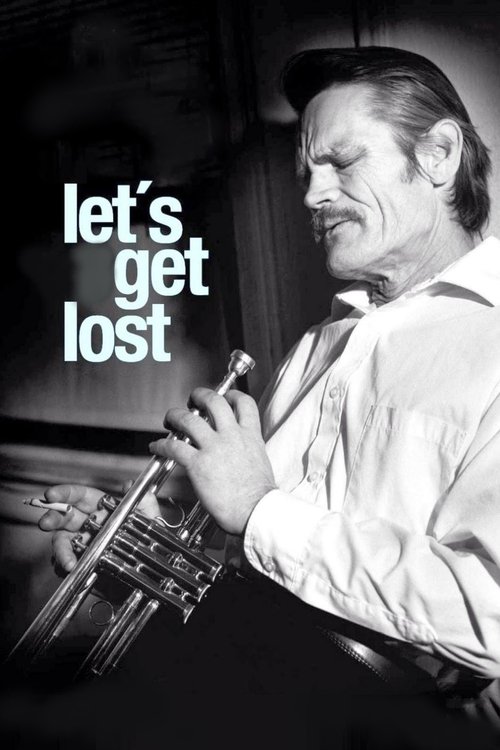
Let's Get Lost
1988 · Bruce Weber
For a late night alone with something beautiful and sad — when you want to be haunted rather than entertained. Not a pick-me-up; a slow, gorgeous ache.
What it's about
A portrait of jazz trumpeter and singer Chet Baker, filmed in the last months of his life. Fashion photographer Bruce Weber cuts between the ravishing young Baker of the 1950s — the beautiful face of West Coast Cool, in California and Italy — and the ruined, drifting man in his late fifties, while wives, lovers, children, and fellow musicians give testimony that flatly contradicts itself. Fame, addiction, and an unreliable charm hang over every frame.
The experience
Dreamy, seductive, and quietly devastating — it drifts like the music, all silvery black-and-white and late-night melancholy, and lets you fall for Baker even as it shows you exactly what falling for Baker cost everyone who did. It lingers for days.
Performances
Baker himself is the performance: detached, wrecked, still magnetic on camera, still capable of breaking your heart mid-song.
The craft
Weber shoots the aged Baker in luminous black-and-white that's as romantic as the archive footage of the young star, and the film's structure — circling, contradictory, refusing a tidy arc — is its boldest choice. The music alone earns good speakers.
Why it matters
One of the defining music documentaries, it helped establish the idea that a portrait film could interrogate its own infatuation with its subject rather than just celebrate him.
Snapshot
Let's Get Lost is fashion photographer Bruce Weber's feature-length documentary portrait of the jazz trumpeter and singer Chet Baker, made in the final months of Baker's life and released in the year he died. It is at once a biographical inquiry and an act of infatuation: Weber intercuts luminous new black-and-white footage of the ruined, sixtyish Baker with archival images of the young "James Dean of jazz," the beautiful West Coast Cool star of the 1950s. The film refuses the tidy arc of the standard music documentary. It circles its subject, gathers contradictory testimony from wives, lovers, children, and fellow musicians, and lets the discrepancies stand. The result is a meditation on beauty, memory, addiction, and the seductions of the myth-making camera — a film as interested in its own romance with Baker's face as in the facts of his life. It premiered at the Venice Film Festival in 1988 and was nominated for the Academy Award for Best Documentary Feature. Baker died in Amsterdam in May 1988, before the film reached wide release, which lends the whole enterprise the character of an unintended elegy.
Industry & production
The film was produced through Weber's own company, Little Bear Productions, with his longtime partner and creative collaborator Nan Bush among the producing team. This is essentially independent, auteur-financed nonfiction filmmaking, made outside the studio documentary apparatus and closer in spirit to the vanity-of-passion project — a commercially successful still photographer turning his resources and access toward a personal obsession. Let's Get Lost was Weber's first feature; he had directed the medium-length documentary Broken Noses (1987), about the young boxer Andy Minsker, immediately before it, and the two films share a producer's sensibility and a fascination with a single charismatic male body.
Production ran through 1987 and into 1988, following Baker across locations that included California, New York, and Europe; footage was captured at the Cannes Film Festival, where Baker performed, and in the recording studio during some of his last sessions. The shoot's economics were unusual for documentary: Weber could command professional crews, elaborate lighting, and staged set-ups more typical of a fashion campaign than of vérité reportage. That access came with an ethical charge that critics have noted — Weber was paying for, staging, and to some degree stage-managing scenes with a frail, drug-dependent subject. After a limited late-1980s life the film became difficult to see for years; a restoration returned it to theatrical and home-video circulation in the late 2000s, which is when much of its current critical reputation consolidated.
Technology
Let's Get Lost is built on the deliberate collision of two image technologies across time. The archival layer draws on 1950s materials — studio and publicity photography, television kinescope, and film clips, including footage from Baker's brush with the Italian cinema of around 1960 — carrying the grain, contrast, and framing conventions of mid-century media. Against this, Weber and cinematographer Jeff Preiss shot new material on black-and-white film, a pointed anachronism in a 1988 documentary landscape increasingly given over to color and, at the low end, to video. Choosing monochrome was a technological statement: it let the new footage rhyme visually with the old, so that a shot of the aged Baker could sit beside a 1954 glamour portrait without a jarring seam of color.
The soundtrack technology matters as much as the image. The film is scored almost entirely from Baker's own recordings across four decades, and it incorporates newly captured audio from late sessions, so that Baker's deteriorated late voice and trumpet play against his silken early ones. The accompanying soundtrack album extended the film's life as a music object in its own right.
Technique
Cinematography
Jeff Preiss's photography is the film's signature, and it is unabashedly a photographer's cinema. The new footage is high-contrast black and white, sculpted with the kind of directional light and reflective surfaces one associates with a Weber fashion sitting: convertibles, beaches, hotel rooms, and nightclubs rendered as glossy, nostalgic tableaux. Baker's face — the "beautiful face" of the young man and the "ruin" of the old, in the synopsis's terms — is the recurring compositional subject, framed in close-up and lingered over. Preiss would go on to direct his own jazz-adjacent feature, Low Down (2014), about the pianist Joe Albany, confirming how formative this material was to him. The camera's evident adoration is also the film's central tension: the same lighting that ennobles Baker also cosmeticizes him, prettifying a life of hard use.
Editing
Angelo Corrao's editing is where the film's argument lives. Rather than a chronological biography, the cutting is associative and juxtapositional, splicing past against present so that youth and decay comment on each other continuously. Testimony is assembled to expose contradiction: different witnesses give incompatible accounts of the same events, and the edit sets these side by side without adjudicating. Music is used as connective tissue and as counterpoint, a phrase of Baker's trumpet carrying across a cut from an old photograph to a present-day interview. At roughly two hours the film is long for its form, and it earns the length by accretion rather than plot, building a mosaic whose meaning is cumulative.
Mise-en-scène / staging
This is one of the most staged documentaries of its era, and openly so. Weber arranges scenes — Baker riding in a convertible surrounded by young admirers, beach and pool set-ups populated by beautiful people — that import the iconography of 1950s Southern California and of Weber's own commercial imagery. The mise-en-scène is a deliberate fabrication of nostalgia: the film is not merely recording Baker but restaging the fantasy of West Coast Cool around him. That artifice is both the film's aesthetic pleasure and, for its skeptics, its ethical problem, since the glamour surrounds a man visibly diminished.
Sound
The sound design foregrounds Baker's voice in two registers: the famously fragile, androgynous vocal instrument of his singing, and the halting, evasive speaking voice of the interviews, in which he is by turns charming and unreachable ("detached, indifferent"). Music and speech are woven so that Baker's art continually re-enters over the testimony of those he damaged, complicating our judgment. The interplay of the pristine early recordings with the rougher late ones is itself a dramatic device.
Performance
Though a documentary, the film is intensely concerned with performance — Baker's, and the performances of self offered by those around him. Baker performs charm, victimhood, and blankness, seemingly aware of and manipulating the camera's love for him. The interviewed women — the ex-wife, the companions named in the synopsis — and his children deliver testimony that is plainly shaped by decades of hurt, and the film treats their self-presentation as part of its subject. Weber's own presence, off-camera but pervasive, is a kind of performance too: the seductive interviewer courting an evasive muse.
Narrative & dramatic mode
The dominant mode is the essayistic, subjective portrait rather than the expository biography. There is no omniscient narrator marshaling facts; instead the film advances through interview, archival montage, and staged reverie, and its "plot" is the viewer's gradual disillusionment as the beautiful surface gives way to the wreckage beneath. The dramatic engine is contradiction — between the myth and the man, between competing witnesses, between the seductive images and the cruelty they encase. The impending fact of Baker's mortality, which the historical record supplied when he died before release, retroactively frames the whole as an elegy, but even within the film the sense of a life nearing its end is palpable.
Genre & cycle
Let's Get Lost sits within the jazz documentary and the music-portrait film, but it is a self-conscious outlier in that cycle. Against the reverent, canon-building jazz documentary — and in the same decade as more conventional celebrations of the music — Weber's film substitutes ambivalence, glamour, and doubt. It also belongs to a lineage of documentaries about self-destructive artists in which the filmmaker is implicated in the fascination. Within Weber's own small filmography it forms a pair with Broken Noses, extending his documentary cycle devoted to charismatic, physically striking men photographed with erotic tenderness.
Authorship & method
The controlling authorial vision is Weber's. He came to the film not from cinema but from fashion and portrait photography, and he imported that discipline's methods wholesale: the primacy of the face, the seductive lighting, the staged idyll, the fetishizing of male beauty. His method here is frankly partial — he does not pretend to neutrality, and the film is best understood as a portrait of Weber's desire for Baker as much as of Baker himself. That subjectivity is the film's originality and its most-debated feature.
The key collaborators translate that vision. Cinematographer Jeff Preiss realized the black-and-white photographic idiom that fuses new and archival material. Editor Angelo Corrao built the associative, contradiction-driven structure that keeps the film from collapsing into hagiography. Producer Nan Bush, Weber's long-term partner, anchored the production. The "composer," in effect, is Chet Baker himself: the score is his recorded music across his career, so that the subject supplies the film's emotional soundtrack from within. There is no conventional screenwriter; the film is authored in the shooting and the cutting. Where the documentary record on precise division of creative labor is thin, it is fair to say the film reads as a photographer's vision executed by a small, sympathetic team.
Movement / national cinema
As a work of American independent nonfiction, the film stands apart from any organized movement, but it can be located against two currents. First, the observational and vérité traditions that dominated postwar American documentary — which Let's Get Lost pointedly rejects in favor of staged, stylized artifice. Second, the crossover of fine-art and fashion photography into moving images in the 1980s, of which Weber is a leading example. The film's subject also invokes a specifically American musical geography — West Coast Cool, the California jazz scene — even as Baker's biography spills into Europe, and Italy in particular, giving the film a transatlantic reach beyond its national base.
Era / period
The film is doubly periodized. Its making belongs to the late 1980s, and it reflects that moment's appetite for reworked nostalgia and its emerging debates about documentary ethics and staging. But its imaginative home is the 1950s — the era of Baker's fame, of cool jazz, of the convertible-and-beach American idyll that Weber restages. The film's power comes from holding these periods in the same frame, using the 1980s vantage to mourn and interrogate the 1950s myth. The historical accident of Baker's 1988 death sealed the film as the terminus of his era.
Themes
Beauty and its decay is the governing theme: the film is organized around the ravaged face measured against the golden one, and asks what we owe, and forgive, the beautiful. Closely bound to it are addiction and self-destruction, treated without redemption and without full condemnation. Memory and unreliability form a second axis — the film is a study in how the same life is remembered irreconcilably by those who lived it. There is the theme of the seductive image itself: the movie is reflexive about the camera's complicity in myth-making, and about glamour as a moral anesthetic. Running beneath all of this is the erotics of looking — Weber's tender, desiring gaze at the male subject — and the cost of that romance to the women and children left in Baker's wake, whose testimony the film honors even as it remains bewitched by the man who wounded them.
Reception, canon & influence
Critically, Let's Get Lost was received as a striking and controversial arrival: widely admired for its ravishing images, its music, and its refusal of easy biography, and challenged for the ethics of its glamour — for aestheticizing a dying addict and for Weber's evident infatuation clouding his judgment of a man who caused real harm. That productive argument, between seduction and skepticism, has shadowed the film ever since and is central to its standing. Its festival premiere at Venice in 1988 and its Academy Award nomination for Best Documentary Feature established its immediate prestige. The specifics of any Venice prize I won't assert here, as I cannot verify the exact citation.
The influences on the film run backward into Weber's own photographic practice and into the iconography of 1950s American cool — the jazz-album cover, the studio glamour portrait, the myth of the doomed beautiful artist. Musically it draws entirely on Baker's recorded legacy, including his late recording of Elvis Costello's "Almost Blue," a song itself written under Baker's influence, closing a neat loop of homage.
Its legacy forward is twofold. Within music documentary, it became a touchstone for the subjective, image-driven, ethically self-aware portrait, standing against the reverent norm and licensing later filmmakers to make music films that are as much about the filmmaker's gaze as about the artist. It also cemented Baker's posthumous image, shaping how subsequent generations picture him and feeding the durable romance of his story. Cinematographer Jeff Preiss carried the film's jazz-portrait DNA into his own directorial work. And the film's own difficult availability followed by celebrated restoration made its late-2000s rediscovery a small case study in how documentaries are canonized after the fact — a film that, like its subject, was very nearly lost and then returned, more beautiful and more troubling than the myth remembered.
Reception
On release some critics knocked it as a fashion photographer's fetish object — too in love with Chet Baker's ruined beauty to interrogate it — but it picked up an Oscar nomination anyway, then spent years nearly impossible to see before a 2008 restoration and re-release cemented it as one of the great music documentaries.
How Let's Get Lost was received, from release to now →
Influences: the films it descends from and the films it influenced
- Jazz on a Summer's Day (1959) — A fashion and advertising stills photographer treating jazz musicians as glamour-lit photographic objects rather than performers to document — the photographer's-eye jazz film Weber inherits wholesale.
- Portrait of Jason (1967) — Feature-length portrait built entirely from a single self-mythologizing subject who performs, seduces, and contradicts himself on camera, making the confessional unreliable by design.
- Lightning Over Water (Nick's Movie) (1980) — Films a beautiful artist in visible physical decline and openly stages his last days, foregrounding the same ethics-of-aestheticizing-a-dying-man that shadows Weber's Baker.
- Grey Gardens (1975) — Subjects who perform faded glamour and staged nostalgia for a camera they are keenly aware of — the self-aware performance of decay Weber lets Baker enact.
- Chronicle of a Summer (1961) — Reflexive interview method in which subjects contradict, perform, and comment on being filmed, dismantling documentary 'truth' — the contradictory-testimony structure Corrao's cut exploits.
- Sans Soleil (1983) — Associative essay-montage of images and memory in place of chronological biography, letting juxtaposition rather than narration carry meaning.
- Buena Vista Social Club (1999) — Image-driven elegiac music portrait openly shaped by the filmmaker's romance with aging musicians, their own recorded playing supplying the emotional score from within.
- Chop Suey (2001) — Weber reworking his own fashion-photographer essay-portrait — fetishized male beauty, scrapbook associative structure, and frankly partial authorial desire as method.
- Searching for Sugar Man (2012) — Documentary staged as romance of the lost-and-rediscovered beautiful artist, privileging myth-making and image over fact-checking — the canonization-after-the-fact arc Weber's own restoration enacted.
- Amy (2015) — Archival-driven elegy for a doomed musician whose own recordings score the film while contradictory offscreen voices narrate, refusing the reverent talking-head norm.
- Kurt Cobain: Montage of Heck (2015) — Subjective collage music documentary as much about the filmmaker's gaze as the artist, using the subject's own material as emotional soundtrack — the ethically self-aware portrait Weber licensed.
- Listen to Me Marlon (2015) — Constructs an intimate, unreliable self-portrait from the artist's own archival audio deployed as first-person voice-as-instrument narration.
- Born to Be Blue (2015) — Chet Baker fiction that directly extends the doomed-beautiful-jazzman iconography Weber's film cemented, down to the high-contrast cool-jazz glamour of its imagery.
- Cold War (2018) — Renders a doomed romance through luminous high-contrast monochrome and a jazz idiom, lighting faces like studio glamour portraits in the beauty-and-decay register Weber pioneered on film.
- The Thin Blue Line (1988) — Same-year rejection of vérité: interviews treated as unreliable contradictory testimony and expressive stylized staging replacing observational neutrality.
- Superstar: The Life and Times of Andy Warhol (1990) — Collage portrait of an art-world icon assembled from archival fragments and clashing witness accounts rather than a reverent linear biography.
- Thelonious Monk: Straight, No Chaser (1988) — Monochrome portrait of a jazz musician's physical ruin assembled from the subject's own performance of himself for a rolling camera, with the clinical facts of the decline never stated — the same withheld-diagnosis discipline, released the same year.
Similar films
- Thelonious Monk: Straight, No Chaser (1988) — shared sensibility
- Soundtrack to a Coup d'Etat (2024) — shared sensibility
- Breathless (1960) — shared sensibility
- Whiplash (2014) — shared sensibility
- Leaving Las Vegas (1995) — shared sensibility
- It's Never Over, Jeff Buckley (2025) — shared sensibility
- Beautiful Boy (2018) — shared sensibility
- Basquiat (1996) — shared sensibility