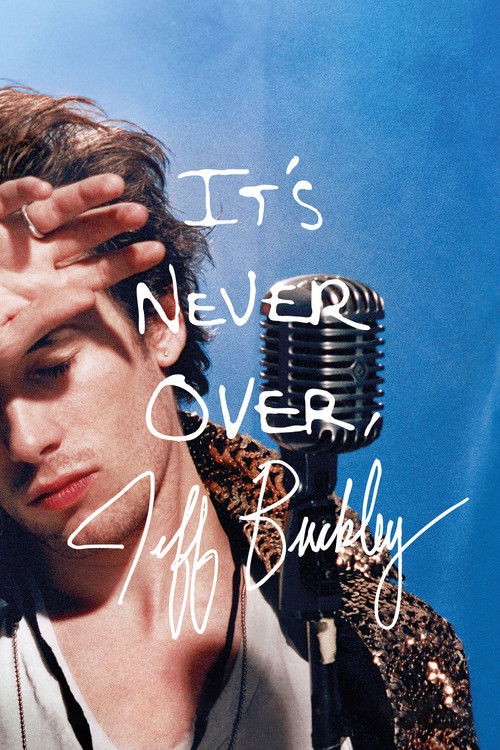
It's Never Over, Jeff Buckley
2025 · Amy J. Berg
For a quiet night when you want to fall for a voice and feel the weight of what was lost — comfort viewing for music lovers, but bring tissues. Reach for it when you want to be moved, not merely informed.
What it's about
A documentary portrait of Jeff Buckley, the singer-songwriter who released just one studio album, Grace, before drowning in a Memphis river in 1997 at age thirty. Made with the full cooperation of his estate, it draws on never-before-seen footage, home recordings, notebooks, and answering-machine messages his mother preserved for decades. Rather than a standard rise-and-fall music bio, it builds his story through his relationships — the people who knew him, loved him, and are still not over him.
The experience
Intimate and aching, paced like a long conversation with someone grieving a person they adored. The voicemails and home tapes make Buckley feel startlingly present, so the film plays less like history and more like eavesdropping on a life mid-sentence — expect it to leave a lump in your throat.
The craft
Amy J. Berg assembles a genuinely rare archive — unheard voice messages, private notebooks, unseen performance footage — into a portrait organized by intimacy rather than chronology. The musical material is the payoff: Buckley's voice deserves good speakers, and the film gives his performances room to land uncut and unhurried.
Why it matters
As the first documentary made with the Buckley estate's blessing, it became the definitive screen account of a musician whose single album has only grown in stature since 1997, premiering at Sundance and reaching wide audiences through HBO.
Snapshot
It's Never Over, Jeff Buckley is Amy J. Berg's feature documentary portrait of the singer-songwriter Jeff Buckley, who released a single studio album — Grace (1994) — before drowning in the Wolf River near Memphis in May 1997 at the age of thirty. Premiering at the Sundance Film Festival on January 24, 2025, and released theatrically by Magnolia Pictures on August 8, 2025 ahead of an HBO broadcast, the film is the first documentary made with the full cooperation of Buckley's estate. It draws on never-before-seen archival footage, home recordings, notebooks, and answering-machine messages preserved by his mother, Mary Guibert, who has administered his legacy since his death. Rather than a conventional cradle-to-grave music biography, Berg organizes the film around Buckley's relationships — with his absent father, the folk musician Tim Buckley; with his mother; and with the women and collaborators who knew him most intimately — to trace how a private, ferociously self-critical artist became a posthumous icon. It belongs to the durable subgenre of the estate-authorized archival music documentary, and its title, drawn from the lyric of "Lover, You Should've Come Over," signals its central preoccupation: grief that does not resolve.
Industry & production
The film emerged from a long gestation. By multiple accounts the project grew out of years of collaboration between Berg and Mary Guibert, the executor of Buckley's estate, whose stewardship gave the production access to the master recordings and personal archive that any serious Buckley film requires. That access is the decisive industrial fact of the project: because Buckley's catalog and image rights are tightly held, an authorized film of this scope had not previously been possible, and the estate's participation shaped both what could be shown and heard and the reverent register critics later noted.
The production assembles a substantial nonfiction-industry coalition. Production companies attached include Plan B Entertainment, Topic Studios, and Fremantle, with a producing team that spans Berg herself alongside Ryan Heller, Christine Connor, Mandy Chang, Jennie Bedusa, and Matthew Roozen. Distribution rights were acquired jointly by Magnolia Pictures and HBO Documentary Films in mid-2025 following the Sundance premiere — a theatrical-then-television pattern typical of prestige music documentaries, where a festival launch and limited theatrical run seed the far larger streaming and broadcast audience. The involvement of HBO Documentary Films places the film within the most established American brand for feature nonfiction, and the Plan B affiliation lends it the imprimatur of a company known for auteur-driven, awards-oriented work.
Technology
As an archival documentary, the film is fundamentally an exercise in format heterogeneity: it interweaves material shot across roughly three decades and multiple gauges and resolutions — home video, standard-definition broadcast and tour footage, personal photographs, handwritten notebooks, and audio recordings including Buckley's own voice on answering-machine tapes — with newly captured high-definition interviews. The technological achievement is less about capture than about restoration, conforming, and integration: bringing degraded and disparate source formats to a coherent screen presentation, and, crucially, foregrounding audio artifacts (voicemail hiss, room tone, rough demos) as expressive texture rather than sanitizing them. The estate's control of the master recordings means the film can deploy Buckley's studio and live audio at full fidelity, a resource unavailable to unauthorized projects and one that materially shapes the viewing experience.
Technique
Cinematography
Four cinematographers are credited — Alex Takats, Curren Sheldon, Wolfgang Held, and Jenna Rosher — a roster consistent with the documentary practice of assigning different shooters to interviews conducted in different cities and periods. Held in particular is a veteran nonfiction and fiction cameraman, and the presence of multiple experienced hands suggests the contemporary interview footage was composed with care to sit alongside the archive. The newly shot material's principal task is tonal: to frame present-day witnesses in a controlled, intimate style that contrasts with, and cushions, the rougher archival imagery.
Editing
Editing, by Brian A. Kates and Stacy Goldate, is the film's true authorial instrument, as it is in most archival documentaries. Kates is an accomplished narrative and documentary editor, and the cutting carries the burden of turning fragments — clips, stills, audio, animation — into an emotional argument. Reviewers emphasized the film's associative, memory-like construction, moving between childhood and stardom and death rather than marching chronologically, which is an editorial rather than a shot-level decision. The recurring use of Buckley's recorded voice as connective tissue, letting the dead man narrate stretches of his own story, is likewise an assembly strategy.
Mise-en-scène / staging
In a compilation documentary the staging that the filmmakers control is chiefly the interview setup and the treatment of paper artifacts. The film reportedly incorporates Buckley's own notebooks and drawings and turns some into animated passages, a device that stages the interior life — handwriting, doodles, private lyrics — as moving image. This animation of the archive is the closest the film comes to designed mise-en-scène, giving visual form to material that is otherwise static.
Sound
Sound is arguably the film's decisive dimension. Beyond Buckley's music, the film's most discussed element is his speaking voice as preserved on answering-machine messages, which lend an uncanny intimacy and supply the emotional spine. The design must balance three registers — the polished catalog recordings, the lo-fi personal audio, and the clean contemporary interviews — and the film's reverent reputation rests substantially on how it lets the music breathe at length. The detailed sound-department record is thin in public sources, and I will not attribute specific mixing credits I cannot verify.
Performance
"Performance" here divides between Buckley's archival musical performances — the film's gravitational center, drawn from his brief but incandescent live career — and the testimonial "performances" of its witnesses. The interviewees include his mother Mary Guibert, former partners Rebecca Moore and Joan Wasser (Joan As Police Woman), bandmates Michael Tighe and Parker Kindred, and fellow musicians including Ben Harper and Aimee Mann. The film's noted emphasis on the women in Buckley's life makes their candor a load-bearing part of its texture.
Narrative & dramatic mode
The film operates in the elegiac-biographical mode, but organized thematically rather than as a strict timeline. Its animating structure is relational: Buckley defined against the father he barely knew, understood through his mother, and revealed through his partners and bandmates. This produces a dramatic irony the audience carries throughout — we know the ending, and the film trades on that foreknowledge, framing an ascendant career as an interrupted one. The recurring motif of the unfinished — a debut with no follow-up, sessions for a second album left incomplete at his death, grief that "never" ends — supplies the throughline in place of conventional rising-and-falling plot. It is confessional and mournful rather than investigative; unlike Berg's exposé work, it does not seek a culprit, treating the drowning as accident and absence rather than mystery.
Genre & cycle
The film sits squarely in the estate-authorized archival music documentary, a cycle that has intensified in the streaming era as catalog owners and platforms recognize the value of definitive artist portraits: the format spans films on Amy Winehouse, Whitney Houston, and countless others, and Berg herself contributed to it with her Janis Joplin film. Within that cycle, It's Never Over belongs to the more specific subset of the posthumous-genius elegy — the artist who died young with a slender but revered body of work, where scarcity itself becomes the subject. It also carries traces of the family-and-legacy documentary, given the estate's centrality and the mother-son axis.
Authorship & method
Amy J. Berg is an Oscar-nominated documentarian whose reputation was built on investigative work — Deliver Us from Evil (2006), on clerical sexual abuse, and West of Memphis (2012) and An Open Secret (2014) — but who has a demonstrated second track in music portraiture, most directly with Janis: Little Girl Blue (2015). That prior Joplin film is the essential precedent for her method here: sustained cooperation with an estate, heavy reliance on personal letters and recordings, and a sympathetic rather than prosecutorial stance toward a self-destructive-seeming but here-accidental early death. Her authorship in It's Never Over is expressed less through on-camera presence than through curation and access — the patient accumulation of trust with Mary Guibert that unlocked the archive.
The key collaborators reflect that emphasis on assembly. Editors Brian A. Kates and Stacy Goldate translate the archive into narrative; the four-person cinematography roster (Takats, Sheldon, Held, Rosher) captures the contemporary layer. The film does not appear to foreground a traditional original score, which would be consistent with a documentary built on its subject's own music — Buckley's recordings function as the score. Public sources on a dedicated composer or writer credit are thin, and I will not invent attributions; the writing of such a film is, in any case, largely an editorial act performed in the cutting room.
Movement / national cinema
The film is an American production within the mainstream of United States independent-prestige nonfiction — the Sundance-to-HBO pipeline that has been the dominant channel for feature documentary in the country for two decades. It reflects no formal avant-garde movement; its idiom is the polished, emotionally accessible archival portrait that platforms and specialty distributors have standardized. Its subject, too, is a distinctly American figure — a Southern California-born artist canonized through a New York club scene and a Memphis death — so the film also participates in a national mythology of the doomed American singer.
Era / period
Produced and released in 2025, the film is a product of the streaming-era documentary economy, in which archival music films command significant acquisition interest and serve catalog and brand strategies for both rights-holders and platforms. It looks back, however, on the early-to-mid 1990s — Buckley's ascent through the Sin-é café scene in New York's East Village and the release of Grace — a period the film reconstructs as a lost moment of pre-internet music culture. The gap between the 1990s subject and the 2025 vantage is part of the film's meaning: it addresses an audience for whom Buckley is already myth.
Themes
The film's dominant themes are grief and its refusal to conclude — the title's promise that loss is "never over." Around that center cluster inheritance and the shadow of the absent father (Tim Buckley, whose own early death doubles his son's); the burden and gift of prodigious talent; perfectionism and self-doubt as engines of an artist who released so little; and, most distinctively in this film, the shaping role of women — mother and partners — in a male artist's life and afterlife. Underlying all of it is the theme of the archive itself: what survives a person, who controls it, and how the recorded voice lets the dead keep speaking.
Reception, canon & influence
Critical reception out of Sundance was warm and frequently described the film as reverent — a word that recurred as both praise and gentle reservation, some reviewers finding its estate-sanctioned tenderness moving and others wishing for more friction or critical distance. The performance footage and the answering-machine audio were widely singled out as its most affecting material, and the film was generally received as a definitive, emotionally satisfying portrait rather than a revisionist or investigative one.
Its influences run backward to the tradition of the authorized archival music elegy and, most specifically, to Berg's own Janis: Little Girl Blue, whose method it extends. It also inherits from the broader wave of streaming-era artist documentaries that established the commercial and formal template it occupies. Looking forward, the film's likeliest legacy is custodial: as the estate-endorsed screen account, it stands to become the standard visual reference for Buckley, shaping how new audiences encounter him and very plausibly renewing interest in Grace and the posthumous recordings — the familiar pattern by which a well-received music documentary drives a catalog's rediscovery. As a 2025 release its long-term critical standing is not yet settled, and it would be premature to claim a fixed place in the documentary canon.
Sources: Wikipedia · Variety review · Deadline interview · The Current · USC Annenberg Media
Reception
It premiered at Sundance 2025 to warm, teary receptions and arrived as the long-awaited 'definitive' Buckley film — though critics split between calling it deeply intimate and calling it a touch too reverent.
How It's Never Over, Jeff Buckley was received, from release to now →
Influences: the films it descends from and the films it influenced
- Janis: Little Girl Blue (2015) — Berg's own template that this film extends: guardian-of-the-estate cooperation (Guibert here as the Joplin family there) unlocking personal letters and recordings read as narration, with an early death framed sympathetically as accident rather than inevitability.
- Amy (2015) — Archival-only assembly of camcorder intimacy anchored by the subject's own recorded voice — the voicemail/private-audio device that Buckley's answering-machine tape reprises as the film's most affecting sound.
- Cobain: Montage of Heck (2015) — Family-authorized access to home cassettes and journals dramatized through animated-archive sequences — the specific staging device (animating lo-fi private recordings) Berg's film borrows.
- The Devil and Daniel Johnston (2005) — Built primarily from the subject's own answering-machine tapes and lo-fi cassette self-recordings as source text, the answering-machine-voice and lo-fi-audio-texture sourcing this film inherits.
- Marley (2012) — Family-sanctioned archival music elegy that assembles a chorus of testimonial witnesses around the catalog, the authorized-archival-elegy tradition this film descends from.
- No Direction Home: Bob Dylan (2005) — Weaves multi-witness testimonial interviews into deep archival assembly — the interview-plus-archive grammar of the prestige musician portrait Berg operates within.
- George Harrison: Living in the Material World (2011) — Widow-authorized entry into a closely held private archive shaping a reverent, access-driven portrait — the cooperation-as-authorship method (trust with the guardian unlocks the material) Berg practices with Guibert.
- West of Memphis (2012) — Berg's own multi-shooter, access-and-curation authorship — building narrative from a vast assembled archive rather than on-camera presence — the assembly-driven method she redeploys with editors Kates and Goldate here.
- Moonage Daydream (2022) — Estate-authorized associative, nonlinear archival montage across heterogeneous formats with the subject's own music functioning as diegetic score — the associative-editing and format-heterogeneity craft carried forward.
- Little Richard: I Am Everything (2023) — Streaming-era archival elegy that reclaims a musician's legacy through testimonial witnesses and catalog-as-score, extending the authorized-portrait-as-standard-reference function.
- Listen to Me Marlon (2015) — Constructs a posthumous first-person account entirely from the subject's private audio tapes — the same 'the dead speak in their own recorded voice' device Buckley's answering-machine audio performs.
- Searching for Sugar Man (2012) — A music doc engineered as an instrument of catalog rediscovery, the custodial commercial function the dossier predicts this film will serve for Grace and the posthumous recordings.
- What Happened, Miss Simone? (2015) — Daughter/estate-authorized archival elegy using the artist's own recordings as de facto score, part of the streaming-era (Netflix) template that established this film's formal and commercial occupancy.
- The Beatles: Get Back (2021) — Foregrounds archival-restoration technology (image cleanup and audio de-mixing) as the enabling craft that makes legacy footage feel present — the restoration layer Berg's team applies to decades-old Buckley material.
- Whitney (2018) — Estate-cooperative posthumous portrait negotiating the reverence-versus-friction tension via privileged access to family and home footage, the same balance critics flagged in this film.
- Tina (2021) — HBO legacy-defining elegy pairing testimonial witnesses with the artist's own performance recordings, exemplifying the Sundance-to-HBO nonfiction movement this film moves through.
Similar films
- Moonage Daydream (2022) — influence & lineage
- Blue (1993) — shared sensibility
- A Star Is Born (2018) — shared sensibility
- Grizzly Man (2005) — shared sensibility
- The Devil and Daniel Johnston (2006) — shared sensibility
- My Own Private Idaho (1991) — shared sensibility
- Michael (2026) — shared sensibility
- Peter Hujar's Day (2025) — shared sensibility