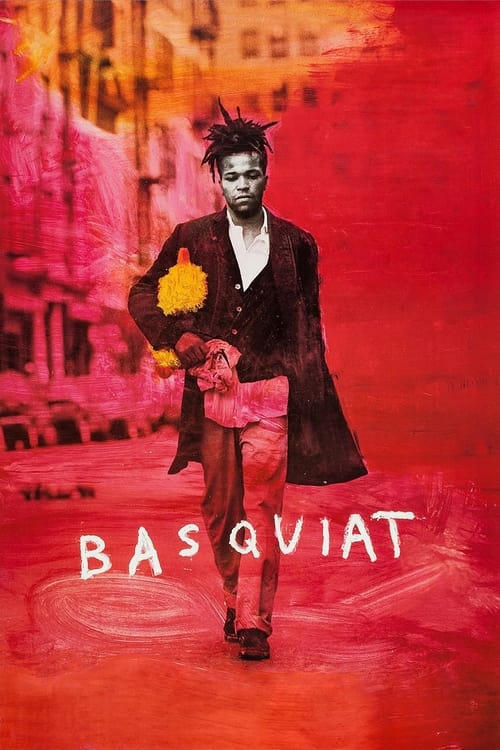
Basquiat
1996 · Julian Schnabel
For when you're drawn to art, ambition, and the cost of being seen — a film to watch when you want beauty with an ache in it.
What it's about
The short, meteoric life of Jean-Michel Basquiat, the graffiti poet who went from sleeping in a cardboard box to the center of the 1980s New York art world in a few dizzying years. The film follows his rise through galleries and vernissages, his friendship with Andy Warhol, and the fame, money, and heroin that crowd in on him — all told by Julian Schnabel, a painter who was actually in those rooms.
The experience
Lyrical and elegiac rather than biographical — it drifts through Basquiat's life in lit scenes and recurring dream images, with an undertow of sadness you feel long before anything goes wrong. Loose, seductive, and mournful.
Performances
Jeffrey Wright's breakthrough turn is extraordinary — watchful, gentle, and opaque, letting you feel Basquiat slipping away even at his most charming. David Bowie's Warhol is a small miracle: courtly, wounded, and funnier than any impression.
The craft
Schnabel directs like the painter he is — the film thinks in images, most memorably a surfer riding a wave that keeps opening in the Manhattan sky, and it renders the downtown art world with an insider's exactness. The starry supporting cast and period soundtrack give the whole thing the texture of a scene remembered by someone who lived it.
Why it matters
It launched Schnabel's second career as a filmmaker, made Jeffrey Wright a name, and remains the definitive screen account of the 1980s art boom and Basquiat's posthumous canonization.
Snapshot
Julian Schnabel's first film is an artist's account of another artist, made by a man who was in the room. Schnabel — the plate-painting star of the same early-1980s New York Neo-Expressionist boom that lifted Jean-Michel Basquiat from the sidewalk to the auction house — directed Basquiat as a debut feature at the age of forty-four, having never worked in the industry. The result is less a life story than a series of lit panels: the boy at MoMA before Guernica with a paper crown lowering onto his head; SAMO© scrawled on SoHo walls; Warhol as a courtly, wounded ghost; a surfer riding a wave that keeps opening in the Manhattan sky. Released by Miramax in the summer of 1996, it arrived in the middle of the American independent boom and at the crest of Basquiat's posthumous re-canonization, and it remains the most-seen dramatization of the New York downtown scene of 1978–1988 — as well as the most argued-over, because its author is also a character in it.
Industry & production
The project reached Schnabel secondhand. The Polish director Lech Majewski had developed a Basquiat film and is credited on the story alongside Michael Thomas Holman, the musician who co-founded the band Gray with Basquiat and was therefore a primary witness; Schnabel took over and wrote the screenplay himself. Jon Kilik — Spike Lee's longtime producer, and later Schnabel's — produced, and the picture was financed at the small end of the mid-1990s specialty scale and distributed by Miramax, then the dominant house for exactly this kind of star-dense, low-budget, culturally credentialed American film.
The decisive production fact is a rights refusal. Basquiat's estate declined permission to reproduce his paintings on screen. Rather than abandon the images, Schnabel and his assistants painted stand-ins — works in Basquiat's idiom of crowns, anatomical diagrams, crossed-out words and griot-figure heads, but not copies of specific canvases. A film about an artist thus contains almost none of that artist's art, and the paintings the camera lingers on are the director's own hand impersonating his dead contemporary. The same rights pressure shows in the script's composites: Basquiat's actual SAMO© collaborator Al Diaz and his girlfriend Suzanne Mallouk are folded into the invented Benny Dalmau (Benicio del Toro) and Gina Cardinale (Claire Forlani), while the real dealers — Bruno Bischofberger, Mary Boone, Annina Nosei — and the critic René Ricard appear under their own names.
The cast was assembled on the strength of Schnabel's art-world standing rather than his filmography: Jeffrey Wright, then a stage actor, in the lead; David Bowie as Andy Warhol; Dennis Hopper, Gary Oldman, Michael Wincott, Parker Posey, Christopher Walken, Willem Dafoe, Courtney Love, Tatum O'Neal, Paul Bartel. Bowie wore Warhol's own wig and eyeglasses, obtained from the Warhol holdings — a relic-based performance choice that doubles as a statement of what the film could and could not borrow.
Technology
Basquiat was shot on 35mm in 1996, several years before the digital intermediate became standard practice, so its optical effects belong to the photochemical era. The recurring wave that rolls through the sky above lower Manhattan — a surfer crossing the frame where the skyline should be — reads as optical superimposition rather than digital compositing; the specific method is not well documented in the available record, but the period and the film's budget make an optical-printer solution far likelier than an early digital one. The texture elsewhere is deliberately unpolished: available and practical light, real New York interiors, handheld coverage in the club and party scenes.
The film's more interesting technological subject is inside the story. It stages the tools of two opposed image-making regimes: Warhol's silkscreen and Polaroid, an industrial apparatus for multiplying pictures, against Basquiat's oilstick, spray can, xerography and found supports — doors, refrigerators, foam packing. When the two men paint together, the film is showing a collision of technologies as much as of temperaments, and it is honest about the asymmetry: Warhol's machine can absorb Basquiat's hand more easily than the reverse.
Technique
Cinematography
Ron Fortunato shot the film in a mode closer to portraiture than reportage. Interiors are warm, close and often frontal; Basquiat is repeatedly framed head-on against his own surfaces, so that man and canvas occupy the same plane and the picture behind him becomes a second face. Street work is looser and grainier, letting SoHo in 1981 look like a place someone actually walked through rather than a set. The camera has a painter's patience with the object: it holds on a surface, a smear, a crossed-out word, longer than narrative economy requires. Against this, the sky inserts break the film's realism entirely — a flat blue field, a wave, a surfer — functioning as lyric punctuation rather than point-of-view.
Editing
Michael Berenbaum, who cut the film early in a career that would run through prestige television, edits for ellipsis. Scenes begin late and end before resolution; years pass between cuts with no marker but a change of address. The rise is rendered as accumulation rather than causality — a party, a dealer, a check, a better apartment — which keeps the film from becoming a case study in ambition. The decline is handled by subtraction: fewer people in the frame, longer holds, more silence. Basquiat's death is not dramatized as an event, and the withholding is the film's most disciplined choice.
Mise-en-scène / staging
The film's most loaded set is Schnabel's own. Gary Oldman plays Albert Milo, a successful painter transparently modeled on the director, and Milo's studio, home and paintings are Schnabel's actual studio, home and paintings; the plate works on Milo's walls are the real thing, while Basquiat's are forgeries by the same hand. The staging elsewhere is anthropological about art-world space: the gallery basement where a dealer installs her artist to produce on demand, the collector's dinner table where Basquiat is seated as an ornament, the restaurant where a waitress serves and a critic pronounces. The film consistently blocks Basquiat as the only Black figure in white rooms, and lets the composition make the argument without dialogue.
Sound
John Cale composed the score, a choice with its own historical charge: Cale came out of the Velvet Underground, the band Warhol managed and put his name on, so the film's Warhol scenes are underscored by a musician who had actually been inside that arrangement. Cale's cues are sparse — viola, piano, held tones — and mostly refuse to editorialize. Around them the film builds a dense source-music track spanning the two musical worlds Basquiat lived between: bebop, above all Charlie Parker, whose life and death are the explicit template Basquiat drew on in paintings like CPRKR and Charles the First, and the punk, post-punk and no-wave downtown he actually inhabited. Bowie's contemporary music appears as well, an anachronism the film accepts as the price of its casting.
Performance
Jeffrey Wright's Basquiat is built on withholding. He plays a man who has decided that charm is a currency and spends it sparingly, alternating deadpan comedy with a stillness that reads as either serenity or absence depending on the scene. He does not explain himself, and the performance's refusal of the biopic's usual articulacy is what keeps the character from becoming a lecture on genius. Bowie's Warhol is the film's other pole — high, flat, fussy, funny, and finally touching, a portrait informed by Bowie's own encounters with Warhol in the early 1970s. Michael Wincott's René Ricard supplies the film's rhetorical register, delivering the aestheticizing critical voice that Ricard had invented in his 1981 Artforum essay "The Radiant Child," which made Basquiat's name. Dennis Hopper, Christopher Walken and Parker Posey work in shorter, sharper strokes; Walken's interviewer is played as absurdist interrogation.
Narrative & dramatic mode
The structure is the standard biographical arc — discovery, ascent, corruption, death at twenty-seven — but the telling is episodic and fabulist rather than causal. The film opens with a myth of election (the child, the Picasso, the descending crown) and thereafter proceeds by tableau. Ricard's voice-over frames the story in the language of art criticism, which means the film narrates Basquiat partly in the discourse that consumed him, a doubling that is either a critique or a symptom. Drug use is present but never given the confessional set pieces the genre expects; there is no intervention scene, no rock-bottom monologue. The wave motif functions as the film's non-narrative channel, a recurring image of escape that the dialogue never explains and never needs to.
Genre & cycle
Basquiat belongs to the artist biopic, a genre with a long tradition of treating creation as pathology — Minnelli's Lust for Life (1956), Tarkovsky's Andrei Rublev (1966), Jarman's Caravaggio (1986). It also sits inside a remarkably tight mid-1990s cluster: I Shot Andy Warhol and Surviving Picasso both appeared in 1996, John Maybury's Love Is the Devil followed in 1998 (denied the rights to Francis Bacon's paintings, exactly as Schnabel had been denied Basquiat's), and Ed Harris's Pollock in 2000. Read across that cycle, Basquiat is the entry most concerned with the market: its subject is less how art gets made than how it gets priced, brokered and consumed.
Authorship & method
Schnabel's method is that of a painter who has decided cinema is another surface. He directs for image and texture over dramatic architecture, trusts held shots and unexplained motifs, and constructs the film around a first-person authority he possesses in fact — he knew Basquiat, he lived the scene, he owns the paintings on Milo's wall. The Milo device is the crux of any account of his authorship: by casting Gary Oldman as himself and filming in his own home, Schnabel writes his own success into the story of Basquiat's destruction, positioning the surrogate as the mentor who understood. Critics have read this as candor and as vanity; both readings survive the film. His key collaborators are notably outside the studio system — Fortunato from independent New York cinema, Cale from the Factory's own musical history, Berenbaum early in his career — and the story credit to Majewski and Holman preserves a trace of the film Schnabel displaced. The three artist biopics that followed — Before Night Falls (2000), The Diving Bell and the Butterfly (2007), At Eternity's Gate (2018) — confirm Basquiat as the founding statement of a coherent authorship: the artist as subject, sensation as method, the frame as canvas.
Movement / national cinema
The film is American independent cinema of the Miramax decade in its financing and release, but its lineage runs through downtown New York rather than Sundance. Behind it stand Warhol's own Factory films, the No Wave features of the late 1970s, Charlie Ahearn's Wild Style (1983), and above all Downtown 81 — shot in 1980–81 with Basquiat playing a version of himself, shelved for two decades, and released in 2000 as the film's inadvertent primary-source rival. Schnabel's picture is that world reconstructed from inside, twelve years after its subject's death, by a survivor with the resources of a 1990s specialty release. It also belongs to the small international tradition of painters' cinema, closest in spirit to Jarman's Caravaggio in its willingness to sacrifice period accuracy to painterly effect.
Era / period
Two eras press on the film. The one depicted, 1978–1988, spans graffiti's move from the subway to the gallery, the Reagan-era art boom, and an escalating market that treated young artists as assets — a bubble that burst around 1990. The one it was made in mattered just as much: the Whitney Museum's 1992–93 Basquiat retrospective had substantially re-canonized an artist many obituaries had dismissed as a fad, and the mid-1990s were rebuilding his reputation and his prices. Basquiat is a product of that revaluation, and it carries the period's other preoccupation as well — an increasingly explicit argument about who gets to narrate Black artists, arriving just as the American independent sector was at its most confident.
Themes
The governing subject is authenticity as a commodity. Basquiat is valued precisely for the rawness that the market's attention destroys, and the film returns again and again to the moment of transaction: the dealer's basement, the collector's dinner, the check written at the table. Race organizes every one of those scenes — the film is unambiguous that Basquiat is admitted as an exception and read as a primitive by people convinced they are admiring him. Fame is figured as consumption in the literal sense; friendship, in the Warhol relationship, as the film's one uncorrupted bond, and its severing by Warhol's 1987 death as the event that leaves Basquiat undefended. Beneath all of it runs the theme of anointing: the crown that opens the film is Basquiat's own recurring motif, and the film treats it as both a coronation and a sentence, with Charlie Parker as the explicit precedent for the Black genius consumed at speed.
Reception, canon & influence
Reviews in 1996 were broadly favorable and consistently divided along the same fault line: near-unanimous praise for Jeffrey Wright's performance and Bowie's Warhol, alongside skepticism about Schnabel's self-inscription and about a film that renders the art world's exploitation of Basquiat while itself being made by, and about, that world. Wright's work took the Independent Spirit Award for Best Debut Performance. The sharpest critical framework had in fact been established before the film existed, in essays by Greg Tate and bell hooks on Basquiat the artist, which had already contested the primitivist reading the film sometimes reproduces; those arguments were carried directly into the reception of Schnabel's picture.
Its backward influences are legible: the Warhol-Factory film tradition and the No Wave downtown; Wild Style and Downtown 81; the painter-director example of Jarman; and, as sources rather than styles, Ricard's "Radiant Child" and the 1985 New York Times notice on the Warhol–Basquiat collaboration show that framed Basquiat as Warhol's mascot and helped end their partnership. Forward, the film did three things. It launched Schnabel as a filmmaker of international standing and set the template he has worked in ever since. It made Jeffrey Wright's screen career. And it fixed the popular image of Basquiat — dreadlocked, suited, paint-flecked, ironic — as the version most people carry, an image later documentaries, notably Tamra Davis's Jean-Michel Basquiat: The Radiant Child (2010), have had to work against as much as with. Its stranger legacy is Bowie's Warhol, which stands beside Jared Harris's from the same year as the definitive screen Warhol. Thirty years on, Basquiat is read less as biography than as testimony: an interested, compromised, unusually intimate account of the scene that made and spent its subject, filed by a witness who profited from it.
A Deleuzian reading
A boy stands in front of *Guernica* with his mother.
The full Deleuzian reading of Basquiat →
Reception
Dismissed by many in 1996 as Julian Schnabel's vanity project — a famous painter casting a Schnabel stand-in (Gary Oldman) in his own directing debut — it's since been reappraised as the definitive downtown-NYC art-world movie, with Jeffrey Wright's breakout turn and Schnabel's later acclaim (Before Night Falls, The Diving Bell and the Butterfly) doing the rehabilitating.
How Basquiat was received, from release to now →
How to watch Basquiat: what to notice on a first viewing
- Watch how often Basquiat is filmed head-on against his own paintings. Fortunato frames him frontally again and again, so his face and the canvas behind him sit on the same plane, held longer than the scene requires. The picture behind him becomes a second face, so you are always watching the man and his work as one image.
- Notice Basquiat is almost always the only Black person in the room. The film blocks him alone in gallery basements, collector dinners, and restaurant tables full of white faces, and never points this out with dialogue. The isolation is not a plot point, it is staged, and the film trusts you to see it without being told.
- Listen for bebop and Charlie Parker running under the punk soundtrack. The score alternates Cale's sparse viola and piano with a dense mix of bebop and the no-wave, post-punk music of the downtown scene Basquiat actually lived in. The two musical worlds map the two lives pulling at him, the jazz lineage he claimed and the street scene that made him.
- Watch how scenes start late and end before anything is resolved. Berenbaum's cuts skip explanation, and years pass marked only by a change of address, so the rise plays as a pile of events rather than one causing the next. The looseness keeps the film from turning Basquiat's rise into a simple lesson about ambition.
The whole guide to watching Basquiat, with the keys for a rewatch →
Influences: the films it descends from and the films it influenced
- Chelsea Girls (1966) — Warhol's practice of running the camera on a scene participant performing a heightened version of himself is exactly Schnabel's method of holding long frontal takes on Wright while casting actual downtown figures around him — closed into a loop by Bowie playing Warhol in Warhol's own wigs and glasses.
- The Man Who Fell to Earth (1976) — Roeg established the readymade-persona casting Schnabel exploits — Bowie's affectless, watching-from-outside surface is the register he brings back as Warhol — and Roeg's associative non-diegetic cutaways prefigure the lyric sky inserts.
- Downtown 81 (1981) — The literal source text: Basquiat drifting Lower Manhattan trying to sell one canvas, with No Wave bands playing as diegetic source music — Schnabel restages its wandering-with-a-painting structure and its street geography as fiction.
- Wild Style (1983) — Ahearn's hybrid of documentary texture and thin fiction, with writers playing themselves and the camera holding on a painted wall after the actors leave frame, is the direct model for Basquiat's held shots on SAMO tags and studio surfaces.
- Stranger Than Paradise (1984) — Scene-as-single-held-tableau separated by blackouts gives Schnabel his additive tableau grammar and its elliptical jumps across years, along with the downtown deadpan of a protagonist who refuses to explain himself.
- Caravaggio (1986) — The painter-director template — studio-built tableaux lit as canvases, deliberate anachronism, the patron/dealer economy staged as static composition rather than dramatized scene — is what Schnabel imports wholesale.
- Andrei Rublev (1966) — An artist biopic built as discrete panels around a near-silent, withholding protagonist that finally abandons narrative to scan the surfaces of the actual work — the structural pairing of tableau and surface-hold that Basquiat runs.
- Edvard Munch (1974) — Watkins lays a period critical voice in voiceover over the painter working, letting hostile criticism narrate the image — the same device as Rene Ricard's 'Radiant Child' narration authorizing what we see.
- Bird (1988) — Eastwood renders decline by subtraction — scenes shorten and darken as the addiction advances — and lets Parker's own recorded solos carry the score, which is precisely the sound-and-editing logic Basquiat applies to a subject obsessed with Parker.
- Vincent & Theo (1990) — Altman relocates the artist biopic from genius to transaction — the dealer, the price, the unsold canvas — and shoots paint handling in tactile close-up, the vein Schnabel works in every gallery and studio-visit scene.
- Before Night Falls (2000) — The same kit carried to Arenas: lyric sky and water inserts cut against narrative, optical superimposition of text and image, and the director's personal acquaintance with the milieu underwriting the film's authority.
- Pollock (2000) — Takes Schnabel's premise that painting must be filmed as physical labor and pushes it further — Harris learned to pour and shot the drip sequences in unbroken real-time takes, making the act itself, not the finished surface, the camera's subject.
- The Diving Bell and the Butterfly (2007) — Extends held-shots-on-surfaces into sustained subjective optics — Kaminski's smeared rack-focus standing in for a single eye — with the same associative inserts of sky and ice interrupting the narrative line.
- Jean-Michel Basquiat: The Radiant Child (2010) — Built around Davis's own 1985 interview footage, it rebuts Schnabel at the level of performance — restoring the articulate, funny speaking voice that Wright's withholding, near-mute characterization had displaced from the popular image.
- At Eternity's Gate (2018) — Closes the loop begun with the Basquiat forgeries — Schnabel paints the canvases himself again, then puts the camera handheld in the painter's eyeline so the held shot on a surface becomes first-person mark-making.
- I Shot Andy Warhol (1996) — Released the same year with the same reconstruction problem, Harron arrives at the flat, deflecting Warhol delivery through research where Schnabel arrives through acquaintance and costume; together the two performances fixed the screen grammar for Warhol.
- Love Is the Devil (1998) — Denied the Bacon estate's paintings, Maybury converts the refusal into method — distorting lenses, mirrors, fish-eye framings that produce Bacon's optics without Bacon's canvases — the same rights-refusal-as-technique problem Schnabel solved by painting his own forgeries.
- Control (2007) — A stills photographer does for Curtis what the painter did for Basquiat: static frontal portrait framings, monochrome surface treated as the point rather than the mood, and decline staged by progressively stripping dialogue out of the performance.
- Love Is the Devil: Study for a Portrait of Francis Bacon (1998) — Contemporaneous painter biopic made by a painter, wrestling with the same problem — how to put a visual artist's seeing, not just his life, on screen.
Similar films
- At Eternity's Gate (2018) — influence & lineage
- Caravaggio (1986) — influence & lineage
- Before Night Falls (2000) — influence & lineage
- The Diving Bell and the Butterfly (2007) — influence & lineage
- Love Is the Devil: Study for a Portrait of Francis Bacon (1998) — shared sensibility
- King of New York (1990) — shared sensibility
- Trainspotting (1996) — shared sensibility
- La Belle Noiseuse (1991) — shared sensibility