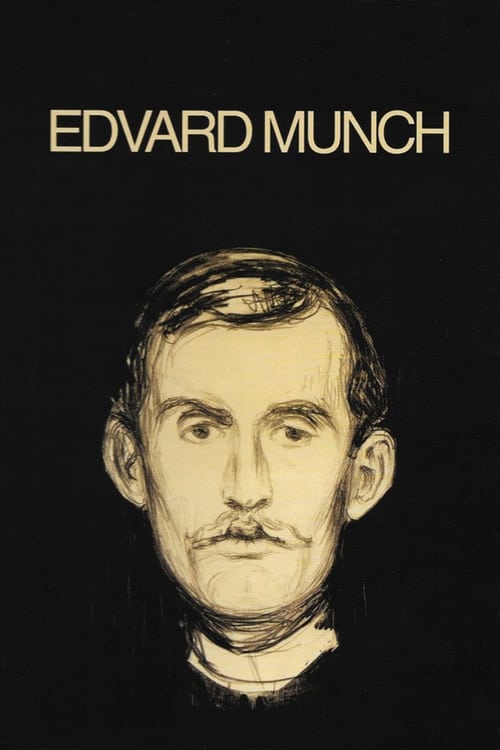
Edvard Munch
1974 · Peter Watkins
For when you want total immersion — a long, demanding, deeply moving film to surrender an evening to. This is the opposite of background viewing; it asks for patience and repays it with something close to communion.
What it's about
A three-hour docudrama portrait of the Norwegian painter Edvard Munch, centered on the decade in which a grief-stricken young artist — his childhood shadowed by the deaths of his mother and sister and his own near-fatal illness — transformed into the radical image-maker who helped invent Expressionism. It follows him through the bohemian circles of 1880s Kristiania, a scandalous love affair, and the hostile reception of paintings the world wasn't ready for.
The experience
Nothing like a standard artist biopic: handheld cameras, characters glancing at the lens, interviews that shouldn't exist in the 1880s, and a dense weave of whispered memory and sound that puts you inside Munch's head rather than in front of his easel. Slow, hypnotic, and cumulatively overwhelming — grief and creation braided together for three hours.
Performances
The cast is made up of Norwegian amateurs, and that's the miracle — faces that feel documentary-real, led by a haunted, inward performance as Munch that lets long silences and sidelong looks at the camera do the talking.
The craft
Peter Watkins invents a form for the film: pseudo-documentary interviews inside a period reconstruction, restless handheld imagery, and layered subjective sound that loops phrases of memory like recurring wounds. The scenes of Munch scraping and scarring his canvases make painting feel physical in a way few films ever manage.
Why it matters
Widely regarded as one of the greatest films ever made about an artist, and a high-water mark of the docudrama form that has influenced how filmmakers approach biography ever since.
Snapshot
Peter Watkins's Edvard Munch is a three-hour docudrama biography of the Norwegian painter, made for television and covering roughly the decade from the mid-1880s to the mid-1890s — the years in which Munch moved from an academically trained provincial artist into the radical, subjective image-maker who would help inaugurate Expressionism. Produced for Norwegian and Swedish public broadcasting and released in 1974, the film is at once a work of art history and a formal experiment: Watkins reconstructs Kristiania (present-day Oslo) bohemian society using a cast of Norwegian amateurs, layers dense subjective sound over restless handheld imagery, and repeatedly interrupts dramatic scene-building with pseudo-documentary interviews in which characters address the camera directly. It is widely regarded as one of the most searching films ever made about the psychology of an artist and about the social hostility that met early modernism. The film exists in more than one length — a longer television version and a shorter theatrical cut — a fact worth keeping in mind, since durations cited for it vary.
Industry & production
Edvard Munch was a co-production of the Norwegian Broadcasting Corporation (NRK) and Swedish Television (Sveriges Radio/SR), conceived and financed as television rather than as a theatrical feature. This origin is central to understanding the film: it was made inside a public-service broadcasting culture that, in the late 1960s and 1970s, still had room for long-form, formally ambitious authorial work, and it reached its first audiences on the small screen. It was subsequently cut down and circulated theatrically and on the festival and repertory circuit, where its critical reputation was built.
The production suited Watkins's established working method, which by 1974 was already notorious. He had left Britain after conflicts with the BBC over The War Game (1965) and worked as an itinerant director across several national systems. In Norway he assembled a large non-professional cast drawn substantially from the local community, researched the period exhaustively, and shot on location and in constructed interiors that emphasize cramped, candle- and lamp-lit domestic space. The reliance on amateurs was both an aesthetic and an economic strategy, characteristic of Watkins's practice throughout his career. Beyond these broad contours, the granular production record — precise budget, shooting schedule, exact number of cast members — is not something I can state with confidence, and I won't invent figures.
Technology
The film was shot on 16mm color stock, the standard acquisition format for ambitious 1970s television drama of this kind, and this choice is inseparable from its look: the grain, the tolerance for available and practical light, and the mobility of a smaller camera all enable Watkins's intimate, roving style. Sound was built in post as a dense, multi-layered construction rather than captured as clean synchronous dialogue — overlapping voices, whispered interior monologue, ambient noise, and fragments of period music are woven together. The film is bilingual in conception: it was produced in Norwegian, and an English-narrated version exists carrying Watkins's own commentary voice-over, which frames and historicizes the drama for non-Norwegian audiences.
Technique
Cinematography
The camerawork, by Norwegian cinematographer Odd-Geir Sæther, is one of the film's defining instruments. It is predominantly handheld and searching, favoring close and mid-shots that press against faces, hands, and the surfaces of paintings in progress. Light is low and directional, drawn from windows, lamps, and hearths, so that interiors read as shadowed and tubercular; the palette leans toward muted browns, sickly greens, and the pallor of skin. The camera behaves less like a neutral recorder than like an anxious observer — it drifts, reframes, and lingers on details, mimicking the restlessness of memory and perception. This visual grammar externalizes Munch's own move away from descriptive naturalism toward a painting of felt, subjective states.
Editing
Editing is arguably the film's most radical dimension. Watkins constructs the narrative associatively rather than chronologically, cutting continually between the "present" of the 1880s–90s and recurring flashes of earlier trauma — the sickbeds and deaths of Munch's sister Sophie and his mother. Certain images and sounds return as motifs, restated at intervals so that the past keeps erupting into the present, formally reproducing the way grief and memory intrude on lived experience. The rhythm is fragmentary and accumulative; scenes are frequently broken by cutaways to interview-style testimony. Watkins is closely identified with the editorial shaping of his own films, and that authorial control over the cut is evident here; I am not certain of a separately credited editor's name and will not guess one.
Mise-en-scène / staging
The staging emphasizes crowded, airless bourgeois and bohemian spaces — the family home, cafés and meeting rooms of the Kristiania Bohème, studios, exhibition halls. Bodies are packed into frames; social scenes hum with simultaneous conversation. Watkins stages the making of pictures with unusual attention: we watch canvases being worked, scraped, reworked, and physically abused, so that painting appears as labor and as violence against the surface rather than as genteel accomplishment. The period detail is dense but never merely decorative; costume, furniture, and the physical textures of illness and poverty carry the film's argument about a repressive, mortality-haunted society.
Sound
The soundtrack is a deliberately unstable, layered field. Interior monologue and whispered voices sit under and over spoken dialogue; ambient sound and sparse musical fragments enter and recede. Rather than an original symphonic score, the film uses this collage of voice and period-flavored music to create a subjective sonic environment — I am not aware of a conventionally credited composer and will not attribute one. The effect is that we seem to inhabit Munch's consciousness, hearing the murmur of judgment, memory, and desire as continuous psychic noise.
Performance
The performances come from non-professionals, led by Geir Westby as Edvard Munch and Gro Fraas as the married older woman identified as "Mrs. Heiberg" (a fictionalized rendering of Munch's early love, associated with Milly Thaulow). The amateur casting produces a quality of hesitancy and inwardness — glances, silences, unpolished gestures — that suits a film about repression and unspoken feeling. Westby's Munch is watchful and withdrawn, more absorbed than declamatory. Crucially, actors periodically turn and address the camera as if being interviewed, delivering testimony about themselves and their period; this breaks conventional identification and converts performance into a documentary-style act of witness.
Narrative & dramatic mode
The film's dramatic mode is hybrid and self-consciously anti-classical. It fuses three registers: dramatized biography, first-person subjective flashback, and mock-documentary interview. There is no tidy three-act arc; instead the film advances through repetition, digression, and the layering of a private psychological story onto a broad social panorama. Watkins's English narration supplies historical context, dates, and analysis, positioning the viewer as a student of history even while the interior scenes solicit emotional immersion. The result is a constant oscillation between intimacy and analytical distance — the viewer is pulled inside Munch's grief and desire, then pushed back out to consider the social and intellectual forces shaping him. This dialectic between empathy and critique is the film's signature structure.
Genre & cycle
Nominally an artist biopic and a period historical drama made for television, Edvard Munch belongs far more meaningfully to the tradition of the docudrama — the reconstructed-history film that borrows the tools of documentary (interviews, narration, handheld immediacy) to dramatize the past. Watkins is one of the form's principal inventors, and this film sits within his own cycle of works that stage history as if it were being reported as it happens. It also participates in a small, distinguished lineage of films about painters that take the problem of representing creativity seriously rather than as costume melodrama. Within both categories it is an outlier for its length, formal density, and refusal of biopic conventions such as triumphal arcs and explanatory psychology.
Authorship & method
The film is thoroughly a Peter Watkins work, expressing the method he developed across Culloden (1964), The War Game (1965), Punishment Park (1971), and later La Commune (Paris, 1871) (2000): rigorous historical research, casting of local non-professionals, direct-to-camera interviews that collapse the distance between past and present, handheld reportage aesthetics, and a critique of the "monoform" — his term for the standardized, rapid, homogenized language of mainstream media, which his own long, layered constructions resist. Watkins also serves as the film's narrating voice in the English version and is closely identified with its editorial architecture.
His key collaborator on the images is cinematographer Odd-Geir Sæther, whose intimate, mobile, low-light photography realizes the film's subjective vision. The screenplay is Watkins's own, built from documentary sources including Munch's writings and the historical record of the Kristiania Bohème. On the questions of a separately credited editor and composer I have flagged genuine uncertainty above rather than fabricate names; the film's sound-and-image collage is, in any case, a strongly authorial construction consistent with Watkins's habit of controlling post-production himself.
Movement / national cinema
Edvard Munch is a Scandinavian television production and belongs to the Norwegian–Swedish public-broadcasting culture of the period, but it is not easily assimilated to a national cinema; Watkins was a stateless auteur working across borders, and the film's true home is his personal, transnational body of work. Its subject, however, is deeply national and art-historical: the film reconstructs the Kristiania of the 1880s–90s, the radical bohemian and anarchist milieu around the writer Hans Jæger, and the emergence of a distinctly Northern European modernism. As a chronicle of the birth of Expressionism, it situates Munch at the origin point of a movement that would reshape European painting and, later, cinema.
Era / period
Made in 1974, the film is a product of a particular moment in both television and political culture — a post-1968 European climate receptive to formally radical, socially critical, long-form authorial work inside public-service broadcasting. Its subject period is the fin-de-siècle: the tuberculosis-haunted, sexually repressive, class-bound society of late-nineteenth-century Norway, and the anarchist-bohemian revolt against it. The film draws a pointed line between the two eras, using Watkins's analytical narration to invite the 1970s viewer to recognize continuities of conformity, censorship, and the mistreatment of artistic and sexual nonconformity across the century separating them.
Themes
Death and illness saturate the film: the early losses of Munch's sister and mother to tuberculosis, and his own brushes with sickness, are treated as the formative wounds from which his art emerges. Sexuality and repression run alongside — the affair with the married "Mrs. Heiberg," and the broader clash between the Bohème's free-love radicalism and bourgeois morality. Artistic creation itself is a theme: the film insists on the physical, effortful, often hostile process of making new images, and on the derision that greeted them. Above all it dramatizes the collision between the individual sensibility and a repressive social order — the artist as both product and antagonist of his society. Memory and trauma, formally enacted by the editing, unify these strands: Munch's art is presented as the transformation of private grief into a universal visual language.
Reception, canon & influence
Critically, Edvard Munch has come to be regarded as one of Watkins's finest achievements and one of the most respected films about an artist. Its reputation grew steadily after its television broadcast as it circulated theatrically and in repertory, and it is frequently invoked by critics and filmmakers as a benchmark for how cinema might render the interior life of a painter and the texture of a historical period simultaneously. It is often noted that Ingmar Bergman held the film in very high regard; I recall that his praise was emphatic, but I will not reproduce a specific quotation I cannot verify.
Looking backward, the film's influences lie less in other movies than in the historical and documentary record — Munch's own diaries and paintings, the writings of Hans Jæger and the Kristiania Bohème — and in Watkins's own prior invention of the docudrama form in Culloden and The War Game. Looking forward, its legacy is twofold. Within Watkins's career it anticipates the fully realized synthesis of La Commune (Paris, 1871), extending the same interview-driven, historically analytical method. More broadly, it stands as a model for the serious art biopic and for subjective, essayistic approaches to biography on film, demonstrating that a life in art can be filmed as a problem of consciousness and form rather than as a sequence of illustrated milestones. Its precise, measurable influence on individual later filmmakers is harder to document than its reputation as a touchstone, and I present it as the latter.
A Deleuzian reading
A man's voice, level and informed, gives a date.
The full Deleuzian reading of Edvard Munch →
Reception
Made for Norwegian and Swedish TV in 1974 after Watkins had been effectively frozen out of British broadcasting, it got a muted, wary reception at home — then its 1976 US theatrical run drew raves, and after decades of being hard to see it's now routinely called the greatest artist biopic ever made.
How Edvard Munch was received, from release to now →
How to watch Edvard Munch: what to notice on a first viewing
- Watch the camera drift and reframe instead of holding still. Sæther's handheld camera presses close on faces and hands, lingering and shifting like an anxious observer rather than a steady recorder. The restless camera puts you inside a nervous, subjective way of seeing rather than a calm historical record.
- Notice how the light comes from a single lamp or window. Interiors stay shadowed and low-lit, drawn from a visible source, lamps, hearths, windows, in muted browns and sickly greens. The dim, sourced light makes every room feel close, sick, and a little airless.
- Watch for actors suddenly turning to address the camera. Performers periodically break from the drama to speak straight to the lens, as if being interviewed about their own period. The switch pulls you out of the story and asks you to weigh what you just watched as history.
- Watch for sudden cuts back to sickbeds and illness. The film keeps breaking from Munch's adult life to flash back to the deaths of his sister and mother, returning at intervals rather than once. The past keeps erupting into the present exactly the way memory intrudes on someone who cannot let it go.
- Watch the canvas being scraped and reworked, not just painted. Watkins stages the act of painting as physical struggle, scraping and reworking the surface, rather than as a genteel accomplishment. Making the image looks like labor and even violence, not simply talent being expressed.
The whole guide to watching Edvard Munch, with the keys for a rewatch →
Influences: the films it descends from and the films it influenced
- Culloden (1964) — Watkins here invented the anachronistic direct-to-camera interview with historical non-professionals and handheld battlefield reportage that Munch redeploys to collapse past and present.
- The War Game (1965) — Establishes the newsreel grammar Munch inherits — jittery handheld framing, cold analytical narration, and dense layered sound collage applied to a reconstructed reality.
- Punishment Park (1971) — Refines the technique of a non-professional cast improvising directly to a visible reportorial crew, with overlapping vérité sound that Munch turns inward toward interior monologue.
- Battleship Potemkin (1925) — Source of the dialectical/intellectual montage in which juxtaposed shots generate a third meaning — the grammar behind Munch's associative editing and recurring-motif cutting.
- The Passion of Joan of Arc (1928) — Sustained available-light close-ups on raw, near-documentary faces to externalize interior anguish, a device Munch uses to render Munch's own psychic states.
- The Cabinet of Dr. Caligari (1920) — The founding Expressionist move of distorting the visible environment into a projection of a disturbed psyche, the movement (and mode of subjectivity) Munch's painting and Watkins's film both draw on.
- Night and Fog (1955) — Model for the essay-film architecture — measured first-person narration steering an associative montage of historical images toward argument rather than chronicle.
- Hiroshima mon amour (1959) — Pioneers the interior-monologue voiceover and involuntary-memory cutting that fold traumatic past into lived present, exactly Munch's method for Munch's remembered illness and loss.
- Letter from Siberia (1957) — Establishes the reflexive essayistic narration that interrogates and re-reads its own documentary footage, the self-questioning authorial voice Watkins adopts.
- La Commune (Paris, 1871) (2000) — The full realization of Munch's prototype — interview-driven historical reconstruction with non-professionals, explicit critique of the media 'monoform,' and past/present collapse extended to feature scale.
- Van Gogh (1991) — A painter biopic shot in unglamorous available light that foregrounds the daily labor, body, and milieu of the artist over the myth of genius, extending Munch's materialist attention to the act of making.
- Mishima: A Life in Four Chapters (1985) — Structures a life through recurring motifs and interleaved registers of biography and artwork rather than linear chronology, inheriting Munch's associative, form-as-argument approach to the art biopic.
- Mr. Turner (2014) — Uses immersive period texture and near-wordless performance to reconstruct a painter's sensorium and the physical act of painting, the same effort to film artistic creation from inside perception.
- Basquiat (1996) — Watkins lays a period critical voice in voiceover over the painter working, letting hostile criticism narrate the image — the same device as Rene Ricard's 'Radiant Child' narration authorizing what we see.
- La Commune (Paris, 1871) (2003) — Perfects the anachronistic interview and the dense overlapping-whisper sound bed — period figures breaking off mid-scene to answer an unseen modern questioner, with no composer and no score to organize the emotion.
- At Eternity's Gate (2018) — The template for the painter film built on direct address — Munch and his circle turn and speak into the lens — plus obsessively repeated associative fragments in place of scene-to-scene causality, which is precisely the elliptical cutting and to-camera close-up grammar Schnabel and Kugelberg use.
- Persona (1966) — Renders psychological interiority through facial superimposition and deliberate rupture of the narrative surface — a Nordic subjectivity kin to Munch, whose director publicly championed Watkins's film.
- The Battle of Algiers (1966) — Independently pursues newsreel-grain handheld reconstruction of history staged with non-professionals playing versions of themselves, the same docudrama fusion of reportage and re-enactment.
- Andrei Rublev (1966) — Films an artist's biography as episodic crises of creation and conscience — the life treated as a problem of consciousness and faith rather than a sequence of illustrated milestones.
Similar films
- Persona (1966) — influence & lineage
- Punishment Park (1971) — influence & lineage · often watched together
- Gertrud (1964) — often watched together
- Wild Strawberries (1957) — often watched together
- Landscape Suicide (1987) — often watched together
- The Hypothesis of the Stolen Painting (1978) — often watched together
- La Belle Noiseuse (1991) — often watched together
- Loving Vincent (2017) — shared sensibility