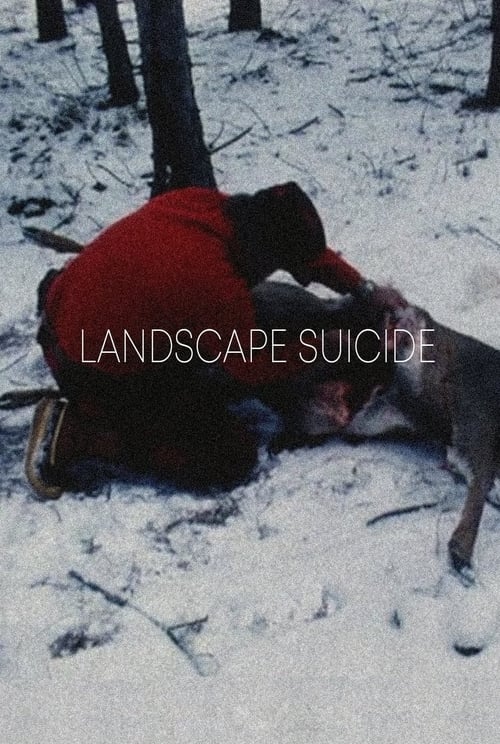
Landscape Suicide
1987 · James Benning
For when you want to sit with something contemplative and unsettling rather than be thrilled — a patient, chewy film for viewers who like doing the work. Definitely a challenge, not a comfort.
What it's about
Two American murder cases, held side by side: a California teenager who stabbed a classmate to death in an affluent Bay Area suburb in 1984, and Ed Gein, the Wisconsin farmer whose crimes in the 1950s made him the most mythologized killer in American culture. James Benning approaches both through the killers' own recorded words and long, fixed shots of the ordinary places where the violence happened.
The experience
Slow, quiet, and quietly chilling — no reenacted violence, no true-crime music cues, just landscapes, transcripts, and the space between them where you do the connecting yourself. It builds a hush that stays with you.
The craft
Shot on 16mm with Benning's signature fixed frames, the film separates word from image: interrogation transcripts delivered flatly to camera, then long takes of suburbs, farmland, and winter roads. The refusal of drama is the technique — the banality of the places becomes the horror.
Why it matters
A touchstone of American avant-garde cinema and the clearest early statement of Benning's landscape method, it anticipated decades of arguments about how true crime should — and shouldn't — be told.
Snapshot
Landscape Suicide is James Benning's 95-minute, 16mm diptych on two American murders, and it remains the clearest statement of the method that would define the rest of his career: the fixed frame, the recorded place, and the criminal's own words, held apart from one another so that the viewer has to do the joining. The first half concerns Bernadette Protti, a fifteen-year-old who stabbed her Miramonte High School classmate Kirsten Costas to death in the affluent Bay Area suburb of Orinda in June 1984, confessed months later, and was adjudicated in juvenile court. The second concerns Ed Gein, the Plainfield, Wisconsin farmer arrested in November 1957 after the disappearance of the hardware-store owner Bernice Worden, whose grave-robbing and manufacture of objects from human remains made him the most mythologized criminal in postwar American culture. Benning refuses both the true-crime idiom and the horror idiom that Gein had already spawned. Instead he interleaves long static shots of Orinda and of rural Wisconsin with scenes in which actors, seated in a locked frame and facing the lens, speak language drawn from the case records to an interrogator who is never shown. The film's title is its argument: that these acts belong to their ground.
Industry & production
Benning has never worked inside the American film industry in any meaningful sense, and Landscape Suicide was made outside it entirely. Since the mid-1970s he had financed his films through the ecology that sustained the American avant-garde in that period — arts fellowships, university teaching, rental income from a self-managed distribution practice, and personal money — and produced them essentially alone, functioning as his own producer, camera operator, sound recordist, and editor. No verified budget figure for Landscape Suicide exists in the public record, and the documentation of its shooting schedule, crew (if any beyond Benning), and post-production is genuinely thin; what is well established is the general economy of the practice, which was measured in thousands rather than millions and imposed real material discipline on how much film could be exposed.
The year of the film's completion is also the year Benning joined the film/video faculty at the California Institute of the Arts, where he would teach for roughly three decades. That fact matters institutionally as well as biographically: it marks the migration of American experimental filmmaking from the co-op and loft screening culture of the 1960s and 1970s into the art school and the museum. Landscape Suicide circulated accordingly — through festival sidebars hospitable to avant-garde work, cinematheques, museum programs, and university screenings, with Benning himself frequently present — rather than through any form of theatrical release. The film's institutional afterlife has been substantially European, and Austrian in particular: the Österreichisches Filmmuseum in Vienna became the principal custodian of Benning's reputation, publishing the standard monograph on him (James Benning, edited by Barbara Pichler and Claudia Slanar, 2007) and mounting the retrospectives that consolidated his canonical status.
Technology
The film is a photochemical object, and its formal decisions are legible as responses to photochemical constraints. Shot on 16mm color stock with location sync sound, it was made in the last decade before video assist, nonlinear editing, and cheap digital acquisition changed the arithmetic of the long take. A 400-foot 16mm magazine runs roughly eleven minutes at 24 frames per second; every foot cost money Benning did not have in quantity. The result is a filmmaker who framed by eye through a reflex viewfinder, could not review a take, and had to decide before rolling how long a shot deserved to be. Benning's later durational work — the ten-minute shots of 13 Lakes and Ten Skies (both 2004) — is often described as a purely conceptual rigor, but it is also the systematization of a habit that 16mm economics taught him.
Editing was done photochemically on a flatbed, with the film conformed and printed at a lab; the on-screen text that carries case information had to be generated optically rather than typed into a timeline. Sound was recorded on location and married in post, which is why the film's ambiences have the density and slight hiss of direct recording rather than the sweetened cleanliness of a library track. Benning would not move to digital acquisition until Ruhr (2009), more than twenty years later, and the difference is audible and visible: Landscape Suicide has the grain, the color shifts across the day, and the slight instability of emulsion, all of which contribute to the sense that these landscapes are being witnessed rather than illustrated.
Technique
Cinematography
Benning photographs the film himself, as he does nearly all his work, and the grammar is austere and consistent: the camera is on a tripod, the frame is locked, the lens is chosen so that the composition reads as a considered rectangle rather than a snapshot. There is no handheld reportage, no Steadicam, no camera movement mobilized for emphasis. Depth is organized graphically — road, treeline, roofline, horizon — in a way that owes as much to landscape painting and to the American topographic photography of the 1970s (Robert Adams, Lewis Baltz, Stephen Shore) as to any cinematic tradition. The two halves are chromatically and texturally distinct: California's Orinda offers dry hills, freeway edges, ranch-house streets and the pale flat light of a Mediterranean climate; Wisconsin offers snow, bare hardwood, farm buildings and low gray sky. The contrast is not decorative. It is the film's way of insisting that "American violence" is not one thing but a set of local conditions.
The interrogation scenes use the same fixed-frame logic turned inward. The performer sits centered, addressing the lens, in a shallow and largely undescriptive space. Benning gives the confessional material exactly the same optical treatment as a hillside: no reaction shots, no cutaways, no coverage. The camera does not move closer as the testimony intensifies, which is precisely the point — it declines the standard grammar by which cinema signals that we are approaching truth.
Editing
The film's structure is arithmetical, in keeping with Benning's training as a mathematician before he came to film. It is built as two parallel movements, each alternating landscape blocks with testimony blocks, so that the second half rhymes against the first rather than continuing from it. Within blocks, cuts are hard and unornamented; there are no dissolves smoothing the transition from a road to a face. Compared with the extreme durational patience of his later work, the shots here are relatively short and relatively numerous — Landscape Suicide is a film of many long-ish takes rather than a few enormous ones — and Benning still uses on-screen text as an organizing device, a technique he had pushed furthest in American Dreams (lost and found) (1984). The editing's most consequential decision is an omission: the murders themselves are never staged, never reconstructed, never shown. The film cuts around the act, leaving a hole at its center that the landscape shots are made to circulate around.
Mise-en-scène / staging
Outdoors, Benning stages nothing; he selects. The mise-en-scène is the found world of Orinda and Plainfield, chosen and framed. Indoors, the staging is deliberately impoverished — a chair, a body, a wall — approximating the visual poverty of a police interview room or a deposition. This anti-illusionist minimalism is a critical position. The film arrives at the same historical moment as a wave of documentary reenactment, but where reenactment conventionally works to make the past vivid, Benning's staging works to make it flat, verbal, and legally shaped. What we are watching is not the crime but the institutional residue of the crime: the transcript, the answer given to the question asked.
Sound
Sound carries at least half the film's meaning. The landscape passages are accompanied by their own recorded ambience — wind, birds, distant traffic, machinery, the specific hum of a suburban afternoon or a frozen field — and there is no non-diegetic score to tell us how to feel about any of it. The absence of music is the single most anti-generic choice in the film, since scoring is the primary instrument by which true crime converts information into dread. In the testimony scenes, the questioner remains off-screen and disembodied, which places the viewer uncomfortably in the interrogator's seat while denying the reassurance of an on-screen surrogate. The result is a soundtrack that treats a girl's voice and a farmer's voice and a field of snow as equally available evidence, all recorded with the same attention.
Performance
The performances are given by Rhonda Bell as Protti and Elion Sacker as Gein; the biographical record on both performers is slight. Benning does not direct them toward psychological inhabitation. They deliver the case language in a register closer to recitation than to impersonation — affect withheld, rhythm slightly off the naturalistic beat — so that the viewer remains aware of a person speaking words that belong to someone else. This is the film's ethical hinge. A conventionally "great" performance would offer access to the killer's interiority and thereby manufacture an understanding the historical record cannot support. Benning's flattened delivery refuses that transaction and leaves the words as words: self-serving, banal, sometimes childish, occasionally horrifying, and never sufficient.
Narrative & dramatic mode
Landscape Suicide is not a narrative film and does not pretend to be one. It is an essayistic diptych organized by juxtaposition, closer in mode to the paired case study than to the story. Nothing is dramatized in the ordinary sense: there is no rising action, no revelation, no verdict delivered as climax. What the film offers instead is a set of relations — between a place and a sentence, between two crimes forty years and two thousand miles apart, between the language of confession and the silence of terrain — and it declines to resolve them. The viewer is positioned less as an audience than as a juror handed an incomplete file, and the film's real drama is the discomfort of that position: the pull toward explanation and the film's steady refusal to supply one.
The pairing itself is the film's most audacious dramatic gesture. Setting a teenage girl's stabbing of a classmate over social humiliation beside Gein's necrophilic crimes is close to obscene by the standards of proportional judgment, and Benning knows it. The point is not that the two are equivalent but that both are American, both are local, and both were metabolized by the culture into stories — Gein into horror, Protti into a tabloid morality tale — that made the ground they grew from disappear.
Genre & cycle
The film sits at the intersection of three lineages without belonging comfortably to any. It belongs to the experimental-documentary essay film; to the landscape film, of which Benning is the most sustained American practitioner; and to true crime, which it enters in order to dismantle. Its position relative to that last cycle is the sharpest thing about it. By 1987 Ed Gein had been the raw material for Robert Bloch's Psycho (1959) and Hitchcock's film of it (1960), for Tobe Hooper's The Texas Chain Saw Massacre (1974) and Deranged (1974), and would soon underwrite Thomas Harris's Buffalo Bill in The Silence of the Lambs (1988). Benning approaches Gein directly and documentarily, which almost no one had done, and finds not a monster but a slow, evasive, unremarkable voice attached to a very particular patch of Wisconsin. There is a hard fact underneath the diptych: Gein died in July 1984, weeks after Kirsten Costas was killed in June of the same year. The two American stories overlap by a matter of days.
Authorship & method
Benning is the film's total author in the most literal sense — director, cinematographer, editor, and sound recordist — and the absence of the usual collaborators (no composer, no screenwriter, no DP) is itself a methodological statement. Born in Milwaukee in 1942, he took degrees in mathematics before an MFA at the University of Wisconsin–Madison in the mid-1970s, and the mathematician's habits are everywhere: films built on counts, symmetries, and constraints (One Way Boogie Woogie, 1977, with its sixty one-minute shots; 11 x 14, 1977). His early work was made partly in collaboration with Bette Gordon, who would go on to direct Variety (1983); their daughter Sadie Benning became a significant video artist in the 1990s, and their work has occasionally intersected.
Landscape Suicide is the middle panel of what functions as Benning's American violence trilogy. American Dreams (lost and found) (1984) sets a Hank Aaron memorabilia collection against the scrolling diary of Arthur Bremer, who shot George Wallace. Used Innocence (1988), made immediately after, concerns Lawrencia Bembenek, the Milwaukee police officer convicted of murder. Across the three, Benning develops the procedure he would return to decades later in Stemple Pass (2012), where static shots of a replica of Ted Kaczynski's Montana cabin across four seasons are accompanied by readings from Kaczynski's writings — the same architecture as Landscape Suicide, refined. Benning has often described his practice and his teaching alike as an education in looking and listening, and the phrase is exact: his films assign the viewer a task rather than delivering a thesis.
Movement / national cinema
The film descends from American structural film — the tradition P. Adams Sitney named in Visionary Film (1974), running through Michael Snow, Hollis Frampton, and Ernie Gehr — but Benning belongs to the generation that reopened structural form to social and documentary content. Where the first-generation structuralists used the fixed frame and the predetermined system to investigate perception and the film apparatus, Benning uses them to investigate America: labor, land use, race, industry, violence. This is the decisive move that separates his work from formalism and makes it available to political reading.
It is also a distinctly regional American cinema. Benning's Midwest is not a symbol but a set of specific counties, and his California is not Hollywood's but the state's actual topography of suburbs, freeways, and agricultural interior — the terrain he would map exhaustively in the California Trilogy (El Valley Centro, 1999; Los, 2000; Sogobi, 2001). Landscape Suicide is the film in which the two halves of his own biography, Wisconsin and California, are put in the same frame and asked to explain each other.
Era / period
1987 places the film precisely. The mid-1980s were when the serial killer completed his transformation from criminal category into cultural archetype, propelled by the FBI's Behavioral Science Unit, the national coverage of cases like Richard Ramirez's, and a publishing and television industry discovering an inexhaustible market. Reenactment-driven crime television was arriving — Unsolved Mysteries began in 1987, America's Most Wanted in 1988 — and Errol Morris's The Thin Blue Line would appear in 1988, making stylized reenactment a legitimate documentary instrument. Benning's film is a counter-move inside that exact moment: it takes the true-crime materials and strips out the machinery of fascination.
The Reagan-era setting is equally present in the landscapes themselves. The Orinda half is a portrait of achieved suburban affluence and its social ferocity, where exclusion from a high-school clique is a survivable humiliation everywhere except where it isn't. The Wisconsin half looks at an agricultural interior in decline — the farm crisis of the 1980s is the offscreen weather of those images. And institutionally, the film arrives just before the late-1980s culture wars over the NEA reshaped the funding environment that had made work like it possible.
Reception, canon & influence
Landscape Suicide was never widely reviewed in the mainstream press, and there is no meaningful box-office record because there was no commercial release. Its reception took place in the specialist critical and curatorial literature, where it was recognized quickly as a breakthrough. Benning's most durable American advocates were the critic Jonathan Rosenbaum and the scholar Scott MacDonald, whose interviews with Benning in the A Critical Cinema series and whose study of place-based independent film, The Garden in the Machine (2001), did much to establish the terms in which the work is discussed. The Vienna monograph of 2007 consolidated the European canonization, and the film is now routinely named among the essential Benning titles alongside One Way Boogie Woogie, American Dreams, Deseret (1995), and 13 Lakes.
Looking backward, the film's inheritances are clear enough: structural film's fixed frame and predetermined system; the New Topographics photographers' unsentimental attention to altered American land; the tradition of the nonfiction crime account descending from Truman Capote's In Cold Blood (1966), with its interest in a killer's own language and a specific American nowhere; and, in its refusal of psychological explanation, a broadly Brechtian distrust of identification that ran through the political modernism of the 1970s.
Looking forward, its influence operates less through direct citation than through the establishment of a viable model, amplified by Benning's thirty years of teaching at CalArts — an institution whose graduates and faculty have shaped a large share of American artists' moving-image practice. The landscape-as-evidence film, in which duration and place carry an argument that no voiceover states, runs through Sharon Lockhart's work, through Deborah Stratman's investigations of American violence and terrain, through Lee Anne Schmitt's essayistic portraits of California, and into the international slow-cinema documentary of Ben Rivers and others. The specific tactic of Landscape Suicide — verbatim testimony performed at a deliberate remove from naturalism — recurs, by convergence rather than demonstrable lineage, in Clio Barnard's The Arbor (2010) and in the reenactment ethics debated around Joshua Oppenheimer's The Act of Killing (2012). Gus Van Sant's Elephant (2003), which withholds explanation for adolescent murder and lets architecture and duration do the analysis, arrives at conclusions Benning had already framed.
The most direct legacy, though, is Benning's own. Stemple Pass and the Two Cabins project (2011) are Landscape Suicide's method applied to Kaczynski and, in counterpoint, to Thoreau — the American who withdrew into the woods to think, set against the one who withdrew into the woods to kill. That pairing is the 1987 film's structure rebuilt at a larger scale, and it confirms what the earlier work discovered: that in Benning's cinema the landscape is never innocent, and never merely a view.
A Deleuzian reading
A street in Orinda, California.
The full Deleuzian reading of Landscape Suicide →
Reception
Barely seen outside avant-garde circles on release in 1987, it has been steadily reappraised — helped by restorations of Benning's 16mm work — and now regularly gets named among his major films, with the true-crime boom making it look eerily ahead of its time.
How Landscape Suicide was received, from release to now →
How to watch Landscape Suicide: what to notice on a first viewing
- Watch the empty street stay on screen after nothing happens. Benning holds a locked shot of an ordinary place, a sprinkler, a parked car, long after you've taken in all the information it offers. The shot forces you to look at a place for its own sake, with no action waiting to happen in it.
- Notice how different the color feels in each half. California gives you dry hills and pale flat light, Wisconsin gives you snow, bare trees, and low gray sky, and the film never explains the switch. The two climates argue that violence is not one thing but a set of local conditions.
- Listen for the total absence of music. Wind, birds, traffic, and machinery fill the landscape passages, but no score ever tells you when to feel dread or relief. Without music cueing your reaction, whatever unease you feel is something you supplied yourself.
- Watch the speaker sit centered, facing straight at the camera. Both performers are locked in frame addressing an interrogator you never see, given the same flat, undescriptive space as a hillside or a farmhouse. You end up sitting in the interrogator's chair, with no one on screen to stand in for you.
- Notice the flat, recitation-like delivery of both speakers. Rhonda Bell and Elion Sacker speak case language with affect withheld, their rhythm just off natural speech, so you stay aware someone else's words are being said. The flatness keeps you from mistaking a recitation for a confession you actually understand.
The whole guide to watching Landscape Suicide, with the keys for a rewatch →
Influences: the films it descends from and the films it influenced
- Wavelength (1967) — Establishes the structural-film contract Benning works inside: a predetermined camera system (here a 45-minute zoom) runs to completion regardless of the human death that occurs in the room, so violence becomes an incident the apparatus declines to privilege.
- In Cold Blood (1967) — Shot in the actual Clutter farmhouse and along the killers' real Kansas route using Capote's verbatim confession material, it models the idea that the site of a murder, filmed as itself, is the primary document — the found-location half of Benning's method minus its noir lighting.
- (nostalgia) (1971) — Systematically desynchronizes an offscreen reciting voice from the image it describes, forcing the viewer to hold text and picture apart — the sound/image gap Benning reopens by letting transcript testimony play against landscapes that never illustrate it.
- Fortini/Cani (1976) — Pans across the Apuan Alps where Nazi massacres occurred while a flatly recited written text runs beside the images, inventing the exact figure Benning rebuilds: a landscape held long enough to be read as the scene of an atrocity that the camera arrived too late to see.
- One Way Boogie Woogie (1977) — Benning's own sixty locked one-minute 16mm shots of Milwaukee's industrial zone establish the mathematician's grammar — fixed tripod, fixed duration, no camera movement inside the take — that Landscape Suicide applies to two crime scenes instead of a city.
- News from Home (1977) — Reads found private text (her mother's letters) in an even, affectless voice over static and tracking shots of an indifferent New York, with traffic ambience allowed to bury the words — the found-text-over-unresponsive-place structure Benning adopts for trial transcripts.
- Gates of Heaven (1978) — Frames subjects head-on in symmetrical static compositions and lets them talk in long takes to an unheard, unacknowledged interviewer, with no narration and no score — the offscreen-interrogator setup Benning keeps while replacing the real speakers with actors.
- American Dreams (lost and found) (1984) — First panel of the American violence trilogy: Arthur Bremer's diary crawls across the bottom of the frame as scrolling text against a collection of baseball cards, proving out the intertitle/found-text device that Landscape Suicide promotes to a full structural principle.
- Shoah (1985) — Refuses archival footage entirely, setting spoken testimony against present-day shots of the emptied killing sites, so that duration on unremarkable terrain — a field, a rail spur — becomes the only available image of the crime.
- Deseret (1995) — Pushes the found-text method to a formal rule: 93 New York Times dispatches about Utah are read offscreen with a new locked Utah landscape shot cut in at every sentence, so editing rhythm is dictated by syntax rather than by anything in the image.
- Elephant (2003) — Swaps the locked tripod for the mobile long take but keeps Benning's wager intact — withhold all psychological explanation for the killing and let architecture, walking distance and real time perform the analysis that a voiceover would otherwise supply.
- California Company Town (2008) — Surveys abandoned California company towns in static 16mm frames with sparse narration drawn from company and government documents, treating depopulated terrain as the legible residue of economic violence — the landscape-as-evidence model taken from crime to capital.
- Double Tide (2009) — Builds an entire film from two locked long takes of the same clam digger on the same Maine mudflat at dawn and at dusk — Benning's diptych structure reduced to its minimum, where meaning is produced purely by the rhyme between two panels.
- O'er the Land (2009) — Composes American ritual and terrain in static, unnarrated frames while the film's central catastrophe — a pilot's fall through a thunderstorm — is delivered only as recited text, so the violence is never staged and never illustrated.
- The Arbor (2010) — Has actors lip-sync verbatim recorded interviews while standing in the actual Buttershaw estate, producing the same deliberate seam between authentic testimony and an obviously performing body that Benning gets from transcript recitation.
- Stemple Pass (2012) — The 1987 structure rebuilt at maximum scale: four 30-minute static shots of a replica Kaczynski cabin across four seasons, with Benning reading the killer's own journals offscreen — same locked frame, same verbatim source text, duration multiplied.
- The Act of Killing (2012) — Returns perpetrators to their own killing sites to perform their accounts in openly artificial registers, extending Benning's refusal to render a murderer's speech naturalistically — though it dramatizes what he leaves as a flat recitation against an empty road.
- Landscape (for Manon) (1987) — Arrives the same year at the same discipline of the composed static 16mm landscape held far past narrative usefulness, but from the opposite pole of sound — total silence where Benning keeps raw location ambience — isolating the frame itself as the unit of argument.
Similar films
- In Cold Blood (1967) — influence & lineage
- Wavelength (1967) — influence & lineage · often watched together
- Elephant (2003) — influence & lineage · often watched together
- News from Home (1977) — influence & lineage · often watched together
- The Act of Killing (2012) — influence & lineage · often watched together
- Edvard Munch (1974) — often watched together
- Weekend (1967) — often watched together
- Koyaanisqatsi (1983) — often watched together