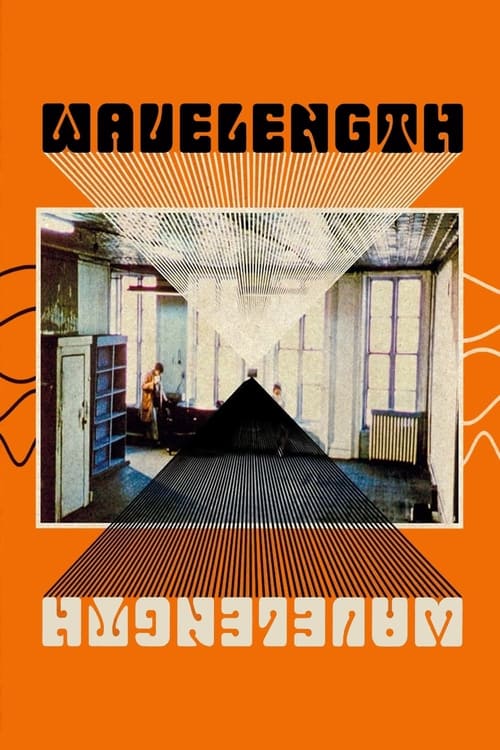
Wavelength
1967 · Michael Snow
For when you're curious rather than tired — a sit-with-it experiment for a focused, distraction-free hour, ideally when you want to test what a film can even be. All challenge, zero comfort.
What it's about
One room, one camera move, forty-five minutes. In a Lower Manhattan loft, the lens creeps by slow zoom toward a small photograph of ocean waves pinned to the far wall, while fragments of human incident — a radio, people passing through, something that in any other film would be the plot — drift in and out at the edges. A single electronic tone climbs steadily underneath, from a low hum to a piercing height.
The experience
Demanding, hypnotic, and genuinely confrontational — the fixed trajectory and rising sine tone build real physical tension out of almost nothing. Some viewers find it transcendent, others maddening; either way, you feel time passing in a way no ordinary film lets you.
The craft
The entire film is one structural idea executed with total commitment: the zoom as narrative, the room as world, the climbing tone as score, with flickers of color and film-stock texture as events in themselves. Michael Snow makes the camera itself the protagonist — it registers a human drama and refuses to turn toward it.
Why it matters
The most argued-over film of the postwar American avant-garde and the cornerstone of what came to be called structural film — a work that generations of experimental filmmakers, gallery artists, and film courses define themselves against.
Snapshot
Forty-five minutes, 16mm, one room, one direction. Michael Snow's Wavelength takes a camera fixed at one end of an eighty-foot loft on Canal Street in Lower Manhattan and moves it — by zoom, not by tracking — toward the far wall, where a small photograph of ocean waves is pinned between two windows. Over the course of the journey a bookcase is carried in, a radio plays, a man enters and falls dead, a woman discovers the body and telephones someone about it. None of these events deflects the camera. The lens keeps closing, indifferent, and comes to rest inside the photograph, the sea filling the frame, before the image gives out into whiteness. Beneath and around all of it runs a sine tone climbing from a low hum to a shriek at the top of hearing.
It is the most argued-over film of the postwar American avant-garde and, along with Andy Warhol's early durational work, the film that made it possible to talk about cinema as a medium whose subject could be its own act of looking. P. Adams Sitney's coinage "structural film," introduced in 1969, was built substantially on it. Annette Michelson's 1971 Artforum essay "Toward Snow" read the zoom as an analog of consciousness itself — of expectation, projection, the forward lean of knowing. Manny Farber, reviewing it for the same magazine, called it a tough, pure forty-five minutes that might become the Birth of a Nation of underground film. Very few experimental works have been canonized that fast or held that position that long.
Industry & production
There is no industry here in any conventional sense. Snow, a Toronto-born painter, sculptor, photographer and working jazz pianist, had moved to New York in 1962 with the artist and filmmaker Joyce Wieland, his wife; the couple lived and worked in a loft at 300 Canal Street. That loft is the film's entire location, and its landlord-grade particulars — the row of industrial windows, the traffic noise off Canal, the yellow chair, the bare floor — constitute the whole of the production design.
The shoot occupied roughly a week in the winter of 1966–67, with Snow operating alone or nearly alone and his friends supplying the human incidents. Precise budget figures for Wavelength are not part of the reliable record, and it would be an invention to supply one; what can be said is that the film was made on the artist's own resources at the scale that 16mm stock, a rented lens and a handful of unpaid performers imply. Snow was at that point supporting himself as an artist rather than a filmmaker — 1967 was also the year he supplied Walking Woman sculptures to the Ontario Pavilion at Expo 67 in Montreal — and Wavelength belongs to a studio practice, not a production pipeline.
Its distribution followed the co-op model that the New York avant-garde had built for itself: prints circulated through the Film-Makers' Cooperative, and subsequently through the Canadian Filmmakers Distribution Centre, founded the same year in Toronto. The film's career was made not by a release but by a festival. At the fourth International Experimental Film Competition at Knokke-le-Zoute, Belgium, held across the 1967–68 New Year, Wavelength took the Grand Prize — a verdict that transformed a private loft experiment into an international event and made Snow, almost overnight, the most discussed artist-filmmaker outside Warhol's orbit.
Technology
The film's technological premise is a single instrument: the zoom lens. A zoom does not move through space; it re-frames it, magnifying a portion of a fixed image. This distinction is the film's entire intellectual engine, and it is a distinction that only became available to artists once variable-focal-length lenses became cheap and common on 16mm cameras in the 1960s. Wavelength is unthinkable a decade earlier.
Snow used the rest of the 16mm toolkit as a set of variables rather than as a transparent recording apparatus. He shot on more than one stock, including stock past its date; he held colored gels in front of the lens; he varied exposure deliberately and let the room slide from daylight to night and back; superimpositions layer earlier stages of the zoom over later ones, so the room haunts itself. Flash frames, negative and near-solarized passages, and visible splices puncture the illusion of a single unbroken movement. The apparent continuity of the zoom is a construction, assembled from many discrete camera runs, and the film is candid about this.
The soundtrack's central element — a sine tone generated by an audio oscillator, rising by glissando from a very low frequency to a very high one — was, in 1967, a piece of laboratory equipment repurposed as a musical instrument, in the same spirit as the drone and phase experiments then current in downtown New York. It is also the film's most fragile technical element: the top of the sweep sits where speaker systems and, later, lossy digital transfers begin to fail. Wavelength is a work whose meaning depends materially on projection conditions, which is one reason its custodians have insisted on film prints. Snow himself later produced WVLNT (Wavelength For Those Who Don't Have the Time): Originally 45 Minutes, Now 15! (2003), which folds the film into three superimposed fifteen-minute layers — a wry acknowledgment that the work's relationship to its own duration had become a curatorial problem.
Technique
Cinematography
The camera does not move once. Everything that reads as movement is optical. The frame begins wide enough to hold the loft's whole depth — floor, windows, street beyond — and narrows in stages until the far wall's small rectangle of sea is all there is. Because a zoom flattens as it magnifies, the room does not so much recede as compress: the space the viewer thought they were entering turns out to be a picture getting bigger.
Snow calibrates this with color. The gels and stock changes mean the loft is never stably one place; it turns magenta, then blue-green, then blanches, and the street outside cycles through night and day irrespective of the fictional continuity. Exposure is pushed until the windows blow out into pure light. This is cinematography as spectral analysis — the "wavelength" of the title referring as much to the physics of light and sound as to the length of the loft, the length of the film, and the photographed waves at the end.
Editing
The film is often loosely described as a single shot; it is not, and the misdescription is itself instructive. Snow's cuts are frequently visible, and he does nothing to hide the change of stock or the jolt of a new exposure. The editing logic is not continuity but accumulation along a single vector. Nothing can be cut away to, because there is no elsewhere; there are no reverse angles, no inserts, no coverage of the death that occurs in the middle of the frame. What the film substitutes for editing's usual work — selection, emphasis, dramatic causality — is the monotonic, irreversible narrowing of attention. Superimpositions in the later passages perform a kind of temporal editing instead of a spatial one, letting the film's own past bleed into its present.
Mise-en-scène / staging
Staging is subordinated to the frame's contraction, and the contraction is the plot. Early on, when the field is wide, human activity has room: figures cross, carry furniture, occupy the floor. As the aperture of attention closes, the humans are progressively cropped out of relevance. The dying man falls in a part of the room the zoom will soon abandon; by the time the woman makes her phone call, she is already at the edge of a shot that no longer cares about her. Snow has effectively built a mise-en-scène with an expiry date, in which the set itself is consumed.
The far wall is the film's one designed object: a small array of pinned images, among them the photograph of waves that turns out to be the destination. That the film's terminus is a still photograph — a flat, motionless, mechanically reproduced image of the most restless thing there is — is the joke and the thesis at once.
Sound
Three layers. First, the ambient and sync sound of the loft: footsteps, traffic on Canal Street, an offscreen crash of glass that precedes the man's collapse, the woman's flat telephone speech. Second, a radio playing the Beatles' "Strawberry Fields Forever," which stamps the film with a precise cultural moment. (A chronological note worth flagging rather than smoothing over: the single was released in February 1967, while the shoot is usually dated to December 1966 — which at minimum indicates that the soundtrack was assembled after the fact rather than captured live. The published record on the film's exact sound post-production is thin.) Third, the sine glissando, which by Snow's own program note travels from its lowest to its highest pitch over roughly forty minutes.
The tone is the film's other zoom. It performs the same operation on the ear that the lens performs on the eye — a single irreversible narrowing toward a point — and because rising pitch is physiologically stressful, it converts the viewer's patience into something closer to dread. Snow, a practicing musician, is explicit that the film is structured as a crescendo.
Performance
The performers, drawn from Snow's downtown circle, include the filmmaker and theorist Hollis Frampton, who plays the man who collapses, and Amy Taubin — later a significant film critic at the Village Voice, Film Comment and Sight & Sound — who discovers the body and telephones. Joyce Wieland appears among the figures in the loft's early sequences; other credited participants come from the same artist community. Performance style is deliberately unmodulated: entrances and exits are executed as tasks, the death is undramatized, the phone call is delivered without inflection. Nobody plays to a camera that is visibly not watching them.
Narrative & dramatic mode
Wavelength contains, in outline, the components of a thriller: an unexplained sound of breaking glass, a body, a witness, a call for help. It then refuses every obligation those components create. No investigation follows. The dead man is not identified. The person on the other end of the phone never arrives. The camera, having been offered a crime, declines it and continues toward a picture of the sea.
The dramatic mode is therefore best described as narrative held in suspension — genre material used as bait to make visible the viewer's own appetite for story. Michelson's reading, still the most influential, treats the zoom as the film's protagonist: an entity with intention and horizon, whose forward movement generates suspense in the purest possible form, since the only question the film poses is what is at the end. Snow's own account of the project — his wish to make what he called a definitive statement of pure film space and time, a balancing of illusion and fact, all about seeing — is consistent with this. The film's drama is epistemological. Something is going to be arrived at, and the arriving is the plot.
Genre & cycle
Database taxonomies file Wavelength as "Drama," which is a category error worth naming: the film belongs to the avant-garde, and specifically to the cycle that Sitney would christen structural film in Film Culture in 1969 and elaborate in Visionary Film (1974). Sitney's structural film was defined by a shape known in advance and by a small set of devices — fixed camera position, flicker, loop printing, rephotography — and Wavelength fits the definition slightly awkwardly, since its "fixed camera" is fixed only in position while its lens is in constant motion. Sitney treated the zoom as the predetermined shape, and Wavelength became the paradigm case anyway.
Its cycle-mates are Tony Conrad's The Flicker (1966), Paul Sharits's Ray Gun Virus (1966) and N:O:T:H:I:N:G (1968), Ken Jacobs's Tom, Tom, the Piper's Son (1969), Ernie Gehr's Serene Velocity (1970) and Frampton's Zorns Lemma (1970). In Britain the tendency hardened into theory as Peter Gidal's "structural/materialist film," with Malcolm Le Grice, William Raban and Chris Welsby working in parallel.
Authorship & method
The credits are essentially one name. Snow conceived, shot, edited and designed the sound of Wavelength; there is no cinematographer, no composer, no editor, no screenwriter to distribute the authorship among. His collaborators are the performers, and their contribution is presence rather than interpretation — though the presence of Frampton and Wieland, both major artists in their own right, marks the film as a document of a specific creative community as well as a formal exercise.
Method matters more than collaboration here. Snow came to film from painting and sculpture, by way of a stint in the mid-1950s at Toronto's Graphic Associates animation studio, where he made his first film. Through the 1960s he pursued the Walking Woman Works, a single silhouetted figure serially re-executed across media, and that serial logic — one premise, exhaustively worked — carries straight into the films. He was also a jazz musician; his earlier New York Eye and Ear Control (1964) was built around a free-jazz score, and the compositional thinking in Wavelength's glissando is a musician's.
Wavelength opens the sequence of rigorous camera-premise films that defines Snow: ↔ (Back and Forth) (1969), which pans instead of zooms; One Second in Montreal (1969); La Région Centrale (1971), shot in the Quebec wilderness with a custom-built robotic camera mount that moves in every axis; the language experiments Rameau's Nephew… (1974) and So Is This (1982); and, decades later, Corpus Callosum (2002). Each isolates a single cinematic parameter and pushes it to its limit.
Movement / national cinema
The film sits on a border. It was made in New York, by the New York underground's own means, and it belongs to the American avant-garde's canon without qualification. It was also made by a Canadian who returned to Toronto in the early 1970s and became, arguably, the central figure in Canadian art of the second half of the twentieth century — public sculpture (Flight Stop at the Toronto Eaton Centre, The Audience at the city's stadium), photography, music, and a founding presence in the country's experimental film infrastructure. Both national canons claim it, and both claims are legitimate.
Its immediate cousins are not primarily filmic. Wavelength is contemporary with minimalist sculpture's serial objects and with the drone and phase music of La Monte Young, Tony Conrad, Terry Riley and Steve Reich; it shares their conviction that a single sustained process can carry a whole work. Snow's proximity to that milieu, as an artist and a musician rather than a spectator of it, is the most useful context for the film.
Era / period
1967 is the year of Canada's centennial and Expo 67, of Sgt. Pepper and "Strawberry Fields Forever," of the New American Cinema's consolidation and of a New York art world in which the boundary between gallery and cinema was dissolving. Warhol's Chelsea Girls had reached commercial theaters the previous year; the underground was briefly, genuinely famous. Wavelength arrives at the point where that scene's anarchic phase gives way to a rigorous, quasi-scientific one — where the avant-garde stops being bohemian and starts being systematic.
It also arrives just as film studies is becoming an academic discipline and as art criticism turns toward cinema. Artforum's engagement with film in the late 1960s and early 1970s, and the founding of October by Annette Michelson and Rosalind Krauss in 1976, gave Wavelength an interpretive apparatus of unusual sophistication. The film and its criticism grew up together.
Themes
Seeing as a physical process. The film treats attention as something with mass and duration, that takes forty-five minutes to cross a room and cannot be recalled.
Irreversibility. The zoom cannot go back. Neither can the sine tone, nor the film in the projector, nor the man on the floor. Snow described wanting a time monument in which equivalence — beauty and sadness at once — could be celebrated, and the film's melancholy comes from its single unrepeatable direction.
Illusion versus fact. The room is both a real place with real dust and a two-dimensional image being magnified. The film keeps both readings live and refuses to choose.
The image inside the image. The destination is a photograph, and a photograph of moving water at that. The zoom's reward for forty-five minutes of forward motion is a still surface — an arrival that is also an admission that there was never any depth to reach.
Death without event. A man dies in the middle of the film and it changes nothing about what the film does next. This is either the coldest gesture in the American avant-garde or its most honest one about what a camera actually is.
Reception, canon & influence
The Knokke Grand Prize made the film's reputation instantly, and the reputation was contested from the start: the same duration that critics called rigorous, hostile audiences called an endurance test, and Wavelength has always been as much notorious as admired. But the serious criticism arrived quickly and at a high level. Farber's Artforum notice framed it as a foundational work. Sitney built a category around it. Michelson's "Toward Snow" (Artforum, June 1971) supplied the reading — the zoom as consciousness, the film as a grand metaphor for narrative expectation — that subsequent writing has been arguing with ever since. Snow's own program note, with its account of the sine glissando and its description of the setting and the action as cosmically equivalent, is among the most-reprinted artist's statements in experimental cinema, and its precision helped set the terms of debate.
Looking backward, the film's debts are legible. Warhol's fixed-camera durational films — Sleep, Empire — established that a camera could simply remain and that this could be the work; Snow added a vector. Minimalist sculpture supplied the ethic of a single declared premise. Drone and process music supplied the model of a sustained tone as structure. Snow's own New York Eye and Ear Control supplied the practice. And behind all of it sits the long-take realist tradition's faith in unbroken time, turned inside out: where André Bazin's cinema preserved the world's continuity for the sake of the world, Snow preserves it for the sake of the apparatus.
Looking forward, the influence is broad and traceable. Gehr's Serene Velocity answers Wavelength directly, producing pulsing pseudo-movement by shifting focal length on a locked camera. Frampton and Wieland's own subsequent films are in conversation with it. British structural/materialist film took it as a founding object. In the gallery, the film helped legitimize the moving image as an art-world medium and stands behind decades of durational installation work; in cinemas, the slow-cinema tendency of the last thirty years — films that make duration the primary material and let narrative dissolve into looking — draws on the permission Snow established, whether or not individual filmmakers cite him. Critics routinely place the contemporary long take's ambitions in this lineage; direct lines of transmission are harder to document than the family resemblance, and it is fairer to describe the relationship as an inheritance than as a debt.
Snow continued working until his death in Toronto in January 2023, at ninety-four, with retrospectives at major institutions on both sides of the border. Wavelength remained the work he was introduced by, sometimes to his visible impatience. It is still difficult, still divisive, and still doing exactly what it set out to do: making an audience aware, minute by minute, that they are looking at something, and that looking takes time.
A Deleuzian reading
Midway through, a man walks into the loft, something in him gives out, and he goes down on the floor.
The full Deleuzian reading of Wavelength →
Reception
It won the Grand Prize at the Knokke-le-Zoute experimental film festival in 1967 and was almost instantly enshrined as the defining 'structural film' — and it's held that spot ever since, less reappraised than permanently installed, the avant-garde title even people who've never seen it feel obliged to have an opinion on.
How Wavelength was received, from release to now →
How to watch Wavelength: what to notice on a first viewing
- Watch the frame slowly narrow toward the far wall the whole time. The shot is one continuous zoom across an eighty-foot loft, magnifying rather than traveling, so the room compresses instead of opening up. The film treats the room less as a place to explore than as a picture waiting to be magnified.
- Notice the color of the room change without anyone touching a light. The loft turns magenta, then blue-green, then blanches out, the color shifting independent of anything happening in the story. The color is doing its own work, on its own schedule, regardless of what's happening in the room.
- Listen for a single tone slowly climbing higher over the whole film. A sine tone rises steadily from a low hum toward the edge of hearing, running on its own schedule alongside the zoom. The tone performs on your ear exactly what the lens performs on your eye, a single narrowing in a different material.
- Notice the visible jumps and splices inside what looks like one shot. What reads as a single unbroken zoom is actually cut together from visible splices and stock changes that the film does nothing to hide. The film is honest about its own machinery even while performing an illusion of one continuous motion.
- Watch how little room the frame leaves for people as it narrows. Early on people cross the wide loft freely; as the zoom tightens, anyone in the room gets cropped toward the edge of what still matters to the frame. The space itself decides what counts as important, not anything a person does in it.
The whole guide to watching Wavelength, with the keys for a rewatch →
Influences: the films it descends from and the films it influenced
- Sleep (1963) — Established the fixed-camera durational premise Snow inherits — one subject held far past narrative usefulness, with reel-change flares and looped repeats left in as the film's only 'events'.
- Empire (1964) — Eight hours on a single locked-off setup proved that a declared premise plus running time can be the entire structure; Snow keeps the premise and adds one vector of movement to it.
- New York Eye and Ear Control (1964) — Snow's own prior film supplied the method — a single serial motif (the Walking Woman cut-out) exhaustively re-executed against a sustained free-jazz sound field, the template for Wavelength's one-premise/one-tone design.
- Arnulf Rainer (1960) — Metric film built from a precalculated score of clear/black frames and tone/silence — the precedent for composing a film from one predetermined parameter rather than from shots.
- The Flicker (1966) — A single-parameter structure driven toward crescendo with an escalating sound element and an explicit audience-endurance contract, which Wavelength's 45-minute sine glissando restates in spatial terms.
- Vertigo (1958) — The dolly-zoom made a change of focal length itself the dramatic event; Snow strips away the counter-dolly and lets the zoom's optical flattening carry the drama unaided.
- Rope (1948) — A thriller sealed in one apartment in near-unbroken time, structured around a body and a concealed splice — Snow keeps the room, the corpse and the withheld crime but makes the splices visible.
- Man with a Movie Camera (1929) — Snow's structural film strips away every element except the camera's own optical transformation — a 45-minute zoom across a loft — making the mechanism's spatial-temporal capacity the sole subject, the logical terminus of Vertov's axiom that cinema's truth lies in what the apparatus can do rather than what it depicts.
- Back and Forth (1969) — Substitutes the horizontal pan for the zoom — one machine-driven axis accelerated to a blur, then closed with a superimposition, replicating Wavelength's accumulation-along-a-single-vector architecture.
- Serene Velocity (1970) — Answers Wavelength directly: a locked camera in an institutional corridor with the zoom reset in incremental focal-length pairs, producing pulsing pseudo-movement from the same lens Snow ran continuously.
- Zorns Lemma (1970) — Frampton — Wavelength's dying man — built his feature on a fully declared arithmetic system of one-second shots and substituted letters, formalizing the structural contract that a film's shape be knowable in advance.
- La Région Centrale (1971) — Extends apparatus-as-protagonist to a purpose-built robotic arm moving the camera on every axis, with electronic tones cueing the machine — the zoom's single degree of freedom made total.
- (nostalgia) (1971) — A fixed frame on a hot plate while photographs curl and burn in real time, with narration describing the next image rather than the present one — duration-as-suspense plus deliberate sound/image displacement.
- Room Film 1973 (1973) — The British materialist reply: one room scanned in low light until grain and emulsion become the subject, taking Wavelength as founding object while refusing even its single vector.
- Hotel Monterey (1973) — Silent, static frames and slow advances through a building's corridors, lobbies and elevators until architecture rather than incident is the subject — the room-as-protagonist inheritance at feature scale.
- Jeanne Dielman, 23 quai du Commerce, 1080 Bruxelles (1975) — Undramatized task-based performance held in fixed frontal apartment shots for hours, so that accumulated duration alone builds the suspense a withheld act of violence finally discharges.
- Goodbye, Dragon Inn (2003) — Long locked takes of a cinema emptying, the space contracting toward a final held frame of the auditorium itself — the slow-cinema inheritance of duration as primary material rather than a documented debt.
- Gerry (2002) — Structural-film insistence on a single sustained formal gesture across real time, normalizing duration and minimal incident as a rigorous compositional system rather than a failure of event.
- The Meetings of Anna (1978) — The New York structural-film duration Akerman absorbed circa 1971—privileging the fixed apparatus and elapsed time as the subject—licenses her long, event-poor takes.
- Syndromes and a Century (2006) — Apichatpong's structural-film training surfaces in the closing sustained, unmotivated push into the hospital's ventilation duct — a durational camera gesture divorced from character, exactly Snow's zoom-as-form logic.
- Sailboat (1967) — Wieland, on screen in Wavelength, made her own one-idea film the same year — a single boat held in frame under a lettered title — from the same Toronto/New York reductive premise and equipment.
- N:O:T:H:I:N:G (1968) — Color-field frames and a tone-based sound track organized as one sustained progression, the parallel late-60s move to make raw stock, pitch and duration the material rather than the vehicle.
Similar films
- Blue (1993) — same viewing thread · often watched together
- Vertigo (1958) — influence & lineage
- Rope (1948) — influence & lineage
- As I Was Moving Ahead Occasionally I Saw Brief Glimpses of Beauty (2000) — same viewing thread · often watched together
- Goodbye, Dragon Inn (2003) — influence & lineage · often watched together
- Last Year at Marienbad (1961) — often watched together
- The Hypothesis of the Stolen Painting (1978) — often watched together
- News from Home (1977) — often watched together
All the films related to Wavelength →
Watch it with: curated runs of related films
- Landmarks of the Avant-Garde — Watch these together when you want cinema stripped to its essentials — a life, a corpse, a color, a single camera move — each one testing what film can be without story.