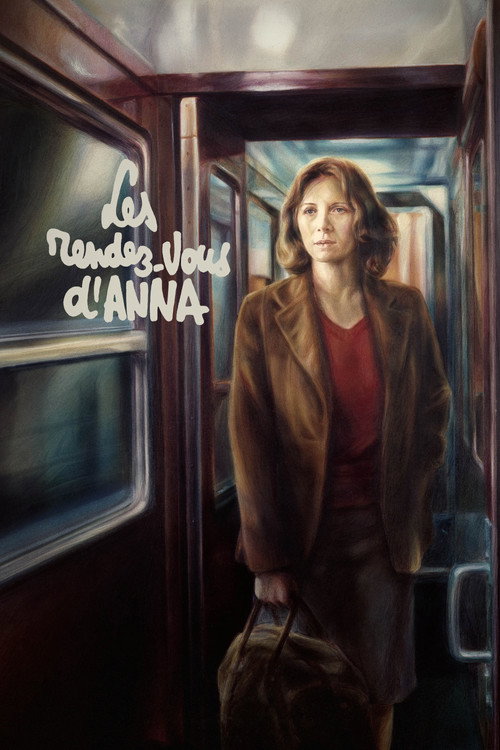
The Meetings of Anna
1978 · Chantal Akerman
For a solitary, contemplative night when you want cinema as a mood rather than a plot — something to sink into and sit with. This is a challenge, not comfort viewing, but if you've ever felt like a stranger in your own life it will find you.
What it's about
Anna, a Belgian filmmaker, travels by train through Europe to present her latest film — Cologne, then onward through a chain of hotel rooms, station platforms, and brief encounters. Strangers, an old flame, her mother: everyone she meets unburdens themselves to her, while Anna herself stays courteous, tender, and just out of reach.
The experience
Slow, hushed, and hypnotic — a film of long stillnesses where the emotion gathers in what isn't said. It leaves you with a particular ache: the loneliness of being the person everyone confides in, drifting through rooms that all look the same.
Performances
Aurore Clément carries nearly every frame as Anna, doing extraordinary work mostly by listening — her guarded face making each confession land on us instead. Lea Massari's turn as her mother gives the film its warmest, most piercing passage.
The craft
Chantal Akerman composes every shot with frontal, symmetrical precision — corridors, beds, and train windows framed like altarpieces, the camera holding still while people talk. The formal control isn't coldness; it's how the film lets a postwar Europe's unease seep into hotel rooms, and on a big screen the compositions become quietly overwhelming.
Why it matters
Akerman's first fiction feature after her landmark breakthrough, now regarded as one of the great films about the traveling artist's solitude and a touchstone for generations of filmmakers drawn to stillness.
Chantal Akerman's first fiction feature after Jeanne Dielman sent a version of herself out into the world: Aurore Clément plays Anna, a Belgian filmmaker drifting by train from one European city to the next to present her latest film, receiving confessions from strangers, lovers, and family in a chain of hotel rooms and station platforms. Akerman frames it all with her signature frontal symmetry — corridors, beds, and windows arranged like altarpieces, the camera fixed while people unburden themselves to a woman who mostly listens. Beneath the stillness runs an entire continent's unease: the itinerary crosses a Germany still haunted by the war, and Anna's tender, evasive reunion with her mother (Lea Massari) carries the weight of Akerman's own family history as the daughter of a Holocaust survivor. Made when Akerman was still in her twenties, it is among cinema's great studies of the artist as perpetual transient — of someone at home only in transit — and its night trains, fluorescent lobbies, and half-lit phone calls have echoed through decades of slow, searching European cinema since. Few films have made loneliness look so composed.
A Deleuzian reading
A hotel room, shot head-on.
The full Deleuzian reading of The Meetings of Anna →
Reception
Released in the shadow of Jeanne Dielman and met with a muted, somewhat baffled reception, it spent decades as 'the other Akerman' — but restorations and the post-2015 Akerman revival have pushed it up to near-masterpiece status, with many now calling it her most personal film.
How The Meetings of Anna was received, from release to now →
Influences: the films it descends from and the films it influenced
- Jeanne Dielman, 23 quai du Commerce, 1080 Bruxelles (1975) — Akerman's own prior film establishes the head-on, dead-center fixed frame and refusal to cut away from duration that Anna carries out of the kitchen and into hotel rooms and station platforms.
- L'Avventura (1960) — Directly cited via the casting of Lea Massari (its vanished Anna) and its method of dwarfing figures against blank modernist architecture so that alienation is composed into the frame rather than acted.
- Journey to Italy (1954) — Supplies the episodic-journey armature: a transient protagonist drifting through hotels and postwar European interiors where landscape and history, not plot, produce the emotional crisis.
- Au Hasard Balthazar (1966) — Bresson's affectless 'model' performance and elliptical, undramatized staging underwrite Aurore Clément's neutral delivery and Akerman's stripping of psychological signposting.
- India Song (1975) — Duras's near-static tableaux of enervated bodies in transient diplomatic/hotel spaces, with narration detached from action, models Anna's monologue-driven encounters and held stillness.
- Late Spring (1949) — The low, frontal, locked-off camera and characters addressing near the lens against symmetrical domestic geometry is the compositional grammar Akerman secularizes into hotel rooms.
- Wavelength (1967) — The New York structural-film duration Akerman absorbed circa 1971—privileging the fixed apparatus and elapsed time as the subject—licenses her long, event-poor takes.
- Two or Three Things I Know About Her (1967) — Godard's frontal framing of a woman against the alienating grids of new European construction, with essayistic detachment, prefigures Anna's stations and high-rise thresholds.
- Stranger Than Paradise (1984) — Extends the deadpan static tableau and episodic-journey structure—blackout-separated single-take scenes of drifters in anonymous transit spaces—into American independent cinema.
- Vive L'Amour (1994) — Inherits the held fixed shot of lonely bodies in borrowed rooms, letting unbroken duration and dead air carry the ache of urban isolation exactly as Anna's hotel scenes do.
- Wendy and Lucy (2008) — Carries forward the minimalist road-film of a solitary woman in transit through unglamorous waystations, with plain fixed framing and withheld backstory.
- In Vanda's Room (2000) — Adopts the frontal fixed frame trained on a private room for durations far exceeding narrative need, turning domestic stasis into the film's subject as Jeanne Dielman/Anna did.
- Lost in Translation (2003) — Reworks the specific motif of the transient artist marooned in an international hotel, where loneliness is staged through the geometry of the room and the corridor rather than dialogue.
- Gerry (2002) — Pushes Akerman's durational stillness into extended real-time takes where the passage of time and space itself, not incident, becomes the drama.
- Stranger Than Paradise (1984) — His frontal, symmetrically composed static shots of lonely deadpan figures in bare interiors parallel Akerman's evacuation of expressive camera movement in favor of the held tableau.
- Portrait of a Young Girl at the End of the '60s in Brussels (1994) — The solitary young woman traversing European stations, streets and transient rooms in static long takes, punctuated by frank confessional encounters.
- Sátántangó (1994) — Shares the slow-cinema wager that unhurried real-time long takes, not montage, are the primary expressive tool for rendering exhausted postwar European interiority.
Similar films
- Stranger Than Paradise (1984) — influence & lineage
- The Passenger (1975) — same viewing thread · often watched together
- The Silence (1963) — same viewing thread
- Last Year at Marienbad (1961) — same viewing thread
- Persona (1966) — same viewing thread
- Face to Face (1976) — same viewing thread
- Journey to Italy (1954) — influence & lineage · often watched together
- L'Avventura (1960) — influence & lineage · often watched together
All the films related to The Meetings of Anna →
Watch it with: curated runs of related films
- The Fractured Self — A run of art films where identity, memory, and sanity refuse to stay solid — watch them near each other and the faces, silences, and doublings start to rhyme.