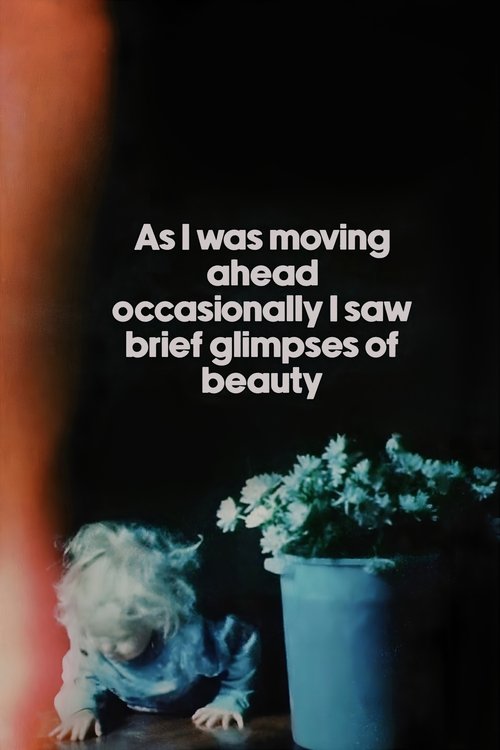
As I Was Moving Ahead Occasionally I Saw Brief Glimpses of Beauty
2000 · Jonas Mekas
For when you want to slow all the way down — a contemplative, meditative marathon for a day when you're thinking about time, family, and what a life adds up to. This is the far end of the challenge scale, and it repays surrender, not impatience.
What it's about
Jonas Mekas spent more than thirty years filming his own life on a wind-up 16mm camera — his marriage, his children growing up, meals with friends, gardens, snowfalls, weddings — and then assembled the footage into a nearly five-hour film, deliberately out of order. There's no plot, only a life: twelve chapters of ordinary days, with Mekas's own murmuring voice reflecting over the images about memory, happiness, and why he filmed at all.
The experience
Hypnotic and unexpectedly emotional — the flickering single-frame bursts feel like memory itself, and the sheer accumulation of ordinary joy becomes quietly overwhelming. It's long, and it's meant to be lived in rather than watched; drifting is part of the experience.
The craft
Everything here is handmade: hand-wound camera, in-camera editing, light flaring and stuttering, with Mekas's whispered voiceover and scraps of music laid over decades of home footage. The 'assembled by chance' structure is itself the craft — refusing chronology so that the film works the way remembering actually does. It's rough by design, and the roughness is where the beauty lives.
Why it matters
It stands as the culminating work of the diary-film form Mekas defined for American avant-garde cinema — proof that a life recorded casually, over decades, could become a monumental film — and it anticipated our era of compulsive everyday self-documentation.
Snapshot
A nearly five-hour first-person film assembled by Jonas Mekas from more than three decades of his own 16mm home-movie footage, As I Was Moving Ahead Occasionally I Saw Brief Glimpses of Beauty is the culminating statement of the diary-film form that Mekas, more than any other figure, defined for American avant-garde cinema. Running roughly 288 minutes and divided into twelve chapters, it gathers marriage, the birth and growing-up of his children, seasons in the country and the city, meals, gardens, weddings, funerals, and the faces of friends into a rhythm of single-frame bursts and murmured voiceover. Its premise — stated in an opening title and reiterated by Mekas himself — is that the material was strung together "by chance," without chronology, a curatorial abdication that becomes the film's deepest formal wager: that a life, sifted at random, still yields beauty. It stands as both a personal testament and a theoretical demonstration of what Mekas called filming "in the present tense."
Industry & production
The film belongs entirely to the non-industrial, artisanal economy of the postwar American avant-garde — a world Mekas himself had helped build. There is no studio, no producer in the commercial sense, and no conventional financing; the footage was shot privately over decades on Mekas's personal camera and only later constituted as a "film." Mekas (1922–2019) was uniquely positioned to make and circulate such a work: a Lithuanian displaced-person émigré who arrived in New York in 1949, he founded Film Culture magazine in 1954, wrote the influential "Movie Journal" column for The Village Voice, co-founded the Film-Makers' Cooperative (1962) as a distribution collective for independent artists, and co-founded Anthology Film Archives (1970), the museum and archive that became the institutional home of the American experimental tradition.
The film's production model is therefore inseparable from these institutions: it was made possible not by capital but by a lifetime's accumulation of exposed reels and by a distribution infrastructure — the Co-op, Anthology, and later the Paris-based imprint Re:Voir — capable of circulating a five-hour personal film to cinematheques, festivals, and museums. Precise budget and completion figures are not part of the public record in any verifiable form, and I will not invent them; what is documented is that the work emerged from the same hand-processed, self-distributed economy in which Mekas had operated since the 1950s.
Technology
The material substrate is the 16mm spring-wound Bolex, the instrument Mekas used throughout his diaristic career. The Bolex's mechanical constraints are not incidental but constitutive: its clockwork motor permits only short runs (on the order of a half-minute) before rewinding, and its single-frame and variable-speed capabilities invite the staccato, one-frame-at-a-time shooting that became Mekas's signature. Reversal color stock (of the Kodachrome/Ektachrome family typical of the era) gives the image its saturated, grainy, sun-struck quality, and the camera's hand-cranked immediacy encourages exposure that shifts, flares, and stutters with the operator's breath and movement.
The film's second technological horizon is the moment of its assembly around 2000, at the threshold of the digital turn. Mekas here remains committed to celluloid as origin and as final form, even as the wider culture — and eventually Mekas himself, in his later web-based 365 Day Project (2007) and digital diaries — moved toward video. The work was subsequently issued on DVD (notably by Re:Voir), a transfer that inevitably alters the flicker and grain of projected 16mm; the ideal encounter remains the filmic one. I am not able to verify the exact finishing chain (laboratory, telecine, or optical steps) from the reliable record and will not reconstruct it speculatively.
Technique
Cinematography
Mekas is his own cameraman, and the cinematography is the film's authorial voice made visible. He shoots almost entirely handheld, often in short single-frame or few-frame taps that produce a pulsing, discontinuous image — light itself seems to flicker and breathe. Whip-pans, sudden zooms, deliberate over- and under-exposure, lens flares, and superimpositions are treated not as errors to be corrected but as the very grammar of perception. This is a lyric, first-person camera in the tradition Mekas explicitly traced to Marie Menken: the frame registers the filmmaker's bodily presence — a turn of the head, a catch of breath, a spontaneous glance toward a child or a window of light. Color is intense and seasonal; snow, foliage, candle flame, and skin are rendered with a diaristic sensuousness that privileges the fleeting glimpse over the composed shot.
Editing
Editing is the film's conceptual center and its most radical gesture. Mekas foregrounds — in title and narration — that he assembled the reels "by chance," refusing chronology and thematic ordering. Much of the rhythmic "cutting," however, was performed in-camera at the moment of shooting, so that the montage is doubled: the micro-montage of single frames laid down years earlier, and the macro-arrangement of chapters made at the end. The result is a paradox the film openly embraces — an aesthetic of accident that nonetheless produces sustained, musical cadence. Bursts of imagery alternate with stretches of black leader and intertitles, giving the viewer room to breathe across the twelve chapters. The refusal of narrative order is itself an argument about memory: that a life is not lived or recalled in sequence but in constellations of returning images.
Mise-en-scène / staging
There is essentially no staging in the fictional sense; the film's "sets" are the actual rooms, gardens, streets, and countryside of Mekas's life, and its "blocking" is the unrehearsed movement of family and friends. What functions as mise-en-scène is instead the recurring iconography Mekas selects from the world — snow, flowers, the domestic table, water, hands, the faces of Hollis and the children — and the graphic intertitles (white text on black) that punctuate the flow with fragments of reflection, place-names, and dedications. These cards are a deliberate compositional element, turning the screen periodically into a page and reasserting Mekas the poet within Mekas the filmmaker.
Sound
The soundtrack is a collage rather than a score. Its through-line is Mekas's own voice — a soft, accented, ruminative narration that comments, remembers, apologizes, and occasionally breaks into song. Around it he layers ambient fragments, snatches of music, and his own musical playing, so that sound and image are often deliberately unsynchronized, meeting by association rather than by literal correspondence. The effect is intimate and confessional; the voice is the binding agent that turns disparate footage into address. I cannot reliably attribute a discrete "composer" or a fixed music-rights list for the film and will not fabricate one — the sonic authorship, like the visual, is essentially Mekas's own assemblage.
Performance
No one "performs" in the theatrical sense; the people onscreen are Mekas's wife Hollis Melton, his children Oona and Sebastian, and a rotating company of friends and figures from the New York art world who drift through his life and lens. What performance exists is the involuntary expressiveness of real people caught unawares — and, crucially, the performance of the author himself through voice and camera. Mekas is the film's sole "actor" in the sense that its sensibility, humor, grief, and gratitude are entirely his presence, felt in every gesture of the handheld frame and every turn of the narration.
Narrative & dramatic mode
The film is anti-narrative by design and yet profoundly dramatic in effect. It has no plot, no arc, no causal chain; its organizing principle is the diary — dated, accreted, present-tense observation — deliberately scrambled out of sequence. The "drama" arises from accumulation and juxtaposition: the recurrence of children growing, seasons turning, and friends aging generates an undertow of mortality and loss beneath the surface of domestic happiness. Mekas's voiceover supplies a confessional, essayistic register, addressing the viewer directly about memory, exile, and the impossibility of holding onto what passes. The mode is closest to lyric poetry and to the personal essay film — a first-person meditation in which the filmmaker's consciousness, not a story, is the subject.
Genre & cycle
The work sits at the intersection of the film diary, the personal documentary, and the lyrical avant-garde film. As documentary it records nothing staged and makes no claim to objectivity; it is documentary of the self and the intimate circle. Within Mekas's own career it belongs to a decades-long cycle of diary works — most importantly Walden (Diaries, Notes, and Sketches) (1969), Reminiscences of a Journey to Lithuania (1972), and Lost, Lost, Lost (1976) — of which this later film is the vast, retrospective summa. More broadly it extends the tradition of the domestic and lyrical avant-garde film established by figures such as Marie Menken and Stan Brakhage, while pushing the home movie itself, that most disposable of amateur forms, to the scale and seriousness of the epic.
Authorship & method
This is total authorship: Mekas is director, cinematographer, editor, narrator, "sound designer," and subject. His method — filming continuously as a way of living, then constituting films long afterward from the accumulated reels — collapses the usual separation between shooting and editing into a single decades-spanning practice. The stated compositional method here, assembly "by chance," is a Cagean, aleatory gesture that nonetheless expresses a coherent worldview: that meaning is not imposed but found, and that the filmmaker's task is attention rather than control.
The essential collaborators are, in a real sense, the people who share his life and thus his frame: Hollis Melton, his wife, and their children Oona and Sebastian are the film's recurring presences and its emotional ground. Beyond the family, the wider "collaboration" is with the milieu Mekas moved through — the poets, musicians, and artists of downtown New York — though as onscreen subjects rather than craft contributors. There is no separate credited cinematographer, composer, or editor of the conventional kind; where such attributions would ordinarily go, the honest answer is that the film is the work of a single hand, and I decline to invent collaborators the record does not support.
Movement / national cinema
The film is a landmark of the American avant-garde — specifically the New York underground and lyrical-film tradition of the 1960s onward that Mekas both chronicled and institutionalized. At the same time it is inescapably a work of exile cinema: Mekas was a Lithuanian displaced by war, and the film's preoccupation with home, transience, and the fragile happiness of a life rebuilt in a foreign country is inseparable from that biography. It thus occupies a doubled national position — a foundational American experimental film made by a permanent émigré whose sensibility, folk memory, and elegiac tone carry the imprint of a lost Lithuania. This émigré condition connects it to a broader twentieth-century tradition of displaced European artists remaking their inner homelands on American soil.
Era / period
Completed in 2000, the film arrives at a hinge in cinema's history: the end of the analog century and the onset of the digital and networked image. Its footage spans roughly the late 1960s through the 1990s, so that the work is at once a document of those decades and a valediction to the 16mm amateur apparatus that made diaristic filmmaking possible. Coming at the millennium, it reads as a summing-up — a life's worth of celluloid gathered just before Mekas, like the culture around him, would turn to video and the internet. It is, in that sense, a late-analog masterwork consciously poised on the threshold of what came next.
Themes
The film's governing themes are memory, transience, and gratitude. Its refrain — beauty glimpsed "occasionally" while "moving ahead" — frames existence as forward motion through loss, in which happiness is real but never held. Exile and the meaning of home run beneath everything: for a man who lost his country, the domestic idyll of wife, children, garden, and friends is both a hard-won paradise and a thing shadowed by the knowledge of its impermanence. Time and its irreversibility structure the whole; the deliberate scrambling of chronology enacts the way memory actually works, in returns and echoes rather than lines. And underlying it all is a redemptive, almost devotional attention to the ordinary — the conviction that the small, unrepeatable moments of daily life are the only paradise there is, and that filming them is a way of loving the world.
Reception, canon & influence
Critically, the film has been received as the crowning achievement of Mekas's diary practice and as one of the essential works of the American avant-garde, cementing his stature as the tradition's central figure and archivist. Its scale, intimacy, and formal daring have made it a touchstone in writing on the essay film, the diary film, and first-person documentary; it circulates through cinematheques, festivals, and museum retrospectives rather than commercial release, and I will not attach unverifiable box-office or specific award claims to it.
Backward — influences on the film. The most explicit lineage runs to Marie Menken, whose handheld, lyrical camerawork Mekas repeatedly credited as liberating him toward the personal film. The single-frame, gestural aesthetic and the elevation of the domestic connect to Stan Brakhage and the mid-century lyrical avant-garde, and the "by chance" method resonates with the aleatory procedures of John Cage and the Fluxus circle around Mekas's close friend George Maciunas. Deeper still lie Mekas's own roots: his identity as a poet, the folk culture and landscape of rural Lithuania, and the documentary humanism that runs back through the history of the poetic nonfiction film.
Forward — what it shaped. Mekas's diaristic model is one of the primary sources of contemporary personal and first-person documentary, and its influence extends, directly and diffusely, into video diaries, the essay film, and the confessional aesthetics of the digital and vlogging age — a lineage Mekas himself would extend in his web-based daily films of the 2000s. Filmmakers working in the lyrical and diaristic vein (the tradition carried on by artists such as Jem Cohen, and adjacent to the lyrical cinema of Nathaniel Dorsky and Peter Hutton) work in a space Mekas defined. More broadly, by insisting that the home movie could bear the weight of an epic meditation on time and loss, the film helped legitimize the intimate, the amateur, and the everyday as serious cinematic subjects — an argument whose consequences are visible across personal filmmaking today.
A Deleuzian reading
Snow on a window.
The full Deleuzian reading of As I Was Moving Ahead Occasionally I Saw Brief Glimpses of Beauty →
Reception
In 2000 it was a marathon diary film that barely traveled beyond avant-garde circles and Mekas devotees; two decades later it's become one of the highest-rated films on Letterboxd, a strange and lovely case of a nearly five-hour experimental home movie getting canonized by a generation Mekas never edited it for.
How to watch As I Was Moving Ahead Occasionally I Saw Brief Glimpses of Beauty: what to notice on a first viewing
- Watch the image flicker in short bursts of a few frames. Mekas shoots almost entirely handheld in single-frame or few-frame taps, so light itself pulses and breathes rather than flowing continuously. The flicker is not a flaw. It is Mekas filming the way attention actually catches at the world.
- Listen for Mekas's own voice narrating, unsynced from the image. His soft, accented narration comments, remembers, and occasionally sings, layered over ambient sound and music that rarely lines up literally with what you see. The voice, not the picture, is what binds thirty years of scattered footage into one address to you.
- Track the objects that keep recurring: snow, flowers, hands, a table. In place of staged scenes, Mekas returns again and again to the same small iconography of daily life, gathered from real rooms, gardens, and streets. These repeated objects become the film's real subject, standing in for the plot it refuses to have.
- Notice the black screen and text cards between bursts of footage. White-on-black intertitles and stretches of black leader punctuate the twelve chapters, giving you room to breathe between one memory and the next. These pauses turn the screen into a page, reminding you a poet is arranging what you are seeing.
- Watch how saturated and seasonal the color looks in every scene. Snow, foliage, candlelight, and skin are shot on grainy reversal stock that renders each season and each moment in intense, sun-struck color. The color itself carries feeling, favoring the fleeting glimpse of a moment over any composed, deliberate shot.
Influences: the films it descends from and the films it influenced
- Notebook (1962) — Menken's free, wrist-driven Bolex handling — the camera as a dancing, gestural instrument sketching light, water, and city fragments — is the direct technical model Mekas credited for freeing him toward the lyrical handheld diary.
- Geography of the Body (1943) — Its intimate, poet's-eye treatment of the domestic body and voiced literary text prefigures Mekas's fusion of home-scale imagery with spoken poetic voiceover.
- Window Water Baby Moving (1959) — Brakhage's hand-scaled, ecstatic filming of childbirth and family as sacred subject, using rapid superimposition and single-frame bursts, models the elevation of private domestic life into lyrical avant-garde cinema.
- The Dead (1960) — Its single-frame gestural cutting and reversal-stock color palette establish the in-camera montage rhythm and saturated 16mm surface Mekas builds his shimmer from.
- 4'33" (1952) — Cage's chance-operation aesthetic — composition by indeterminacy, attention over control — is the conceptual source of Mekas's stated 'by chance' assembly method.
- Lost Book Found (1996) — Cohen's accumulated, lyrical street footage assembled as a first-person meditation on the city and memory works directly in the diaristic-essay space Mekas defined.
- Song series (2001) — Dorsky's silent 'devotional' montage of everyday light and domestic detail carries forward Mekas's belief that attentive lyrical looking, not narrative, is cinema's task.
- Study of a River (1997) — Hutton's patient, wordless single-camera observation of landscape extends the contemplative, present-tense attention of the diaristic tradition Mekas anchored.
- Tarnation (2003) — A first-person documentary built from a lifetime of accumulated home footage edited into an epic meditation on family and memory — the seed film's legitimization of the home movie as serious autobiographical form.
- No Home Movie (2015) — Akerman's handheld, intimate filming of her mother and domestic space as a first-person elegy on loss inherits Mekas's argument that the private and everyday can bear an epic meditation on time.
- 365 Day Project (2007) — Mekas's own web-based daily films extend the diary method into the digital era, the direct bridge from his 16mm practice to the confessional video-diary and vlogging aesthetic.
- N:O:T:H:I:N:G (1968) — Shares the single-frame flicker as a structural unit, though Sharits systematizes it into a perceptual grid where Mekas keeps it aleatory and diaristic.
- Walden (Diaries, Notes and Sketches) (1969) — Mekas's own earlier assembly of accumulated Bolex reels with staccato single-frame bursts, intertitles, and collage voiceover is the same diary method later distilled to its most personal in the seed film.
- Reminiscences of a Journey to Lithuania (1972) — Extends the exile-cinema diary: fragmentary handheld footage of homeland and displacement narrated in the first person, the emotional template of memory and transience the seed film universalizes.
- Lost Lost Lost (1976) — Constitutes a film decades after shooting from stockpiled reels of émigré life, the same collapse of shooting-and-editing-into-living that structures the seed film.
- Mothlight (1963) — Shares the ethos that the ephemeral, found, and organic (moth wings, chance material) can be composed into cinema without narrative — the aleatory 'meaning is found not imposed' worldview.
- Zorns Lemma (1970) — A structuralist counterpart that also organizes everyday urban imagery by a non-narrative ordering system, sharing the milieu's interest in procedure-generated form over story.
- Hollis Frampton (nostalgia) (1971) — Pairs autobiographical photographic material with essayistic voiceover, extending the same first-person essay-film register Mekas practices with collage narration.
Similar films
- Wavelength (1967) — same viewing thread · often watched together
- Battleship Potemkin (1925) — often watched together
- Man with a Movie Camera (1929) — shared sensibility
- Moonage Daydream (2022) — shared sensibility
- Mirror (1975) — shared sensibility
- Peter Hujar's Day (2025) — shared sensibility
- Boyhood (2014) — shared sensibility
- It's Such a Beautiful Day (2012) — shared sensibility
All the films related to As I Was Moving Ahead Occasionally I Saw Brief Glimpses of Beauty →
Watch it with: curated runs of related films
- Landmarks of the Avant-Garde — Watch these together when you want cinema stripped to its essentials — a life, a corpse, a color, a single camera move — each one testing what film can be without story.