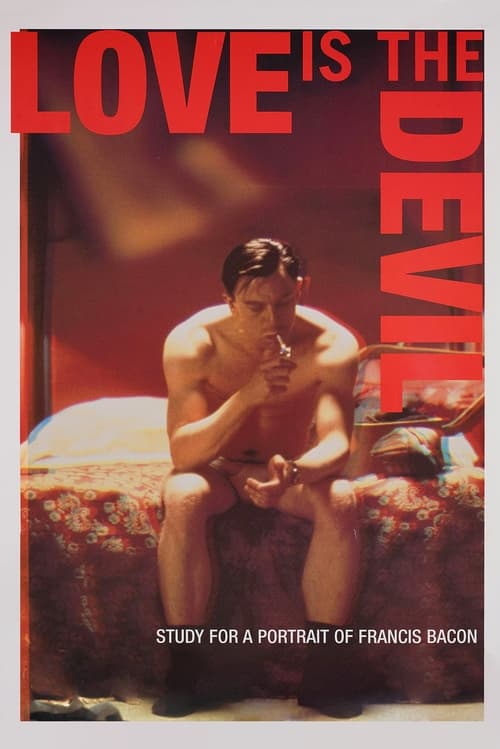
Love Is the Devil: Study for a Portrait of Francis Bacon
1998 · John Maybury
For when you want an intense, adult art-house drama about love as a power struggle — the kind of film you watch alone with a drink and sit with afterward. Firmly on the challenging end.
What it's about
London in the 1960s: the painter Francis Bacon catches a burglar coming through his skylight and takes him to bed. The thief is George Dyer, a working-class East End man who becomes Bacon's lover, model, and eventually his casualty, pulled into a Soho world of gin, wit, and casual cruelty where he never stops being an outsider. It's a portrait of a love affair rather than a career — intimate, corrosive, and true to how Bacon saw the world.
The experience
Claustrophobic and woozy, beautiful in an unnerving way — faces warp through glass and mirrors as the relationship curdles. It's tender and vicious in the same breath, and it lingers like a bruise.
Performances
Derek Jacobi is extraordinary as Bacon, all silken wit over genuine cruelty, and a young Daniel Craig — years before stardom — gives Dyer a wounded physicality that makes his slow unraveling hard to watch.
The craft
Denied the rights to show Bacon's actual paintings, John Maybury paints with the camera instead: distorting lenses, mirrors, and smeared light that translate Bacon's canvases into film grammar. It's one of the rare artist biopics that looks like its subject's work.
Why it matters
It redefined what a screen portrait of an artist could be — anti-biographical, formally daring — and remains a landmark of British queer cinema, as well as the film that announced Daniel Craig as a serious actor.
Snapshot
Love Is the Devil is John Maybury's incandescent, deliberately anti-biographical portrait of the painter Francis Bacon, focused almost entirely on his relationship with George Dyer — the East End petty criminal who, in the film's telling, fell through Bacon's skylight during a burglary and into his bed. Rather than dramatize a career, Maybury isolates a doomed love affair that runs from the mid-1960s to Dyer's death in 1971, and renders it through a battery of optical distortions that translate Bacon's pictorial vocabulary into film grammar. Derek Jacobi plays Bacon as a wit poised between cruelty and tenderness; Daniel Craig, years before his stardom, plays Dyer as a beautiful man being slowly unmade; Tilda Swinton presides over the Soho demimonde as Colony Room proprietor Muriel Belcher. The film is significant on three counts: as one of the most formally radical artist films of the 1990s, as a key late entry in the British avant-garde queer lineage descending from Derek Jarman, and as a case study in what a biopic can do when it is legally forbidden from showing its subject's art — the Bacon estate withheld permission to reproduce any paintings, a constraint Maybury turned into the film's defining aesthetic strategy.
Industry & production
The film was a British public-service production, financed principally through the BBC and the British Film Institute, with the BFI Production Board's backing situating it squarely within the late-1990s ecosystem of subsidized auteur cinema in the UK. It was a low-budget feature — modest even by art-house standards — and its economy is legible in its concentration: a handful of interiors (the studio, the Colony Room, gambling clubs, hotel rooms), a small principal cast, and a running time of roughly ninety minutes.
The production's most consequential fact was a rights refusal. Bacon's estate, controlled by his heir John Edwards and the Marlborough gallery interests, declined to license reproduction of the paintings. Maybury, who had no intention of making a reverent gallery tour in any case, used the prohibition as license: the film never shows a finished Bacon canvas, and instead conjures "Bacon" through the way it photographs flesh, rooms, and faces. The screenplay drew on the published record of Bacon's life, with Daniel Farson's intimate biography The Gilded Gutter Life of Francis Bacon — Farson having been a Soho drinking companion of Bacon's — among the acknowledged sources for the milieu and anecdote. The casting of Jacobi, a classical stage eminence, against the then-little-known Craig was itself an industrial bet that paid off critically. The film premiered on the 1998 festival circuit, including a berth at Cannes, and circulated as a prestige art-house title rather than a commercial release; precise box-office figures are not something I can responsibly cite.
Technology
Technically the film is a hybrid of conventional 35mm feature shooting and a homemade optical toolkit. Maybury and cinematographer John Mathieson shot much of the film through and against improvised distorting elements — drinking glasses, ashtrays, water, curved and aged mirrors, fish-eye and wide-angle lenses — so that the image itself warps, smears, and doubles in the manner of Bacon's screaming, dissolving heads. This is a pre-digital, in-camera approach to distortion: the smearing is largely physical and optical rather than composited in post, which gives it a tactile unpredictability. Maybury's own background in experimental film and video — he had worked extensively in Super-8 and music video — informs the willingness to treat the camera as a manipulable instrument rather than a transparent window. The result reads less like a 1990s prestige biopic and more like an experimental film operating at feature length and budget.
Technique
Cinematography
John Mathieson's photography is the film's engine, and Love Is the Devil stands as one of the calling-card works of his early career, shortly before Gladiator (2000) made him an A-list cinematographer. The visual program is openly mimetic of Bacon: faces are shot through curved glass so that a nose or jaw blooms out of proportion; figures are isolated in pools of light against engulfing black, recalling Bacon's habit of pinning his subjects in shallow, cage-like spaces; mirrors fracture and multiply the body. Reflections, refractions, and extreme close-ups of skin, teeth, and eyes recur until the human face becomes the unstable, meat-like object Bacon painted. The palette favors sour interior color — the bruised reds and greens of clubs and studios — against deep shadow. The camera is voyeuristic and intimate at once, frequently pressing too close, implicating the viewer in Bacon's own appetite for looking.
Editing
The cutting, credited to Daniel Goddard, abandons smooth biographical chronology for an associative, fragmentary rhythm. Scenes are interrupted by flash-images, dream and nightmare inserts, and recurring motifs — Dyer falling, the threat of violence, the body in distress — so that the film's structure mirrors the disintegration of its central relationship. Time is elastic: the affair is presented less as a sequence of events than as a memory-field collapsing toward its known catastrophe, Dyer's death. The editing's refusal of conventional cause-and-effect is part of the film's argument that a life lived this way cannot be tidied into a three-act narrative.
Mise-en-scène / staging
Maybury stages the film in claustrophobic, art-directed interiors that double as psychological spaces. Bacon's studio is rendered as a den of squalor and creation; the Colony Room is a smoke-filled chamber of cruelty disguised as conviviality. Compositions repeatedly box characters into doorways, mirrors, and beds, echoing the geometric "space-frames" Bacon drew around his figures. The staging is theatrical in the best sense — designed, lit, and posed — and the human body is consistently arranged as a Baconian motif: sprawled, contorted, caught mid-spasm. Even the recurring image of Dyer on the toilet, a direct citation of one of Bacon's most famous compositional subjects, is staged as living tableau rather than reproduced as painting.
Sound
Ryuichi Sakamoto composed the score, and his contribution is central to the film's mood: spare, melancholy, and modern, the music holds the lurid imagery in a register of elegy rather than sensation. Against the period setting it is pointedly contemporary, refusing nostalgia. The sound design leans into the textures of Soho drinking culture — the clink, murmur, and aggression of the club — and into bodily, often unpleasant intimacies. The interplay of Sakamoto's restraint with the film's visual excess is one of its most effective tensions.
Performance
Derek Jacobi's Bacon is the performance the film is built around: epicene, mordant, generous and merciless by turns, fluent in the camp aphorism and the wounding remark. Jacobi captures Bacon's masochism and his theatrical self-presentation without reducing him to caricature. Daniel Craig's George Dyer is the film's tragic center — physically magnetic, verbally outmatched, and visibly drowning as drink, pills, and his own dependency pull him under; it remains one of the most important of Craig's pre-stardom roles. Tilda Swinton's Muriel Belcher is a sharp, stylized cameo of Soho monarchy. The supporting ensemble fills out Bacon's circle of hangers-on and fellow drinkers; where I cannot verify a specific actor-to-real-person attribution with confidence, I leave it unstated rather than guess.
Narrative & dramatic mode
The film is structured as a tragedy whose ending is foreknown: it effectively opens in the shadow of Dyer's death and circles back through the affair. Its dramatic mode is closer to the tone poem or the dramatized portrait than to conventional narrative — a "study," as the Baconian title insists, rather than a story. Causation is psychological and atmospheric rather than plotted; we understand the relationship's doom not through a chain of incidents but through accumulating images of dependency, humiliation, and tenderness curdling into harm. The dialogue, much of it built from Bacon's recorded epigrams and the cadences of Soho repartee, supplies wit that constantly undercuts sentiment. The mode is unmistakably modernist: elliptical, subjective, and unconcerned with explaining its subject.
Genre & cycle
Love Is the Devil belongs to the artist biopic, but it is best understood as an anti-biopic — a film that refuses the genre's usual machinery of formative childhood, struggle, triumph, and explanatory psychology. It sits within a distinct 1990s British cycle of literate, often queer films about artists and bohemians: Christopher Hampton's Carrington (1995), Brian Gilbert's Wilde (1997), and, further back, the touchstone of Jarman's Caravaggio (1986). Against the heritage film's plush nostalgia, Maybury's film offers something abrasive and formally aggressive — a deliberate counter-tradition within British costume cinema. Its lineage also runs through the broader strand of New Queer Cinema, transplanting that movement's frankness about desire, violence, and the body into a specifically British, Soho key.
Authorship & method
The film is strongly authored. John Maybury — director and screenwriter — came up through the British experimental scene and, crucially, through Derek Jarman's orbit, having contributed design and collaborative work to Jarman's films from the late 1970s onward; he was also a prolific maker of music videos and short experimental works, including his celebrated promo for Sinéad O'Connor's "Nothing Compares 2 U." That dual formation — avant-garde film artist and pop-image craftsman — is everywhere in Love Is the Devil's fusion of formal experiment and emotional directness. His key collaborators define the film as much as he does: cinematographer John Mathieson, whose optical inventiveness realizes the Baconian image; composer Ryuichi Sakamoto, whose score supplies the elegiac counterweight; and editor Daniel Goddard, whose fragmentary assembly enacts the relationship's collapse. The method throughout is translation rather than reproduction: the problem the film sets itself is how to make a film about a painter's vision by building that vision into the apparatus of cinema, since the paintings themselves were off-limits.
Movement / national cinema
This is British art cinema at a particular hinge. Maybury is one of the most direct inheritors of Derek Jarman, who died in 1994; Love Is the Devil can be read as carrying the Jarman project — queer, painterly, experimental, made on subsidy and conviction — into the post-Jarman decade. It is a product of the BBC/BFI public-funding model that sustained non-commercial British filmmaking, and it represents the experimental, anti-heritage wing of that national cinema, standing in pointed contrast to the polished period dramas with which 1990s "British cinema" is often identified abroad. Its Soho subject matter also places it within a specifically London bohemian iconography — the Colony Room, the postwar artistic underworld — that recurs across British art and literature.
Era / period
The film depicts the mid-1960s through 1971, the years of Bacon and Dyer's relationship, culminating in Dyer's death in Paris on the eve of Bacon's major Grand Palais retrospective — the catastrophe that would haunt Bacon's subsequent "black triptychs." But it is equally a document of its own moment, the late 1990s: made as British cinema negotiated lottery funding, the legacy of Thatcher-era arts politics, and the afterlife of New Queer Cinema, it treats a 1960s gay relationship without apology or period coyness, a stance that registers the distance traveled since the decades it portrays, when male homosexuality was criminalized in England for part of the film's own timeline.
Themes
The film's central theme is the entanglement of love with cruelty — the "devil" of the title — and specifically Bacon's masochism, both erotic and creative, his conviction that suffering and beauty are inseparable. It explores the artist-and-muse relationship as a fundamentally unequal, even predatory, transaction: Bacon feeds on Dyer's body, vulnerability, and eventual ruin, transmuting them into art the film cannot show us. Class is everywhere — the gulf between Bacon's articulate, monied bohemia and Dyer's inarticulate working-class displacement is the engine of the tragedy. Other recurring concerns: voyeurism and the violence of looking; the body as meat and as image; addiction and self-destruction; and the moral cost of art, the question of what an artist is permitted to take from the people who love him. The film withholds easy judgment, presenting Bacon as neither monster nor martyr but as a man whose genius and appetite are the same faculty.
Reception, canon & influence
Critically, Love Is the Devil was received as a bold and divisive achievement — admired especially for Jacobi's performance, Mathieson's photography, and the audacity of its formal conceit, while some viewers found its abrasive style and bleakness forbidding. Jacobi's work drew particular praise and the film raised the profiles of its collaborators; in retrospect, Daniel Craig's casting looks like an early marker of a major career. Its influences run backward to Francis Bacon's own painting (the governing visual source), to Derek Jarman's experimental queer biographical films, and to the documentary and biographical record of Bacon's Soho world, including Farson's writing. Its legacy is twofold. It consolidated Maybury's reputation as a singular British stylist and helped launch the feature careers of key craftspeople, Mathieson above all. More broadly, it stands as a frequently cited example of how to make a great film about a visual artist without the art — a model for the "anti-biopic" that influences how later filmmakers approach the problem of dramatizing painters and the creative process. Within the canon of British art-house and queer cinema it endures as a touchstone: a film that took a legal handicap and a modest budget and produced one of the most genuinely Baconian objects in any medium other than paint. Where the longer-term influence record is thin — direct citations by later filmmakers are not always documented — that is a limit of the record rather than a claim I will manufacture.
A Deleuzian reading
Start with the glass.
The full Deleuzian reading of Love Is the Devil: Study for a Portrait of Francis Bacon →
Reception
A prickly Un Certain Regard premiere at Cannes '98 that won acting prizes at Edinburgh but stayed a niche arthouse item — until Daniel Craig became Bond in 2006 and a whole new audience came looking, cementing its slow climb into the queer-cinema canon.
How Love Is the Devil: Study for a Portrait of Francis Bacon was received, from release to now →
Influences: the films it descends from and the films it influenced
- Caravaggio (1986) — The governing model of the painter anti-biopic: dramatize the artist via tableaux vivants that recreate the canvases' chiaroscuro compositions and gesture, rather than ever showing the act of painting.
- The Last of England (1987) — Associative, non-narrative montage of degraded film texture that Maybury worked on directly inside Jarman's unit, the source of his fragmentary, image-led assembly.
- Jubilee (1978) — Maybury's design apprenticeship under Jarman — punk-collage staging where tableau and décor carry meaning over plot, the formation behind his later art-direction-as-authorship.
- Performance (1970) — Distorting wide-angle lenses, warped mirrors and fractured cross-cut editing that dissolve identity inside a closed decadent milieu — the template for Mathieson's Baconian optical warping.
- Bad Timing (1980) — Achronological, intercut editing that structures a destructive love affair as foreknown catastrophe, the editing logic Daniel Goddard adapts to enact the relationship's collapse.
- Repulsion (1965) — Wide-angle and fish-eye distortion that bends a domestic interior into externalized psychological space — the in-camera method of making architecture express a disturbed mind.
- The Diving Bell and the Butterfly (2007) — Builds the protagonist's impaired sight into the apparatus via subjective, optically blurred and distorted POV camera — the heir to Maybury's principle of translating a way of seeing into the lens itself.
- At Eternity's Gate (2018) — Handheld camera with split-diopter lower-frame blur renders Van Gogh's vision through the optics, extending the 'painter's eye as camera' method instead of depicting finished paintings.
- I'm Not There (2007) — Anti-biopic that shatters the artist into discontinuous fragments and refuses a single coherent subject, the logical extension of dramatizing a creator without conventional biography.
- Control (2007) — A career image-maker's feature debut imposing rigorous monochrome formal design on a foreknown tragic death, mirroring Maybury's path from music-video craft to the artist-death film.
- Jackie (2016) — Anti-biopic built from fragmented, achronological grief and suffocating close framing around a foreknown death, the foreknown-tragedy structure and intimate confinement carried forward.
- Edward II (1991) — New Queer Cinema staging of a biographical subject through minimal, anachronistic tableaux against void, refusing period-recreation realism for stylized space.
- Wittgenstein (1993) — Anti-biopic of a difficult creative mind rendered as theatrical tableaux against black, dramatizing thought through staged frames rather than incident.
- Velvet Goldmine (1998) — Same-year anti-biopic that fragments a glam artist across a nonlinear Kane-like structure, refusing the unitary cradle-to-grave biography just as Maybury refuses the painter's canvases.
- Swoon (1992) — New Queer Cinema reconstruction of a foreknown crime through stylized, anachronistic black-and-white staging that aestheticizes doomed desire.
- Merry Christmas Mr. Lawrence (1983) — Ryuichi Sakamoto's elegiac piano-and-synth scoring method — the same composer's emotional counterweight to formal severity that he supplies here.
- The Last Emperor (1987) — Sakamoto's mournful orchestral elegy framing a life as foreknown loss, the scoring approach he carries into Maybury's film.
- Basquiat (1996) — Contemporaneous painter biopic made by a painter, wrestling with the same problem — how to put a visual artist's seeing, not just his life, on screen.
Similar films
- Caravaggio (1986) — influence & lineage
- Basquiat (1996) — influence & lineage
- At Eternity's Gate (2018) — influence & lineage
- Performance (1970) — influence & lineage
- Queer (2024) — shared sensibility
- The Portrait of a Lady (1996) — shared sensibility
- Leaving Las Vegas (1995) — shared sensibility
- Blow-Up (1966) — shared sensibility
All the films related to Love Is the Devil: Study for a Portrait of Francis Bacon →