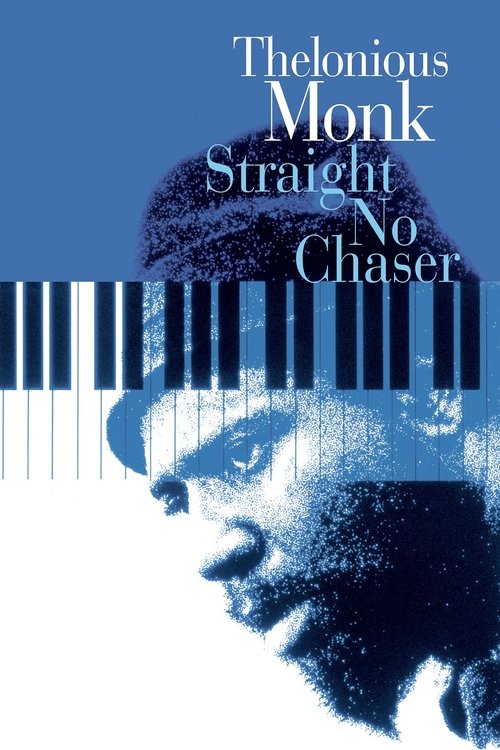
Thelonious Monk: Straight, No Chaser
1988 · Charlotte Zwerin
For a late-night deep hang with a genius — when you want to put on something absorbing, let great music carry you, and come away feeling you've actually met someone.
What it's about
A portrait of Thelonious Monk, jazz's great eccentric genius, built on a windfall: hours of black-and-white footage shot in 1967 and 1968 that followed his quartet through clubs, studios, hotel rooms, and airports, then sat in storage for two decades. Charlotte Zwerin weaves that rediscovered material together with later interviews with his family and bandmates into a picture of a brilliant, elusive man — spinning in circles at airports, mumbling instructions at rehearsals, and playing like nobody else on earth.
The experience
Intimate and mesmerizing — you're not being told about Monk, you're in the room with him, close enough to watch his hands and catch the private logic in his silences. Funny, mysterious, and finally very moving.
The craft
The 16mm vérité footage is astonishingly close and alive — Monk at the piano, mid-creation, filmed with a patience that lets whole performances breathe. Zwerin, the editor behind landmark vérité documentaries, shapes fourteen hours of raw material into a portrait that trusts the music and the man's own behavior over narration.
Why it matters
The definitive film document of Monk, made from footage that could easily have been lost forever, and a cornerstone of the late-1980s wave of serious jazz preservation on screen.
Snapshot
A portrait documentary built on a windfall: roughly fourteen hours of black-and-white 16mm footage shot in 1967 and 1968 by the German-born, New York–based filmmakers Christian and Michael Blackwood, who followed Thelonious Monk's quartet through clubs, studios, hotel rooms, and airports on assignment for West German television. A fraction of it aired; the rest sat in storage for two decades. Charlotte Zwerin — the editor who had shaped Salesman (1969) and Gimme Shelter (1970) for the Maysles brothers and shared directing credit on both — was given that material and asked to make a film from it. She combined it with interviews recorded in the mid-1980s (among them Monk's son, the drummer T. S. Monk; the tenor saxophonist Charlie Rouse, Monk's front-line partner for eleven years; the manager Harry Colomby; the Riverside producer Orrin Keepnews; the pianist Barry Harris) and produced, in about ninety minutes, the rare music documentary whose subject is neither anecdote nor legend but work.
The film was produced by Bruce Ricker and Zwerin and released by Warner Bros. under the banner "Clint Eastwood Presents," Eastwood serving as executive producer. It arrived the same year as Eastwood's Charlie Parker biopic Bird, and its combination of vault footage and retrospective testimony has become, in the decades since, the default grammar of the theatrical music documentary.
Industry & production
The production history is a lesson in how films get made out of things nobody wanted. The Blackwood footage existed because West German television, in the late 1960s, was a more reliable patron of American vernacular music than any American broadcaster — a pattern familiar from the recording industry, where European labels and festivals sustained jazz musicians whom the domestic market had discarded. Michael Blackwood produced; Christian Blackwood shot. What the commission required was a short television profile. What the brothers exposed was an archive.
Two decades later, Bruce Ricker — whose The Last of the Blue Devils (1979), about the Kansas City jazz scene, had brought him into Clint Eastwood's orbit — moved to get the material into a film. Eastwood's participation is the decisive industrial fact. A star with a Warner Bros. relationship and an unfashionable devotion to jazz could underwrite a black-and-white documentary about a dead pianist and secure it a studio release, which no independent documentary of the period could reasonably expect. The "Clint Eastwood Presents" credit is not vanity; it is the mechanism by which the film reached theaters at all.
Zwerin's role was not to shoot a film but to find one. That inversion — director as archaeologist, the primary creative labor happening in the cutting room on footage the director never supervised — is the film's governing production condition and shapes every choice in it.
The financial record is genuinely thin. This was a limited art-house release, and reliable grosses are not well documented; any specific figure should be treated with suspicion. A soundtrack album drawing on Monk's Columbia catalog accompanied the release, part of the label's broader reissue activity in the compact-disc era.
Technology
The film exists because of a specific mid-1960s toolkit. Crystal-controlled sync had cut the umbilical cable between camera and recorder; lightweight 16mm bodies (the Éclair NPR and its contemporaries) could be shouldered; the Nagra put location sound in one person's hands; and faster black-and-white emulsions made it possible to expose usable images in a nightclub without lighting it. That combination is what let the Blackwoods follow a working band into rooms cameras had previously been unable to enter — the dressing room, the hotel, the moving car — and, crucially, to record performance in sync rather than reconstructing it.
The technology also explains the footage's limits. The sound is mono, room-bound, subject to the acoustics of whatever space Monk happened to be in; there is no multitrack isolation of instruments, no possibility of remixing a solo forward. For the 1988 theatrical release the 16mm original was blown up to 35mm and the audio prepared for theatrical exhibition, work that flatters the material without pretending it was recorded in a studio. The grain is legible on screen, and Zwerin does not disguise it.
Two further technological contexts matter. First, the CD reissue boom, which in the late 1980s was returning the Blue Note, Riverside, Prestige, and Columbia catalogs to circulation and making Monk's recorded work purchasable in a way it had not been for years — the film had a merchandisable object waiting behind it. Second, home video, which by 1988 meant that a documentary with a modest theatrical footprint could keep earning and, more importantly, keep being seen. Straight, No Chaser is one of the films that taught distributors this.
Technique
Cinematography
Christian Blackwood's camera is patient in a way that has become rare. It settles on Monk's hands — the flattened fingers, the percussive attack, the elbow-and-forearm clusters — and stays there through long passages of playing rather than cutting away to reaction. It watches Monk when nothing is happening: waiting, sitting, not speaking, revolving slowly in place, in what has become one of the film's most-cited passages. Available light does most of the work, which means faces sometimes fall into shadow and stage lighting sometimes blows out; the images have the density and unevenness of documents rather than compositions.
Against this, the mid-1980s interviews are shot in color, on sticks, evenly lit, framed conventionally. Zwerin makes no attempt to blend the registers. The visual seam is the film's argument: here is the man, unmediated and twenty years gone; here are the people trying, now, to explain him.
Editing
This is where the film is authored. Zwerin came to directing through the cutting room — she had assembled Salesman and was central to the construction of Gimme Shelter, a film whose entire architecture is a reckoning with footage after the fact — and her decisive choice here is to let performances run. Where the conventional music documentary uses music as connective tissue, chopping a solo into twenty seconds of illustration under a talking head, Straight, No Chaser treats a performance as a scene with its own duration and internal shape. The consequence is that the viewer is asked to listen, not merely to be told that Monk was worth listening to.
The rehearsal material is the sharpest editorial coup: sequences of Monk working with the arranger Hall Overton in Overton's Sixth Avenue loft, hammering out voicings for a large-ensemble treatment of his tunes, and sequences of Monk drilling his own band. Cut at length, these demolish the myth the rest of the culture had built. The "eccentric" is a precise, demanding, sometimes withering craftsman who knows exactly what he wants and can hear when he hasn't got it.
Zwerin's structure moves broadly forward through the tour footage while the interviews reach back across Monk's whole life, so that biography arrives as commentary on a present-tense body. She largely forgoes an omniscient narrator; the connective voice is testimony, which means the film's assertions are always attributed to someone with an interest.
Mise-en-scène / staging
Nothing is staged, and yet the film is full of staging — Monk's own. The hats (skullcaps, fur, whatever the night called for), the rings, the sunglasses, the deliberateness with which he occupies a bandstand: this is a man who understood self-presentation as part of the music's delivery, and the camera catches him constructing it. The recurring settings — the club stand, the Columbia studio, the anonymous hotel room, the airport concourse — compose an accidental portrait of the touring economy that structured a jazz musician's life in the 1960s: perpetual transit, unglamorous rooms, the band as a small mobile workplace.
The piano itself is staged twice over, as furniture in ordinary rooms and as the one site where Monk is unambiguously fluent.
Sound
The film's sound design is essentially a matter of restraint and trust. Monk's music is built on space — dissonances left ringing, phrases stopped short, silences that function as rhythm — and a documentary that scored its interviews with continuous underscoring would obliterate exactly what makes the music what it is. Zwerin keeps music and speech largely apart. When Monk plays, that is the whole of the soundtrack.
The location audio brings its own texture: room tone, chairs, the mutter and grunt Monk emitted while playing, the ambient wash of a club. It sounds like 1967 recorded on portable equipment, and that grain carries information — about the size of the rooms, the attentiveness of the audiences, the physical labor of the instrument.
Performance
Two performances run in parallel. The first is musical: Monk at the keyboard, and the quartet — Rouse's dry, unhurried tenor, the rhythm section's willingness to hold ground while Monk withholds. The second is behavioral. Monk rising from the bench to turn in slow circles while his sidemen solo; Monk not answering questions; Monk in a room with his wife Nellie, whose steadiness the footage records without underlining. The camera is present for a great deal of non-speaking, and the film's tact lies in declining to interpret it.
The interviewees perform too — each of them, twenty years on, offering an account that is partly love and partly the management of an unresolved memory. Rouse's presence is doubled and, in retrospect, elegiac: he appears both as the young saxophonist in the tour footage and as an older man explaining him. Rouse died in November 1988, weeks after the film's release.
Narrative & dramatic mode
The film is a portrait rather than a biography, and it declines the two shapes most available to it. It is not the rise-and-fall arc, because the footage that anchors it comes from a single late-middle period and refuses to be teleological. It is not pure observational cinema either, because Zwerin admits interviews, chronology, and context — the direct-cinema purism of her mentors is set aside in favor of legibility.
What results is a hybrid that has since become standard: an observational core framed by retrospective explanation. Its distinguishing quality is what it withholds. Monk's periods of disorientation, hospitalization, and eventual near-total withdrawal from public life in the 1970s are addressed, but no diagnosis is delivered and no cause is settled. The film ends, in effect, in a silence it will not fill — a documentary about a man who stopped speaking, which has the discipline not to speak for him.
Genre & cycle
It belongs to the jazz film, a genre with a long and mostly compromised history: the short-form showcase (Jammin' the Blues, 1944), the festival film (Jazz on a Summer's Day, 1959), the live television broadcast (The Sound of Jazz, 1957), and the affectionate regional documentary of Ricker's own The Last of the Blue Devils (1979). Against those, Straight, No Chaser is unusual in taking a single musician's working process as its subject.
1988 was a landmark year for the theatrical documentary in general — Errol Morris's The Thin Blue Line, Marcel Ophüls's Hôtel Terminus, Bruce Weber's Let's Get Lost — and the coincidence with Weber's Chet Baker film is instructive. Both are black-and-white portraits of self-destroying jazz musicians assembled largely from the past; Weber's is a seduced, stylized, complicit film, Zwerin's an evidentiary one. The pairing marks the point at which the music documentary became a serious critical form rather than promotional apparatus.
Authorship & method
Zwerin (1931–2004) is one of the essential and long under-credited figures of American nonfiction film. Her authorship was exercised principally through editing — the mode least visible to auteurist accounting, and the one to which women in the documentary world of the 1960s were most often confined. Gimme Shelter, whose recursive structure remains the most sophisticated formal gesture in the Maysles filmography, is unimaginable without her. Straight, No Chaser is the film in which that editorial intelligence stands alone and unmistakably in front, precisely because the shooting was someone else's.
Christian Blackwood is the film's other true author: without his instinct to keep rolling on unremarkable time, there is no film. The Blackwood brothers built substantial careers documenting artists, and their nose for the between-moments is what Zwerin had to work with.
There is no composer, and that absence is a choice — Monk wrote the score twenty years before the film existed. The interview material was gathered in the mid-1980s under Zwerin's direction; where credits for the contemporary photography and cutting are concerned, the readily verifiable record is thinner than for the archival material, and it is safer to say that the film's decisive craft is editorial and Zwerin's than to assign specifics.
Movement / national cinema
The film is a late, mutated product of American direct cinema — the Drew Associates lineage running through Leacock, Pennebaker, Wiseman, and the Maysles — inherited by one of its own practitioners at a moment when its purism had become untenable. The 1967–68 footage is orthodox direct cinema; the 1988 film around it is a compromise formation that admits the interview, the very device the movement was founded to reject. That compromise is not a failure of nerve but an acknowledgment that observational footage of a dead man cannot explain itself.
There is a transnational dimension worth naming. The core material is German-financed and German-shot, an instance of European institutions preserving American art that American institutions had not thought to record. The most consequential archival recoveries in Monk's own history follow the same logic — the 1957 Carnegie Hall quartet performance with John Coltrane, taped by the Voice of America and unheard for nearly half a century until it surfaced in the Library of Congress in 2005.
Era / period
The footage is from Monk's Columbia years, the tail of his commercial visibility: he had made the cover of Time in February 1964, one of a handful of jazz musicians ever to do so, and by 1968 the label relationship was ending. The band on screen is the long-running quartet with Rouse. Behind the images lie the events the interviews recount — the house-pianist years at Minton's in the early 1940s that helped incubate bebop; the 1951 narcotics arrest, after which Monk declined to implicate Bud Powell and lost his New York cabaret card for roughly six years; the 1957 Five Spot residency with Coltrane that restored him.
The film's release moment is equally particular. By 1988 jazz was entering its neoclassical, institutional phase — Jazz at Lincoln Center founded the previous year, the Thelonious Monk Institute of Jazz established in 1986, the Young Lions ascendant, the catalog reissued on CD. Monk, six years dead, was being converted from difficult modernist into heritage. Straight, No Chaser participates in that canonization while quietly complicating it, since the man on screen is neither monument nor martyr but a working musician in an airport.
Themes
Craft against myth. The film's central intervention is to replace "eccentric genius" with visible labor. The Overton loft sequences show music being constructed, argued over, and corrected.
Illness without diagnosis. Monk's withdrawals are presented as fact and left unexplained. Later scholarship — above all Robin D. G. Kelley's 2009 biography, the standard account — has gone considerably further into the medical and pharmacological history, and has been sharply critical of the mad-genius framing the culture built around Monk. The film predates that work and is notably careful; it neither diagnoses nor romanticizes.
Care and its cost. Nellie Monk in the archival footage, and later the patronage of Pannonica de Koenigswarter, at whose New Jersey home Monk spent his final years until his death in 1982, describe a life sustained by other people's sustained attention.
The economics of Black artistic labor. Cabaret cards, club payment, record contracts, endless touring: the material conditions are visible in the frame rather than argued in the commentary.
The archive as afterlife. The film is itself an argument that what survives of an artist is partly an accident of who happened to be filming.
Reception, canon & influence
The film was widely and warmly received on release, praised in particular for its refusal to condescend to either its subject or its audience, and it appeared on year-end best lists. It did not appear among the Academy's documentary nominees for 1988 — a slate whose omissions, above all The Thin Blue Line, became the standing example of that branch's blind spots and eventually forced changes to its process. Its critical standing has held: it is routinely cited as one of the best films made about a musician, and it remains the primary moving-image record of Monk in performance.
Looking backward, its influences are legible: direct cinema's ethic of duration and non-intervention; the Maysles' practice, which Zwerin helped build; the jazz-performance film's long tradition of pointing a camera at a bandstand and trusting it; and Ricker and Eastwood's shared conviction that jazz deserved serious cinematic treatment, a conviction that produced Bird the same year and a long run of Eastwood-backed music documentaries afterward.
Looking forward, the influence is broad enough that it is easy to miss. The archival-footage-plus-retrospective-interview structure, the insistence on letting performances play, the treatment of vault material as a discovery to be honored rather than raw stock to be cut up: this is now the house style of the prestige music documentary, and it runs directly to films built on recovered footage of Black musical performance — Amazing Grace (2018) and Summer of Soul (2021) most obviously, both of which turn on the same premise that the crucial document was shot decades ago and shelved. Zwerin continued in the mode herself, with Music for the Movies: Toru Takemitsu (1994) and Ella Fitzgerald: Something to Live For (1999).
Its narrower legacy is to Monk's reputation. The film arrived at the beginning of his institutional canonization and gave that process something better than hagiography to work with: ninety minutes of evidence that the strangeness was inseparable from the rigor, and that the two had been the same thing all along.
A Deleuzian reading
Monk stands up in the middle of a tune.
The full Deleuzian reading of Thelonious Monk: Straight, No Chaser →
Reception
Acclaimed on release in 1988 as an instant-essential jazz documentary, and its reputation has only hardened — it's now the standard answer to 'where do I start with Monk on film.'
How Thelonious Monk: Straight, No Chaser was received, from release to now →
How to watch Thelonious Monk: Straight, No Chaser: what to notice on a first viewing
- Watch the camera stay on Monk's hands through whole solos. Christian Blackwood's camera settles on the flattened fingers and percussive attack and stays there through long stretches of playing instead of cutting away to reactions. You get to watch the actual physical work of the music instead of being told it mattered.
- Notice the hats, rings, and sunglasses Monk wears on stage. Monk treats his hats, rings, and sunglasses as part of the music's delivery, occupying the bandstand with the same deliberateness he brings to a phrase. His look is not decoration, it is one more instrument he's playing.
- Listen for how completely music replaces any score when Monk plays. Zwerin keeps music and speech almost entirely separate, so when Monk plays, the performance itself is the whole of the soundtrack, with nothing laid over it. The silence around the music matters as much as the notes, so the film refuses to cover it up.
- Notice the jump between grainy black-and-white and clean color footage. The 1967 footage is grainy black-and-white, the 1980s interviews are clean color, and Zwerin never tries to blend the two. The visual seam is the film's argument: here is the man, here are people explaining him.
- Watch Monk rise and turn slowly while his band keeps playing. The camera holds as Monk leaves the piano bench and revolves in place during a bandmate's solo, and the film declines to explain or interpret it. The turning stops looking like a symptom and starts looking like part of the work.
The whole guide to watching Thelonious Monk: Straight, No Chaser, with the keys for a rewatch →
Influences: the films it descends from and the films it influenced
- Jammin' the Blues (1944) — Mili shot each number as a continuous take against black, cutting on the music's own phrasing rather than on narrative beats and treating hands, embouchure and the drummer's face as the dramatic event — the grammar Zwerin obeys when she refuses to leave a Monk solo.
- Jazz on a Summer's Day (1959) — Established that a jazz film could run numbers end to end with no narrator, no biography and no explanatory apparatus, trusting the bandstand and the audience's faces to carry a feature's worth of structure.
- Primary (1960) — Drew Associates' crystal-sync rig — modified Auricon/Eclair plus portable Nagra, two-man crew, no lights — is the exact technology that let Christian Blackwood walk backward into dressing rooms and hotel corridors ahead of Monk in available light.
- Chronicle of a Summer (1961) — Introduced the retrospective layer wrapped around observational footage — subjects commenting after the fact on material already shot — which Zwerin reorganizes as color mid-80s interviews framing monochrome 1967–68 coverage.
- Dont Look Back (1967) — Codified the touring-musician film as hotel rooms, corridors, promoters and dead time rather than concerts, shot handheld in available-light 16mm — the 'touring economy rooms' staging Zwerin inherits wholesale.
- Monk (1968) — Literal source: Christian Blackwood's roughly fourteen hours of black-and-white 16mm shot for this West German television portrait is the archive Zwerin cut twenty years later, and its habit of keeping the camera rolling through unremarkable time is what left anything worth recovering.
- Salesman (1969) — Zwerin's own proving ground for building feature structure entirely in the cutting room from unshaped sync coverage, with no narration and no interviews to paper over the joins.
- Gimme Shelter (1970) — Zwerin's recursive frame — the past examined from a later vantage, with participants confronting footage of themselves — is the structural move Straight, No Chaser redeploys as archive interrogated by retrospective testimony.
- Music for the Movies: Toru Takemitsu (1994) — Zwerin re-running her own method on a composer: working sessions filmed at length and left uncut, interviews used strictly as retrospective commentary, and no added score over a subject who writes his own.
- A Great Day in Harlem (1994) — Builds an entire feature from one archival artifact plus surviving participants' testimony about the day it was made, the archive-as-discovery-to-be-honored structure Zwerin had just normalized for jazz.
- Buena Vista Social Club (1999) — Films rehearsal and studio takes as the craft event itself — available-light digital video, numbers allowed to run whole, players' interruptions and count-offs left in rather than scored over.
- I Called Him Morgan (2016) — Elegiac jazz portrait built on a recovered cassette interview and long-held archival stills, with the killing withheld and circled rather than announced — Zwerin's structure of retrospective voice over an irreplaceable audio-visual document.
- Amazing Grace (2018) — Shelved 1972 footage restored and released with the performances intact and unnarrated, the vault material treated as a finished document to be resynced and honored rather than raw stock to be intercut.
- Summer of Soul (2021) — Recovered 1969 tapes cut against present-day participants watching themselves on a monitor — Zwerin's archive-plus-retrospective-interview armature fused with Gimme Shelter's device of subjects confronting their own footage.
- The Beatles: Get Back (2021) — Treats vault footage of rehearsal, false starts and unremarkable waiting as the substance rather than the offcuts, extending the Blackwood-shot/Zwerin-cut premise that a song being worked out is more revealing than a song performed.
- Ornette: Made in America (1985) — The opposite formal wager on the same problem: Clarke answers a jazz composer's strangeness with video collage and staged reenactment where Zwerin answers it with duration and non-intervention, both refusing to translate the music into explanation.
- Let's Get Lost (1988) — Monochrome portrait of a jazz musician's physical ruin assembled from the subject's own performance of himself for a rolling camera, with the clinical facts of the decline never stated — the same withheld-diagnosis discipline, released the same year.
- Bird (1988) — Eastwood, executive producer on Straight, No Chaser, had Parker's solos stripped off acetates and rebuilt with newly recorded rhythm sections — a fiction film applying the same preservationist ethic toward the surviving take as an artifact not to be improved.
Similar films
- Let's Get Lost (1988) — influence & lineage
- Chronicle of a Summer (1961) — influence & lineage
- Gimme Shelter (1970) — influence & lineage
- Soundtrack to a Coup d'Etat (2024) — shared sensibility
- Whiplash (2014) — shared sensibility
- Shoot the Piano Player (1960) — shared sensibility
- The Mastermind (2025) — shared sensibility
- The Hypothesis of the Stolen Painting (1978) — shared sensibility
All the films related to Thelonious Monk: Straight, No Chaser →