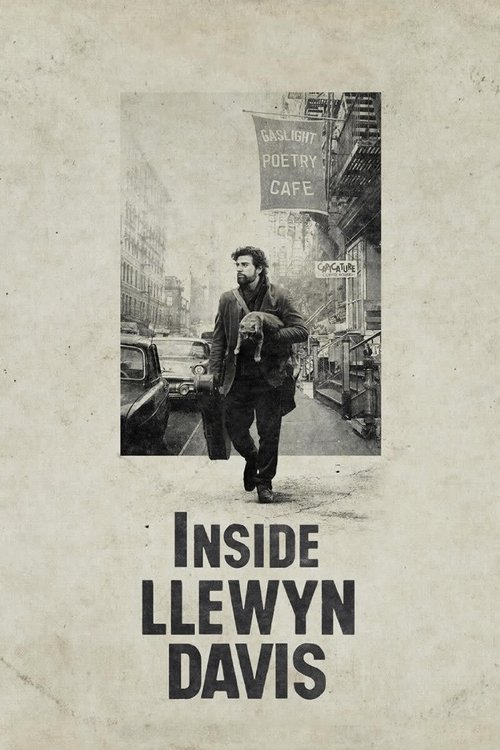
Inside Llewyn Davis
2013 · Joel Coen
For when you need a good sad — a gray-afternoon film for anyone who's ever been broke, stuck, or almost good enough. Comfort and heartbreak in the same cup of coffee.
What it's about
Greenwich Village, winter 1961, the folk scene just before it exploded. Llewyn Davis is a genuinely gifted singer with no money, no coat, no fixed address, and a talent for burning every couch he sleeps on. Over one punishing week he chases gigs, a runaway cat, and a shot at an audition in Chicago, trying to figure out whether the world owes an artist anything at all.
The experience
Melancholy and mordantly funny in equal measure — the Coens' deadpan comedy laid over a deep ache. It's unhurried and wintry, and the music keeps stopping the film cold in the best way.
Performances
Oscar Isaac's breakout: he sings every song live and in full, beautifully, while playing a man you'd never lend your couch to — the gap between the voice and the person is the whole movie.
The craft
The songs are performed complete, not in montage, so the music carries the argument the dialogue won't make. The cinematography renders 1961 New York in cold, smoky, almost snow-blind light — this one rewards good speakers as much as a good screen.
Why it matters
Its soundtrack sparked a fresh wave of interest in the early-'60s folk revival, and it minted Oscar Isaac as a major actor; it has settled in as one of the Coens' most beloved and quietly devastating films.
Snapshot
A gifted but abrasive folk guitarist drifts through a single, punishing week in Greenwich Village in the winter of 1961, couch-surfing between alienated friends, losing a borrowed cat, fathering an unwanted child, and driving overnight to Chicago for an audition that goes nowhere. The film ends precisely where it began: Llewyn Davis singing at the Gaslight Café, then stepping into the alley to be beaten by an unseen man. Nothing has changed; nothing will. Inside Llewyn Davis is the Coens' most austere and emotionally concentrated work — a portrait of talent marooned by temperament on the wrong side of a historical pivot point, set the season before Bob Dylan arrived and changed the terms of American folk music forever.
Industry & production
Joel and Ethan Coen developed the film after encountering Dave Van Ronk's posthumously published memoir The Mayor of MacDougal Street (co-written with Elijah Wald, 2005). Van Ronk — the leading figure of the pre-Dylan Greenwich Village folk scene — died in 2002, and the Coens optioned the memoir as a source of period atmosphere and character texture rather than as a story to adapt literally. The central character, Llewyn Davis, is not Van Ronk: the Welsh surname, the solo career, and the specific arc of failures are fictional constructs, though the Coens acknowledged drawing on Van Ronk's world extensively.
The film was produced through Scott Rudin Productions and the Coens' own Mike Zoss Productions. CBS Films handled North American distribution; StudioCanal distributed internationally, reflecting the European financing that shaped the project. The relatively modest budget gave the production a discipline consistent with its subject matter — no studio period-piece polish, no glamorizing of the Village milieu. The film premiered at the Cannes Film Festival in May 2013, where it won the Grand Prix, the festival's second-highest honor, before receiving a limited US release in December of that year, expanding gradually through the awards season.
Technology
Bruno Delbonnel shot the film on 35mm film, anamorphic format, a deliberate choice that imposed a widescreen frame on a story of domestic claustrophobia and winter exteriors. The anamorphic format allowed for a shallow depth of field in interiors and a certain quality of lens flare and natural bokeh, while the 35mm grain gave the image a texture consistent with early 1960s photographic memory. Delbonnel's color approach was deeply desaturated: the palette of the film is largely composed of muted greens, grays, and cold browns, with the warmth of interior spaces (a kitchen, a recording booth) offered as fragile, temporary refuges rather than comfort. There is no attempt to render the Village picturesque; the snow-covered streets are exhausting, not charming. This visual grammar was constructed in-camera and in grading, producing what amounts to a de-nostalgized image of an era that popular culture habitually romanticizes.
Technique
Cinematography
Delbonnel, a French cinematographer best known before this film for his work with Jean-Pierre Jeunet (Amélie, 2001) and David Yates (Harry Potter and the Half-Blood Prince, 2009), brought a European severity to what might have been a nostalgic assignment. His compositions favor Llewyn at the edges of frames, caught between walls, caught in doorways — spatially marginalized within the widescreen format. The recurring interiors (the Gorfeins' Upper West Side apartment, Jean and Jim's cramped space, the cramped back seats of cars) are photographed with available and motivated sources, giving the impression of a world barely lit. The Chicago section, with its long night highway, is rendered in near-darkness relieved only by headlights and the orange sodium glow of truck stops — a passage through purgatory more than geography.
Editing
The film was edited under the pseudonym Roderick Jaynes, the Coens' long-standing fiction of a British film critic-cum-editor. The cutting is notably restrained, favoring long takes within scenes, particularly during musical performances. The decision to hold on Oscar Isaac performing "Hang Me, Oh Hang Me" in the opening Gaslight sequence — nearly in full — establishes the film's temporal logic: we will wait for things to unfold, and they will not resolve. Transitions are often abrupt without being jarring; the film moves from scene to scene without the conventional bridging that smooths narrative time, enacting the sensation of a life that has lost its connective tissue. The circular structure — the final sequence replaying the opening — is the editing's largest gesture, a formal loop that forecloses any illusion of progress.
Mise-en-scène / staging
The Coens are meticulous stagers, and Inside Llewyn Davis deploys that precision in the service of stasis. Apartments are crowded with period accumulation — bookshelves, posters, coats piled on chairs — but the mise-en-scène never becomes production design for its own sake. The cat, which Llewyn loses and chases across the film's first half, is staged with real animals and real spatial consequence: Llewyn crouches, pivots, searches hallways, and the cat moves according to no human logic. The Gaslight Café is cramped and warm and full of people sitting very close together; the impresario Bud Grossman's Chicago club is the opposite — cold, vast, the stage isolated in space, the audition performed in an acoustic that makes failure feel geometric.
Sound
The film's sound design makes a radical choice: there is effectively no conventional non-diegetic score. All music is performed or recorded within the world of the film. T Bone Burnett, the Coens' longtime musical collaborator who had produced O Brother, Where Art Thou? (2000), supervised the soundtrack, but the songs are rendered with a fidelity to period recording practice and live performance. This means that when music stops, the film is very quiet. Wind, street noise, the hum of a car engine — these become the film's ambient soundtrack. The contrast between the richness of the musical passages and the flatness of the non-musical scenes is itself thematic: Llewyn's gift is real, and it sounds real, but it exists in a world that is largely indifferent to it.
Performance
Oscar Isaac, in what was for many viewers an introduction to his range, plays Llewyn without an ounce of performance toward likability. Isaac, who trained as a musician and performs all of his own guitar and vocal work in the film, brings a technical grounding that makes Llewyn's talent unambiguous — the scenes are not impressionistic evocations of musicianship but actual demonstrations of it. This matters because the film's drama depends on the audience accepting that Llewyn is genuinely gifted, not merely deluded. Carey Mulligan plays Jean with a precise and impatient anger that refuses to become melodrama. John Goodman's Roland Turner — a massive, morphine-addled jazz musician encountered on the road to Chicago — is a grotesque that Goodman inflects with actual menace, a vision of where Llewyn might end up. Garrett Hedlund's near-silent Johnny Five completes this road-trip tableau. Justin Timberlake and Adam Driver appear in the recording studio sequence, the former as the guileless folk singer Jim, the latter in a small role as a fellow performer.
Narrative & dramatic mode
The film operates in a mode of sustained irresolution. There is no second-act turn that promises escape, no antagonist whose defeat would clear the path. The dramatic mode is closer to what might be called Sisyphean realism — a mode in which effort is genuine and failure is structural rather than earned by the protagonist's specific choices. Llewyn's problems are partly temperamental (he alienates everyone around him) and partly circumstantial (his partner Mike Timlin's suicide before the film begins has left him without a career structure or an emotional anchor). The film never condescends to Llewyn by suggesting a simple path he is too proud to take, nor does it sentimentalize his refusal of compromise. The circular narrative structure — unusual even for the Coens — transforms the story from a chronicle of a bad week into something more like a meditation on recurrence. The brief glimpse at the film's end of a young, unprepossessing performer taking the Gaslight stage (left deliberately unidentified) implies the historical arc: the machine is about to change gears, and Llewyn will not be in the new gear.
Genre & cycle
Inside Llewyn Davis sits at the intersection of the failure biopic and the road movie, while ultimately belonging to neither. The failure biopic — films about artists who do not make it, or make it too late, or at too great a cost — has a long tradition in American cinema, from Lenny (1974) to Shine (1996) to Big Eyes (2014). But those films typically deliver catharsis or retrospective recognition. The Coens refuse this. The road movie element — the Chicago sequence, the night drive with Goodman and Hedlund — enacts the genre's promise of transformation only to cancel it; Llewyn returns to the Village unchanged and unenlightened. The film is also part of a broader early-2010s cycle of music-world period pieces (Whiplash, 2014; Love & Mercy, 2014) that interrogated artistic ambition through the machinery of a specific scene or subculture, though it is tonally distinct from all of them.
Authorship & method
Joel and Ethan Coen wrote and directed together, as always, though the film is credited to Joel as director. Their working method involves intensive joint writing, detailed storyboarding, and unusual fidelity to the prepared script on set — actors have noted that improvisation is not on offer. The Coens' relationship with T Bone Burnett extended from O Brother, through The Ladykillers (2004), and into this project; Burnett's role was both curatorial (selecting and arranging period-appropriate folk material) and collaborative, working with Oscar Isaac to develop the musical performances. Delbonnel's collaboration was new — the Coens had worked primarily with Roger Deakins for most of their career — and represented a deliberate choice to bring a different visual sensibility to a film that demanded coldness over the burnished formalism Deakins had mastered. The editing, as always, remained in-house under the Jaynes pseudonym, with the Coens cutting their own work and retaining complete post-production control.
Movement / national cinema
The film is American independent cinema in its financing and sensibility, but it bears the marks of its European co-production context in its willingness to withhold resolution. It belongs to the Coens' own body of work more than to any broader movement, though it can be situated within a strain of American film that treats folk and roots music as a site of cultural and historical investigation — a strain that includes O Brother and, further back, documentaries like D.A. Pennebaker's Don't Look Back (1967), which haunts the film as a kind of negative image (Dylan's triumphant emergence is the horizon against which Llewyn's stasis is measured).
Era / period
The film is set in the winter of 1961, a narrow historical moment: the Greenwich Village folk revival was at its height, the Newport Folk Festival had recently been revived (1959), and the period of intense commercial and artistic ferment that would produce Dylan, Joan Baez, and the broader counterculture was just beginning. The film's historical precision is not nostalgic but elegiac and diagnostic: it identifies the season just before the scene's transformation, when the existing hierarchy of the Village — in which someone like Van Ronk/Llewyn was a central figure — was about to be overturned. The Coens' choice to end just before that overturning is a formal argument: the film is about a particular kind of talented, difficult person who cannot survive a historical transition, and it refuses to show the transition itself.
Themes
The central thematic preoccupation is the relationship between artistic integrity and self-destruction. Llewyn refuses commercial accommodation not from principled aesthetics but from a temperamental incapacity to perform warmth, gratitude, or the social lubrication that careers require. The film does not celebrate this refusal; it examines it with a forensic neutrality. A secondary theme is grief — Mike Timlin's absence is the hole at the center of the film's world, and Llewyn's inability to process it is implicated in every failure that follows. The cat, which Llewyn loses and recovers and loses again, functions as a displaced object of care: he is capable of concern for the animal in ways he cannot manage for the people around him. The film is also about historical timing — about being genuinely talented in precisely the wrong season, a misalignment not of merit but of moment.
Reception, canon & influence
Critical reception. The film was embraced as one of the Coens' finest works on release, winning the Grand Prix at Cannes and accumulating strong year-end critical support, including significant presence on critics' lists. Its reputation has grown in the intervening years; it is now widely regarded as among the essential films of the 2010s. Oscar Isaac's performance is the usual point of entry for appraisals, though the film's structural ambition — the loop, the refusal of catharsis — is increasingly foregrounded in critical accounts.
Influences on the film (backward). The most direct influence is Van Ronk's memoir, which supplied the milieu, some narrative beats, and the moral texture of a figure too honest and too difficult for the market. The Coens have cited Homer's Odyssey as a structural model — Llewyn as a modern Odysseus, the cat as a kind of Hermes-figure guiding and escaping, the journey to Chicago as a Nekuia — though this Homeric scaffolding is worn lightly and is legible rather than labored. Albert Camus's Sisyphus is a plausible intellectual antecedent for the circular structure, though the Coens have not named it. The film is also in conversation with the Coens' own A Serious Man (2009), another film about a man visited by misfortune who cannot locate the pattern that might make it meaningful. The visual tradition of New York street photography — Walker Evans, Diane Arbus, the cold documentary aesthetic of 1950s and 1960s social realism — informs Delbonnel's approach, though no direct influence has been documented.
Legacy (forward). Inside Llewyn Davis is not a film that generated immediate imitators, but its influence has been diffuse and sustained. It established Oscar Isaac as a major screen presence, directly enabling the range of roles that followed. Its model of the music film as character study without redemptive arc — as opposed to the biopic's rise-and-fall structure — has been visible in subsequent work, including Whiplash (which shares the film's ambivalence about talent and cost). T Bone Burnett's approach to period-authentic folk performance, developed here and in O Brother, has informed the wider practice of music supervision in prestige film. More broadly, the film has become a touchstone for discussions of artistic failure, historical bad timing, and the difference between talent and success — the kind of cultural work that circulates in essays and syllabi rather than box-office conversation.
A Deleuzian reading
The cat gets out first.
The full Deleuzian reading of Inside Llewyn Davis →
Reception
It won the Grand Prix at Cannes in 2013 but got famously stiffed by the Oscars (just two technical nods) and made modest money — then spent the next decade climbing best-of-the-2010s lists until 'the Coens' most underrated' became the consensus take.
How Inside Llewyn Davis was received, from release to now →
Influences: the films it descends from and the films it influenced
- O Brother, Where Art Thou? (2000) — T-Bone Burnett developed his period-authentic diegetic folk recording methodology here — live vocal performances without amplification, sourced from period-appropriate genres — then transferred this exact practice to Llewyn Davis, making O Brother the direct technical prototype for the sound design.
- A Serious Man (2009) — The Coens' immediately prior film established their Sisyphean male-protagonist structure — a man beset by compounding misfortune who cannot locate its pattern, ending on an unresolved image of impending disaster — which Llewyn Davis inherits wholesale as circular irresolution without catharsis.
- Barton Fink (1991) — The Coens' first sustained portrait of an artist trapped in creative paralysis uses spatial confinement — a single decaying hotel floor — to externalize irresolution; Llewyn Davis inherits this spatial-marginalization strategy, substituting the city's winter geography for the hotel.
- Five Easy Pieces (1970) — Rafelson established the American model of the musician-protagonist constitutionally incapable of commercial accommodation; the road trip that leads nowhere — Bobby Dupea's hitchhike into disappearance — is the direct ancestor of Llewyn's purposeless Chicago detour and its structural function as non-destination.
- Shadows (1959) — Cassavetes shot in the Greenwich Village bohemian milieu Llewyn Davis inhabits, using non-professional jazz musicians playing adjacent to themselves; the practice of diegetic musical performance as the primary mode of character disclosure — not illustrative, but constitutive — enters American independent film here.
- McCabe & Mrs. Miller (1971) — Vilmos Zsigmond flashed the film stock for a cold, diffused, underexposed quality that ages the image into period texture — the direct visual ancestor of Delbonnel's desaturated-palette strategy for rendering the early 1960s as already elegiac before the frame begins.
- Two-Lane Blacktop (1971) — Hellman cast musicians (James Taylor, Dennis Wilson) as leads to secure an uncommunicative authenticity, then drove the road-movie genre to deliberate dissolution — the film literally burns out before arriving anywhere — establishing narrative incompleteness as a formal option that Llewyn Davis's Chicago arc directly exercises.
- Lenny (1974) — Fosse used high-contrast desaturated cinematography to render the failure-biopic as documentary-adjacent testimony, establishing the template of depicting artistic integrity and commercial failure as structurally inseparable — the moral logic Llewyn Davis inherits without the conventional biopic retrospective frame.
- Down by Law (1986) — Jarmusch cast Tom Waits as a character essentially continuous with his own musician-drifter persona, and Robby Müller's cold black-and-white location photography established the visual grammar of a desaturated, spatially marginal America that Delbonnel extends directly to 1961 New York.
- Walk the Line (2005) — Burnett's supervision of full in-character songs performed and recorded live on set, the captured-live-performance technique Walk the Line normalized.
- Harry Potter and the Half-Blood Prince (2009) — Delbonnel extends his Half-Blood Prince palette — cold, diffused, desaturated low-key light with soft haze — into a wintry chamber portrait, showing the technique detached from franchise scale.
- Whiplash (2014) — Chazelle adopts Llewyn Davis's structural ambivalence about whether extraordinary dedication to music is admirable or self-destructive, refusing the biopic's requirement that the audience celebrate the protagonist's sacrifice; the film does not adjudicate between its competing value systems, following the precedent Llewyn sets.
- Paterson (2016) — Jarmusch extends the circular-structure logic — a seven-day loop that returns to its own beginning — to an artist-protagonist whose talent exists entirely outside commercial recognition; diegetic ambient sound replaces conventional scoring throughout, inheriting Llewyn Davis's diegetic-only sound philosophy.
- First Cow (2019) — Reichardt deploys circular narrative bookending — the film begins with the ending, bones discovered in earth — and Christopher Blauvelt's soft, underexposed desaturated cinematography renders period marginalization; both strategies trace directly to Llewyn Davis's structural and visual precedents.
- Tár (2022) — Field extends Llewyn Davis's music-film-as-character-study-without-redemptive-arc model: a musician-protagonist whose relationship to their own talent is simultaneously their defining quality and their destruction, rendered through extended performance takes and a structural refusal to deliver the moral resolution the genre convention demands.
- A Poet (2025) — The failed-artist portrait as cyclical humiliation: deadpan comedy layered over real pathos, following a genuinely talented figure whose gift never converts into recognition.
- The Ballad of Wallis Island (2025) — Portrait of a folk artist's decline delivered through full, unbroken diegetic performances that function simultaneously as character exposition rather than as musical interludes.
- The Loneliness of the Long Distance Runner (1962) — Richardson's protagonist deliberately loses a race he could win — a structural refusal of redemptive success that the film frames not as tragedy but as integrity — making this the British New Wave prototype for the Sisyphean sabotage of one's own potential that Llewyn enacts at every professional opportunity.
- The Wrestler (2008) — Maryse Alberti's handheld desaturated cinematography places a performer whose talent has no available reward structure in a social-realist visual register identical in logic to Delbonnel's, and the final frame refuses to confirm whether the protagonist's last performance is triumph or death — the same irresolutory strategy Llewyn Davis uses.
- A Complete Unknown (2024) — T Bone Burnett's live acoustic folk performance recording in the Greenwich Village scene directly preceding Dylan's emergence is the sound-production methodology ACU's folk-scene sequences inherit; the Coens' withholding protagonist who refuses commercial compromise — his talent and self-destructiveness inseparable — is the direct formal sibling of Mangold's Dylan.
- Once (2007) — T Bone Burnett's rule of complete songs performed live in unbroken takes, with the camera holding for the full number instead of cutting it into montage — the same editing law that lets 'Falling Slowly' play end to end.
Similar films
- O Brother, Where Art Thou? (2000) — influence & lineage
- Barton Fink (1991) — influence & lineage
- My Own Private Idaho (1991) — same viewing thread
- The Big Lebowski (1998) — shared sensibility
- Once (2007) — shared sensibility
- Fallen Leaves (2023) — shared sensibility
- Synecdoche, New York (2008) — shared sensibility
- Fruitvale Station (2013) — shared sensibility
All the films related to Inside Llewyn Davis →
Watch it with: curated runs of related films
- Adrift and Coming Apart — A run of solitary souls drifting through motels, deserts, and empty apartments and quietly dissolving — they rhyme on stillness, loneliness, and dread.