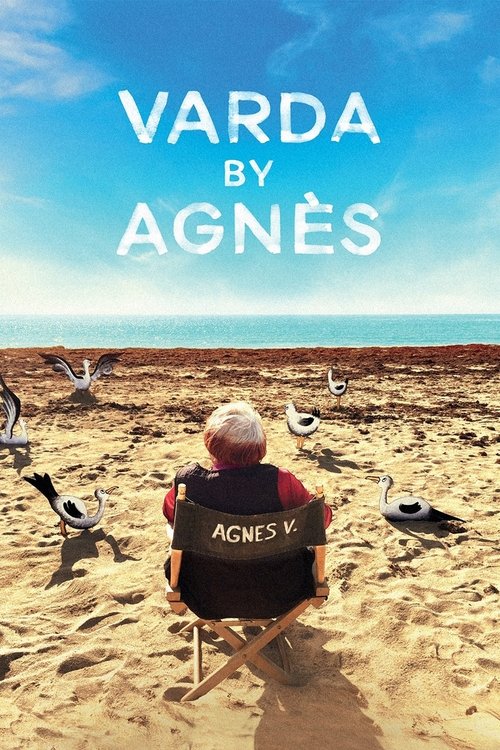
Varda by Agnès
2019 · Agnès Varda
For a curious night in when you want to be inspired rather than gripped — perfect if you make things, or want to. Total comfort viewing that still leaves you with a notebook full of ideas.
What it's about
Agnès Varda, ninety years old and one of cinema's great originals, sits before an audience and walks through six decades of her own films, photographs, and installations — from Paris's Rue Daguerre to Los Angeles and Beijing. Framed as a masterclass, it's really a testament: her account of what she called 'cine-writing,' the idea that every frame, cut, and sound is authorship. It was her last film, finished in the final months of her life.
The experience
Playful, generous, and quietly moving — like spending two hours with the wisest, most mischievous artist you know while she tells you her secrets. The undertow of farewell sneaks up on you; it's a warm film that can still put a lump in your throat.
The craft
Varda structures the film as a conversation, weaving clips, on-location returns, and her installation art into an argument about how films are written with images and sound. It's a masterclass in editing about editing — every cut demonstrates the very principle she's explaining.
Why it matters
Premiered at the Berlinale weeks before her death in March 2019, it became the self-authored final word of a filmmaker whose influence runs from the French New Wave — which she helped invent — to generations of personal, first-person documentary makers.
Snapshot
Varda by Agnès (French: Varda par Agnès) is the final film by Agnès Varda, completed in the last months of her life and premiered at the 69th Berlin International Film Festival in February 2019, roughly six weeks before her death on 29 March 2019 at the age of ninety. It is a documentary in the literal sense but a testament in spirit: a self-authored retrospective in which Varda uses the frame of a public masterclass to walk through six decades of work — from La Pointe Courte (1955) to Faces Places (2017) — and to lay out the principles that governed all of it. The film's organizing idea is the term she coined, cinécriture ("cine-writing"), her insistence that every choice of frame, cut, movement, and sound is a form of authorship equivalent to a writer's word choice. Structured loosely in two movements — the first on her cinema, the second on her photography and gallery installations — it is at once a career summary, an artist's statement, and a farewell delivered with characteristic warmth and mischief.
Industry & production
The film was produced by Ciné-Tamaris, the production and distribution company Varda founded in 1954 and ran across her entire career, keeping ownership and control of her catalog — an unusually durable model of artisanal independence in European cinema. Rosalie Varda, the director's daughter and longtime producer, oversaw the production; the intimate, in-house scale of the operation is inseparable from the film's confessional register. Financing and broadcast partnership came through the French public-cultural sphere, with Arte among the associated broadcasters, consistent with Varda's late-career relationships and with how her documentaries were customarily funded and aired in France. The precise co-financing arrangements and any international distribution guarantees are not something I can detail reliably here without risking invention.
Varda by Agnès is best understood as a coda to a remarkable late resurgence. In her final decade Varda had become, improbably, one of the most celebrated living filmmakers in the world: an honorary Palme d'Or at Cannes in 2015, an honorary Academy Award (the Governors Award) in 2017, and an Oscar nomination for Best Documentary Feature for Faces Places the same year — the first for a competitive category she had never before entered. That wave of recognition created both the audience and the occasion for a summing-up, and the film capitalized on the public appetite to hear Varda explain herself in her own voice.
Technology
The film is a hybrid of formats gathered across sixty-plus years. Its raw material includes 35mm and 16mm excerpts from Varda's fiction and documentary films, standard-definition digital video from her early-2000s work, and freshly shot high-definition digital footage of her lectures and site visits. This heterogeneity is not incidental: Varda was one of the first established auteurs to embrace lightweight digital video enthusiastically, and The Gleaners and I (2000) is a landmark of what small consumer-grade cameras made possible — a filmmaker able to shoot alone, hold the camera herself, and film her own aging hand. Varda by Agnès folds that history of tools into its argument, treating the shift from film to digital not as a loss but as a widening of who gets to write with images. The gallery-installation material documented in the second half further extends the film's technological range into the realm of moving-image art projected on non-cinematic surfaces.
Technique
Cinematography
Because so much of the film is compiled, its "cinematography" is really two things at once: the archival image-making of decades of collaborators, and the new photography of Varda on stage and on location. The freshly shot material — Varda addressing a theater audience, wandering a beach, visiting installation sites — is filmed in a clean, unfussy digital style whose plainness is deliberate, keeping attention on her speech and her hands rather than on the camera. Several camera operators contributed to the new footage; among the names associated with the film's photography are Claire Duguet and François Décréau, though the exact division of shooting duties is not something I can specify with confidence. The contrast between the composed, painterly framing of her fiction excerpts (the tracking shots of Cléo from 5 to 7, the saturated color of Le Bonheur) and the informal address of the new footage is itself part of the film's grammar.
Editing
Editing is the heart of the film and the demonstration of its thesis. Varda edited the picture herself in collaboration with an editing team, and the assembly is where cinécriture is most literally enacted: clips are chosen, trimmed, and juxtaposed so that her spoken commentary and the images comment on one another. She frequently interrupts a clip to explain the decision behind it — why a shot lasts as long as it does, why a cut lands where it lands — so that the edit becomes both the object and the subject. The rhythm is associative rather than strictly chronological, doubling back and jumping forward as a lecturer's talk would. I want to name the credited co-editor precisely, but I am not certain enough of the attribution to state it as fact.
Mise-en-scène / staging
The film's principal staging conceit is the masterclass. Varda sits or stands before an audience — including a large session filmed in a theater — and speaks directly, sometimes to the room, sometimes past it to the camera. This lecture frame is the mise-en-scène: it gives the compilation a physical body and a speaker, and it lets Varda perform the role she cultivated for decades, the small, bowl-haircutted sage with the two-tone hair, at ease and unhurried. Interspersed are staged visits to meaningful locations — her home and studio on the Rue Daguerre in Paris, beaches, exhibition spaces — that turn autobiography into a kind of guided tour.
Sound
Sound is dominated by Varda's own voice — both her live lecture and voiceover narration — which threads the disparate clips into a single consciousness. Excerpted scenes carry their original sound and scores, so the film's audio texture shifts with each source. On the question of an original score composed for Varda by Agnès, the record as I can verify it is thin; much of the film's music is inherited from the excerpted works rather than newly composed, and I will not attribute a specific composer to the new material without certainty.
Performance
There is one performance, and it is Varda's — not acted but curated. She is a practiced and disarming public speaker, and the film depends entirely on her presence: her timing, her self-deprecation, her willingness to be both authority and grandmother. Archival footage also returns us to earlier performances in her films — Corinne Marchand as Cléo, Sandrine Bonnaire as the drifter Mona in Vagabond — but these appear as illustrations within Varda's argument rather than as independent dramatic events.
Narrative & dramatic mode
The film is essayistic and first-person, belonging to the tradition of the lecture-film and the filmed self-portrait. There is no plot; the through-line is Varda's own account of how she worked and why. Its dramatic engine is retrospection and, unavoidably, mortality — the knowledge, felt if rarely stated, that this is a last accounting. Varda structures her talk around a triad she offers the audience as her working principles: inspiration, creation, and sharing (partage). The last of these, sharing, gives the film its emotional shape, framing the entire enterprise as a gift handed to an audience rather than a monument built for one.
Genre & cycle
Formally it is a documentary and, more specifically, an autobiographical essay-film and artist's self-retrospective. It sits within a small cycle of late-career Varda works that turned the camera on herself and her own history: The Beaches of Agnès (2008), an inventive autobiography, is its clearest predecessor, and Faces Places (2017), her collaboration with the artist JR, its immediate companion. Within the broader genre of the filmmaker's testament — films in which aging directors reckon with their own oeuvre — Varda by Agnès is unusually direct, dispensing with fictional cover to simply explain the work.
Authorship & method
This is authorship as subject matter. Varda directs, narrates, and effectively curates the film, and its entire purpose is to articulate her method. Cinécriture — the notion that a film is written not on the page but through the totality of its cinematic choices — is her signature theoretical contribution, and here she teaches it by example. Her method across her career combined documentary curiosity with formal daring: real time in Cléo, the deliberately unsettling beauty of Le Bonheur, the fractured backward structure of Vagabond, the digital intimacy of The Gleaners and I. Key collaborators on this specific film include the Ciné-Tamaris production team led by Rosalie Varda and the camera and editing personnel noted above; I have flagged where I cannot pin individual crew attributions with confidence, and I would rather leave those gaps visible than fill them with invention. The deeper collaborative fact is historical: Varda's life and work were entwined with those of her late husband, the filmmaker Jacques Demy, and with the Left Bank circle of Chris Marker and Alain Resnais, and their influence hovers behind her account even when unnamed.
Movement / national cinema
Varda is a foundational figure of French cinema whose position is slightly, productively off-center. La Pointe Courte (1955) is frequently cited as a precursor to the French New Wave, made before the Cahiers du cinéma critics turned director; yet Varda is more precisely associated with the Rive Gauche (Left Bank) group — Varda, Marker, Resnais — a cohort more literary, more documentary-minded, and more politically engaged than the Right Bank Cahiers wing. Varda by Agnès is a French national-cinema artifact through and through, produced within France's public-cultural funding ecology and rooted in a Parisian artistic life, even as it travels — as the synopsis notes — to Los Angeles and Beijing, reflecting Varda's genuinely transnational career, including her Californian films of the late 1960s and early 1980s.
Era / period
The film belongs to the late 2010s, a moment when documentary and the essay-film enjoyed unusual cultural prominence and when a generation of postwar European auteurs was passing. Its content, however, spans the entire second half of the twentieth century and the first two decades of the twenty-first, using the vantage of 2019 to survey everything from the postwar art cinema of the 1950s to contemporary gallery installation. It is, in a sense, a period piece about an entire period — the era of auteur cinema itself — narrated from its far end.
Themes
Its themes are the recurring preoccupations of Varda's whole body of work, gathered and named: the dignity and texture of ordinary people and overlooked things; feminism and the female gaze (Cléo learning to see rather than be seen); the pleasures and politics of looking; the passage of time and the approach of death; the ethics of the documentary encounter; and the porousness between fiction, documentary, photography, and installation art. Above all the film is about making — the conviction that creation is a form of attention and that sharing what one has made is the point of having made it. Chance, curiosity, and play recur as method as much as motif.
Reception, canon & influence
Critical reception was warm and frequently elegiac; the film arrived as Varda's stature had never been higher, and its Berlinale premiere weeks before her death gave it the weight of a farewell that critics received with affection and gratitude. As a synthesizing document it has become a natural entry point into Varda's filmography and a touchstone for how she wished her work to be understood — its articulation of cinécriture now routinely cited in writing about her.
Influences on the film (backward): it draws on the whole of Varda's own output as raw material and method, and on the essayistic, first-person tradition she helped build with the Left Bank filmmakers. Its most direct antecedent is her own The Beaches of Agnès, which had already turned autobiography into cinematic self-portraiture; the lecture-film and the artist's talk are its formal models.
Legacy (forward): as a coda, its influence is bound up with the broader, still-growing reassessment of Varda as one of cinema's essential figures — a reassessment that has shaped feminist film scholarship and a generation of essay- and diary-filmmakers who cite her as a permission-giving example. Because the film so clearly frames her own principles, it has effectively supplied the vocabulary — cinécriture, inspiration/creation/sharing — through which her legacy is now discussed. Any claim of specific, traceable influence on particular later films would be premature given how recent it is; its most durable effect so far is on how Varda herself is read and taught.
A Deleuzian reading
An old woman sits on a stage in front of an audience while a clip from one of her own films plays.
The full Deleuzian reading of Varda by Agnès →
Reception
It premiered at the Berlinale in February 2019 as a charming career-spanning masterclass — then Varda died just weeks later, and it was instantly reframed as a deliberate, graceful goodbye. It's now widely regarded as one of cinema's great final films, a testament she seemed to know she was making.
How Varda by Agnès was received, from release to now →
Influences: the films it descends from and the films it influenced
- The Beaches of Agnès (2008) — Its direct template: Varda's earlier turning of her own biography into cinematic self-portrait, staging herself amid reconstructed installations and mirrors so that autobiography is performed as mise-en-scène rather than merely narrated.
- The Gleaners and I (2000) — Establishes the handheld lightweight-DV first-person essay in which Varda films her own aging hands and inserts herself as subject, the intimate digital-diary mode she compiles and teaches from here.
- Cléo from 5 to 7 (1962) — The real-time construction and cinécriture she dissects on-screen as a masterclass exhibit — proof that structure (the ticking chapter clock) is 'written' through editing and duration, not the script.
- Letter from Siberia (1957) — Founds the essay-film device of re-reading identical footage under shifting voiceover commentary, the associative image/word montage her lecture-film inherits from her Left Bank colleague.
- Sans Soleil (1983) — The first-person essayistic voiceover threaded over compiled travel footage from disparate formats — the meditative montage-and-narration architecture Varda's compiled hybrid adopts.
- Night and Fog (1955) — Left Bank essayistic montage that binds archival material to a personal literary commentary track, the intellectual-editing lineage Varda draws on when speaking over her own excerpts.
- F for Fake (1973) — The director-as-on-screen-narrator trickster essay, where playful associative cutting makes authorship and the act of construction the film's actual subject — precisely Varda's self-curating stance.
- Histoire(s) du cinéma (1998) — The compiled-hybrid, self-reflexive lecture on one's own relationship to cinema, layering clips, text and spoken argument into a first-person theoretical statement — the New Wave sibling to her cinécriture summation.
- News from Home (1977) — The diaristic first-person voiceover laid over autobiographical images, pioneering the personal essay-diary register Varda's curated self-presence extends.
- Cameraperson (2016) — Assembles an autobiography and an ethics of image-making out of a career's leftover documentary footage — the retrospective self-portrait-by-compilation method that Varda's Gleaners-to-lecture practice licensed.
- Dick Johnson Is Dead (2020) — Confronts mortality and farewell through playfully staged self-implicating reenactments, the same disarming mix of formal gamesmanship and grief that Varda models in her valedictory address.
- Faces Places (2017) — Her immediately prior film built on the same curated-self-presence: Varda performing her authorial persona on camera as a warm, wandering guide, the direct-address self-staging carried straight into the masterclass frame.
- Stories We Tell (2012) — A hybrid autobiographical documentary that foregrounds its own construction — mixing real and fabricated 'archival' material — making authorship and how a life is edited into narrative the explicit subject, as Varda does with cinécriture.
- Los Angeles Plays Itself (2003) — A feature-length compiled-footage lecture essay carried entirely by first-person voiceover over reappropriated clips, the same clips-plus-commentary architecture as Varda's talk-film.
- No Home Movie (2015) — A late diary-film of impending mortality and farewell shot in lightweight digital intimacy, extending the first-person essay tradition toward the elegiac register Varda's coda occupies.
- I Am Not Your Negro (2016) — A key film of the late-2010s essay-film revival built as a first-person voiced compilation of archival fragments organized by an authorial argument rather than chronology — the same essayistic montage current Varda's film rides.
Similar films
- Cléo from 5 to 7 (1962) — influence & lineage
- The Gleaners and I (2000) — influence & lineage
- Sans Soleil (1983) — influence & lineage
- Vagabond (1985) — shared sensibility
- Jacquot (1991) — shared sensibility
- One Sings, the Other Doesn't (1977) — shared sensibility
- Nouvelle Vague (2025) — shared sensibility
- Vivre Sa Vie (1962) — shared sensibility