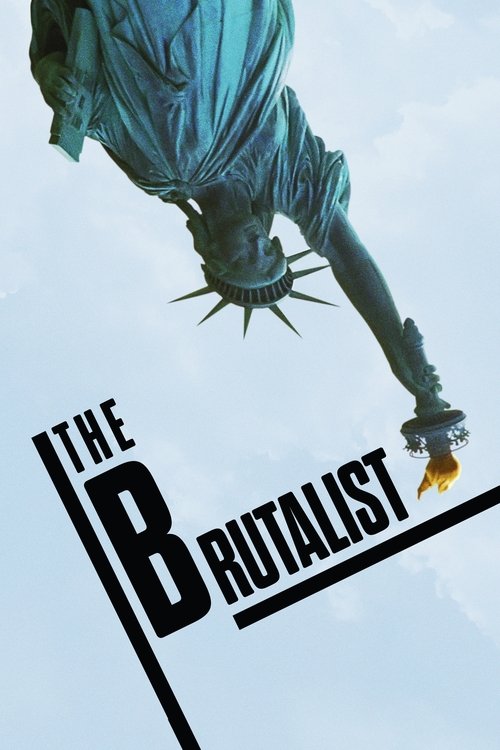
The Brutalist
2024 · Brady Corbet
A 215-minute VistaVision epic with an intermission became a hit and then an AI scandal when its editor revealed Adrien Brody's Hungarian was machine-tuned — the moment "AI in film" discourse arrived inside prestige cinema, not just outside it.
When you want to give a whole evening to something huge — a challenge, not a comfort, for the mood where only a capital-E Epic will do. Best when you're ready to feel awed and unsettled in equal measure.
What it's about
A visionary Hungarian-Jewish architect survives the Holocaust and lands in postwar Pennsylvania with nothing, shoveling coal and sleeping in back rooms while carrying a whole modernist vision in his head. Then a wealthy industrialist takes him up as a protégé — and the film spends decades tracing what that patronage costs him, his wife, and his work. It's an epic about immigration, ambition, and what America extracts in exchange for the dream.
The experience
Monumental and slow-burning — three and a half hours with an actual intermission — but it grips like a novel you can't put down, swinging between intimate marital scenes and images of overwhelming scale. It's demanding, sometimes brutal, and it leaves you arguing with it for days.
Performances
Adrien Brody won an Oscar for his gaunt, wounded, ferociously proud architect, and Guy Pearce is chilling as the patron whose generosity always has teeth.
The craft
Shot on a shoestring yet staged like a 1950s roadshow spectacle — overture, intermission, epilogue — with Lol Crawley's Oscar-winning cinematography turning concrete and quarry-light into something biblical. The score is jagged and enormous. If any film this decade demands the biggest screen and best sound you can find, it's this one.
Why it matters
A Venice prize-winner that swept up three Oscars and established Brady Corbet as one of the most ambitious American directors working — proof that the giant, serious, decades-spanning epic still has a pulse.
Snapshot
The Brutalist is Brady Corbet's third feature, a 215-minute epic — overture, two titled parts, a fifteen-minute intermission, and an epilogue — that follows László Tóth, a fictional Hungarian-Jewish architect and Holocaust survivor, from his arrival in postwar America through decades of struggle, patronage, exploitation, and partial vindication. Shot for a reported budget under ten million dollars yet scaled to the dimensions of a classical Hollywood roadshow picture, the film is at once a künstlerroman about a Bauhaus émigré and a corrosive parable of the American Dream as a transaction between artist and capital. It premiered at the 2024 Venice Film Festival, where Corbet took the Silver Lion for Best Director, and went on to win three Academy Awards — Best Actor for Adrien Brody, Best Cinematography for Lol Crawley, and Best Original Score for Daniel Blumberg. Its formal ambition, its anachronistic VistaVision aesthetic, and its unusually frank dramatization of antisemitism and immigrant precarity made it one of the most discussed prestige releases of its year.
Industry & production
The Brutalist is a study in how a maximalist art film can be financed and executed at minimal cost. Written by Corbet and his creative and life partner Mona Fastvold, the script reportedly circulated for the better part of a decade before financing came together through a coalition of independent producers and international co-production money; the film was distributed in North America by A24. The production decamped to Budapest, where Hungarian crews, favorable costs, and standing locations allowed Corbet to construct postwar Pennsylvania on a fraction of a studio budget. Exteriors and the marble-quarry sequence were filmed in Carrara, Italy. The reported sub-$10 million figure — widely cited though not officially audited — is central to the film's reception: critics repeatedly framed it as evidence that scope is a matter of vision and discipline rather than money.
The runtime itself was an industrial gambit. By building in a literal intermission, Corbet revived the roadshow exhibition model of the 1950s and 1960s, forcing distributors and exhibitors to treat the film as an event rather than a standard multiplex slot. The decision courted commercial risk but generated precisely the cultural conversation that sustains awards campaigns. The film accumulated major precursor honors — including Golden Globes for Best Motion Picture (Drama), Director, and Actor — and ten Academy Award nominations, converting three.
Technology
The film's defining technological choice is its capture format: VistaVision, the horizontal large-area 35mm process Paramount developed in 1954 and largely abandoned by the early 1960s. Running the film stock sideways through the camera yields a negative roughly twice the area of standard 35mm, with correspondingly fine grain and resolution. By reviving a format associated with the very period the story inhabits, Corbet and Crawley fused subject and apparatus: the image carries the texture of mid-century American cinema as a material fact, not a digital filter. Select engagements were presented in 70mm, amplifying the sense of an exhumed roadshow object.
The film also became a flashpoint in the debate over generative AI in filmmaking. During awards season, editor Dávid Jancsó disclosed that the production used Respeecher, a voice-modeling tool, to refine specific Hungarian-language vowels and consonants in Brody's and Felicity Jones's dialogue so the pronunciation would withstand a native ear; he also indicated that AI tools assisted in generating some of the architectural renderings glimpsed in the closing montage. Corbet subsequently clarified that the performances were fundamentally the actors' own and that the building designs originated with the production's own artists, with AI used in a limited, finishing capacity. The disclosure provoked genuine discourse about authenticity and disclosure norms; the precise extent of the tools' use is best described as contested at the margins rather than fully settled in the public record.
Technique
Cinematography
Lol Crawley's Oscar-winning photography is the film's most immediately legible signature. The VistaVision negative produces deep, stable, almost sculptural images well suited to a film about mass, surface, and built form. The picture opens with a celebrated disorienting passage — a careening, handheld ascent out of a ship's hold toward light, resolving on an inverted Statue of Liberty — that announces both the immigrant's vertigo and the film's willingness to skew the iconography of arrival. Throughout, Crawley alternates between this restless subjectivity and a rigorous architectural stillness: low angles that monumentalize concrete, long static compositions that let Tóth's structures dominate the frame, and a controlled palette that shifts from the bruised tones of postwar displacement toward colder, harder light as the patron's money reshapes the work. The Carrara quarry sequence, with its blinding marble and abyssal cuts, supplies the film's most overtly symbolic landscape.
Editing
Dávid Jancsó's cutting governs the film's unusual architecture of time. The picture is partitioned by an overture, two titled chapters — "Part One: The Enigma of Arrival" and "Part Two: The Hard Core of Beauty," whose titles nod to V.S. Naipaul (and, beneath him, the de Chirico painting) and to William Carlos Williams respectively — a hard intermission, and an epilogue leaping to the 1980 Venice Biennale. Within scenes the editing can be patient to the point of duration as endurance; across the macro-structure it executes large temporal ellipses that ask the audience to register years lost to bureaucracy, addiction, and waiting. The rhythm enacts the film's thesis that an immigrant artist's life is measured less in achievements than in intervals of deferral.
Mise-en-scène / staging
Production and costume design build a tactile postwar America — boarding houses, furniture showrooms, industrial Pennsylvania — without recourse to nostalgia. The centerpiece is the community center/library/chapel complex Tóth designs for his patron, a monumental brutalist structure whose construction and compromise organize the back half of the film. Corbet stages power architecturally: the patron's estate, the negotiating table, and the building site become arenas where class and ethnicity are spatialized. The brutalist idiom — raw concrete, severe geometry, light admitted as if rationed — is not merely decor but argument, the émigré modernist's austere European conscience set against American appetite.
Sound
Daniel Blumberg's score, recorded with improvising musicians, is abrasive, brass-heavy, and dissonant where a period epic might default to lushness. It refuses consolation, scoring ambition as something closer to anxiety. The sound design pairs this with the concussive presence of construction and industry; the VistaVision spectacle is matched by an aggressively physical soundtrack that keeps the film's grandeur from curdling into comfort.
Performance
Adrien Brody's László Tóth is a study in controlled depletion — pride, talent, and trauma compressed beneath a survivor's wariness, periodically breaking open into need or rage. Brody, himself the son of a Hungarian émigré and previously an Oscar winner for another Holocaust narrative, brings biographical resonance to the role. Guy Pearce plays Harrison Lee Van Buren as seductive menace, a patron whose generosity is inseparable from ownership; the relationship's drift from mentorship toward violation drives the film's moral engine. Felicity Jones, as Tóth's wife Erzsébet, arrives midway and supplies the film's clearest external conscience, her physical frailty masking moral steel.
Narrative & dramatic mode
The film operates as a long-form realist epic with allegorical undertow. Its mode is the émigré künstlerroman crossed with the rise-and-ruin arc of American myth: the gifted outsider is welcomed, used, broken, and only belatedly canonized. Corbet resists the redemptive curve such material usually follows. Compromise is constant, the patron's patronage curdles into something predatory, and the "success" that frames the epilogue is retrospective and ambiguous — an institutional honoring that may distort as much as it vindicates the work. The chaptered, intermission-bearing structure deliberately invokes the literary and roadshow traditions, asking to be received as a novelistic totality rather than a tidy three-act drama.
Genre & cycle
The Brutalist belongs to the lineage of the American immigrant epic and the artist-and-patron drama, while formally resurrecting the mid-century prestige roadshow picture. It sits within a recent cycle of ambitious, long, auteur-driven period films — works that stake their identity on duration, analog capture, and seriousness of subject as a counter-position to streaming-era disposability. Thematically it converses with the long tradition of films about the corruption of American ambition, from the robber-baron portraiture of classical Hollywood to There Will Be Blood's vision of capital as appetite, with which it has been frequently and aptly compared.
Authorship & method
Corbet, a former actor who moved decisively behind the camera with The Childhood of a Leader (2015) and Vox Lux (2018), has built a body of work preoccupied with the 20th century's catastrophes and the architecture of power — fascism's incubation, celebrity as cultural symptom, and now postwar capital. The Brutalist extends his interest in the individual crushed or co-opted by historical forces, rendered in long, formally daring structures. His collaboration with Mona Fastvold, his co-writer here and herself a director, is central to the film's literary density and its female perspective. The authorial signature is collective in the best sense: Crawley's VistaVision image, Blumberg's confrontational score, and Jancsó's temporal architecture are not decorations on a script but co-equal bearers of meaning. The choice to make a film about a modernist obsessive in a self-consciously rigorous, resource-constrained, period-correct mode reads as a statement of method — form as ethics.
Movement / national cinema
The film is a genuinely transnational object: an American-set story financed across borders, shot in Hungary and Italy by a British cinematographer, scored by a British musician, edited by a Hungarian, and directed by an American working in a European art-cinema register. Its subject — the Bauhaus modernist exiled to America — mirrors the real mid-century migration of Central European architects and artists fleeing fascism, the diaspora that reshaped American modernism. The film thus belongs less to a national cinema than to the cosmopolitan tradition of the émigré sensibility it depicts.
Era / period
The narrative spans roughly 1947 to 1960, with an epilogue at the 1980 Venice Biennale. It inhabits the postwar moment of American ascendancy — industrial confidence, suburban expansion, and the consolidation of private wealth — and reads that era through the eyes of someone for whom it is both refuge and trial. The recovery of VistaVision binds the film's production era to its diegetic one, so that the period is evoked not only by design but by the grain of the image itself.
Themes
At its core the film anatomizes the American Dream as a contract whose terms favor the powerful: the immigrant offers genius and labor; the native patron extends opportunity that doubles as control. Antisemitism runs through the work as ambient and eruptive, structuring how Tóth is welcomed and how he is degraded. Other governing themes include the survival and disfigurement of artistic integrity under patronage; trauma carried across an ocean and never set down; assimilation as a form of erasure; and the gap between a building (or a life) as conceived and as compromised in the making. The brutalist aesthetic itself becomes the film's central metaphor — beauty defined by honesty of material and refusal of ornament, an ethic perpetually under threat from money's desire for spectacle.
Reception, canon & influence
Critical reception was strong and the awards trajectory commanding: the Venice Silver Lion, multiple Golden Globes, ten Oscar nominations, and three wins (Brody, Crawley, Blumberg). Critics widely praised its ambition, its performances, and its vindication of analog, large-format filmmaking on a small budget; some dissented over its length, the schematic cruelty of its allegory, and a late narrative turn that polarized viewers. The AI-disclosure controversy supplied the season's sharpest counter-current, prompting industry-wide debate about where assistive tools end and authorship begins.
Looking backward, the film draws on the émigré modernist history of figures such as Marcel Breuer and the broader Bauhaus diaspora (Tóth is fictional, an amalgam rather than a portrait), on the American epic tradition and There Will Be Blood in particular, and on the formal grammar of the 1950s roadshow picture it revives. The protagonist's name, shared with the man who vandalized Michelangelo's Pietà in 1972, has invited interpretation as a deliberate resonance, though the film does not gloss it. Looking forward, its most concrete legacy is demonstrative: it became the standard-bearer for the argument that genuinely large-scale, formally serious cinema can be made cheaply and on celluloid, and a reference point in the still-unfolding debate over generative tools in prestige filmmaking. As it is a very recent film, claims about its lasting canonical position remain provisional, but its immediate influence on the discourse around budget, format, and authorship is already evident.
A Deleuzian reading
The first thing you see clearly is wrong-way-up.
The full Deleuzian reading of The Brutalist →
Reception
It premiered at Venice 2024 to instant 'great American epic' rapture (Corbet took Best Director), swept into 10 Oscar nominations and 3 wins — and then got relitigated almost immediately, with an AI-voice controversy and a wave of 'is it actually a masterpiece?' backlash arriving before the awards season even ended.
How The Brutalist was received, from release to now →
Influences: the films it descends from and the films it influenced
- There Will Be Blood (2007) — The film's explicit structural model: an American epic of capital staged as the long, corrosive war between a driven outsider and his wealthy patron, scored with abrasive dissonant strings that function as argument rather than accompaniment.
- Lawrence of Arabia (1962) — The roadshow grammar The Brutalist deliberately revives — 70mm scale, overture, and a literal intermission cleaving the work into two formally distinct movements.
- 2001: A Space Odyssey (1968) — Large-format roadshow exhibition with intermission and the monolithic, low-angle framing of man-made structures as objects of awe and dread.
- The Fountainhead (1949) — The template of the uncompromising modernist architect as hero, with reverent low-angle photography of buildings that stages architectural form itself as a moral argument.
- Citizen Kane (1941) — Toland's low-angle deep-focus framing of monumental interiors and the cradle-to-ruin anatomy of an American empire built on a poisoned bargain.
- The Godfather Part II (1974) — The immigrant-arrival epic in which the American dream curdles into a corrupt contract, narrated across decades through interleaved temporal blocks.
- Once Upon a Time in America (1984) — An immigrant epic whose meaning is carried by vast temporal ellipses and an elegiac long-form architecture spanning a lifetime.
- Barry Lyndon (1975) — Period-correct formal rigor and an anti-redemptive arc tracking a striver's rise and destruction, rendered in painterly large-format compositions.
- The Searchers (1956) — The VistaVision large-format compositions whose horizontal clarity and grandeur The Brutalist's revival of the dormant format directly invokes.
- Vertigo (1958) — VistaVision's deep, oversized-negative clarity marshaled for total obsessive control of the image — the same format kinship driving Crawley's photography.
- The Childhood of a Leader (2015) — Corbet's first deployment of the chaptered/intertitle structure and Scott Walker's confrontational, dissonant orchestral score as a co-equal bearer of meaning.
- Oppenheimer (2023) — Corbet's choice of VistaVision large-format anamorphic as an anti-digital statement — for a 3.5-hour genius-destroyed-by-ambition biopic — extends Oppenheimer's proof-of-concept that analog large-format photography at epic runtime remains commercially and aesthetically viable against the streaming default.
- The Master (2012) — Large-format 65/70mm photography of a postwar-America drifter absorbed and deformed by a charismatic benefactor, built on a controlled, depleted central performance of suppressed damage.
- Vox Lux (2018) — The Corbet–Fastvold chaptered epic, with an act/prologue framework, a dissonant Scott Walker score, and a protagonist deformed by impersonal historical and cultural forces.
- The Immigrant (2013) — A period immigrant epic of Ellis Island arrival and exploitation, shot in warm large-format-style imagery and resolving into a hard, anti-redemptive reckoning with the American promise.
- Red Desert (1964) — Industrial and modernist architecture composed as psychological and ideological argument — the built environment as the film's thesis rather than its backdrop.
- Top Gun: Maverick (2022) — Prominent prestige-cinema use of Respeecher's generative-voice technology to reconstruct a performance — the same assistive AI tool The Brutalist used to refine Hungarian-accent dialogue.
- The Testament of Ann Lee (2025) — Shares the large-format photochemical epic mode — period capture engineered for 70mm projection — and the Hungarian-inflected repertory production team, dramatizing an uncompromising outsider broken yet vindicated by history.
- The Bride! (2026) — Revives an obsolete capture standard (VistaVision) as a period argument rather than nostalgia and pairs it with Blumberg's brass recorded to sound damaged — the parallel case for the seed's rehoused-stills-lens-on-Venice-2 hybrid and its distorted orchestra.
Similar films
- Barry Lyndon (1975) — influence & lineage
- Oppenheimer (2023) — same viewing thread
- The Promised Land (2023) — same viewing thread
- Killers of the Flower Moon (2023) — same viewing thread
- Babylon (2022) — shared sensibility
- The Pianist (2002) — shared sensibility
- The Grand Budapest Hotel (2014) — shared sensibility
- The Revenant (2015) — shared sensibility
All the films related to The Brutalist →
Watch it with: curated runs of related films
- Great Men, Grand Reckonings — A run of prestige true stories about singular, obsessive men chasing an epochal achievement — the bomb, the moon, the checkered flag, a nation — and reckoning with what it cost them and everyone around them.