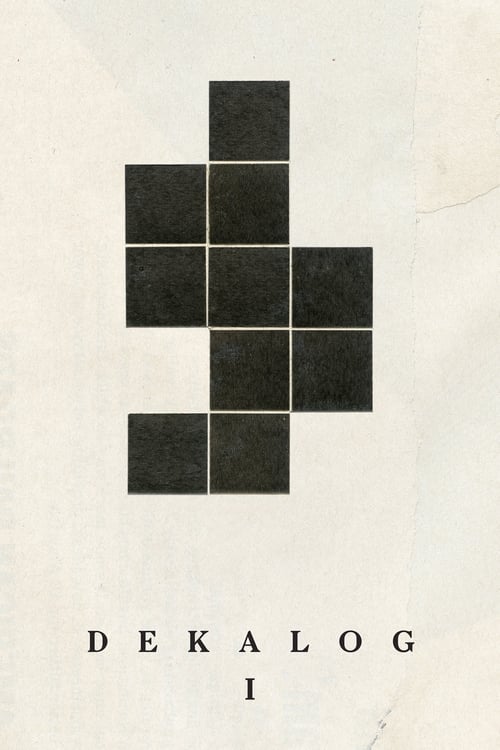
Decalogue I
1989 · Krzysztof Kieślowski
When you want a film to chew on for days — one that asks the biggest questions through the smallest domestic moments. This is challenge, not comfort: profoundly moving, and it will wreck you a little.
What it's about
Krzysztof, a university lecturer and devoted amateur programmer, is raising his bright young son Paweł to trust what can be measured — the two of them run calculations together on the home computer like a shared game. Paweł's aunt Irena lives by faith, and the boy shuttles between the two worldviews, asking the kind of questions adults can't quite answer. Over one Warsaw winter day, an ordinary domestic calculation puts both belief systems to the test.
The experience
Quiet, tender, and then quietly shattering. It plays like an intimate family drama for most of its hour, warmth between father and son filling every scene, while a low hum of dread builds underneath — and it leaves you sitting in silence when it's done.
Performances
Henryk Baranowski is remarkable as the father — a rationalist whose certainty erodes in real time — and young Wojciech Klata gives Paweł an unforced curiosity and sweetness that makes the film land as hard as it does.
The craft
Kieślowski works in a hushed, wintry palette where a frozen pond, a glowing computer screen, and a bottle of ice-blue ink all carry enormous charge — nothing is decoration, everything means something. Made for Polish television on modest means, it proves how much devastation precise writing and patient framing can deliver without a single raised voice.
Why it matters
The opening film of the Dekalog cycle, widely regarded as one of the great achievements of world cinema and the work that carried Kieślowski to international prominence — proof that television could house films of this stature.
Snapshot
Dekalog I (English: Decalogue One) is the opening film of Dekalog, Krzysztof Kieślowski's ten-part cycle made for Polish state television and broadcast in 1989–90. Each roughly hour-long episode takes a loose, oblique bearing from one of the Ten Commandments; the first is most often associated with "I am the Lord thy God; thou shalt have no other gods before me." Kieślowski and his co-writer Krzysztof Piesiewicz refused tidy one-to-one mappings, and the film is better understood as a meditation on the limits of rational knowledge than as an illustration of a precept. Krzysztof (Henryk Baranowski), a university lecturer in linguistics and an enthusiastic home-computer hobbyist, raises his young son Paweł (Wojciech Klata) in a faith that measurement, calculation, and the machine can render the world legible. His devout sister Irena (Maja Komorowska) offers Paweł a different vocabulary, one of soul and mystery. When father and son calculate that the ice on a nearby pond is thick enough to bear the boy's weight, the ice gives way and Paweł drowns — and the film's quiet catastrophe is that the numbers were not wrong so much as insufficient. It is among the most admired hours in the cycle and a touchstone for any account of cinema that thinks seriously about belief.
Industry & production
Dekalog was produced by the Polish film unit Zespół Filmowy "Tor", with the West German broadcaster Sender Freies Berlin (SFB) participating as a co-financing partner — an arrangement that brought hard-currency support to a project mounted under the straitened conditions of late-communist Polish television. Ryszard Chutkowski served as producer. The cycle originated, by Kieślowski's own account, in a period of personal and national discouragement in mid-1980s Poland; Piesiewicz, a lawyer Kieślowski had met while researching No End (1985), proposed the Ten Commandments as an armature, and the two wrote all ten screenplays together. The films were conceived for television first, with the understanding that their hour-long form suited the medium, though Kieślowski secured the freedom to shoot two of them as expanded theatrical features (A Short Film About Killing and A Short Film About Love, from episodes five and six).
Precise budget figures for Dekalog I are not part of the reliably documented record, and I will not invent them; what is clear is that the cycle was made economically, on television schedules, with a rotating crew strategy that spread resources across ten productions. That strategy — most visibly, a different cinematographer for nearly every episode — was as much an artistic decision as an economic one.
Technology
The film's deep subject is technology itself, and specifically the personal computer as an emblem of late-twentieth-century faith in calculability. Krzysztof's apartment hums with a home computer that he treats almost as an oracle: it computes the load-bearing capacity of the ice, and in one of the film's most unsettling touches the machine appears to switch itself on and display a message ("I am ready") unprompted, lending the apparatus an autonomy that exceeds its master's intentions. Kieślowski uses the computer not as science-fiction spectacle but as a domestic god — a thing consulted, trusted, and ultimately betrayed by the gap between what it can model and what actually happens.
On the production side, Dekalog was shot on film for television exhibition; I am not certain enough of the exact gauge and stock used on episode one to state it as fact, and would rather flag the gap than guess. What can be said with confidence is that the imagery depends on photochemical control of a cold, desaturated palette and on practical effects — frozen liquids, the cracking pond, condensation and frost — handled in-camera and on location rather than through optical trickery.
Technique
Cinematography
Dekalog I was photographed by Wiesław Zdort, one of the several distinguished Polish cinematographers Kieślowski assigned across the cycle (others included Sławomir Idziak, Jacek Bławut, and Piotr Sobociński on later episodes). Zdort renders the Warsaw housing estate in chilled blues, grays, and the milky white of winter light, a palette that externalizes the film's spiritual climate. Recurrent motifs of glass, ice, water, and reflective surfaces give the images a quality of looking through something at a truth that stays just out of reach. The frozen pond is shot to feel both ordinary and ominous; the green-tinged glow of the computer screen sets the rationalist interior against the snow-light outside.
Editing
The cutting (editor Ewa Smal) is patient and accumulative rather than dramatic, holding on faces and objects to let dread gather. The film withholds and delays: the central catastrophe is approached obliquely, and the most harrowing passages — the father's dawning realization, the recovery of the body — are paced so that the viewer arrives at knowledge a beat behind or ahead of the characters. The editing's restraint is what makes the ending's release of feeling so forceful.
Mise-en-scène / staging
The action is anchored in the now-iconic Dekalog setting: a Warsaw apartment block whose stairwells, windows, and identical façades recur across the cycle and bind the ten stories into one moral geography. Staging favors the threshold — doorways, windows, the edge of the ice — and the apartment is dressed as a temple of rationality, books and machines and order. Against it Kieślowski places the unfinished church and the icon of the Black Madonna (Our Lady of Częstochowa) that figures in the ending.
Sound
Zbigniew Preisner's music is used sparingly and to devastating effect; his idiom here — grave, hymn-like, withholding — would become inseparable from Kieślowski's later work. Much of the film leans on ambient sound: the hum of the computer, the report of cracking ice, the silence of grief. Diegetic quiet does as much work as scoring.
Performance
Henryk Baranowski plays the father with a contained, intellectual reserve that makes his final collapse the more shattering; sharing the director's own first name, the character carries an implicit authorial self-implication. Wojciech Klata gives Paweł an unforced curiosity — the boy's questions about death and the soul are the film's moral engine. Maja Komorowska, a major figure of Polish theater and cinema, lends Aunt Irena a warmth and conviction that keep the faith/reason opposition from flattening into thesis. Artur Barciś appears, as he does across most of the cycle, as the silent young man by the lakeside fire — a wordless witness whose function is deliberately left unexplained.
Narrative & dramatic mode
The film operates in a mode of tragic irony built on dramatic foreknowledge. Kieślowski seeds omens — a spilled bottle of frozen ink, a dead dog, the witness by the fire, the father's vision of Paweł's face — so that the audience reads catastrophe in advance of the characters. The narration is intimate and domestic in scale but metaphysical in reach: a single death in a single family is made to bear the weight of an argument about how human beings can and cannot know the world. Crucially, the film does not resolve into a verdict. The numbers were sound and the child still died; faith offers consolation but no proof. The dramatic mode is interrogative, ending on a gesture — wax tears on the icon's face — rather than a statement.
Genre & cycle
Nominally a television drama, Dekalog I belongs most meaningfully to the cycle it opens. Dekalog is a portmanteau or anthology structure unified by place (the estate), by theme (moral reckoning under the pressure of the commandments), and by the recurring witness figure. The first film functions as overture, establishing the cycle's tone of metaphysical seriousness, its refusal of melodrama, and its method of letting large questions surface from small domestic incidents.
Authorship & method
Dekalog is the fullest expression of Kieślowski's mature method: a fusion of his documentary roots (he began in the 1960s–70s making documentaries for the Polish state) with a turn toward moral and metaphysical fiction. His working partnership with Krzysztof Piesiewicz — the screenwriting collaboration that would continue through The Double Life of Véronique and the Three Colours trilogy — is foundational; the lawyer's preoccupation with judgment and the writer-director's eye for behavioral detail meet in scripts that dramatize ideas rather than debate them.
The collaborative architecture extends to craft. By rotating cinematographers across episodes (Zdort on the first), Kieślowski let each film find its own optical character while preserving a unified sensibility. Zbigniew Preisner's music and editor Ewa Smal's cutting are central to that sensibility. Kieślowski's own commentary on the cycle — collected in interviews and in the published screenplays — stresses his interest in individuals at moments of moral or existential crisis rather than in political allegory, a stance that defines the film's authorship.
Movement / national cinema
Kieślowski emerged from, and then moved beyond, the Cinema of Moral Anxiety (kino moralnego niepokoju), the late-1970s/early-1980s Polish current — associated also with Wajda and Zanussi — that scrutinized the ethical compromises of life under socialism. Dekalog retains that movement's moral seriousness but redirects it inward and upward, from social critique toward questions of conscience, faith, and the unknowable. The film is a landmark of Polish national cinema precisely in this transposition: it speaks from a specific Warsaw of gray apartment blocks while reaching for the universal.
Era / period
Dekalog was made and first broadcast at the hinge of 1989, the year of the Round Table negotiations and the partially free elections that ended communist rule in Poland. The films are conspicuous for what they leave out: overt politics is almost entirely absent. That absence is itself of the period — an exhaustion with collective and political solutions, and a turn toward private, spiritual reckoning, at the very moment the political order was dissolving. The estate's drab uniformity is the visible residue of the era; the inner lives Kieślowski excavates are his answer to it.
Themes
The governing theme is the insufficiency of reason in the face of mortality and the sacred. Krzysztof's computer can model the ice but not the contingency of a single life; his rationalism is not refuted by error but humbled by limit. Around this center cluster the cycle's recurring concerns: faith versus science, embodied in the father–aunt opposition; death and the soul, raised through Paweł's childlike questions; fate and the witness, figured in the silent man by the fire who sees but does not intervene; and grief as a form of knowledge the intellect cannot prepare for. The closing image — candle wax running like tears down the face of the Black Madonna in the unfinished church, as the bereaved father presses the frozen, frost-rimmed icon to himself — fuses these threads without resolving them into doctrine.
Reception, canon & influence
Dekalog was received, on its festival travels and subsequent international release, as a major achievement, and its standing has only grown; it is routinely cited among the summits of late-twentieth-century cinema and in critics' polls of the greatest films. The most frequently invoked endorsement is Stanley Kubrick's, whose admiring foreword to the published Decalogue screenplays praised Kieślowski and Piesiewicz for the rare ability to dramatize their ideas rather than merely state them — a judgment that has become inseparable from the cycle's reputation.
Influences on the film run backward to Kieślowski's own documentary practice and to the Cinema of Moral Anxiety, and more broadly to a European art-cinema lineage of metaphysical inquiry (Bergman's crises of faith are an oft-noted kinship, though Kieślowski's idiom is his own). Its legacy forward is substantial. Two episodes were expanded into the theatrical features A Short Film About Killing and A Short Film About Love, the former a significant award-winner that fed into debates on capital punishment. The cycle's success carried Kieślowski to the international co-productions that crowned his career — The Double Life of Véronique and the Three Colours trilogy — and consolidated the Kieślowski–Piesiewicz–Preisner partnership as one of the defining creative units of the era. For later filmmakers, Dekalog became a model for the morally serious anthology and for a cinema willing to stage the largest questions on the smallest domestic stage; its influence is felt wherever ensemble or interlocking-story structures are bent toward ethical rather than merely narrative ends. Dekalog I in particular endures as the cycle's keynote — the film that announces, in the death of one child, that the world exceeds our instruments for measuring it.
A Deleuzian reading
A bottle of ink freezes overnight and splits its glass on the sill.
The full Deleuzian reading of Decalogue I →
Reception
Made for Polish television on a tiny budget, Dekalog stunned festival audiences at Venice in 1989 but was famously hard to actually see in the US for years due to rights issues — its 2016 restoration and Criterion release completed the journey from TV oddity to unimpeachable canon.
How Decalogue I was received, from release to now →
Influences: the films it descends from and the films it influenced
- Winter Light (1963) — Sven Nykvist's austere natural-light interiors and static two-shots staging a clergyman's collapse of faith model Kieślowski's contained intellectual reserve and the faith-versus-reason crisis enacted rather than argued.
- Ordet (1955) — The glacially withholding tempo and threshold framing of doorways around a child's/woman's death establish the grammar of delayed revelation and domestic metaphysics Decalogue I inherits.
- Au Hasard Balthazar (1966) — Bressonian 'model' performance drained of theatrical affect, plus stripped diegetic sound and fragmentary framing of hands and objects, underwrite the cycle's behavioral close-observation method.
- Mirror (1975) — Tarkovsky's reflective water, glass and frozen surfaces charged with metaphysical weight, scored against hymnal/liturgical sound, prefigure the reflective-surfaces motif and Preisner-style sacred register.
- Red Desert (1964) — Antonioni's deliberately desaturated, drained industrial palette deployed as an externalized psychological state is the precedent for the cold blue-gray color design of the Warsaw estate.
- Illumination (1973) — Zanussi's essay-fiction about a physicist whose rationalist worldview fails him directly anchors the Cinema of Moral Anxiety's faith-versus-science and insufficiency-of-reason theme that Decalogue I dramatizes.
- Camera Buff (1979) — Kieślowski's own bridge from state-documentary realism into moral fiction—observational, behaviorally exact, ethically interrogative—is the immediate authorial precursor to the Dekalog method.
- Blind Chance (1987) — Its branching, chance-governed structure and refusal to resolve the moral ledger establish the interrogative-unresolved narrative architecture and fate/contingency preoccupation of the cycle.
- The Double Life of Véronique (1991) — The cycle's success consolidated the Kieślowski–Piesiewicz–Preisner unit, whose golden reflective filtering, glass-mediated doubling and Preisner's choral hymnal score carry the Decalogue sensibility into international co-production.
- Three Colours: Blue (1993) — Preisner's hymnal score is promoted to a structuring narrative device—grief measured in surges of music and fades to black—extending Decalogue I's use of withholding editing and sacred sound.
- Heaven (2002) — Directed from an unfilmed Kieślowski–Piesiewicz screenplay, it inherits the partnership's architecture of judgment, tragic irony and ethical irresolution staged through restrained performance.
- A Separation (2011) — Farhadi confines an escalating moral dilemma to a domestic apartment and leaves culpability unadjudicated, extending Dekalog's interrogative-unresolved ethics and contained, reserved performance into Tehran.
- The Return (2003) — Its cold desaturated palette, hushed ambient silences and metaphysical foreknowledge framing a child's confrontation with mortality carry forward Decalogue I's fusion of austere optics and theological dread.
- Ida (2013) — Pawlikowski revives the Polish austere-faith idiom—stilled threshold framing, near-silent diegetic sound and a desaturated (here monochrome) register—to pose faith-versus-reason on the smallest domestic scale.
- Magnolia (1999) — PTA bends the interlocking-story anthology toward ethical rather than merely narrative ends, using coincidence and a unifying score as moral connective tissue in the model Dekalog made canonical.
- A Short Film About Killing (1988) — Expanded from Decalogue V within the same cycle, Sławomir Idziak's green and amber filters and vignetting push the desaturated-cold palette toward an even more aggressively jaundiced moral light.
- A Short Film About Love (1988) — Drawn from Decalogue VI, it extends the same Warsaw-estate threshold framing and reflective-surface voyeurism (telescope, window glass) across courtyard sightlines within the shared housing-block geography.
- The Seventh Continent (1989) — Haneke's clinical, withholding staging of a middle-class family's domestic catastrophe in cold framing and diegetic-ambient sound parallels Dekalog's strategy of staging the largest questions on the smallest domestic stage.
Similar films
- A Short Film About Killing (1988) — influence & lineage
- A Short Film About Love (1988) — influence & lineage
- Camera Buff (1979) — influence & lineage
- The Double Life of Véronique (1991) — influence & lineage
- Ida (2013) — influence & lineage
- The Seventh Continent (1989) — influence & lineage
- Ordet (1955) — influence & lineage
- Decalogue V (1989) — shared sensibility