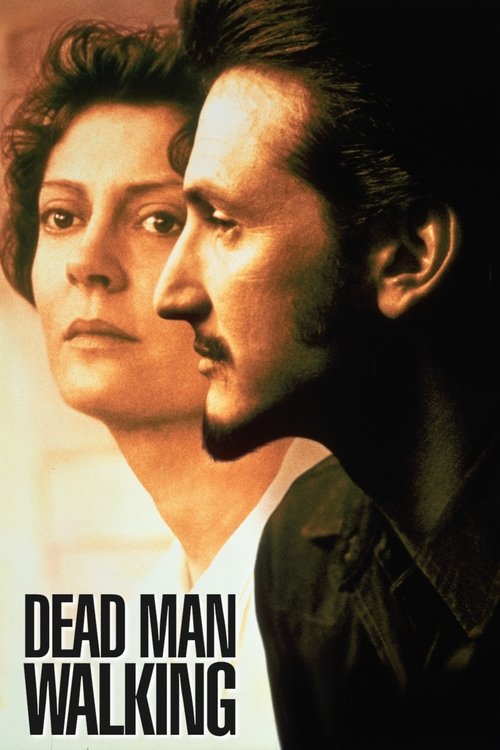
Dead Man Walking
1995 · Tim Robbins
For when you want a film that takes you seriously — something to argue about afterward, that treats a hard moral question honestly from every side. This is a challenge watch, not a comfort watch, and it earns the heaviness.
What it's about
A Louisiana nun, Sister Helen Prejean, answers a letter from a death row inmate convicted of murdering a young couple, and becomes his spiritual advisor in the weeks before his scheduled execution. She's pulled between a man the state has already written off, the shattered families of his victims, and her own uncertainty about what she's doing there. Based on the real Sister Helen's memoir.
The experience
Sober, unhurried, and quietly wrenching — it doesn't manipulate you with music cues or easy villains, it just keeps putting hard questions in front of you and refusing to answer them for you. Expect to sit in silence for a while when it's over.
Performances
Susan Sarandon won the Best Actress Oscar for a performance of remarkable restraint — no big speeches, just steady moral attention — and Sean Penn is equally fearless, playing a condemned man without softening him to make you comfortable.
The craft
Tim Robbins directs with unusual discipline, stripping away courtroom-drama theatrics so the film lives in conversations through prison glass — the framing keeps the two leads separated by barriers almost the entire time, and you feel it. The mournful score, with contributions from Eddie Vedder and Nusrat Fateh Ali Khan, deepens the ache without telling you what to feel.
Why it matters
It arrived at the peak of America's tough-on-crime era and became the rare studio-adjacent film to shape a national debate, cementing Robbins as a real director and giving Sarandon her career-defining role.
Snapshot
Dead Man Walking is Tim Robbins's second feature as a director and the film that established him as a serious filmmaker rather than an actor dabbling behind the camera. Adapted by Robbins from Sister Helen Prejean's 1993 nonfiction bestseller of the same name, it dramatizes the relationship between a Louisiana nun and a condemned murderer in the days before his execution. The film is remembered above all for two things: a pair of performances of unusual rigor from Susan Sarandon (who won the Academy Award for Best Actress) and Sean Penn, and for its refusal to flatter the audience's moral certainties on either side of the death-penalty debate. It arrived at a high-water mark of American executions and "tough on crime" politics, and it remains one of the few Hollywood-adjacent films to treat capital punishment as a genuine ethical problem rather than a thriller's machinery. Its lasting cultural footprint extends beyond cinema into a celebrated American opera and a continuing stage life.
Industry & production
The project originated with Sarandon, who read Prejean's book and brought it to Robbins, her partner. Robbins wrote the screenplay and directed through his production company, Havoc, with producing partners Jon Kilik and Rudd Simmons; the film was financed and distributed under the PolyGram umbrella and released theatrically in the United States through Gramercy Pictures in late 1995. It was made on a modest budget by studio standards — the kind of mid-budget adult drama that the major-independent ecosystem of the mid-1990s (PolyGram, Gramercy, Miramax, October) was uniquely positioned to produce.
The production's central creative decision was structural and legal as much as dramatic: rather than dramatize a single real case, Robbins fused two of the men Prejean had actually counseled on Louisiana's death row — Patrick Sonnier and Robert Lee Willie — into a single fictional inmate, Matthew Poncelet. This composite freed the film from the constraints of a docudrama and, more importantly, allowed Robbins to construct a character who is genuinely guilty and genuinely unsympathetic for much of the running time, sidestepping the wrongful-conviction template that lets audiences oppose execution without confronting the harder question of whether the indisputably guilty should be killed. Filming took place in Louisiana, lending the prison and small-town exteriors documentary texture. The supporting cast was built to give weight to the victims' families as well as the condemned, and the film marked the screen debut of Peter Sarsgaard as one of the murdered teenagers seen in flashback.
Critically and commercially the film performed strongly for a austere subject. It earned four Academy Award nominations — Sarandon for Best Actress (her win, after several prior nominations), Penn for Best Actor, Robbins for Best Director, and Bruce Springsteen for the title song — a remarkable showing for an issue drama with no conventional uplift.
Technology
Dead Man Walking is, technologically, a conventional mid-1990s 35mm production with no special-effects ambitions; its innovations are aesthetic rather than mechanical. The one area where technical choice carries dramatic meaning is the photographic treatment of the flashbacks to the crime, which are shot and graded to feel distinct from the prison present — fragmented, desaturated, and withheld — so that the full horror of what Poncelet did is assembled in the viewer's mind only gradually. The execution sequence relies on careful in-camera staging and superimposition rather than any digital trickery, in keeping with a film that consistently chooses restraint over spectacle.
Technique
Cinematography
The film was photographed by Roger Deakins, then deep into his long collaboration with the Coen brothers and emerging as one of the most respected cinematographers in the English-language industry. Deakins's work here is deliberately unshowy. The death-row visiting scenes are dominated by the mesh and glass that separate Sister Helen from Poncelet, and Deakins repeatedly uses reflections and the screen's diamond grid to overlay their faces — visually insisting on both the barrier between them and their growing intimacy. The palette is muted and institutional; the Louisiana exteriors are flat and hot rather than picturesque. Deakins reserves his most composed image for the climax: Poncelet on the lethal-injection gurney, arms extended on the cruciform table, an inescapable but unforced echo of crucifixion that the film earns rather than imposes.
Editing
Edited by Lisa Zeno Churgin, the film's architecture is built on controlled cross-cutting. The flashbacks to the murders are doled out in fragments throughout, so that the crime is never a single revelation but an accumulating weight. This reaches its purpose in the final movement, where Churgin intercuts the execution with the now-complete depiction of the killings. The effect is morally double-edged by design: the audience is made to hold the reality of Poncelet's crime and the reality of his state-administered death in the same instant, denied the comfort of choosing one image over the other. The pacing elsewhere is patient and conversational, trusting long two-handed exchanges to carry the drama.
Mise-en-scène / staging
Robbins stages the film around confinement and proximity. The visiting room — a small, partitioned space — becomes the central theater, and much of the film's tension is generated simply by what can and cannot pass through the screen between two people. Outside the prison, Robbins is careful to give physical and social texture to the worlds the film moves through: the poor white milieu Poncelet comes from, the grieving households of the victims' parents, the institutional corridors of the penitentiary. The staging consistently refuses to aestheticize either the crime or the punishment.
Sound
The soundtrack is one of the film's signatures and an unusually ambitious piece of music supervision. Alongside an original score by David Robbins (the director's brother), the film assembled an array of major contemporary artists — Bruce Springsteen contributed the spare title song "Dead Man Walkin'," and the soundtrack featured collaborations between Eddie Vedder and the Pakistani qawwali singer Nusrat Fateh Ali Khan, whose devotional, keening vocal lines lend the film a transcultural spiritual register, along with contributions from artists such as Tom Waits, Steve Earle, Johnny Cash, and others. The use of qawwali — Sufi devotional music — under a story of Catholic grace and American execution is among the film's most distinctive choices, universalizing its themes of suffering and redemption beyond any single faith.
Performance
Performance is where Dead Man Walking is most often singled out, and rightly. Penn plays Poncelet without a single bid for the audience's sympathy: he is sullen, racist, self-pitying, evasive, his masculinity a brittle performance of its own. Penn's achievement is to let the man's humanity surface only in increments and never to resolve him into a redeemed innocent — even his final accountability is hard-won and incomplete. Sarandon's Sister Helen is the counterweight: watchful, grounded, frightened, and stubborn, a portrait of moral seriousness without piety or sentimentality. The two never share conventional chemistry; instead they build something closer to spiritual labor conducted across a barrier. The supporting performances — particularly the victims' parents, whose grief and rage the film treats as fully legitimate — keep the drama from tipping into advocacy.
Narrative & dramatic mode
The film operates as a chamber drama braided with a procedural countdown. Its forward engine is the legal clock — appeals, the pardon board, the governor, the scheduled hour — but its true subject is interior and dialogic, advancing through a series of conversations in the visiting room. Crucially, Robbins constructs the narrative around two demands placed on Poncelet that the film treats as equally necessary: that his life not be taken, and that he tell the truth about the lives he took. The dramatic mode is therefore neither thriller nor courtroom film but something closer to a secular passion play, in which the question is not whether a man will be saved from death but whether he can face his own guilt before he dies.
Genre & cycle
Dead Man Walking belongs to the social-problem drama, a venerable American genre stretching back through the studio era's message pictures. Within the death-penalty cycle specifically, it stands apart from earlier entries — works like I Want to Live! or the wrongful-conviction thrillers that proliferated around the same period — precisely by making its condemned man guilty. It thus refuses the genre's usual escape hatch. It also sits within the 1990s wave of mid-budget, performance-driven adult dramas produced by the major-independent companies, films that took serious subjects and prestige craft to the multiplex.
Authorship & method
Robbins came to directing as an established actor (Bull Durham, Jacob's Ladder, Robert Altman's The Player, The Shawshank Redemption) and as a figure shaped by politically engaged theater. His directorial debut, Bob Roberts (1992), was a satirical mockumentary about a right-wing folk-singer politician — sharp, ironic, overtly political. Dead Man Walking is in many ways its opposite: earnest, restrained, and scrupulously even-handed. What unites them is a serious interest in American moral and political life. As writer-director, Robbins's signal method here is the discipline of balance — his repeated, structural insistence on giving the victims' families their full due, refusing to let opposition to the death penalty become indifference to the dead. His key collaborators reflect a deliberate marriage of craft and conscience: Deakins's unsentimental camera, Churgin's morally pointed cutting, his brother David Robbins's score, and a music program assembled to give the film a wide spiritual resonance.
Movement / national cinema
The film is a product of American independent-minded filmmaking of the mid-1990s, operating inside the major-independent distribution system rather than the avant-garde or the no-budget margins. It belongs to a strain of socially conscious American cinema that uses star power and high craft in service of argument — a lineage running from Kazan and the message pictures through the activist-actor tradition of which Robbins and Sarandon were prominent members. It is unmistakably a film of the American South in setting and texture, rooted in Louisiana's specific penal and religious culture.
Era / period
Dead Man Walking appeared at a peak moment for capital punishment in the United States. In the two decades after the Supreme Court permitted executions to resume in the late 1970s, the death-row population and the pace of executions had climbed steadily, and the mid-1990s were marked by punitive crime politics across the spectrum. The film is inseparable from that context: it is an argument made at the high tide of the thing it questions, addressed to a public broadly supportive of execution. Its careful even-handedness can be read as a strategic response to that climate — an attempt to reach viewers who would have rejected a straightforward abolitionist polemic.
Themes
At its center is the theology of grace: the Catholic conviction, voiced through Sister Helen, that no person is reducible to the worst act they have committed and that human dignity is not forfeited by guilt. Around this the film organizes a cluster of related concerns — accountability and the difference between being spared and being absolved; the meaning of witness, both Helen's witnessing of Poncelet and the families' witnessing of the execution; and the symmetry of grief between the condemned's mother and the victims' parents. The film is also quietly attentive to class and the social geography of the death penalty — who ends up on death row and why. Above all it dramatizes the distinction between the state's killing and any notion of justice, asking whether a death administered by law is anything other than another death.
Reception, canon & influence
Looking backward, the film's most direct influence is its source: Sister Helen Prejean's memoir, whose first-person moral account Robbins translates into dramatic form, and behind that the long Catholic tradition of restorative justice and the American social-problem film. Robbins's own theatrical and activist background, and the precedent of his satirical Bob Roberts, inform his method even as the new film abandons irony for gravity.
In its own moment the film was widely acclaimed and garnered the four major Academy nominations noted above, anchored by Sarandon's win. It quickly entered the canon as the reference-point American film on capital punishment, the work most likely to be cited, taught, and screened in classrooms, seminaries, and debates on the subject. Its forward influence is unusually broad for a film of its scale. It lent visibility and authority to Prejean's advocacy and helped shape public discussion of the death penalty through the late 1990s and beyond. Its afterlife in other media is especially notable: it inspired Dead Man Walking, the opera by composer Jake Heggie with a libretto by Terrence McNally, which premiered in 2000 and became one of the most frequently performed new American operas, as well as a subsequent stage adaptation — a rare case of a contemporary film generating a durable presence in the operatic repertoire. Within cinema, it stands as a model for the morally balanced issue film, demonstrating that a director could take a fiercely contested subject and dramatize it without reducing it to a verdict.
A Deleuzian reading
Start with the screen.
The full Deleuzian reading of Dead Man Walking →
Reception
A prestige hit in 1995 — four Oscar nominations and Susan Sarandon finally winning after four previous losses — it's since settled into 'respected but under-discussed' territory, the rare issue film that hasn't dated into preachiness.
How Dead Man Walking was received, from release to now →
Influences: the films it descends from and the films it influenced
- I Want to Live! (1958) — Establishes the execution-countdown procedural that Robbins inherits — detailing the bureaucratic machinery of the death house in near-real time, anchored by a Best Actress performance from the condemned's side of the glass.
- In Cold Blood (1967) — Models the fragmented, gradually-disclosed crime flashback and documentary-realist treatment of killers awaiting execution, withholding the full atrocity until late so the audience must hold guilt and humanity simultaneously.
- A Short Film About Killing (1988) — Pioneers the structural equation of a brutal murder with the equally clinical brutality of state execution, refusing to sentimentalize the killer — the exact even-handed dread Robbins builds his last act around.
- The Passion of Joan of Arc (1928) — Originates the secular-passion-play built from facial close-ups and oppressive proximity, staging a martyrdom countdown as a war of faces between the condemned and their confessor.
- Cool Hand Luke (1967) — Source of the crucifixion-composition vocabulary — framing the incarcerated man as a Christ figure in cruciform poses, the visual theology Deakins quotes in Penn's final walk.
- The Last Temptation of Christ (1988) — Precedent for scoring a passion narrative with devotional world music (Peter Gabriel's 'Passion,' featuring Nusrat Fateh Ali Khan, the same qawwali voice Robbins deploys) to give a theological subject trans-cultural spiritual resonance.
- Birdman of Alcatraz (1962) — Template for the confinement two-hander in which an outside visitor's persistent proximity slowly humanizes a hardened prisoner across a series of cell-bound conversations.
- Decalogue V (1989) — Robbins builds an anti-capital-punishment argument by depicting the execution's procedure in clinical, de-aestheticized detail and withholding easy absolution — the same rhetorical strategy of dramatizing state killing to indict it.
- True Crime (1999) — Extends the procedural-countdown to its thriller limit, cross-cutting the execution preparations against a race to overturn the sentence in the final hours.
- The Green Mile (1999) — Inherits the death-house procedural with its detailed mechanics of execution and makes the condemned an explicit Christ figure, the literalized version of Robbins's crucifixion subtext.
- Monster's Ball (2001) — Opens on the ritual of an execution and builds an intimate social-problem drama outward from it, again earning a Best Actress win from the orbit of the death chamber.
- Monster (2003) — Carries forward the unsympathetic-protagonist gambit — a transformative Best Actress performance that humanizes a real killer without excusing the crimes, refusing the audience an easy verdict.
- The Life of David Gale (2003) — A direct heir in the morally-loaded death-penalty issue film, deliberately structured around the contested ethics of capital punishment as advocacy cinema.
- Just Mercy (2019) — Adapts a first-person advocate's memoir of ministering to the condemned — Bryan Stevenson standing in for Sister Prejean — replicating the outsider-counsel-meets-death-row structure as restorative-justice drama.
- Clemency (2019) — Reworks the execution-day countdown from the prison-staff perspective, sustaining the same procedural dread and proximity to the machinery of death that Robbins centered.
- The Shawshank Redemption (1994) — Roger Deakins shoots both with the same unsentimental, naturalist prison light (and Robbins stars here a year prior) — a shared craft DNA of dignifying carceral space without melodramatic shadow-play.
- Last Dance (1996) — Near-simultaneous death-row counsel drama running the identical clemency-countdown structure, pairing a free advocate with a condemned inmate as the appeals clock runs out.
- The Hurricane (1999) — Deakins-shot two-hander built on intimate cell-bound dialogue scenes as a moral-justice campaign — the staging grammar of two-handers and prison-cell-as-stage.
- The Wrong Man (1956) — Extends the Catholic-grace strand — faith confronting the machinery of criminal justice, redemption sought through prayer and witness rather than exoneration, in the restrained, unglamorous register The Wrong Man pioneered.
Similar films
- The Shawshank Redemption (1994) — influence & lineage · same viewing thread
- The Green Mile (1999) — influence & lineage · same viewing thread
- Just Mercy (2019) — influence & lineage · same viewing thread
- The Last Temptation of Christ (1988) — influence & lineage
- Doubt (2008) — same viewing thread
- 12 Years a Slave (2013) — same viewing thread
- Unforgiven (1992) — same viewing thread
- 12 Angry Men (1957) — same viewing thread
All the films related to Dead Man Walking →
Watch it with: curated runs of related films
- Judgment and Mercy — Watch these together for the way each puts a life on the scales — a jury room, a death-row block, a slave plantation, a gunfighter's conscience — and asks what mercy costs the people handing down the verdict.